
The $50 Billion Freight Claims Problem Nobody's Solving (Until Now)
Cargo losses exceed $50B annually. 74% of companies use outdated tech. 50-60% of claims get denied. SOP-driven AI agents are the first real solution to this problem.
 Mustafa BayramogluApril 6, 202614 min read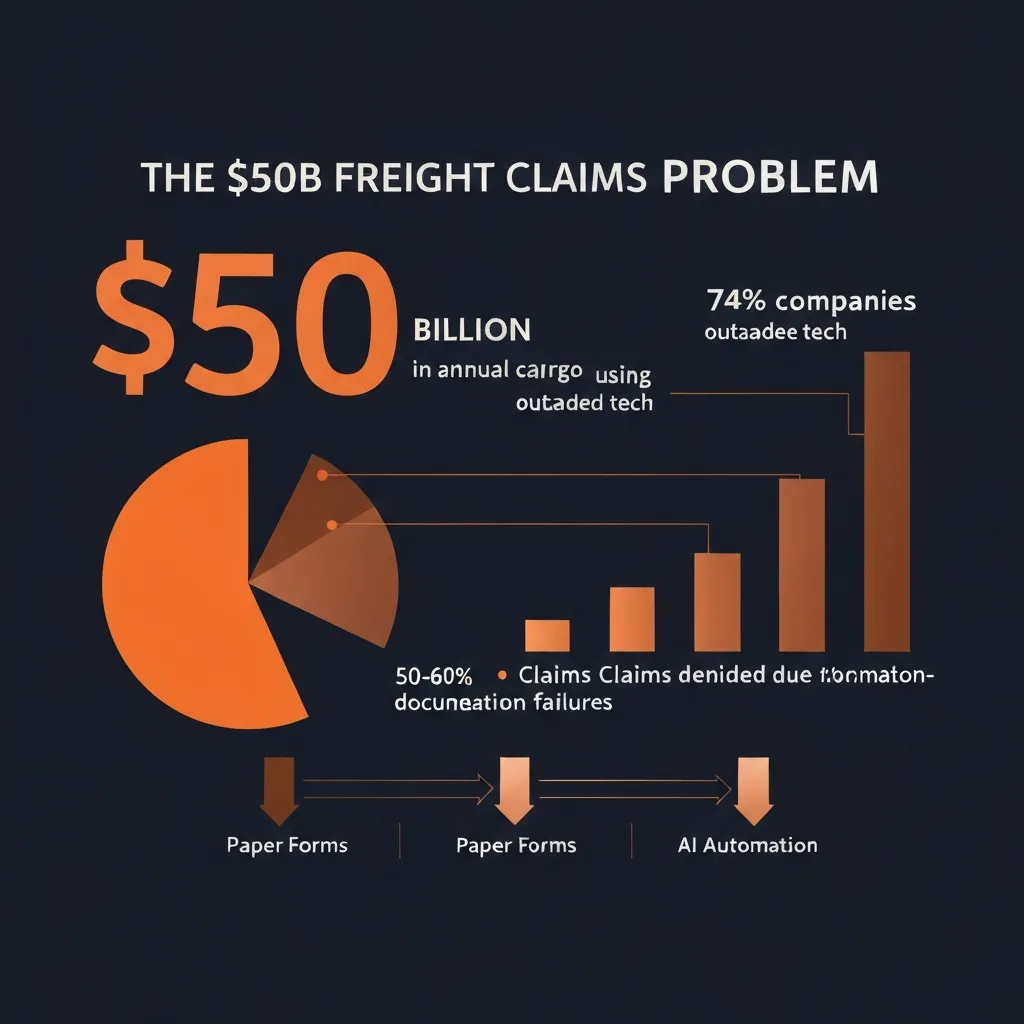
Quick Answer: The U.S. freight industry loses over $50 billion annually to cargo damage, theft, and loss. But the bigger problem isn't the losses themselves — it's that 74% of companies handling claims still use outdated manual processes, and 50-60% of claims get denied due to documentation failures that AI agents could prevent. RPA tools automate individual steps but can't reason across systems. SOP-driven AI agents can.
The Scale of the Problem Most Tech Companies Are Ignoring
If you work in logistics, freight, or supply chain operations, you already know the freight claims landscape is broken. If you're evaluating AI automation for your operations team, here's why freight claims should be at the top of your list.
The numbers:
- $50 billion+ in annual U.S. cargo losses from damage, theft, and loss
- $725 million in cargo theft losses in 2025 alone — up 60% from 2024
- $273,990 average value per cargo theft incident (up 36% year-over-year)
- 74% of companies handling freight claims use outdated technology or manual processes
- 50-60% of valid claims get denied due to documentation failures
- 7-8 hours average manual processing time per claim — often exceeding the claim value
None of these numbers represent inevitable losses. Most denied claims are process failures, not legitimate disputes. Most documentation errors are preventable with better systems. Most of the 7-8 hours per claim is low-value manual work that should have been automated years ago.
But it hasn't been automated — and understanding why is essential to understanding what actually solves it.
Why Freight Claims Are So Hard to Automate
The freight claims process looks simple in a flowchart: file claim → submit documentation → receive payment. The reality involves:
1. Multiple systems that don't talk to each other
- The TMS (Transportation Management System) holds shipment data
- The carrier portal is where claims get filed — and each carrier has their own portal
- The WMS (Warehouse Management System) has receiving records and damage documentation
- Salesforce or a CRM holds customer communication and case data
- Jira or a ticketing system tracks the internal investigation workflow
- Email holds carrier correspondence and approval/denial communications
No single system has all the data needed to file a complete, accurate claim. Every manual claim involves an ops rep pulling data from 4-6 systems and assembling it into a coherent package.
2. Tight and variable deadlines Carrier filing deadlines are unforgiving and inconsistent:
- Visible loss or damage: 9 months from delivery date (most carriers)
- Concealed damage: 9 days from delivery date (many carriers — this is the one everyone misses)
- International freight: 60 days to 2 years depending on transport mode and treaty
- FedEx/UPS small package: 60-180 days depending on service type
Miss the deadline by one day and the claim is void regardless of merit. With manual processes and no automated tracking, deadline misses are common.
3. Documentation requirements that vary by carrier UPS requires different documentation than FedEx, which requires different documentation than XPO, which requires different documentation than a regional LTL carrier, and international carriers like DHL add their own rules on top, covered in our DHL Claims guide. A complete claim for UPS might be missing a required field for Estes Express. Manual claims processors have to know each carrier's specific requirements — and when those requirements change (which they do), the knowledge has to be updated across the team.
4. The investigation workflow itself Before a claim can be filed, someone has to:
- Verify the loss/damage with receiving records
- Identify the responsible carrier and delivery date
- Pull the BOL and proof of delivery
- Document the damage (photos, inspection reports)
- Determine claim value (invoice value vs. carrier liability limit vs. insurance)
- Decide whether to file with the carrier or insurance
- Track the filing and follow up if no response in X days
Each of these is a decision point that requires pulling data from a different system and applying a defined rule. This is exactly the kind of structured, multi-step, multi-system workflow where SOP-driven AI agents excel.
What Existing Solutions Get Wrong
The Spreadsheet Era
Most companies still manage freight claims in Excel or Google Sheets. A shared spreadsheet with claim status, deadlines, and documentation links — updated manually by whoever's responsible that week.
The problems are obvious: version conflicts, no audit trail, deadline tracking only works when someone's watching the spreadsheet, and there's no connection to the actual systems where data lives. But the spreadsheet persists because it's familiar and free.
This is the 74% of outdated technology the industry talks about. Not the absence of any technology — but the reliance on tools designed for a different era of business complexity.
The RPA Approach: Right Idea, Wrong Tool
Tools like iNymbus and FreightClaims.com represent the first generation of freight claims automation, and they've delivered real value. iNymbus claims 80-90% cost reduction on the processes it automates. FreightClaims.com reports reducing claim processing time from 7-8 hours to 2 hours.
These results are real. But they also reveal the limits of the RPA approach.
What RPA does well:
- Automating specific, repetitive steps in the claims process
- Portal navigation and form filling
- Document uploads and status checks
- Generating standard reports
What RPA can't do:
- Reason across systems when data doesn't match
- Decide which documentation is needed for a specific claim type
- Adapt when a carrier portal changes its interface
- Handle exception cases that fall outside the scripted workflow
- Learn from corrections and improve decision quality over time
- Coordinate a multi-step investigation across Salesforce, TMS, and carrier portals simultaneously
RPA automates the easy parts. The hard parts — the decision-making, the exception handling, the cross-system reasoning — still land on your ops team.
The Document-Matching AI Problem
Some newer AI solutions try to improve on RPA by using natural language processing to extract data from documents and match it to claims records. This helps with document ingestion, but it doesn't solve the core problem.
The core problem isn't document reading. It's decision-making under uncertainty, across multiple systems, in real time, following specific business rules that vary by claim type, carrier, and customer tier.
Document-matching AI reads a damage report and extracts the key fields. It can't look at those fields, compare them to the carrier's liability limits, check whether the customer has insurance that would cover the difference, decide which system to file through, and initiate the workflow — all without human intervention.
That requires SOP-driven AI: agents that ingest your actual business procedures and execute them step-by-step across every system involved.
What SOP-Driven AI Agents Actually Change
The Paradigm Shift in 60 Seconds
Traditional automation asks: "What steps can we automate?" SOP-driven AI asks: "How does this process work, end-to-end — and how can AI execute every step?"
The difference is total workflow coverage vs. step coverage. RPA automates individual steps. SOP-driven AI agents automate the entire workflow — including the decision points between steps that RPA can't handle.
How It Works for Freight Claims
Step 1: SOP ingestion You document your freight claims process — the actual procedure your best claims processor follows. Which systems to check, what data to pull, how to make filing decisions, when to escalate, how to follow up. The AI reads this procedure.
Step 2: Multi-system connection The AI agent connects to your TMS, WMS, Salesforce, carrier portals, and email. Not one system — all of them simultaneously.
Step 3: Automated investigation When a claim is triggered (damaged delivery received, shortage reported, theft filed), the AI agent:
- Pulls the BOL and delivery records from the TMS
- Checks receiving documentation from the WMS
- Reviews the customer account in Salesforce for tier and insurance status
- Identifies the carrier and looks up their specific filing requirements
- Assesses whether documentation is complete or needs supplementation
- Makes a filing decision based on your defined SOP rules
- Creates the Jira ticket to track the investigation
- Files the claim through the carrier portal (or flags for human review if required)
- Sets deadline tracking and follow-up reminders
Step 4: Human-in-the-loop for exceptions For claims above a certain value threshold, claims with ambiguous liability, or claims where the AI encounters a scenario not covered by the SOP, a human is looped in. Their decision becomes training data that improves future automated handling of similar cases.
Step 5: Self-improvement Every correction a claims processor makes to the AI's decision becomes a refinement to the SOP-driven model. The AI gets better at handling your specific carrier mix, your customer base, and your exception patterns over time.
Before and After: A Real Freight Claims Workflow
Before (Manual)
Scenario: Customer reports 2 damaged pallets from an LTL delivery
- Claims processor receives email from customer service — 15 minutes after incident
- Processor searches TMS for the BOL — 20 minutes
- Processor checks carrier portal for proof of delivery — 15 minutes
- Processor contacts warehouse for damage photos — waits 2-4 hours for response
- Processor determines carrier liability limits — 30 minutes reviewing carrier tariff
- Processor updates spreadsheet with claim details — 10 minutes
- Processor files initial claim through carrier portal — 45 minutes (navigating portal, uploading documents)
- Processor adds calendar reminder to follow up in 30 days
- Follow-up in 30 days: repeat portal navigation — 20 minutes
- Carrier denies claim for missing documentation — 1 week after filing
- Processor re-files with corrected documentation — 30 minutes
- Carrier processes claim — 30-60 days
Total time: 7-8 hours spread over 60-90 days
After (SOP-Driven AI Agents)
Same scenario
- Customer reports damage in Zendesk — immediately triggers AI agent workflow
- AI agent pulls BOL from TMS, proof of delivery from carrier portal, checks damage notes in WMS — 3 minutes
- AI agent identifies carrier, loads their documentation requirements from SOP — instant
- AI agent checks damage photo status — if not available, sends automated request to warehouse team with 2-hour deadline — automated
- AI agent calculates claim value against carrier liability limits, checks customer insurance status — 2 minutes
- AI agent creates Jira ticket with all documentation attached — instant
- AI agent files claim through carrier portal with complete documentation — 10 minutes (vs. 45 minutes manual)
- AI agent sets automated deadline tracking — no calendar required
- Follow-up triggered automatically on day 28 — 0 human time
- Claim approved on first filing — no re-filing needed
Total time: 15-20 minutes of automated processing, 2-4 hours earlier than manual start
The difference isn't just speed. The AI agent filed a complete, correct claim on first attempt because it knows the carrier's requirements from the SOP. The manual processor filed an incomplete claim because they didn't have current carrier requirements memorized for this specific carrier.
The Economics of Automation
For a logistics company processing 200 freight claims per month:
| Metric | Manual | SOP-Driven AI |
|---|---|---|
| Processing time per claim | 7-8 hours | ~20 minutes automated |
| Human time required | 7-8 hours/claim | Under 30 min/claim (exceptions only) |
| First-time approval rate | ~45-50% | ~80-85% |
| Claims denied (documentation) | 50-60 | 10-15 |
| Monthly cost (labor) | ~$40,000/month | ~$5,000/month |
| Annual recovery improvement | — | +15-25% of claim value |
At an average claim value of $1,500 and 200 claims/month, improving the approval rate by 30 percentage points recovers an additional $90,000/month in legitimate claims. The automation cost is typically $3,000–$8,000/month for that volume. The ROI math is unambiguous.
Why This Problem Has Gone Unsolved
The honest answer: freight claims automation sits at an awkward intersection that most software companies avoid.
It's too industry-specific for general AI platforms. It requires too much logistics domain knowledge for generic workflow tools. It involves too many systems for single-platform automation tools. And the buyers — logistics ops teams — typically don't control the technology budget.
The result is a problem that everyone in the industry agrees is painful, where existing solutions (spreadsheets, RPA, document-matching AI) address parts of the problem but not the whole workflow.
SOP-driven cross-platform AI agents are the first technology that can address the complete workflow — because they're designed specifically to execute multi-step, multi-system processes by following the documented procedures your best claims processors already use.
That's the paradigm shift. Not AI that replaces your freight claims expertise — but AI that scales your freight claims expertise across every claim, every time.
Getting Started with Freight Claims Automation
If you're evaluating freight claims automation, the starting point isn't technology selection — it's process documentation.
What to document before you automate:
- Claim types you process (damage, shortage, loss, theft) and the different workflow for each
- Carrier-specific requirements for each carrier in your network
- Documentation checklist by claim type and carrier
- Filing thresholds — when to file with the carrier vs. insurance vs. absorb
- Escalation triggers — what requires human review regardless of automation capability
- SLA requirements — internal commitments to customers for claim acknowledgment and resolution
Once you have these documented, the AI agent has what it needs to execute. The documentation becomes the SOP library that drives automated decision-making.
For a deeper dive into how SOP-driven AI agents work and the step-by-step workflow for automating freight claims proof gathering, see our related guides.
The Opportunity Ahead
The $50 billion freight claims problem is solvable. Not with spreadsheets. Not with RPA that automates steps but leaves decision-making to humans. Not with document-matching AI that reads files but can't execute workflows.
The solution is AI that can read your SOPs, connect to every system involved, execute every step, and get smarter with every exception your team handles.
That's the technology that's finally available in 2026. The companies that deploy it first will recover more legitimate claims, at lower cost, faster — creating a sustainable advantage over the 74% still running on spreadsheets and manual processes.
Automate Your Freight Claims Workflow
CorePiper's SOP-driven AI agents handle freight claims across your TMS, carrier portals, Salesforce, and Jira. No custom code. No months of implementation.
Frequently Asked Questions
Q: How much do freight claims cost businesses annually?
Cargo losses exceed $50 billion annually in the U.S. alone, combining direct loss value, administrative processing costs, and denied claims that should have been recovered. Cargo theft alone surged to nearly $725 million in 2025, up 60% from 2024. The average claim processing time runs 7-8 hours manually — often exceeding the actual recovered value on smaller claims.
Q: Why do so many freight claims get denied?
50-60% of freight claims are denied primarily due to documentation failures — missing proof of delivery, incomplete damage photos, late filing (carrier deadlines are often 9 months for loss, 9 days for concealed damage), and inability to correlate BOL data with carrier portal records. These are process failures, not legitimate dispute rejections.
Q: What's the difference between RPA-based and AI-agent freight claims automation?
RPA tools like iNymbus automate specific steps in the claims process — form filling, portal navigation, document uploads. They follow fixed scripts and break when carrier portals change. SOP-driven AI agents reason across the entire workflow: they pull data from multiple systems, identify missing documentation, make filing decisions based on context, and adapt when carrier requirements change.
Q: Can AI agents handle freight claims across multiple carrier portals?
Yes — SOP-driven AI agents with cross-platform capabilities can navigate different carrier portals, TMS systems, and CRM data simultaneously. Unlike RPA tools that require separate scripts per portal, AI agents understand the intent of each step and adapt to portal changes without manual reconfiguration.
Q: What ROI can logistics companies expect from freight claims automation?
Companies automating freight claims typically see: 60-80% reduction in processing time per claim, 15-25% improvement in claim recovery rates (fewer documentation failures), 70-90% reduction in manual labor costs for claims processing, and faster cash recovery from approved claims. The ROI calculation depends on claim volume and average claim value.