
From Pilot to Production: Why 2026 Is the Year AI Agents Finally Go Live
Gartner predicts 40% of enterprise apps will embed AI agents by end of 2026. But only 8.6% of companies have agents in production today. Here's how to cross the chasm from pilot to production — and why most organizations are stuck.

Quick Answer: Most enterprise AI pilots fail to reach production because they're built as demos rather than production-grade systems — missing retry logic, error handling, audit trails, and human escalation paths. Crossing the pilot-to-production gap requires treating AI agents as operational software with the same reliability standards as your ERP or CRM, not as experimental prototypes.
The Year Everything Changes (Or Doesn't)
Every analyst firm is saying the same thing: 2026 is the year agentic AI goes from experiment to enterprise reality.
Gartner predicts that 40% of enterprise applications will integrate task-specific AI agents by the end of 2026 — up from less than 5% in 2025. Deloitte's State of AI report shows close to three-quarters of companies plan to deploy agentic AI within two years. McKinsey calls 2026 a "break-or-break year" for AI adoption.
The predictions are bold. The reality on the ground? Far messier.
According to a TechRepublic survey of over 120,000 enterprise respondents, only 8.6% of companies have AI agents deployed in production as of early 2026. Another 14% are still developing agents in pilot form. And a staggering 63.7% report no formalized AI agent initiative at all.
That's a massive gap between prediction and reality. Between ambition and execution. Between the AI agents your vendors demo'd at last year's conference and the AI agents actually handling real work in your operations today.
This gap has a name: pilot purgatory. And it's where most enterprise AI projects go to die.
Pilot Purgatory: The $4.6 Billion Problem
IDC research paints a stark picture: for every 33 AI pilots launched, only 4 reach production deployment. That's an 88% failure rate — not because the technology doesn't work, but because organizations can't navigate the treacherous path from "impressive demo" to "reliable production system."
Gartner's own data is equally sobering: over 40% of agentic AI projects are expected to be canceled or fail to reach production by 2027. The reasons aren't technical limitations — they're organizational, architectural, and operational failures that compound as projects try to scale.
Here's what pilot purgatory actually looks like inside an enterprise:
Month 1-2: The pilot launches with fanfare. A small team configures an AI agent to handle a narrow slice of customer support tickets. Results look promising in the sandbox. Leadership is excited.
Month 3-4: The team tries to expand scope. The agent encounters edge cases the training data didn't cover. Accuracy drops from 85% to 60%. The support team starts routing around the agent instead of through it. Adoption stalls.
Month 5-6: Integration challenges emerge. The agent works in Zendesk but can't access Jira for engineering escalations or Salesforce for account context. Workarounds multiply. The project needs more engineering resources than budgeted.
Month 7-8: The pilot is "still in evaluation." Nobody wants to kill it — too much sunk cost. But nobody is willing to put it in front of all customers either. The agent handles 3% of total ticket volume. Manually.
Month 9+: The team quietly moves on to the next initiative. The pilot joins a graveyard of promising POCs that never scaled.
Sound familiar? You're not alone. This pattern repeats across industries, company sizes, and AI platforms. The question isn't whether AI agents work — it's why so many organizations can't get them into production.
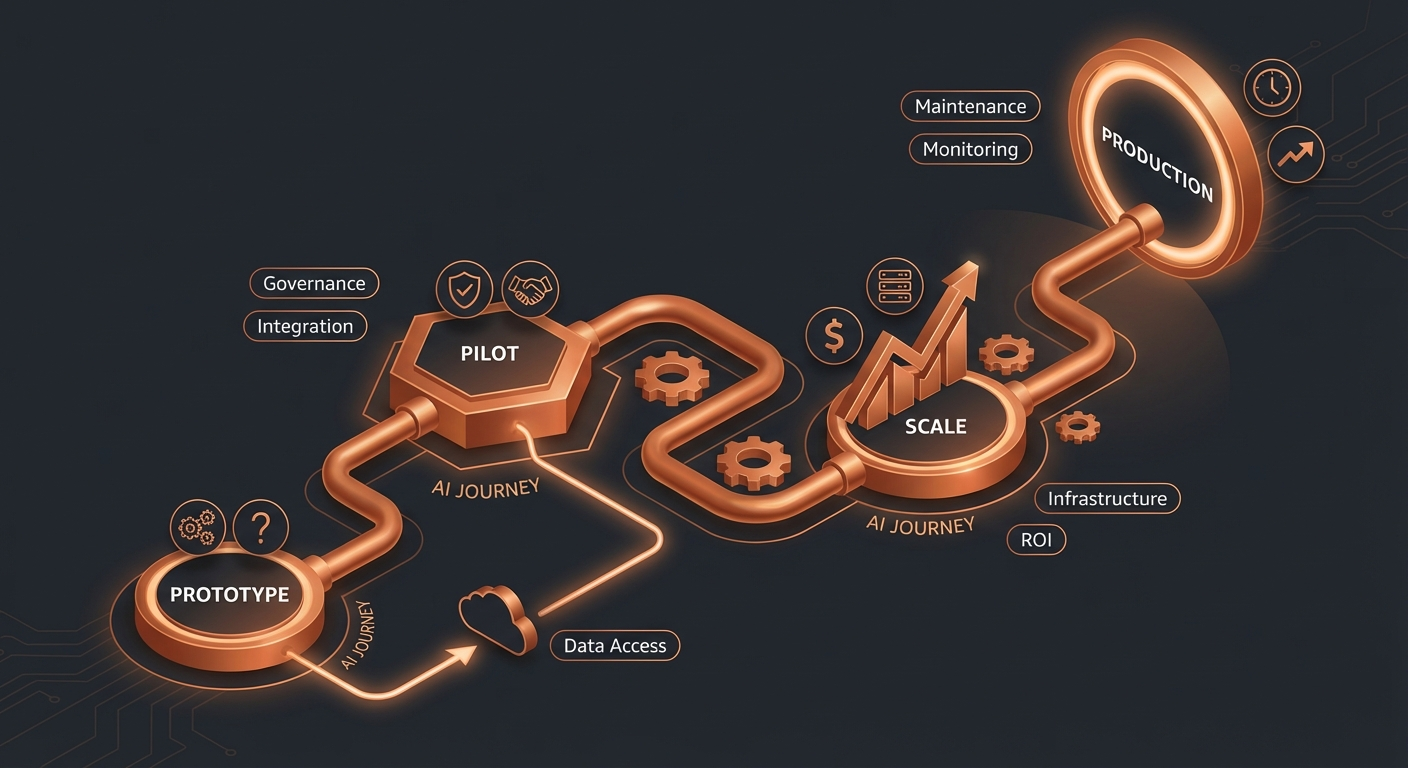
The Five Walls Between Pilot and Production
After analyzing the patterns behind failed AI deployments and successful ones, five consistent barriers emerge. Understanding them is the first step to breaking through.
Wall 1: The Integration Cliff
Pilots work in isolation. Production requires integration.
Most AI agent pilots start within a single platform — Zendesk, Salesforce, or ServiceNow. The agent reads tickets, suggests responses, maybe auto-resolves simple FAQs. In isolation, it performs well.
But real enterprise operations don't live in a single platform. A typical customer issue might touch:
- Zendesk for the initial ticket
- Salesforce for account history and contract details
- Jira for engineering escalation
- Slack for internal coordination
- Email for customer communication
- A carrier portal for logistics-specific actions
When the pilot tries to go production, it hits the integration cliff. The agent can handle the 30% of the workflow that lives in its native platform. The other 70%? Still manual. And partial automation often creates more work than full manual processing, because someone has to bridge the gap between what the agent did and what still needs doing.
This is why Deloitte found that pilots built through strategic partnerships are twice as likely to reach full deployment compared to those built internally. External partners often bring pre-built integrations that internal teams would spend months building.
The production requirement: Your AI agent must work across your entire tool stack from day one — not just the platform it was born in.
Wall 2: The Accuracy Death Spiral
Pilots test on curated data. Production throws everything at you.
In a controlled pilot, you select which tickets the AI handles. You filter for simple, well-documented issue types. You exclude edge cases, escalations, and anything that requires cross-functional judgment.
Production doesn't have filters. Production is a customer at 2 AM with a billing dispute that involves a contract amendment from three years ago, a partial refund that was processed incorrectly, and an emotional email threatening to churn. Production is the edge case.
When AI agents encounter unfamiliar patterns, most do one of two things: hallucinate a confident-sounding wrong answer, or punt to a human with no context. Both outcomes erode trust. And once your support team stops trusting the AI, adoption collapses — regardless of the agent's actual accuracy on routine cases.
The death spiral looks like this:
- Agent encounters edge cases → accuracy drops
- Support team loses trust → starts bypassing the agent
- Agent handles fewer cases → less learning data
- Agent improves more slowly → accuracy stays low
- Leadership questions ROI → project stalls
The production requirement: Your AI agent needs a mechanism to handle uncertainty gracefully — flagging low-confidence cases for human review and learning from the corrections to handle them next time.
Wall 3: The Governance Gap
Pilots can move fast. Production needs guardrails.
Deloitte's 2026 AI report revealed a critical finding: while 75% of companies plan to deploy agentic AI, only 21% have a mature governance model for managing it. That means four out of five organizations are rushing toward production without answering fundamental questions:
- Who approves what the agent does? When an AI agent processes a refund, escalates a case, or updates a customer record, who is accountable?
- What are the boundaries? Can the agent offer discounts? Approve returns? Make commitments to customers? Where do its permissions end?
- How do you audit? When something goes wrong (and it will), can you trace exactly what the agent did, why, and what data it used?
- How do you update policies? When company policy changes — new return window, updated SLA, revised pricing — how quickly can the agent adapt?
In a pilot, these questions are hand-waved. "The team monitors it." "We review everything manually." That works for 50 tickets a week. It doesn't work for 5,000.
The production requirement: Your AI agent needs policy-driven guardrails that are easy to update, transparent to audit, and aligned with your existing operational governance.
Wall 4: The Economics Trap
Pilots justify cost per ticket. Production reveals total cost of ownership.
The pilot math is seductive. "Our AI agent resolved 200 tickets last month at $2 per ticket. A human agent costs $15 per ticket. We saved $2,600!"
The production math is different. It includes:
- Platform licensing — The base cost of the AI platform, often tiered by volume
- Consumption fees — Per-resolution, per-interaction, or per-API-call charges that scale unpredictably
- Integration costs — Engineering time to build and maintain connections to your tool stack
- Implementation services — Weeks or months of professional services for initial setup
- Ongoing maintenance — Model tuning, prompt engineering, knowledge base updates
- Escalation costs — Human agents handling the cases AI can't, often with less context than if they'd handled it from the start
- Failure costs — Customer churn, CSAT drops, and brand damage from incorrect AI responses
When you add it all up, the per-ticket cost in production is often 3-5x higher than the pilot suggested. Zendesk's per-resolution pricing, for example, looks clean at $1-2 per resolution — until your ticket volume doubles and you realize you're paying more for AI than you were for additional human agents.
The production requirement: Transparent, predictable pricing that you can model at scale. No hidden consumption fees. No required add-ons that double the base cost.
Wall 5: The Time-to-Value Canyon
Pilots promise weeks. Production takes months.
Amazon Web Services has openly acknowledged that enterprise AI agent deployment "typically takes months." That's AWS saying it — a company with every incentive to make it sound easy.
The timeline for most enterprise AI deployments looks like this:
| Phase | Typical Duration | What Happens |
|---|---|---|
| Procurement | 4-8 weeks | Vendor evaluation, legal review, security assessment |
| Data preparation | 4-12 weeks | Data cleaning, integration, identity resolution |
| Configuration | 4-8 weeks | Agent setup, prompt engineering, rule definition |
| Testing | 4-8 weeks | UAT, edge case identification, accuracy validation |
| Rollout | 2-4 weeks | Phased deployment, monitoring, adjustment |
| Total | 18-40 weeks | 4-10 months before first production value |
During this entire period, you're paying for the platform, dedicating engineering resources, and not seeing returns. Every month of implementation is a month of negative ROI.
This is why Kore.ai's research found that AI agents aren't failing because of the technology — they're failing because most pilots aren't designed for enterprise production timelines, governance, and ROI requirements.
The production requirement: Time to first production value measured in days, not months. The system should start delivering value while you're still configuring it — not after a multi-month implementation project.
What Organizations That Reach Production Do Differently
Not every organization is stuck in pilot purgatory. The ones that successfully transition AI agents to production share common patterns:
They Start with SOPs, Not Data
The most successful AI deployments don't start by feeding the agent historical ticket data and hoping it figures out what to do. They start by codifying their standard operating procedures — the step-by-step instructions their best operators follow — and teaching the agent to execute those procedures.
Why does this work better?
- SOPs encode institutional knowledge — not just what happened, but what should happen
- SOPs provide clear success criteria — either the agent followed the procedure or it didn't
- SOPs are updatable — when policy changes, you update the SOP, not retrain a model
- SOPs work across platforms — a procedure for handling a refund is the same whether the ticket is in Zendesk or Salesforce
This is fundamentally different from the "throw data at the model and fine-tune" approach that dominates most AI platforms. SOP-driven AI is more accurate from day one because it's following proven procedures, not pattern-matching on historical data that includes both good and bad examples.
They Keep Humans in the Loop (as a Feature, Not a Crutch)
Successful production deployments don't try to remove humans entirely. Instead, they use a graduated autonomy model:
- Phase 1 — Full oversight: AI proposes every action, humans approve or correct
- Phase 2 — Selective oversight: AI executes routine actions autonomously, flags complex cases for human review
- Phase 3 — Exception-based: AI handles 80%+ independently, humans handle true edge cases and policy exceptions
The critical insight: human oversight isn't a temporary workaround until the AI gets smart enough. It's a permanent feedback mechanism that makes the AI continuously better. Every correction teaches the agent something. Every approval reinforces correct behavior.
Organizations that skip straight to "autonomous AI" — like Klarna's widely publicized AI-only support experiment — often face quality collapses that damage customer relationships and force expensive rollbacks.
They Deploy Cross-Platform from Day One
Organizations that reach production avoid the integration cliff by choosing platforms that work across their tool stack from the beginning. If your operations span Salesforce, Jira, and Zendesk, your AI agent needs to orchestrate across all three on day one — not after a 6-month integration project.
This is where most enterprise AI vendors fall short. Agentforce only works within Salesforce. Zendesk AI only works within Zendesk. Intercom Fin only works within Intercom. Each creates a partial solution that requires manual bridging to every other system.
The organizations that reach production choose AI platforms that are platform-agnostic by design — tools that connect to Salesforce, Jira, Zendesk, and other systems as equal integration targets, not afterthoughts.
They Measure Time-to-First-Resolution, Not Time-to-Deploy
A subtle but important shift: successful organizations don't ask "how long until the platform is deployed?" They ask "how long until the AI resolves its first real production case?"
This reframes the entire evaluation process. A platform that takes a day to configure and resolves its first case on day two beats a platform that takes six months to deploy — even if the six-month platform has more features on paper.
Time-to-first-resolution cuts through marketing promises and forces a practical evaluation of how quickly the platform can deliver real value.
The 2026 Production Playbook
If your organization is ready to move AI agents from pilot to production, here's the playbook that works:
Step 1: Audit Your Current State
Before buying any platform, document:
- Your top 10 ticket types by volume — these are your automation candidates
- The SOPs for each — if you don't have documented SOPs, write them. This is valuable regardless of AI.
- Your tool stack — every platform involved in resolving each ticket type
- Your current metrics — resolution time, cost per ticket, CSAT, escalation rate
Step 2: Choose a Platform That Matches Production Requirements
Evaluate against the five production requirements:
- ✅ Cross-platform integration (works across your entire tool stack)
- ✅ Graceful uncertainty handling (human-in-the-loop feedback loop)
- ✅ Policy-driven governance (SOP-based, auditable, updatable)
- ✅ Transparent pricing (predictable at scale, no hidden fees)
- ✅ Fast time-to-value (days to first resolution, not months)
Step 3: Start Narrow, Go Live Fast
Pick one high-volume, well-documented workflow. Get it into production within the first week. The goal isn't perfection — it's production. You can refine accuracy over time through the human feedback loop.
Step 4: Expand Based on Data
Use production data — not pilot estimates — to guide expansion. Which ticket types have the highest volume? The most consistent SOPs? The clearest resolution paths? Expand there next.
Step 5: Graduate Autonomy
Start with full human oversight on every new workflow. As accuracy improves (measured on real production data, not cherry-picked test cases), gradually increase autonomy. Let your team's trust drive the pace, not your vendor's timeline.
Why CorePiper Was Built for Production
We built CorePiper specifically to solve the pilot-to-production problem. Not because we're smarter than anyone else — but because we've watched enough AI pilots fail for the same preventable reasons.
SOP-driven from day one. Upload your procedures. CorePiper follows them across Salesforce, Jira, and Zendesk. No months of data preparation or model training.
Human-in-the-loop by design. Every action starts with human approval. Every correction makes the AI smarter. Autonomy is earned, not assumed.
Cross-platform natively. CorePiper doesn't live inside one tool. It orchestrates across your entire stack — handling the full workflow, not just the slice that lives in one platform.
Live in a day. Not weeks. Not months. Your first production resolution happens on day one, not after a 6-month implementation project.
Transparent pricing. $2.50 per case on pay-as-you-go, or $250/month plus $2.00 per case on Growth. No per-resolution surprises. No mandatory add-ons. No consumption fees that scale unpredictably.
The path from pilot to production doesn't have to be a 10-month death march. It can be a day.
Further Reading
- The VP's Guide to AI in Operations
- What Are SOP-Driven AI Agents? Definition, Benefits, and Use Cases
- Why Cross-Platform Is the Only Path Forward for AI Agents
Ready to Skip Pilot Purgatory?
Download our AI Agent Readiness Checklist — a practical scorecard that helps you evaluate whether your operations are ready for production AI agents. Covers SOPs, integration requirements, governance, and the five metrics that predict success.