
How to Reduce Shopify Support Tickets in 2026: 11 Strategies Ranked by Impact
The 11 highest-impact ways to reduce Shopify support tickets in 2026, ranked by the percentage of ticket volume each one removes. Covers WISMO automation, self-service returns, proactive notifications, and agentic resolution — with a clear automate-vs-deflect hierarchy and real benchmarks.
 Mustafa BayramogluJune 8, 20269 min read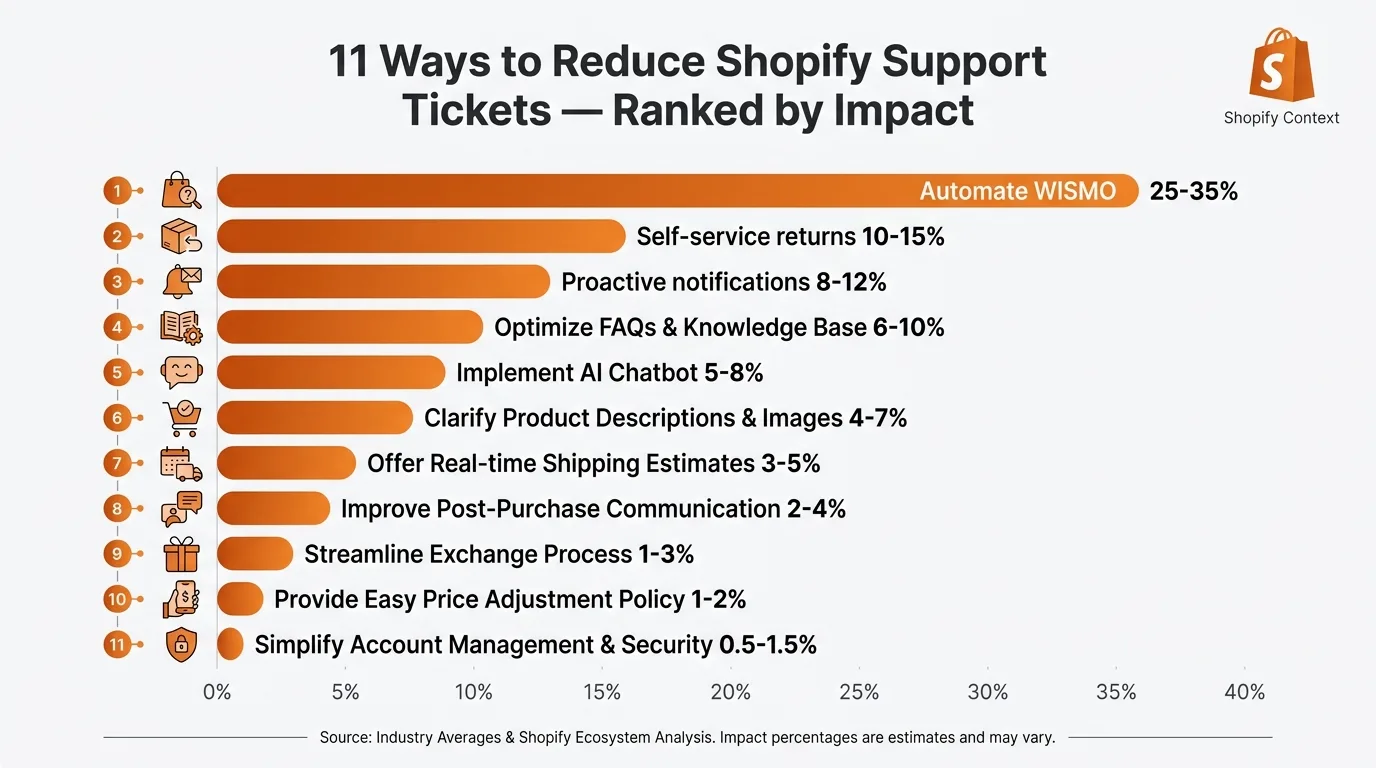
How to Reduce Shopify Support Tickets in 2026: 11 Strategies Ranked by Impact
The fastest way to reduce Shopify support tickets in 2026 is to attack volume in order of impact, not in order of convenience. A handful of repetitive question types — order status, returns, shipping delays, and order changes — drive the majority of e-commerce support volume. Removing them in descending order of frequency, and resolving rather than merely deflecting them, is what actually shrinks the queue. This guide ranks 11 proven strategies by the percentage of ticket volume each one typically removes.
TL;DR: The 11 Strategies, Ranked by Ticket Reduction
| Rank | Strategy | Typical Ticket Reduction | Type |
|---|---|---|---|
| 1 | Automate WISMO ("Where Is My Order?") tickets | 25–35% | Resolve |
| 2 | Self-service returns & exchanges | 10–15% | Resolve |
| 3 | Proactive shipping & delay notifications | 8–12% | Prevent |
| 4 | Agentic tier-1 resolution across channels | 8–10% | Resolve |
| 5 | Self-serve order editing (address & cancellations) | 5–8% | Resolve |
| 6 | Branded order-tracking page | 4–6% | Prevent |
| 7 | Subscription & billing self-management | 3–5% | Resolve |
| 8 | Better product pages & sizing guidance | 3–5% | Prevent |
| 9 | Searchable help center + smart FAQ | 2–4% | Deflect |
| 10 | Reduce payment & double-charge confusion | 2–3% | Prevent |
| 11 | Close the loop: tag, analyze, fix root causes | Compounding | Improve |
A quick note on the right-hand column: prevent stops the ticket from ever being created, resolve completes the customer's task without a human, and deflect merely routes them away from an agent. Prioritize prevent and resolve. Deflection alone tends to push frustrated customers into a second, angrier ticket.
Why a Small Number of Questions Drive Most of Your Volume
Across Shopify stores, the "same nine questions" dominate the queue: order status, returns, refunds, exchanges, address changes, cancellations, shipping delays, double charges, and discount problems. Order-status questions alone — WISMO — account for 30–50% of all e-commerce support tickets, and climb above 50% during peak season. Each one costs $5–$22 to handle when a human touches it.
That concentration is good news: it means you don't need to solve a thousand edge cases. You need to remove the top five drivers in order. The strategies below are sequenced so that each one targets the next-largest slice of your queue.
Before you start: spend 2–4 weeks tagging tickets by reason. Tag each ticket by the exact question asked ("address edit", not "order support"), merge duplicates, then sort by volume and rank your top five friction points. Your ranking may differ slightly from the table above, but the shape almost never does — WISMO and returns sit at the top for nearly every store. Automate in descending order of confirmed volume.
1. Automate WISMO Tickets (25–35% reduction)
This is the single highest-impact lever, and it's not close. Because order-status questions are 30–50% of volume, removing most of them reshapes your entire queue.
The mistake most stores make is treating WISMO as a communication problem — bolt on a chatbot that reads tracking numbers aloud. Real WISMO automation is a resolution problem with decision logic:
- Filter genuine order-status questions from look-alikes (a "where is my order" that's actually a lost-package claim needs different handling).
- Pull live status from Shopify and the carrier, not a stale order record.
- Map status to an answer the customer actually needs ("out for delivery today" vs. "stuck in transit 6 days — here's what we're doing").
- Escalate the exceptions — delays past SLA, no-movement packages, delivered-but-not-received — with the context already gathered.
Done this way, proactive notifications plus agentic resolution cut WISMO volume 60–80%, which translates to 25–35% of total tickets. For the full decision-logic walkthrough, see our guide on SOP-driven AI automation and how it differs from macros.
2. Enable Self-Service Returns & Exchanges (10–15% reduction)
Returns and refunds are the second-largest driver and the most margin-sensitive. A self-service flow that lets customers initiate a return, get a label, and trigger a refund or exchange — with guardrails built in — removes 10–15% of tickets.
The guardrails are what separate a margin-safe flow from a leak:
- Eligibility windows and condition rules enforced at submission, not after.
- Exchange-first prompting to retain revenue before defaulting to a refund.
- Risk-based checks on high-value or high-frequency returners.
This is where "resolve, don't deflect" matters most: a return self-service page that only explains the policy still generates a ticket when the customer wants the label issued. The agent should execute the refund or RMA, not describe how.
3. Send Proactive Shipping & Delay Notifications (8–12% reduction)
Every WISMO ticket is a notification you didn't send. Proactively messaging customers at each meaningful milestone — shipped, out for delivery, delayed, delivered — prevents the question before it forms. The biggest wins come from the exception notifications: telling a customer their package is delayed, with a clear next step, removes the angriest tickets in your queue. Pair this with strategy #1; prevention and resolution compound.
4. Deploy Agentic Tier-1 Resolution Across Channels (8–10% reduction)
Once the top three drivers are handled, a general-purpose AI agent picks up the long tail — discount issues, product questions, account problems — across email, chat, and social. The key word is agentic: the agent should take action (look up an order, apply a credit, update a record), not just generate a plausible reply.
This is precisely where helpdesk-native chatbots hit a ceiling: they answer inside one platform but can't act across your stack. A cross-platform agent reads Shopify, writes back to Gorgias or Zendesk, and touches the carrier portal in one workflow. See our comparison of the best AI agents for customer support for how the architectures differ, and AI agents vs. macros vs. workflows for why automation depth matters more than reply quality.
5. Let Customers Edit Their Own Orders (5–8% reduction)
Shopify doesn't natively let customers change a shipping address or cancel an order after checkout — so every one becomes a ticket, usually an urgent one. A controlled self-serve window (e.g., edits allowed until fulfillment starts) with agent execution behind it removes a steady 5–8% of volume and prevents the downstream WISMO and return tickets that mis-shipped orders create.
6. Ship a Branded Order-Tracking Page (4–6% reduction)
A tracking page hosted on your domain — with live status, estimated delivery, and answers to the obvious follow-ups — gives customers a destination other than your inbox. It also captures the upsell and review-request moments that a carrier's generic tracking page wastes. This is a prevention play: it absorbs the "just checking" WISMO visits that would otherwise become tickets.
7. Offer Subscription & Billing Self-Management (3–5% reduction)
For subscription and replenishment brands, "skip my next order," "change my plan," and "why was I charged" are a recurring tax on the queue. A self-management portal that lets customers pause, skip, swap, and see their billing history resolves these without a human and heads off the chargebacks that billing confusion creates.
8. Improve Product Pages & Sizing Guidance (3–5% reduction)
Many pre-purchase tickets — and a surprising share of returns — trace back to thin product information. Clear sizing charts, fit guidance, material details, and honest photography reduce both "will this fit?" tickets and the returns that ambiguous listings cause. This one compounds with strategy #2: better pages mean fewer returns to process. Show shipping estimates on product and cart pages too, so shoppers know delivery timing before they buy and do not write in to ask.
9. Build a Searchable Help Center + Smart FAQ (2–4% reduction)
A genuinely searchable help center with answer-first articles handles the informational long tail. Keep it honest about what it is: deflection. It works for "how do I…" questions but should never be the front line for "where is my refund" — those need resolution, not an article. Structure FAQ content with direct, 40–60 word answers so it also earns visibility in AI answer engines.
10. Reduce Payment & Double-Charge Confusion (2–3% reduction)
Pending authorizations that look like double charges, declined-then-retried payments, and unclear billing descriptors generate anxious, high-urgency tickets. Clearer checkout messaging, a recognizable billing descriptor, and a self-serve "explain my charge" lookup defuse most of them before they reach a human.
11. Close the Loop: Tag, Analyze, and Fix Root Causes (compounding)
The final strategy makes every other one better. Tag every ticket by reason, review the top drivers monthly, and feed the findings back into product, fulfillment, and your automations. A spike in "damaged on arrival" is a packaging problem, not a support problem. This root-cause loop is what turns a one-time 50% reduction into a queue that keeps shrinking.
The Realistic Ceiling: 50–70% of Tier-1 Volume
Stacked correctly, these strategies remove 50–70% of tier-1 ticket volume — and, more importantly, they remove the repetitive tickets, leaving your team the complex, high-value, and VIP cases where humans actually add value. The order matters: every store should start at the top of this list, because WISMO and returns are where the volume is.
A final principle ties it together: automate to resolve, not to deflect. Deflection metrics can flatter you while customers quietly file a second ticket. Resolution finishes the job — issues the refund, changes the address, sends the label — and that's the only thing that durably shrinks a Shopify queue.
If you want to skip the chatbot-deflection detour, CorePiper's SOP-driven agents resolve order, returns, and shipping tickets end-to-end across Shopify and whatever helpdesk you already run. Book a demo and we'll map your top three ticket drivers to automated resolution.
Resolve Shopify Tickets End-to-End — Not Just Deflect Them
CorePiper's SOP-driven AI agents resolve order, returns, and shipping tickets across Shopify, Zendesk, Gorgias, and your carrier portals — taking real action, not just answering. Book a 30-minute walkthrough and we'll map your top three ticket drivers to automated resolution.