
Salesforce Agentforce Competitors in 2026: The Honest Enterprise Buyer's Guide
Agentforce has a 77% B2B failure rate and true TCO up to $13,600/user/year. Here are 8 competitors ranked by use case with actual pricing and a decision framework.
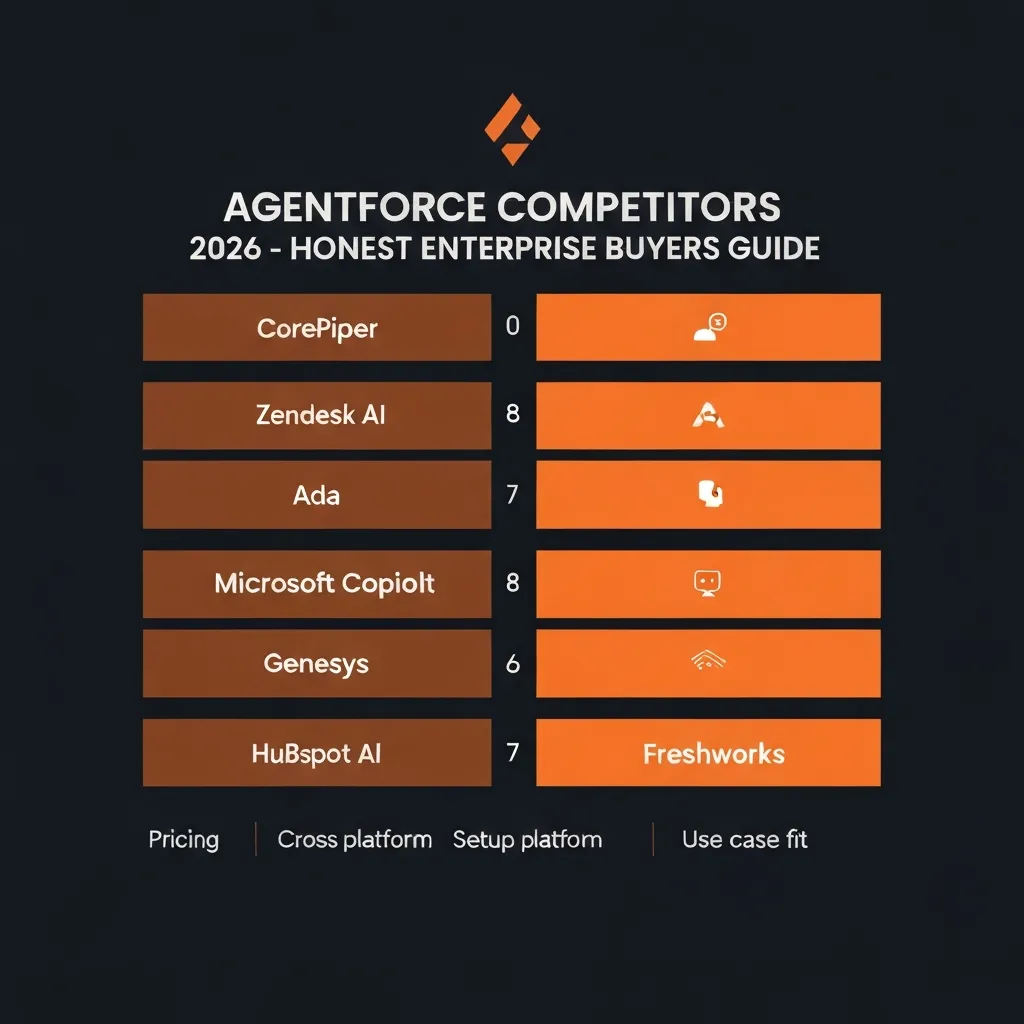
Quick Answer: Salesforce Agentforce has a 77% B2B deployment failure rate, true total cost of ownership up to $13,600/user/year, a hard 20-agent ceiling, and requires mandatory Data Cloud licensing. The best alternatives depend on your use case: CorePiper (cross-platform operations teams), Zendesk AI (high-volume support), Microsoft Copilot Studio (Microsoft-ecosystem teams), Genesys Cloud CX (enterprise contact centers), Ada AI (B2C chat), HubSpot AI (SMB CRM), ServiceNow AI (ITSM), and Freshworks Freddy AI (mid-market). This guide ranks all eight with real pricing and a decision framework.
The Agentforce Reality Check (2026 Edition)
Let's start with the numbers buyers rarely see in Salesforce demos.
77% B2B failure rate. A majority of B2B Agentforce deployments fail to reach production targets within 12 months. The primary cause: the platform requires clean, unified CRM data — and most enterprise orgs don't have it. Agentforce's Atlas reasoning engine is genuinely powerful. But it's powerless without the data quality that most enterprises have been tolerating as "good enough" for years.
$13,600/user/year true TCO. The base $125–$550/user/month is where Salesforce starts the conversation. It's not where enterprise deployments end up. True total cost of ownership includes:
- Data Cloud licensing ($125–$550/user/month additional)
- Einstein AI credit consumption ($0.10–$0.25 per agent action)
- Professional services implementation ($50K–$150K initial)
- Ongoing consulting ($10K–$25K/month during rollout)
- Training and enablement costs
20-agent ceiling. Even on Enterprise plans, Agentforce caps you at 20 deployed agents. For a large enterprise operations team managing case routing, claims processing, billing disputes, escalation management, and compliance documentation across multiple customer segments — 20 agents is exhausted before you've covered the primary use cases.
8% production adoption. Despite Salesforce's massive marketing investment — Super Bowl ads, Agentforce World Tour, bundled contracts — only 8% of eligible Salesforce customers have deployed Agentforce in production. The rest looked at the complexity, the Data Cloud dependency, and the cost, and decided to wait.
Reddit tells the story plainly: "Have anybody tried Agentforce? Is it even working for you guys? Are you seeing any ROI?" It's not a ringing endorsement from the practitioner community.
The 8 Best Agentforce Competitors in 2026
1. CorePiper — Best for Cross-Platform Operations Teams
The problem it solves: Agentforce's biggest limitation isn't its AI quality — it's its Salesforce-only scope. When your workflows span Salesforce, Jira, and Zendesk, Agentforce handles 30% of the workflow and leaves the rest to your ops team.
CorePiper was purpose-built for the other 70%. SOP-driven AI agents that ingest your standard operating procedures and execute them step-by-step across Salesforce, Jira, and Zendesk simultaneously — without custom code, without Data Cloud, without six months of implementation.
Key differentiators:
- No Data Cloud dependency — connects to Salesforce via standard API
- Unlimited agents on Enterprise plans (vs. Agentforce's 20)
- Setup in days, not months
- Human-in-the-loop feedback loop that improves through team corrections
- Flat-fee plans starting at $10/mo (Starter) and $99/mo (Pro) vs. per-user per-month escalating TCO
Pricing: Starter $10/month (5 resolved cases included, $3/case over); Pro $99/month (75 resolved cases included, $2/case over); Enterprise custom volume
Best for: Operations teams where workflows cross Salesforce, Jira, and Zendesk. Logistics, B2B support, freight claims, cross-system case routing, billing dispute resolution.
Not ideal for: Teams that need very high volume B2C conversational AI or that primarily live entirely within Salesforce Service Cloud.
2. Zendesk AI — Best for High-Volume Support Teams
The problem it solves: For teams whose support operation runs primarily through Zendesk, the AI capabilities built into Suite Professional and Enterprise — plus the Advanced AI add-on — deliver genuine value at competitive per-resolution pricing.
Key specs:
- Pricing: $1.50/automated resolution (committed); $2.00 PAYG; base plan $55–$115/agent/month + $50/agent Advanced AI add-on
- Channels: Chat, email, voice (via Zendesk Talk), messaging
- AI capabilities: Intelligent routing, auto-triage, bot conversations, CSAT prediction
- Setup: Weeks, not months for standard deployments
- Limitation: Zendesk-ecosystem only — no native Jira integration, no Salesforce workflow automation
Important 2026 note: Since January 2026, Zendesk auto-bills for resolution overages with no warning. Budget accordingly.
Best for: Support teams that primarily operate within Zendesk, with standardized support flows and predictable volumes.
Not ideal for: Teams with workflows requiring Salesforce data lookups or Jira ticket creation — Zendesk AI can't complete those cross-system actions.
3. Microsoft Copilot Studio — Best for Microsoft-Ecosystem Teams
The problem it solves: For enterprises deeply invested in Microsoft 365, Teams, Dynamics 365, and Azure, Copilot Studio provides a native AI agent builder that integrates with the existing Microsoft stack without additional ecosystem overhead.
Key specs:
- Pricing: $200/month for 25,000 messages (Copilot Studio standalone); also included in Microsoft 365 E3/E5 plans
- Integration: Native Teams, SharePoint, Dynamics 365, Power Platform, Azure
- Channels: Teams, websites, mobile apps, email
- Setup: Varies by complexity; Power Platform familiarity helps
- Limitation: Microsoft ecosystem primarily; weaker for Salesforce-centric orgs
Best for: Enterprises where Microsoft 365, Teams, and Dynamics 365 are the primary platforms. Internal employee-facing use cases, IT helpdesk, HR automation within Microsoft tools.
Not ideal for: Teams running Salesforce, Jira, or Zendesk as primary operational platforms. Copilot Studio's integrations with non-Microsoft systems require additional configuration.
4. Genesys Cloud CX — Best for Enterprise Contact Centers
The problem it solves: For large enterprise contact centers where the primary challenge is omnichannel customer experience at scale — voice, chat, email, social media simultaneously — Genesys Cloud CX is one of the most mature platforms in the market.
Key specs:
- Pricing: $75–$150/agent/month depending on tier; enterprise custom
- Channels: Voice, chat, email, SMS, social media, messaging (truly omnichannel)
- AI capabilities: Predictive routing, voicebot, chatbot, agent assist, workforce management
- Scale: Trusted by thousands of enterprise contact centers globally
- Integration: Pre-built connectors for Salesforce, ServiceNow, Microsoft Dynamics, and others
- Setup: Complex enterprise implementation; 3–6 months typical
Best for: Large enterprise contact centers handling millions of customer interactions across multiple channels, where omnichannel routing and workforce management are as important as AI automation.
Not ideal for: Mid-market companies or teams that don't operate enterprise contact centers. Genesys is feature-rich but expensive and complex for teams that don't need its full capabilities.
5. Ada AI — Best for B2C Chat Automation at Scale
The problem it solves: For B2C companies with high chat volume and standardized support flows, Ada's conversation design tools and per-resolution pricing model can deliver strong ROI — particularly at very high volumes where per-resolution rates drop.
Key specs:
- Pricing: $70,001/year median (Vendr data); $1–$3.50/resolution; $30K+/year base
- Channels: Chat primarily; SMS, voice with additional setup
- AI capabilities: Conversation flow design, intent detection, escalation management
- Setup: Months (conversation design phase required)
- Limitation: Chat-first focus; no Jira/Salesforce workflow automation
Best for: B2C companies with 30,000+ monthly chat conversations, standardized support flows, and the internal resources to invest in conversation design.
Not ideal for: Operations teams, B2B companies, or teams needing workflow automation beyond chat interactions.
6. HubSpot AI — Best for SMB CRM Teams
The problem it solves: For SMB companies that use HubSpot as their primary CRM, HubSpot's built-in AI capabilities (Copilot, AI email writer, predictive scoring, chatbot) provide native AI without the additional implementation overhead of a separate platform.
Key specs:
- Pricing: AI features included in Professional ($800/month) and Enterprise ($3,200/month) hubs; no separate per-resolution fees
- Integration: Native HubSpot CRM, marketing, sales, service hubs
- AI capabilities: AI content assistant, chatbot, predictive lead scoring, AI-powered reports
- Setup: Relatively fast if already on HubSpot
Best for: Companies with 10–500 employees already using HubSpot as their primary CRM and wanting AI without adding another tool. The SMB segment where Agentforce's enterprise complexity and pricing is overkill.
Not ideal for: Large enterprises with Salesforce as primary CRM, cross-platform workflows spanning multiple enterprise tools, or high-volume customer support operations.
7. ServiceNow AI (Moveworks) — Best for ITSM-Centric Enterprises
The problem it solves: Following ServiceNow's $2.85B acquisition of Moveworks in December 2025, ServiceNow now offers deeply integrated AI automation for ITSM workflows. For enterprises already running ServiceNow as their ITSM platform, this is the most natural AI layer.
Key specs:
- Pricing: ServiceNow enterprise pricing (typically $100K+/year); Moveworks per-employee pricing integrated into ServiceNow contracts
- Integration: Native ServiceNow workflows, HR, IT, finance automation
- AI capabilities: IT ticket deflection, HR request automation, knowledge management, employee experience
- Setup: 3–6 months for enterprise deployments
- Limitation: ServiceNow ecosystem dependent; less value for non-ServiceNow orgs
Best for: Large enterprises already running ServiceNow as primary ITSM platform, with 5,000+ employees and dedicated IT AI teams.
Not ideal for: Teams not in the ServiceNow ecosystem — the acquisition has made Moveworks' roadmap increasingly ServiceNow-aligned, reducing investment in other ITSM backend support.
8. Freshworks Freddy AI — Best for Mid-Market Teams
The problem it solves: Freshworks' Freddy AI delivers enterprise-grade AI capabilities at mid-market pricing, integrated with Freshdesk (support), Freshsales (CRM), and Freshservice (ITSM). For teams that don't want Salesforce's complexity or price point, Freshworks offers a coherent alternative.
Key specs:
- Pricing: $15–$99/agent/month for base plans; Freddy AI add-on pricing varies by product
- Integration: Freshdesk, Freshsales, Freshservice natively; connectors for Slack, Jira, Salesforce
- AI capabilities: Ticket routing, agent assist, chatbot, predictive CSAT, conversation summarization
- Setup: Weeks for standard deployments; faster than Salesforce
- Limitation: Freshworks ecosystem primarily; less powerful than Agentforce for pure Salesforce use cases
Best for: Mid-market companies (100–1,000 employees) looking for integrated CRM + support + ITSM with AI built in, at a price point below Agentforce or Zendesk Enterprise.
Not ideal for: Large enterprises with complex, multi-system workflows or teams deeply invested in the Salesforce or Microsoft ecosystem.
Feature Comparison Matrix
| Platform | Cross-Platform | Data Cloud Req. | Agent Limit | Setup Time | Pricing Model | Best Use Case |
|---|---|---|---|---|---|---|
| CorePiper | ✅ SF+Jira+ZD | ❌ | Unlimited | Days | From $10/mo | Cross-platform ops |
| Agentforce | ❌ SF only | ✅ Required | 20 max | 3–6 months | $125–$550/user/mo | SF-native workflows |
| Zendesk AI | ⚠️ ZD only | ❌ | No limit | Weeks | $1.50/resolution | High-vol support |
| Microsoft Copilot | ⚠️ MS stack | ❌ | No limit | Varies | $200/mo + M365 | MS-ecosystem teams |
| Genesys Cloud CX | ✅ Omnichannel | ❌ | No limit | 3–6 months | $75–$150/agent/mo | Enterprise CC |
| Ada AI | ❌ Chat only | ❌ | No limit | Months | $70K+/year + per-res | B2C chat volume |
| HubSpot AI | ⚠️ HubSpot | ❌ | No limit | Weeks | Included in plans | SMB CRM |
| ServiceNow AI | ⚠️ SN stack | ❌ | No limit | 3–6 months | Enterprise custom | ITSM enterprises |
| Freshworks Freddy | ⚠️ FW stack | ❌ | No limit | Weeks | $15–$99/agent/mo | Mid-market |
The Enterprise Decision Framework
Start here: Where do your workflows actually live?
If 80%+ of your workflows are Salesforce-native and you can absorb the Data Cloud dependency and 6-month implementation timeline, Agentforce may still be your best option despite its limitations.
If your workflows span multiple platforms (Salesforce + Jira + Zendesk is common), Agentforce is architecturally wrong for your use case. CorePiper was built for this.
Then ask: What is my primary AI use case?
- Cross-platform operations automation (case routing, claims, escalations) → CorePiper
- High-volume customer support in a single channel → Zendesk AI or Ada
- Microsoft 365-centric internal use cases → Copilot Studio
- Enterprise contact center at scale → Genesys Cloud CX
- Mid-market all-in-one CRM + support + AI → Freshworks Freddy
- ITSM automation at enterprise scale → ServiceNow AI (if already on SN)
Finally: What's your tolerance for implementation complexity?
If you need production value in days or weeks: CorePiper, HubSpot AI, Freshworks Freddy If you can handle months of implementation: Any enterprise platform If you have a dedicated AI/ML team for platform build-out: Kore.ai, Genesys, ServiceNow
Total Cost of Ownership Comparison
For a 50-person operations team over 3 years:
| Platform | Year 1 | Year 2 | Year 3 | 3-Year Total |
|---|---|---|---|---|
| Agentforce (realistic) | $680,000 | $300,000 | $315,000 | $1,295,000 |
| CorePiper (Pro + Enterprise) | $35,000 | $35,000 | $35,000 | $105,000 |
| Zendesk AI | $120,000 | $130,000 | $140,000 | $390,000 |
| Microsoft Copilot | $45,000 | $47,000 | $49,000 | $141,000 |
| Freshworks Freddy | $80,000 | $85,000 | $90,000 | $255,000 |
Agentforce Year 1 includes $150K implementation + $50K consulting/month for rollout + base licensing. CorePiper assumes 15,000 cases/year on Enterprise pricing tuned to volume — at high case volume, Enterprise replaces the public Pro plan.
The 3-year TCO comparison is the most important number for an enterprise buyer. Agentforce's per-user pricing looks competitive in isolation; at full deployment with all required components, the total cost picture looks very different.
For Further Reading
- 7 Agentforce Alternatives for Enterprise Support Teams
- Agentforce vs. Cross-Platform AI Agents: Which Approach Fits Your Team?
- Agentforce vs Netomi in 2026: Enterprise AI Agents Compared
- How to Run AI Agents Across Salesforce, Zendesk, and Jira Without Custom Code
Bottom Line
Agentforce is the right answer for a specific buyer: already committed to Salesforce, willing to invest in Data Cloud, patient with a 6-month implementation timeline, and operating in Salesforce-native workflows. For that buyer, Agentforce's native data access and Atlas reasoning engine are genuine advantages.
For the broader market — teams with multi-platform workflows, teams that need fast time to value, teams that can't afford $13,600/user/year TCO — there are eight strong alternatives that address specific use cases better.
The decision framework above will tell you which one fits your situation. If cross-platform operations is your core need, the answer is CorePiper. If enterprise contact center scale is the challenge, it's Genesys. If Microsoft is your stack, it's Copilot Studio.
The worst outcome is choosing Agentforce for a cross-platform problem and spending six months and $500K+ to discover that the architecture doesn't fit your workflows.
The Agentforce Alternative for Cross-Platform Teams
CorePiper handles cases across Salesforce, Jira, and Zendesk with SOP-driven agents, human-in-the-loop feedback, and transparent per-case pricing. No Data Cloud dependency. No 20-agent ceiling. No 6-month implementation timeline.
Frequently Asked Questions
Q: What is Salesforce Agentforce's true cost of ownership in 2026?
Agentforce's true total cost of ownership reaches $13,600/user/year when including mandatory Data Cloud licensing, Einstein AI credits, professional services implementation ($50K–$150K initial), ongoing consulting ($10K–$25K/month), and training costs. The base $125–$550/user/month pricing is just the starting point.
Q: Why do so many Agentforce implementations fail?
77% of B2B Agentforce implementations fail or underdeliver. The primary causes are: Data Cloud implementation complexity (requires clean, unified CRM data that most orgs don't have), the 20-agent limit creating artificial constraints, ecosystem lock-in (no native Jira, Zendesk, or external portal integration), and expectation gaps between Salesforce marketing and actual production capabilities.
Q: What are the best Agentforce alternatives for enterprises with multi-platform workflows?
CorePiper is the best alternative for enterprises with workflows spanning Salesforce, Jira, and Zendesk — offering SOP-driven cross-platform automation from $10/month, with Enterprise pricing tuned to high-volume operations, all without Data Cloud dependency. For pure Salesforce-native teams needing more AI flexibility, Microsoft Copilot Studio is worth evaluating. For high-volume customer support, Zendesk AI or Genesys Cloud CX are mature alternatives.
Q: Does Agentforce require Salesforce Data Cloud?
Yes. Agentforce requires Data Cloud to function as an AI agent platform. Data Cloud adds $125–$550/user/month to base licensing costs, plus a 4–8 week implementation timeline to unify your data model. This is a mandatory dependency that many buyers discover after initial Agentforce demos.
Q: What is the Agentforce 20-agent limit?
Even on Enterprise Agentforce plans, you can deploy a maximum of 20 AI agents. For large enterprises managing diverse workflow types across departments and customer segments, this ceiling is reached quickly. It's one of the most commonly cited limitations by teams evaluating Agentforce at scale.