
The True Cost of a Support Ticket in E-commerce (and the 3 Hidden Multipliers)
Published e-commerce ticket costs run $2.70–$5.60, but the true cost — including agent turnover, training, and repeat contacts — regularly exceeds $8. Gartner benchmarks assisted-channel contacts at $13.50. Full cost breakdown inside.
 Mustafa BayramogluJune 13, 202610 min read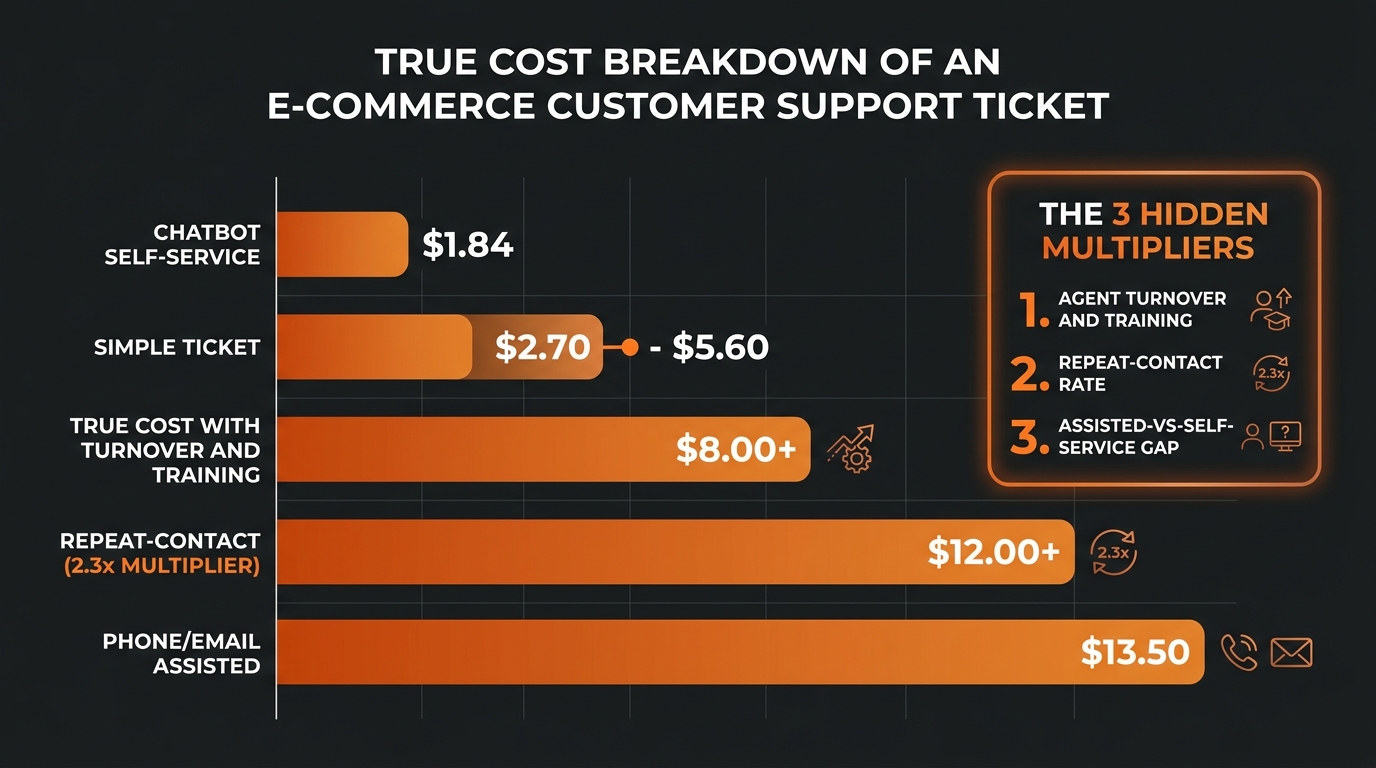
The True Cost of a Support Ticket in E-commerce (and the 3 Hidden Multipliers)
The true cost of a support ticket in e-commerce is not $2.70. Published benchmarks put simple ticket costs at $2.70–$5.60, but once agent turnover, training overhead, and repeat contacts are factored in, the true per-resolution cost routinely exceeds $8. Gartner benchmarks the median assisted-channel contact — phone, chat, email — at $13.50 versus $1.84 for self-service. The gap between those two numbers is where most support budgets disappear.
TL;DR: E-commerce Support Cost Benchmarks
| Cost Category | Per-Contact Cost | Source |
|---|---|---|
| Self-service (chatbot, FAQ, no human) | $1.84 | Gartner |
| Simple e-commerce ticket (order status, refund, address change) | $2.70–$5.60 | Industry benchmarks |
| True cost with turnover and training | $3.00–$8.00+ | Tymely analysis |
| Repeat-contact adjusted cost (2.3x multiplier) | $6.20–$12.90 | Industry analysis |
| Assisted channel (phone, chat, email to human) | $13.50 | Gartner |
What is the average cost per support ticket in e-commerce?
The honest answer is: lower than you think at first glance, and higher than you expect once you do the full math.
Industry benchmarks consistently put simple e-commerce ticket costs in the $2.70–$5.60 range — order status inquiries, refund requests, address changes, and the other high-volume queries that make up 60–70% of a typical Shopify support queue. That figure captures direct agent labor: time per ticket multiplied by fully loaded hourly rate.
Gartner's benchmark is harder to ignore: the median cost per contact is $1.84 for self-service and $13.50 for assisted service (phone, chat, or email to a human agent). That 7.3x gap between self-service and assisted channels is not a rounding error — it is the central cost dynamic in e-commerce support economics.
The $2.70–$5.60 range sits in between, and where your cost falls within that range depends almost entirely on what share of tickets reach a human agent versus those resolved by automation. A 10-point shift in escalation rate — 10% more tickets going to humans — adds $0.68–$1.07 per ticket across your entire volume. At 10,000 tickets per month, that single variable is worth $6,800–$10,700 per month in additional cost.
But the bigger problem is what those benchmarks leave out entirely.
Why does your actual cost per ticket exceed vendor estimates?
Tymely's ticket-cost analysis found that the true cost exceeds $3 even in stores that estimate under $1 per ticket. The discrepancy is not a calculation error — it is a measurement gap. Vendor estimates typically capture direct labor in steady state. They exclude three categories of overhead that compound across every ticket, every month, invisibly.
What are the 3 hidden multipliers that inflate your true cost per ticket?
Hidden Multiplier 1: Agent Turnover and Training
Customer support has one of the highest turnover rates of any business function. Annual support agent turnover runs 30–45% across the industry. Replacing a departing agent costs $5,000–$20,000 in recruiting, onboarding, and productivity ramp, depending on market and product complexity. That cost amortizes across every ticket the departed agent would have handled.
At 35% annual turnover, a 10-person support team loses 3–4 agents per year. If the average replacement cost is $10,000 per agent, that's $30,000–$40,000 in annual overhead that never appears in a per-ticket cost model. At 120,000 annual tickets, that turnover overhead alone adds $0.25–$0.33 per ticket — a 9–12% increase above the headline cost.
Training time compounds this further. A new support agent typically reaches full productivity in 4–8 weeks. During that ramp, their effective output per hour is roughly half a senior agent's. The ramp cost — 160–320 hours of reduced productivity per new hire — scales with ticket volume and turnover rate together.
Hidden Multiplier 2: The Repeat-Contact Rate
The repeat-contact multiplier is the most significant and least measured cost driver in e-commerce support. When a customer contacts support and the underlying issue is not resolved — because a chatbot deflected rather than resolved, because the agent gave a partial answer, or because the follow-up action didn't complete — they contact again.
Industry analysis puts the e-commerce repeat-contact rate at roughly 20–30%. Applied as a multiplier: a 23% repeat-contact rate means that for every 100 unique customer issues, 123 tickets are opened. The effective cost per resolved issue is therefore 23% higher than the cost per ticket processed.
Researchers who have modeled deflection-heavy systems put the average effective repeat-contact multiplier at approximately 2.3x. The mechanism: if your chatbot deflects 70% of contacts but 40% of deflected customers contact again, your real containment rate is 70% × (1 - 0.40) = 42%, not 70%. Your effective cost per resolved issue is more than double what the per-ticket rate suggests.
This is why deflection-rate optimization consistently disappoints at the business level: it improves the visible metric while the underlying cost multiplier stays elevated. The difference between deflection and resolution is precisely the difference between a 1.0x multiplier and a 2.3x multiplier on your per-ticket cost.
Hidden Multiplier 3: The Assisted-Channel Cost Gap
Every ticket that starts as a self-service interaction and escalates to an assisted channel generates a blended episode cost that exceeds $13, regardless of what the starting channel cost. The typical progression:
- Self-service (chatbot or FAQ, no human): $1.84
- Chat to human agent: $8–$12
- Email to human agent: $8–$10
- Phone to human agent: $12–$20
A 10% escalation rate on 10,000 monthly tickets means 1,000 tickets per month crossing from roughly $3 to roughly $13: an incremental $10,000/month in assisted-channel cost exposure. Over a year, that's $120,000 in additional spend driven by a single percentage-point metric most teams don't track.
For WISMO tickets — which make up 30–50% of e-commerce queues — automating the full resolution path rather than deflecting the initial contact eliminates this escalation path for the majority of cases. Proactive order status resolution never enters the assisted-channel pipeline.
How do you calculate your actual cost per support ticket?
A simple fully loaded model:
True cost per resolution = (Direct labor cost per ticket) × (1 + turnover overhead rate) × (repeat-contact multiplier)
Where:
- Direct labor cost per ticket = fully loaded hourly rate ÷ tickets handled per hour
- Turnover overhead rate = (annual replacement cost × annual turnover rate × headcount) ÷ annual ticket volume
- Repeat-contact multiplier = total tickets opened ÷ unique issues resolved
Example calculation: A store handling 10,000 tickets/month, 10 support agents at $30/hour fully loaded, each handling 4 tickets/hour, 35% annual turnover, $10,000 average replacement cost, 20% repeat-contact rate.
| Input | Value |
|---|---|
| Direct labor per ticket | $30 ÷ 4 = $7.50 |
| Annual turnover overhead | (0.35 × 10 × $10,000) ÷ 120,000 = $0.29/ticket |
| Subtotal before repeat-contact | $7.79/ticket |
| Repeat-contact multiplier (20%) | 1.20x |
| True cost per resolution | $9.35 |
That is 67% above the $5.60 upper bound of the published benchmark range — for a cost structure that is not unusual. Stores with lower tickets-per-hour rates (complex cases run 1–2/hour), higher turnover, or escalation-heavy flows routinely land above $10 per resolved issue.
How does per-resolved-case pricing align cost to outcomes?
The standard helpdesk pricing models — per seat, per ticket volume, per conversation initiated — price the input rather than the output. You pay the same whether a ticket resolves cleanly on the first contact or generates three repeat contacts across two channels.
Per-resolved-case pricing inverts the model: you pay when a ticket is genuinely resolved by the AI agent, without human escalation or repeat contact. This makes cost proportional to value delivered, not volume processed. It also creates an incentive alignment: the vendor earns revenue only on outcomes the buyer wanted.
For e-commerce operations where WISMO, returns, and refund requests make up 60–70% of volume, the math is tractable. An AI agent configured with SOP-driven resolution logic resolves 70–85% of tier-1 tickets end-to-end. You pay per-resolved-case pricing on that 70–85% and route the remaining cases to your human queue — at the true cost calculated above — rather than paying per-ticket volume pricing on the combined total.
The net result: the per-resolved-case tier handles the automatable volume at predictable cost; the human tier handles the genuinely complex cases at true fully loaded cost, sized much smaller than before. Neither tier is paying for repeat contacts, escalations, or failed deflections.
What is the business case for auditing your true cost per ticket?
Three practical conclusions from the math:
The self-service-vs-assisted gap dominates all other cost levers. A 10-point reduction in escalation rate is worth more than any efficiency gain on the assisted-channel side. Investments that keep tickets resolved in agentic or self-service channels — genuinely resolved, not just deflected — compound faster than headcount optimization.
Deflection rate is not a cost metric. If your current tool is sold on deflection rate, ask for the re-contact rate on deflected conversations. If the vendor doesn't track it, you're measuring the wrong output. The repeat-contact multiplier is where the cost gap between deflection tools and resolution agents lives.
The difference between a $3 ticket and a $9 ticket is $720,000 per year at 10,000 monthly tickets. That gap closes through genuine resolution — not better ticket routing, not more agents, and not another chatbot layer.
Understanding your true cost per ticket is the prerequisite for any AI support investment decision. The per-resolution pricing comparison only makes sense when you know what your baseline true cost actually is.
Frequently Asked Questions
What is the average cost per support ticket in e-commerce?
Published benchmarks put simple e-commerce support tickets at $2.70–$5.60 per contact. Once you add the fully loaded cost of agent time — including turnover, onboarding, and training — the true cost exceeds $3 even for stores that estimate under $1 per ticket. Gartner benchmarks the median cost of an assisted-channel contact (phone, chat, email) at $13.50, versus $1.84 for self-service.
What are the hidden costs that inflate the true cost per support ticket?
The three hidden multipliers are: (1) agent turnover and training — replacing a support agent costs $5,000–$20,000 in recruiting, onboarding, and productivity ramp; (2) repeat contacts — customers who contact again about the same issue inflate the true resolution cost by a 2.3x multiplier; and (3) the assisted-channel gap — tickets that escalate from self-service to a human jump from roughly $1.84 to $13.50 per contact.
What is a repeat-contact multiplier and how does it inflate ticket costs?
A repeat-contact multiplier reflects how often the same underlying issue generates more than one ticket. Industry analysis puts the e-commerce repeat-contact rate at roughly 20–30%, meaning one in four to five customers contacts support again. A 2.3x multiplier means the effective cost per unique resolved issue is more than double the cost of a single ticket processed.
What is the Gartner benchmark for self-service vs. assisted-channel support costs?
Per Gartner's "Benchmarks to Assess Your Customer Service Costs," the median cost per contact is $1.84 for self-service and $13.50 for assisted channels (phone, chat, and email). The 7.3x gap between the two explains why escalation rate is the primary lever on total support spend: even a small shift from resolved self-service to escalated human contact has an outsized cost impact.
How does per-resolved-case pricing reduce the true cost per ticket?
Per-resolved-case pricing — paying only when a ticket is fully resolved by the AI agent — aligns cost to outcome. You do not pay for tickets that escalate to humans, interactions requiring a second contact, or conversations the chatbot deflected without resolving. The model is a direct proxy for value delivered rather than volume processed.
Stop Paying Per Ticket. Start Paying Per Resolved Case.
CorePiper's per-resolved-case pricing aligns your cost directly to outcomes — you pay when a ticket is genuinely resolved, not when your team processes it, escalates it, or handles it twice. Book a 30-minute walkthrough to see the math for your ticket volume.