
Zendesk AI Pricing Per Resolution: The Hidden Math Behind $1.50 (2026 Analysis)
Zendesk charges $1.50 committed or $2.00 PAYG per automated resolution. Since January 2026, overages are auto-billed with no warning. Here's the real math most buyers miss.
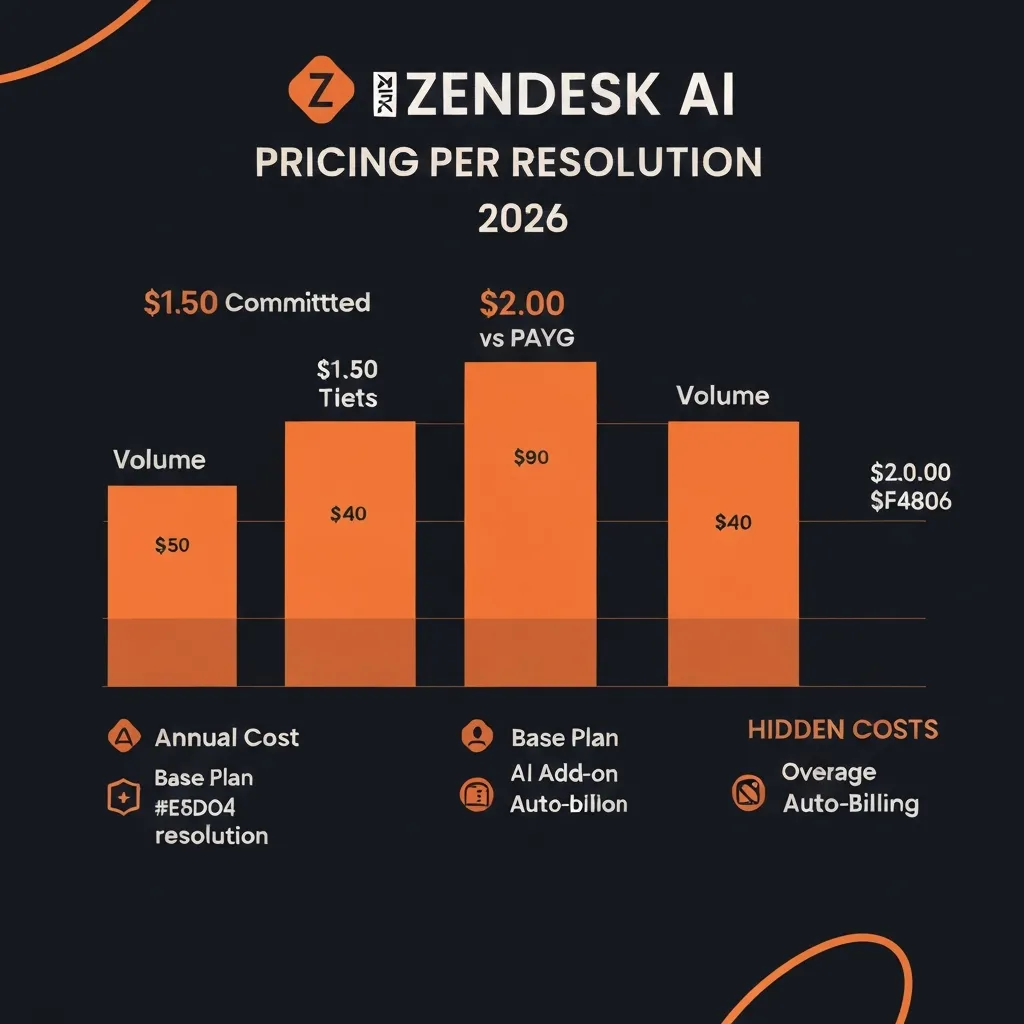
Quick Answer: Zendesk charges $1.50/automated resolution on committed plans and $2.00 on pay-as-you-go. Since January 2026, overages are auto-billed with no warning — a change that has caught many teams off guard on their monthly invoices. The "automated resolution" definition has a 72-hour verification window that can overcount resolutions, and the true total cost of Zendesk AI (including base plan, Advanced AI add-on, and resolution fees) often runs 2–3x higher than the headline $1.50 number implies.
The January 2026 Change That Changed Everything
Before January 2026, Zendesk's per-resolution AI charges worked as follows: your plan included a monthly allocation of automated resolutions. If you exceeded that allocation, overages were billed — but you had to manually activate overage billing, and you could set spending limits.
Starting January 2026, that changed. Overages are now auto-billed automatically. No pause. No warning. No grace period. If your AI bot resolves 500 conversations in a month when your plan only includes 400, the extra 100 resolutions appear on your invoice at $1.50–$2.00 each without any action on your part.
For teams with variable support volume — seasonal businesses, companies growing quickly, or teams running marketing campaigns that drive support spikes — this is a significant budget risk. A support volume spike that doubles your bot conversations for one month doubles your AI bill for that month.
The change was buried in a billing notification email that many teams missed. Many Zendesk customers discovered the new auto-billing behavior on their invoice rather than their inbox.
What You're Actually Paying: The Full Stack
The $1.50 per resolution is one line item in a much larger cost structure. Understanding the full stack is essential for accurate budget planning.
Layer 1: Base Plan Pricing
Zendesk's AI features require at minimum the Suite plans:
| Plan | Price per Agent/Month | AI Features Included |
|---|---|---|
| Suite Team | $55 | Basic AI suggestions |
| Suite Growth | $89 | AI agent (limited), macro suggestions |
| Suite Professional | $115 | Full AI agent, analytics |
| Suite Enterprise | Custom | Advanced AI, custom SLAs |
Prices are annual billing rates. Monthly billing costs 15–25% more.
Layer 2: Advanced AI Add-On
$50/agent/month (required for full AI agent capabilities)
The Advanced AI add-on unlocks:
- Intelligent triage and classification
- AI-powered CSAT predictions
- Intelligent routing beyond basic rules
- Enhanced bot conversation capabilities
Without this add-on, the AI agent capabilities are limited. Most teams evaluating Zendesk AI seriously need this add-on.
Layer 3: Per-Resolution Charges
$1.50/resolution (committed) or $2.00 (PAYG)
Volume tiers for committed plans:
- 1–100 resolutions: $1.50 each
- 101–1,000 resolutions: $1.30 each
- 1,001–5,000 resolutions: $1.10 each
- 5,001+ resolutions: $1.00 each
Free monthly allowance by plan: 5–15 resolutions per agent seat per month. For a 20-agent team on Suite Growth: 20 × 10 = 200 free resolutions/month. Everything above that is billed.
Layer 4: Optional Add-Ons That Become Necessary
Many teams also end up with:
- QA Add-On: $25/agent/month (conversation quality scoring)
- WFM Add-On: $25/agent/month (workforce management — required for teams tracking agent schedules)
The Real Monthly Cost: A 20-Agent Team Example
Assumptions: 20 agents, Suite Growth plan, Advanced AI add-on, 1,000 automated resolutions/month, QA add-on
| Cost Component | Monthly |
|---|---|
| Suite Growth (20 agents × $89) | $1,780 |
| Advanced AI (20 agents × $50) | $1,000 |
| Free resolution allowance: 200 included | $0 |
| Paid resolutions: 800 × $1.30 (tier 2) | $1,040 |
| QA Add-On (20 agents × $25) | $500 |
| Monthly Total | $4,320 |
| Annual Total | $51,840 |
And that's a conservative scenario. At 3,000 resolutions/month:
| Component | Monthly |
|---|---|
| Suite Growth (20 agents) | $1,780 |
| Advanced AI (20 agents) | $1,000 |
| Paid resolutions: 2,800 × ~$1.20 avg | $3,360 |
| QA Add-On | $500 |
| Monthly Total | $6,640 |
| Annual Total | $79,680 |
The per-resolution cost alone at 3,000 resolutions/month is more than the base plan cost. This is the compounding structure that catches teams off guard.
The "72-Hour Resolution" Definition Problem
Here's where the billing math gets particularly fraught.
Zendesk's automated resolution counting process:
- Bot conversation ends (customer stops responding or closes chat)
- Ticket sits inactive for 72 hours
- If no human agent has been involved in 72 hours, Zendesk runs an LLM verification check to confirm resolution
- If the LLM confirms resolution, it's counted and billed
The problem: Step 2 doesn't distinguish between "customer's issue was resolved" and "customer gave up." A frustrated customer who abandons a chat without getting their issue resolved — and doesn't come back within 72 hours — can be counted as an automated resolution.
This inflates your resolution count in ways that don't reflect actual customer value. Teams have reported 15–25% of billed "resolutions" being cases where the customer never confirmed their issue was fixed.
The implications:
- Your AI resolution rate looks higher than it actually is
- Your per-resolution bill is higher than it should be
- Your actual customer satisfaction on AI-handled cases is lower than reported
This isn't necessarily intentional deception — the 72-hour window is a reasonable proxy for many use cases. But for teams with customers who frequently abandon chats (mobile users, buyers doing other research simultaneously, customers in different time zones), it can materially overcount.
The Hidden Contract Landmines
Beyond per-resolution billing, several contract terms create ongoing cost risk:
1. No Mid-Contract Downgrades
Zendesk contracts don't allow plan downgrades mid-term. If you sign a 12-month contract for Suite Professional with 20 agents and three months in you realize you only need 15 agents, you're locked until renewal. Unused licenses are lost.
2. 5–7% Annual Price Escalation Clauses
Enterprise Zendesk contracts typically include automatic annual price escalation clauses of 5–7%. On a $100K/year contract, that's $5,000–$7,000/year in mandatory increases regardless of actual Zendesk cost changes.
3. No Monthly Billing at Parity
Monthly billing runs 15–25% higher than annual billing rates for the same plan. Teams that want billing flexibility pay significantly more per agent per month.
4. Resolution Overage Caps Are Not Default
Resolution overage spending caps are not enabled by default post-January 2026. You can negotiate a monthly resolution cap into your contract, but it's not automatic. You have to specifically request it and it may require an enterprise contract tier.
Zendesk AI vs. Alternatives: An Honest Comparison
| Platform | Per-Resolution Cost | Platform Fee | Cross-Platform | Auto-Billing Risk |
|---|---|---|---|---|
| Zendesk AI | $1.50–$2.00 | $55–$115/agent/mo + $50 add-on | Zendesk only | Yes (since Jan 2026) |
| CorePiper | Included in plan + $2-3/case overage | $10/mo (Starter), $99/mo (Pro), Enterprise custom | SF + Jira + ZD on Enterprise | No, flat plan |
| Intercom Fin | $0.99/resolution | Intercom plan required | Intercom only | Per-resolution |
| Ada AI | $1.00–$3.50/resolution | $30K+/year | Chat only | Per-resolution |
| Forethought (now Zendesk) | Bundled with Zendesk | Enterprise | Zendesk only | N/A |
| Freshdesk Freddy AI | Per-seat, not per-resolution | $15–$99/agent/mo | Freshdesk only | No (seat-based) |
One thing the comparison above shows: Zendesk's $1.50 per resolution is competitive vs. Ada's high end, but it's higher than Intercom's $0.99. The comparison that matters most isn't the per-resolution rate — it's what the platform can actually do per resolution.
Zendesk AI can resolve a conversation that stays entirely within Zendesk. If the resolution requires looking up order data in Salesforce, creating a bug ticket in Jira, or accessing an external shipping portal — Zendesk AI cannot complete that workflow. It either escalates to a human or drops the ball entirely.
CorePiper's flat plans, $10/mo (Starter, 5 resolved cases) and $99/mo (Pro, 75 resolved cases) for Shopify workflows, or Enterprise (custom, tuned to volume) once you need Salesforce, Jira, and Zendesk together, include everything needed to complete that cross-platform workflow. The comparison on pure per-resolution rate ignores the fundamental question of what a "resolution" actually requires.
When Zendesk AI Per-Resolution Pricing Makes Sense
Zendesk AI's per-resolution model is genuinely competitive for specific scenarios:
It makes sense if:
- Your support volume is predictable and your free allocation covers most of it
- Your support workflows are primarily Zendesk-native (no Salesforce lookups, no Jira ticket creation)
- You're already on an enterprise Zendesk contract and the AI add-on is a marginal cost
- High chat resolution rates with standardized flows (e-commerce, subscription management)
- You can negotiate a resolution cap into your contract to limit exposure
It doesn't make sense if:
- Your support workflows require data from Salesforce, Jira, or external systems
- Your volume is unpredictable or seasonal (auto-billing creates budget risk)
- You're paying for the Advanced AI add-on and only getting partial value from it
- Your customers frequently abandon chats (inflated resolution counting)
- You're a mid-market team evaluating total cost of ownership carefully
Calculating Your True Zendesk AI Cost
Use this framework to project actual annual cost:
Step 1: Base plan cost Number of agents × plan rate × 12 months
Step 2: Advanced AI add-on Number of agents × $50 × 12
Step 3: Expected resolutions Monthly conversations × expected AI resolution rate = monthly resolutions
Step 4: Free allowance Number of agents × allowance per agent (5–15 depending on plan)
Step 5: Paid resolutions (Monthly resolutions − free allowance) × applicable tier rate × 12
Step 6: Buffer for auto-billing overages Add 20–30% to Step 5 for volume variability (the January 2026 change makes this essential)
Step 7: Optional add-ons QA add-on, WFM add-on as applicable
Add all steps. That's your realistic annual cost.
For most teams we've seen calculate this honestly, the result is 2–3x the initial estimate based on headline pricing alone.
What to Negotiate in Your Zendesk Contract
If you're signing a new Zendesk contract or renewing, these negotiation points matter most for AI pricing:
-
Monthly resolution cap — Set a hard ceiling on resolution overage billing per month. This protects against volume spikes.
-
Resolution definition in writing — Ask for explicit documentation of what counts as a resolved conversation, specifically how abandoned conversations are handled.
-
Annual escalation clause limits — Push for a 3% maximum annual escalation, or a fixed annual rate for the contract term.
-
Commit to resolution minimums in exchange for lower rates — If your volume is predictable, commit to monthly minimums in exchange for the lower tier rates across all resolutions (not just the marginal ones above tier thresholds).
-
Free allowance per agent — Push for 20-25 free resolutions per agent per month instead of the default 5-15.
Our Zendesk pricing negotiation guide covers the full negotiation playbook for getting 15–30% off your contract.
The Bottom Line
Zendesk's $1.50 per automated resolution headline is accurate — for committed plans, on the first 100 resolutions above your free allowance. In practice, the total cost of Zendesk AI (base plan + Advanced AI add-on + per-resolution fees + optional add-ons) runs significantly higher, and the January 2026 auto-billing change removed the safety valve that protected teams from unexpected overage charges.
For teams evaluating Zendesk AI honestly:
- Calculate the full cost stack, not just the per-resolution rate
- Understand the 72-hour resolution counting mechanism
- Negotiate a monthly resolution cap before signing
- Assess whether your workflows are actually Zendesk-native or require cross-platform data
For teams whose workflows cross Salesforce, Jira, and Zendesk boundaries — the $1.50 per resolution is the wrong number to optimize for, because Zendesk AI can't complete those workflows regardless of the rate.
Zendesk AI Pricing Feels Uncertain?
CorePiper gives you cross-platform AI with transparent per-case pricing — no auto-billing, no 72-hour resolution counting games, no add-on stack surprises.
Frequently Asked Questions
Q: How much does Zendesk charge per automated resolution in 2026?
Zendesk charges $1.50 per automated resolution on a committed annual plan, or $2.00 per resolution on pay-as-you-go. Volume tiers reduce the committed rate: $1.30 for 101–1,000 resolutions, $1.10 for 1,001–5,000, and $1.00 for 5,001+. Each agent seat includes 5–15 free resolutions per month depending on plan.
Q: What changed about Zendesk AI billing in January 2026?
Starting January 2026, Zendesk auto-bills for resolution overages with no grace period, no pause, and no warning. Previously, overages required manual activation. Now, if your bot resolves more conversations than your plan's included allocation, overage charges appear on your next invoice automatically.
Q: What counts as an 'automated resolution' for Zendesk billing?
Zendesk defines an automated resolution as a conversation fully handled by the AI agent without human intervention, verified after 72 hours of ticket inactivity, then confirmed by a secondary LLM check. The 72-hour window means a customer who stops responding (frustrated, moved on, etc.) can be counted as resolved even if their issue wasn't actually fixed.
Q: What is the total cost of Zendesk AI beyond the per-resolution rate?
Total Zendesk AI cost includes: base plan ($55–$115/agent/month), Advanced AI add-on ($50/agent/month), per-resolution charges ($1.50–$2.00 each), QA add-on ($25/agent/month), and WFM add-on ($25/agent/month for larger teams). A 20-agent team at Suite Growth with Advanced AI and 1,000 resolutions/month realistically spends $4,000–$5,000/month on Zendesk AI.
Q: How does Zendesk's per-resolution pricing compare to CorePiper?
Zendesk AI: $1.50 to $2.00 per resolution for Zendesk-native chat automation only. CorePiper: flat plans starting at $10/mo (Starter, 5 resolved cases included) and $99/mo (Pro, 75 resolved cases included), with cross-platform automation spanning Salesforce, Jira, and Zendesk simultaneously available on the Enterprise plan, priced to your case volume. Zendesk is cheaper per interaction for purely Zendesk-native workflows. CorePiper is more economical for workflows that cross system boundaries, where Zendesk's bot cannot complete the workflow regardless of rate.