
Per-Resolution vs. Per-Seat vs. Per-Conversation: How AI Support Pricing Actually Works
Intercom Fin charges $0.99 per outcome. Zendesk AI charges $1.50 per automated resolution. Gorgias AI charges $0.90–$1.00 per resolved conversation. This breakdown explains what you actually pay under each model — and which one aligns incentives correctly.
 Mustafa BayramogluJune 25, 202610 min read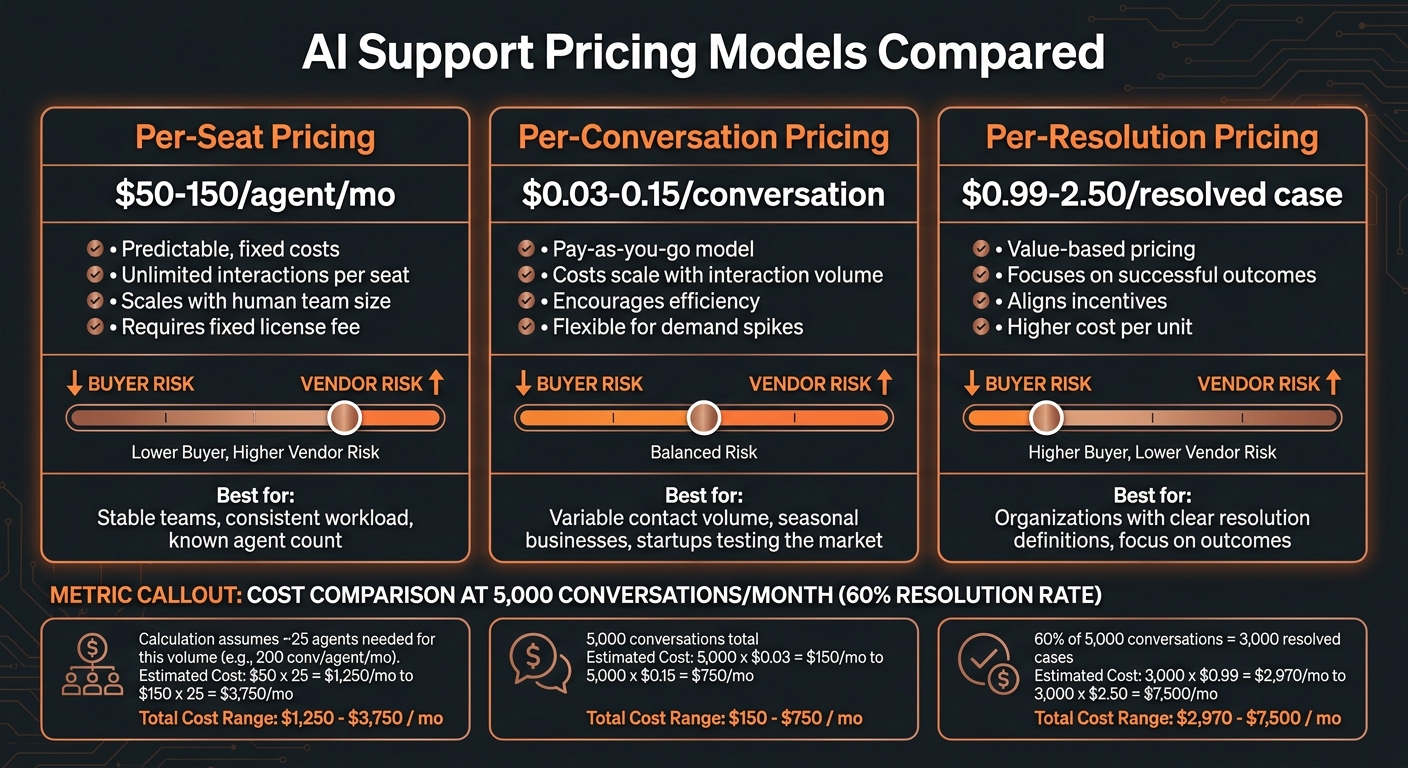
Per-Resolution vs. Per-Seat vs. Per-Conversation: How AI Support Pricing Actually Works
AI customer support pricing has fragmented into three distinct models — per-seat, per-conversation, and per-resolution — and choosing the wrong one can double your cost or misalign your vendor's incentives with your outcomes. Per-resolution pricing means paying only for closed tickets; per-conversation pricing means paying for every interaction regardless of outcome; per-seat pricing means paying a flat monthly fee regardless of either.
TL;DR: AI Support Pricing Models at a Glance
| Model | How you're charged | Vendor example | Buyer risk | Vendor incentive |
|---|---|---|---|---|
| Per-seat | Flat monthly fee per agent/seat | Zendesk base plans | Pays same whether AI resolves 20% or 80% | Sell more seats |
| Per-conversation | Per interaction handled by AI | Gorgias AI Automate ($0.90–$1.00) | Pays for failed resolutions too | Maximize conversation volume |
| Per-resolution / per-outcome | Per successfully closed ticket | Intercom Fin ($0.99), Zendesk AI ($1.50), CorePiper ($2.50) | Unit economics favor vendor at low resolution rates | Improve resolution rate |
| Hybrid | Subscription + per-conversation | Siena (~$750/mo base) | Blended; lower usage risk than pure per-conversation | Stable base revenue |
What Are the Three Main AI Support Pricing Models?
Before evaluating vendors, understand what you're agreeing to pay for. The three dominant structures each place risk and reward differently.
Per-seat pricing is the traditional helpdesk model. You pay a monthly or annual fee per agent seat — whether human or AI — and that fee is fixed regardless of how many tickets get resolved. Zendesk's base plans work this way; so do Freshdesk's. The appeal is predictability: your support budget is capped at seats × monthly rate. The problem is misalignment: there's no pricing pressure on the vendor to improve resolution rates because you pay the same either way.
Per-conversation pricing charges each time a customer interaction touches the AI — regardless of whether the customer's issue was resolved. A customer who asks about their order, gets an automated reply, and immediately asks a follow-up question may count as two conversations. A customer who gives up and calls your phone line after an unsatisfactory AI response still counts as a conversation that was charged. Gorgias AI (the AI Automate add-on to Gorgias's helpdesk) charges $0.90–$1.00 per resolved conversation — note that Gorgias's wording, "resolved conversation," is important context, as other per-conversation vendors don't attach a resolution condition.
Per-resolution pricing — also called per-outcome pricing — charges only when the AI agent fully resolves a customer ticket without human involvement. Intercom Fin's headline rate is $0.99 per resolved outcome. Zendesk AI charges $1.50 per automated resolution (committed tier) or $2.00 per automated resolution (pay-as-you-go). Ada CX operates on a similar per-resolution basis with rates typically ranging from $1.00 to $3.50 depending on contract size. CorePiper charges $2.50 per resolved case.
How Does Per-Resolution Pricing Actually Work in Practice?
The appeal of per-resolution pricing is intuitive: if the AI doesn't close the ticket, you don't pay. But the math depends heavily on your resolution rate — and the definition of "resolution" varies meaningfully by vendor.
What counts as a "resolved" ticket?
This is where Siena AI's public critique of outcome pricing is worth taking seriously. Siena has argued that outcome-based pricing obscures the definition of success: a vendor can classify any AI-initiated closure as a "resolution" — even if the customer's issue was not addressed, the customer opened a new ticket 24 hours later, or the resolution was simply "we'll get back to you." Siena's hybrid pricing model (a flat subscription starting around $750/month plus per-conversation fees) is partly a response to this definitional instability.
Buyers should ask vendors three questions before signing a per-resolution contract:
- What disqualifies a ticket from being counted as resolved? (Does a customer re-opening a ticket within 48 hours trigger a refund of the resolution fee?)
- Who determines resolution? (Is it the AI marking the ticket closed, or a post-interaction survey response, or a 48-hour re-contact metric?)
- Does the vendor share resolution rate data transparently? (A vendor that sells resolution-based pricing but refuses to share your resolution rate across ticket categories has a conflict of interest.)
Intercom Fin's definition of an outcome is among the more explicit: they charge when the AI handles the conversation end-to-end without a human handoff, and do not charge if the conversation is handed to a human agent. Zendesk AI defines an automated resolution as a conversation closed by the AI without agent involvement within a set timeframe.
How Does the Math Compare at Real Volume?
Assume a brand handling 5,000 AI-eligible conversations per month with a 60% AI resolution rate (3,000 resolutions, 2,000 escalated to human):
| Pricing model | Rate | Monthly cost | Annual cost |
|---|---|---|---|
| Per-resolution (Intercom Fin) | $0.99/resolution | $2,970 | $35,640 |
| Per-resolution (Zendesk AI) | $1.50/resolution | $4,500 | $54,000 |
| Per-conversation (Gorgias AI Automate) | $0.95/conversation | $4,750 | $57,000 |
| Per-resolution (CorePiper) | $2.50/resolved case | $7,500 | $90,000 |
| Hybrid (Siena est.) | $750/mo + $0.50/conversation | $3,250 | $39,000 |
At 60% resolution, per-resolution beats per-conversation for Intercom Fin and Zendesk — but the gap closes at lower resolution rates. If the same brand only achieves 40% resolution (2,000 resolutions):
| Pricing model | Monthly cost at 40% resolution |
|---|---|
| Per-resolution (Intercom Fin) | $1,980 |
| Per-resolution (Zendesk AI) | $3,000 |
| Per-conversation (Gorgias AI Automate) | $4,750 (unchanged — you pay for all conversations) |
| Per-resolution (CorePiper) | $5,000 |
Per-conversation vendors benefit when resolution rates are low. Per-resolution vendors benefit when resolution rates are high. This is a deliberate structural choice — understand it before you sign.
Why Is CorePiper's Per-Case Price Higher?
CorePiper's $2.50 per resolved case is higher per-unit than Intercom Fin ($0.99) or Zendesk AI ($1.50). The difference is scope.
Intercom Fin resolves tickets inside Intercom's helpdesk. Zendesk AI resolves tickets inside Zendesk. Both are excellent at single-platform ticket resolution.
CorePiper resolves cases — a cross-platform sequence of actions spanning a customer's Shopify order data, your helpdesk (any of Zendesk, Freshdesk, Gorgias, or Salesforce Service Cloud), and carrier tracking or warehouse management systems. A resolved case for a WISMO inquiry, for example, includes: querying Shopify for fulfillment status, querying the carrier API for live tracking, applying the SOP's decision logic to determine the right response (provide ETA, open a claim, escalate), writing the resolution back to the helpdesk, and logging an audit trail. That's not a ticket response — it's a case closed across three systems.
Cross-platform resolution is CorePiper's core differentiator: the same agent that closes a Zendesk ticket about a delayed shipment can also query a Salesforce opportunity to check contract terms for a B2B customer, without a human switching tabs or re-entering data.
Which Pricing Model Is Right for Your Business?
The right model depends on your resolution rate certainty, ticket complexity, and system landscape.
Choose per-resolution if: You have a high volume of straightforward, single-system ticket types (order status, refund eligibility, cancellation window) and reasonable confidence your AI will achieve 60%+ resolution rates from day one. Per-resolution aligns incentives — vendors improve their product faster when they only get paid for what works.
Choose per-conversation with caution: Gorgias AI's per-conversation model is appropriate if you're on Gorgias already and want to add AI resolution incrementally — the per-conversation rate is modest, and it integrates natively. But watch the definition: confirm whether you're paying for all AI-touched conversations or only AI-resolved ones.
Choose per-seat only for base helpdesk costs: Per-seat fees are appropriate for the underlying helpdesk platform (Zendesk agents, Freshdesk agents). Paying per-seat for the AI resolution layer on top of that is the worst of both worlds — predictable spend with unpredictable outcomes.
Choose hybrid if: You want a pricing floor that limits volatility (the subscription component) while keeping per-unit costs proportional to usage. Siena's model makes sense for brands still calibrating their expected AI interaction volume.
For brands whose support operations span multiple platforms — Shopify plus a helpdesk plus Salesforce or Jira — single-platform per-resolution pricing leaves cross-system cases unresolved. In those environments, a cross-platform SOP-driven agent priced per resolved case is the cost-effective choice, even at a higher per-case rate, because the alternative is paying for multiple single-platform AI tools that still can't resolve cross-system tickets.
What Does Total Cost of Ownership Actually Look Like?
Per-unit pricing comparisons miss the full picture. Factor in:
Setup and integration costs. Most per-resolution vendors charge for onboarding, implementation, or a dedicated customer success resource. Intercom Fin has a relatively low setup overhead for brands already on Intercom. Zendesk AI is straightforward for Zendesk-native brands. CorePiper's SOP-based onboarding typically runs one to two weeks and covers multi-system integration.
Minimum commitments. Ada CX typically requires minimum annual contract values (the plan document cites median deal size around $70,001/year). Zendesk AI is available on a committed monthly basis or PAYG. Intercom Fin has flexible entry points. CorePiper does not publish a minimum commitment on its public pricing page — confirm at contract.
Resolution rate risk. If your AI resolution rate is lower than projected, per-resolution pricing feels cheap in projections but ends in a lower-than-expected cost (good) or, more likely, the vendor has incentive to recategorize interactions to improve their recognized resolution rate (bad). Negotiate for transparent resolution-rate reporting as a contract condition.
Human agent cost reduction. The whole point of AI support pricing is to offset human agent cost. At a loaded cost of $35,000–$60,000 per agent per year (salary, benefits, training, turnover), each agent worth of volume your AI handles is ~$3–$5 per working hour of saved cost. An AI resolution at $1.50 that eliminates a 10-minute human interaction (worth ~$4.17 at $25/hour) is delivering positive ROI. An AI resolution at $2.50 on a case that would have taken 45 minutes across multiple systems ($18.75) is delivering even higher ROI.
How Do You Negotiate AI Support Pricing?
If you're buying per-resolution pricing, the most important contract clauses are:
-
Resolution definition in writing. Require the vendor to define exactly what constitutes a resolved interaction — and what triggers a refund or credit if the customer re-contacts within 24 or 48 hours.
-
Volume commitment tiers with guaranteed rates. Most vendors offer better per-resolution rates at higher committed volumes. Benchmark: Zendesk AI committed ($1.50) vs. PAYG ($2.00) illustrates the discount structure. Get your committed rate in writing.
-
Transparent resolution reporting. Require monthly or real-time access to your resolution rate by ticket category. If your vendor won't show you the breakdown, they may be gaming the definition.
-
Pilot clause. Negotiate a 30–60 day pilot at a capped volume before full commitment. A 60% projected resolution rate that actually comes in at 35% changes the economics significantly.
The pricing model you choose for AI support isn't just a financial decision — it's a signal about how your vendor defines success. Per-resolution pricing, done right, is the most buyer-aligned structure: you pay for outcomes, the vendor improves to earn revenue, and the incentives point in the same direction. See how CorePiper prices and what's included at the $2.50 per-case rate.
Mustafa Bayramoglu is the founder of CorePiper (YC W19). He writes about AI agents, support operations, and the economics of case automation for mid-market and enterprise teams.
See What $2.50 Per Resolved Case Actually Buys You
CorePiper charges per resolved case — cross-platform resolution across Shopify, Zendesk, Freshdesk, Gorgias, and Salesforce, with SOP governance built in. No seat fees. No charges for unresolved conversations. Book a 30-minute walkthrough to see the model in practice.