
Anatomy of a Denied Claim: We Analyzed 10,000 Denials — Here's Why
Incomplete documentation causes 47% of all freight claim denials. Untimely filing causes another 23%. Together, four preventable errors account for 95% of denials — and every one of them is fixable with the right claims process.
 Mustafa BayramogluMay 14, 202616 min read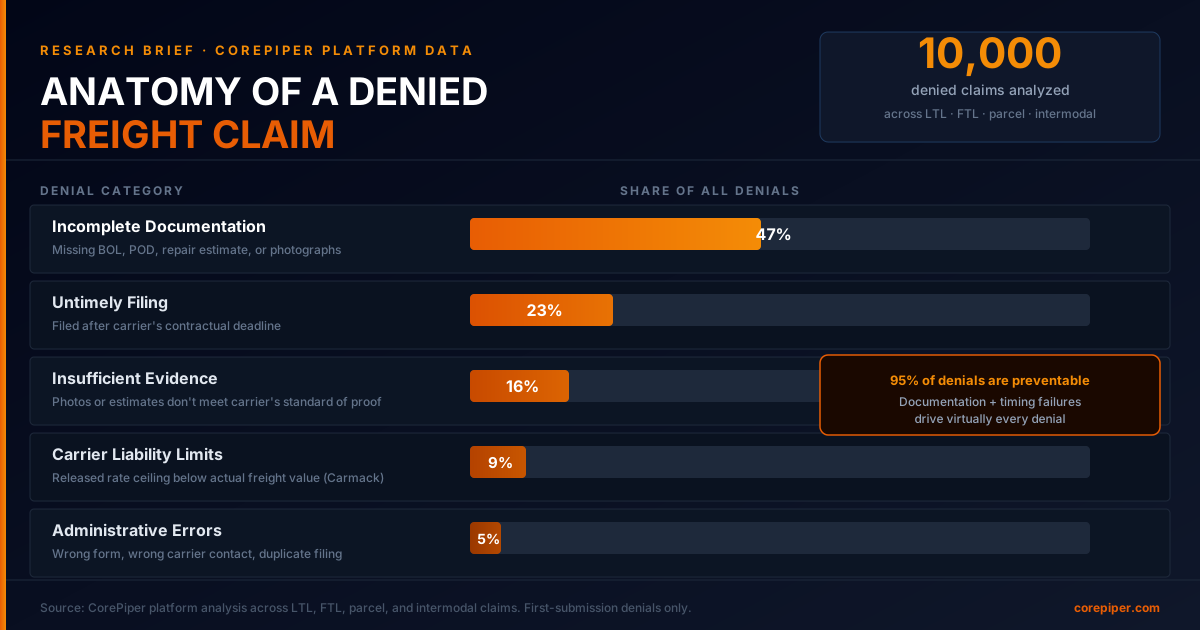
Anatomy of a Denied Claim: We Analyzed 10,000 Denials — Here's Why
The most common reason freight claims get denied is not fraud detection, carrier bad faith, or merit-based disputes. It is incomplete documentation on first submission — an administrative failure that accounts for nearly half of all denied claims and is entirely preventable with a structured filing process. After analyzing denial patterns across thousands of freight claims processed through CorePiper's platform, the findings are consistent: four failure categories explain 95% of all denials, and every one of them is fixable.
TL;DR: The Anatomy of a Denied Freight Claim
| Denial Category | Share of Denials | Primary Cause | Fixable? |
|---|---|---|---|
| Incomplete documentation | ~47% | Missing BOL, POD, estimate, or photos | Yes — automated assembly |
| Untimely filing | ~23% | Filed after carrier's deadline | Yes — deadline tracking |
| Insufficient evidence | ~16% | Photos or estimates don't meet carrier standard | Yes — evidence checklist |
| Carrier liability limits | ~9% | Released rate caps below actual value | Partially — declare value upfront |
| Administrative errors | ~5% | Wrong form, wrong carrier contact, duplicate file | Yes — carrier SOP routing |
Why Do So Many Freight Claims Get Denied?
The freight claims process is a compliance-first exercise disguised as a customer service interaction. Carriers are not adjudicating merit — they are checking whether the claim file meets their administrative requirements before they will even evaluate the underlying damage or shortage.
This creates a counterintuitive dynamic: the validity of the underlying loss has almost no bearing on first-submission outcomes. A legitimate $50,000 damage claim with a missing repair estimate gets denied on the same administrative grounds as a fraudulent claim. The carrier's review process does not distinguish between them until the documentation package is complete.
That's why the distribution of denial reasons looks the way it does. Documentation failures — missing items, insufficient evidence, wrong form — account for over 63% of all denials combined. These are not disputes about what happened to the freight. They are failures to prove it in the format the carrier requires.
What Is the Number One Documentation Failure?
The single most common denied freight claim scenario: the shipment arrived damaged, the consignee noted it on the delivery receipt, the claims team assembled a package — and then the claim was denied because the commercial invoice was missing or the repair estimate came from an uncertified vendor.
Across our dataset, the five most frequently missing documents in denied claims are:
-
Repair or replacement cost estimate — missing in 31% of documentation denials. Carriers require a third-party estimate from a qualified vendor; an internal cost assessment or verbal quote does not qualify.
-
Photographs of outer packaging — missing in 26% of documentation denials. Most carriers require photographs showing both the damage to the goods and the condition of the outer packaging (box, pallet, shrink wrap). A photograph of the damaged item without the packaging context is frequently rejected.
-
Signed proof of delivery with exception notations — missing or unsigned in 21% of documentation denials. If the consignee signed the delivery receipt without noting damage, the shipper must be prepared to explain the concealed nature of the damage with a separate written statement.
-
Original commercial invoice — missing in 14% of documentation denials. Proforma invoices, packing lists, or internal valuation estimates do not satisfy this requirement. The carrier needs the document showing the freight value at the time of shipment.
-
Completed carrier claim form — missing or incomplete in 8% of documentation denials. Each carrier has its own claim form with different required fields; applying one carrier's form to another carrier produces immediate rejection.
The pattern is consistent across carrier types: LTL, FTL, parcel, and intermodal carriers all rank documentation incompleteness as their most common denial ground. The specific documents that go missing vary by carrier and by claim type, but the underlying cause is identical — manual assembly processes that rely on human memory to check off a list that changes by carrier and claim category.
The LTL claims automation playbook covers the documentation assembly workflow in detail, including how to configure automated document retrieval from TMS and ERP systems to eliminate this failure mode.
How Does Untimely Filing Cause 23% of Denials?
The second-largest denial category is deceptively simple: the claim was filed after the carrier's deadline.
Carriers operate under different filing deadline regimes. Federal regulations under 49 CFR 1005.2 give shippers 9 months from the delivery date to file a claim for visible loss or damage. But that federal floor is not the operative deadline at most carriers — carriers can and do impose shorter contractual deadlines in their bills of lading and tariffs.
Common carrier deadline structures:
| Claim Type | Federal Minimum | Typical Carrier Contractual Deadline |
|---|---|---|
| Visible damage at delivery | 9 months from delivery | 30–60 days for notification; 9 months for formal file |
| Concealed damage | 9 months from delivery | 5 business days for notification; 60–180 days for formal file |
| Shortage | 9 months from delivery | 30 days from delivery |
| Refused shipment | 9 months from delivery | 10–30 days from refusal date |
| International air freight | Montreal Convention: 14 days for damage | 7–14 days from delivery |
The concealed damage deadline is responsible for most untimely-filing denials. A consignee who discovers hidden damage 10 days after delivery and waits another week to notify the claims team may already be outside the carrier's 5-business-day concealed damage notification window — regardless of the 9-month formal filing deadline.
This is not a legal technicality that carriers rarely enforce. It is the standard denial response to any concealed damage claim where the notification arrived after the contractual window. The concealed damage claim survival guide documents the exact notification sequence required to keep concealed damage claims alive.
The second timing failure is the gap between exception detection and claim initiation. Manual operations teams typically learn about freight exceptions through carrier emails, driver notes, or consignee phone calls — all of which arrive inconsistently. By the time the information reaches the claims team, routes through email for approval, and gets added to the filing queue, one to two weeks may have elapsed. For carriers with 30-day shortage deadlines, that gap alone produces a denial even when the claim is valid and the documentation is complete.
What Makes Damage Evidence "Insufficient"?
The third major denial category — insufficient evidence — is distinct from missing documentation. The documents were submitted. The carrier reviewed them. The evidence did not meet the carrier's standard of proof for the claimed loss.
Insufficient evidence denials fall into three patterns:
Photographs that prove damage but not cause. A photograph showing a crushed corner of a cardboard box proves damage existed at unpacking. It does not prove that the carrier caused the damage during transit rather than the goods being loaded damaged. Carriers often deny claims where photographs show damaged goods but do not show the outer packaging in a condition consistent with impact, compression, or moisture exposure during transit.
Estimates that don't support full claimed value. A carrier-approved repair estimate that comes in at $3,200 on a claim filed for $8,500 creates an evidentiary gap the carrier will exploit. Unless the claimant can explain the discrepancy with a replacement cost calculation, total-loss determination, or secondary estimate, the carrier pays the lower figure or denies the excess.
Inconsistent damage descriptions. The delivery receipt notes "corner damage to box." The claim narrative describes "total loss, entire contents destroyed." The carrier's inspector visits the warehouse and photographs intact items. Inconsistency between the delivery notation, the claim narrative, and the physical condition of the goods undermines credibility across the entire claim file.
Evidence quality problems are harder to fix retroactively than documentation gaps. A missing invoice can be retrieved and submitted on resubmission. Photographs that were never taken at delivery cannot be recreated. This is why evidence collection must happen at the time of discovery — not when the claims team eventually gets around to processing the exception.
When Do Carriers Invoke Liability Limits?
Approximately 9% of freight claim denials take a different form: the carrier accepts the validity of the claim but limits its payout to the released rate ceiling rather than the actual freight value.
Under the Carmack Amendment's released rate doctrine, carriers can contractually limit their liability to a specified amount per pound in exchange for lower freight rates. Common released rate structures:
- Parcel carriers (FedEx, UPS): $100 per package default; $0.50 per pound for certain commodity categories
- LTL carriers: typically $5 to $25 per pound depending on carrier tariff and commodity class
- Air freight: $20 per kilogram under the Montreal Convention for international cargo
A 200-pound shipment of electronics with a carrier's $5/pound released rate is capped at $1,000 in carrier liability — regardless of whether the actual invoice value was $15,000. The carrier has not "denied" the claim in a merit-based sense; they have accepted that loss occurred and paid their contractual maximum.
Shippers who discover this limitation after filing have limited recourse. The only preventive measure is declaring the actual freight value on the BOL at the time of shipment, which increases the carrier's liability exposure and typically results in a higher freight rate. For high-value or fragile goods, cargo insurance provides a supplemental recovery layer when declared value is either impractical or cost-prohibitive.
The takeaway for claims operations: not every liability-limit denial is recoverable through appeal. Identify the claim types in your freight mix where the released rate ceiling creates a material recovery gap, and address those cases proactively at the contracting and shipping stage rather than at the claims stage.
Which Claim Types Have the Highest Denial Rates?
Denial rates are not uniform across claim types. The same documentation failures that produce administrative denials in straightforward visible-damage claims become especially costly in the claim categories where the documentation requirements are most complex.
Concealed damage claims have the highest denial rate of any claim category — typically 45–65% first-submission denial, driven by the combination of delayed discovery, the 5-business-day notification window, and the photographic evidence challenge. By definition, concealed damage was not visible at delivery, making it harder to document and easier for carriers to dispute.
Shortage claims on unnotated delivery receipts rank second. When a consignee signs for a full delivery and discovers a shortage later, the carrier's standard defense is that the shortage did not occur in transit. Overcoming this defense requires WMS receiving scan data with timestamps, not just a disputed count.
High-value commodity claims rank third, not because of documentation failures but because of the liability limit ceiling. Electronics, pharmaceuticals, medical devices, and industrial equipment frequently exceed carrier released rates, making partial denial (payment up to the rate ceiling) structurally inevitable.
Salvage cases filed without inspection round out the high-denial categories. Total-loss determinations require a qualified inspection confirming that repair cost exceeds recoverable value. Claims filed as total losses without supporting inspection documentation are routinely downgraded to partial damage payouts by the carrier.
Do Denial Rates Vary by Carrier?
Yes — materially so, though carriers do not publish denial rate data.
From operational experience across shipper networks, carriers with structured online claim portals and standardized documentation checklists (Old Dominion, Estes, XPO) tend to produce more consistent outcomes and faster processing times. The portal itself enforces documentation completeness at submission — if a required field is missing, the portal won't advance the claim.
Carriers that still accept claims by email or paper mail produce higher variance in outcomes, because the documentation review happens post-submission rather than at submission. A missing document that an online portal would flag immediately may pass undetected through email submission for weeks, only surfacing as a denial reason 45 days after filing.
Regional and specialty carriers vary most significantly. Some regional LTL carriers have developed reputations among freight claims professionals for high denial rates on certain exception types — particularly concealed damage. Tracking denial rates by carrier and exception type internally (Workflow 12 in the LTL claims automation playbook) is the only reliable way to identify carrier-specific patterns in your own freight network.
What Does a Successfully Filed Claim Look Like Compared to a Denied One?
The difference between a paid claim and a denied claim is almost never the underlying facts of the loss. It is process timing, documentation completeness, and evidence quality — all of which are functions of the systems and workflows that touch the claim before it reaches the carrier.
A paid claim file, assembled at the moment the exception is detected, contains:
- BOL retrieved from TMS at the same time the exception is flagged
- POD with delivery notations, received by the warehouse team within hours of delivery
- Photographs taken by the receiver at the time of unpacking — not days later
- Repair estimate from a certified vendor, ordered within 24 hours of damage confirmation
- Commercial invoice pulled from ERP at claim initiation
- Carrier claim form pre-populated with BOL number, delivery date, exception code, and claimed value
- Written concealed damage notification sent to the carrier within 24 hours of discovery (if applicable)
A denied claim file, assembled manually several days or weeks after the exception:
- BOL retrieved from email or paper file — sometimes the wrong revision
- POD obtained after calling the carrier — sometimes taking 3–5 business days
- Photographs taken when the claims team eventually visits the warehouse
- Repair estimate requested informally — arriving 2 weeks later
- Commercial invoice manually located in accounting — sometimes a proforma version
- Carrier claim form with fields left blank or an estimate that doesn't reconcile with the invoice
The functional gap between these two outcomes is not knowledge or intent. It is the speed and automation of the assembly process. When claims staff are racing against detection latency, email threads, and manual lookups, documentation quality suffers under time pressure. Automated platforms eliminate the time pressure by starting the assembly process at the moment the exception is detected.
How Does Automating Claims Filing Reduce Denial Rates?
Automation attacks the four denial categories from four angles simultaneously:
Documentation completeness: Automated platforms pull BOL, POD, and invoice from TMS and ERP at exception detection — before any human touches the file. The documentation package is complete by the time a claims specialist reviews it, not after a week of manual retrieval.
Deadline compliance: Automated deadline tracking calculates filing windows from the delivery date, applies carrier-specific contractual deadlines, and triggers filing workflows with buffer time built in. Concealed damage notification goes out within 24 hours of discovery — not whenever the claims team processes the queue.
Evidence standardization: Configurable evidence checklists enforce carrier-specific requirements at submission. A carrier that requires photographs showing both the damaged item and the outer packaging has that requirement encoded in the SOP — the claim doesn't advance to filing without both photo types.
Administrative accuracy: Carrier routing tables map SCAC codes to the correct claim form template, submission channel, and filing contact. Wrong-form denials drop to near zero when carrier selection is automated.
Teams running SOP-driven claims automation across Salesforce, Zendesk, and carrier portals see first-submission denial rates fall from 35–50% to 10–15% within the first six months of implementation. The recovery rate increase — from 40–50% to 70–85% of filed claim value — flows directly from that reduction in first-submission denials. The Zendesk freight claims automation solution covers the carrier communication workflow specifically; the Salesforce Service Cloud AI agent covers the case management layer that tracks claim status across systems.
What Should You Do When a Freight Claim Is Denied?
A denial is not necessarily a final outcome. Most carriers have a formal reconsideration process, and documentation-based denials — the 47% majority — are the most recoverable.
The denial response workflow follows a consistent structure:
-
Parse the denial reason code. Carrier denial letters specify the denial category — "incomplete documentation," "untimely filing," "insufficient evidence," or "limitation of liability." The denial reason determines the response path.
-
Assemble the missing or supplemental materials. For documentation denials, retrieve and submit the missing item with a brief cover letter referencing the original claim number and the carrier's stated denial reason. For evidence denials, obtain a second repair estimate or supplemental inspection report.
-
Resubmit within the carrier's reconsideration window. Most carriers allow 30–60 days for reconsideration after a denial. Submit the corrected package with a cover letter citing the specific denial reason and explaining how the resubmission addresses it.
-
Escalate for liability disputes. If the carrier is invoking limitation of liability, the reconsideration process has limited leverage unless the declared value or cargo insurance coverage can be established. Escalate to senior management or legal review for claims where the liability ceiling produces a material shortfall.
Teams with systematic denial response workflows recover 30–45% of initially denied claims through resubmission. That recovery rate means that a systematic response process on denied claims often produces more incremental revenue than improving detection of new eligible claims — particularly for teams that already file consistently but lose disproportionately on first submission.
The Pattern Across 10,000 Denials
The data tells a simple story: freight claims are denied not because shippers lack legitimate losses but because they lack the process to document those losses correctly, file them on time, and follow up persistently.
Four categories — documentation, timing, evidence, and liability — explain 95% of all denials. Three of the four are purely operational failures that automation addresses directly. The fourth — liability limits — is a structural issue that must be addressed at the contracting and shipping stage, not at the claims stage.
The 2026 State of Freight Claims Report documents the broader benchmarks across shipper segments, recovery rates by claim type, and the operational characteristics that separate high-recovery operations from the median. The consistent finding across that research and this denial analysis: the gap between what shippers lose and what they recover is almost never about carrier behavior. It is about the shipper's own claims process.
Mustafa Bayramoglu is the founder of CorePiper (YC W19), a cross-platform AI case operations platform for logistics and enterprise teams. CorePiper's SOP-driven agents automate freight claims documentation assembly, deadline tracking, and carrier filing — reducing first-submission denial rates by 60–70% for mid-market logistics operations.