
Delivered But Not Received: How to Handle the Most Disputed Shipping Claim (2026 Guide)
When a carrier marks a package delivered but the customer says it never arrived, you have 15–60 days to file and a strict evidence chain to follow. Here's the complete dispute playbook for shippers, 3PLs, and DTC brands.
 Mustafa BayramogluAugust 19, 202615 min read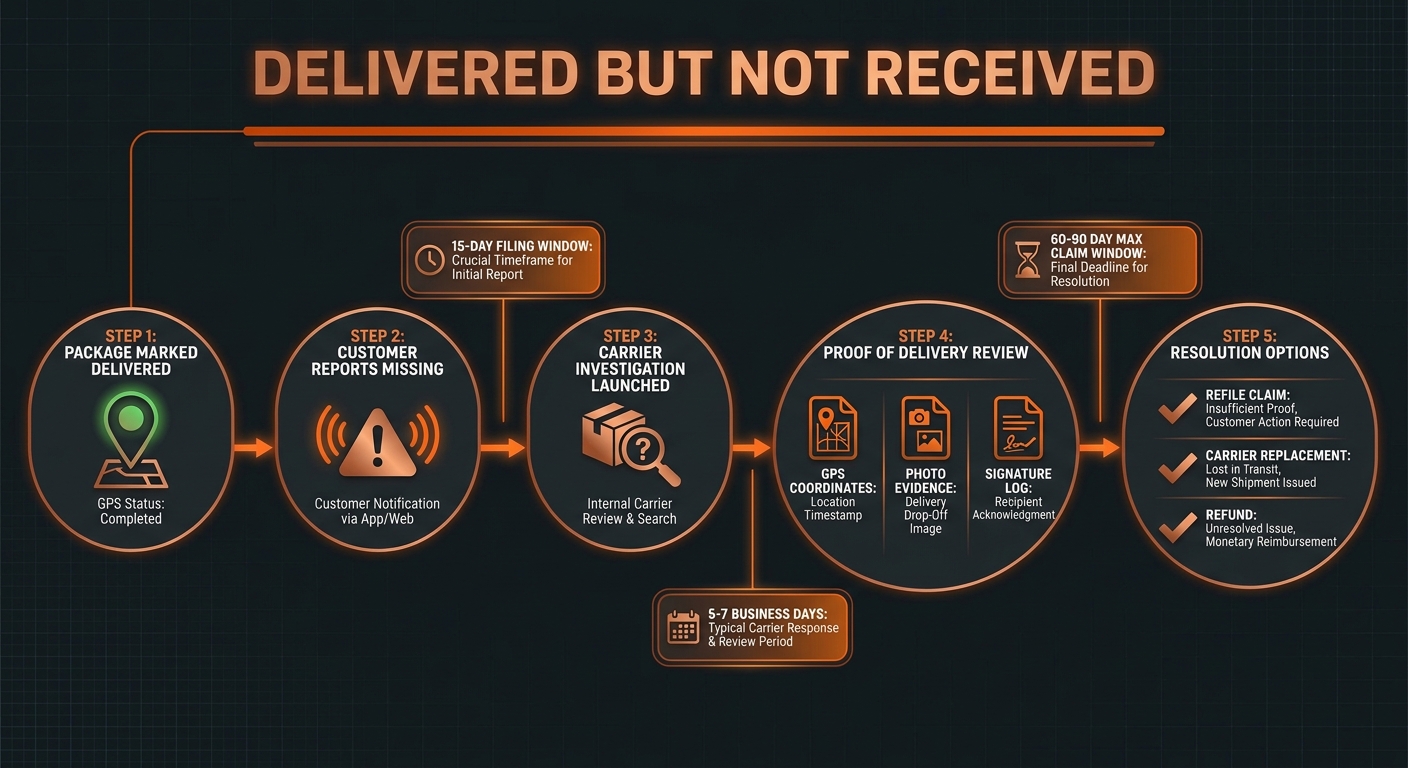
Delivered But Not Received: How to Handle the Most Disputed Shipping Claim (2026 Guide)
A "delivered but not received" (DBNR) case occurs when a carrier's tracking system confirms delivery — GPS scan, photo at the door, or signature record — but the customer reports the package never arrived. DBNR claims have the lowest carrier approval rates of any claim type (30–55%), the most complex evidence requirements, and the tightest filing windows. They are also the most emotionally charged ticket in your support queue. This guide gives you the complete resolution playbook: evidence chain, filing windows by carrier, customer communication, and how to automate the entire workflow.
TL;DR: Delivered But Not Received — At a Glance
| Factor | Detail |
|---|---|
| Carrier approval rate | 30–55% (lowest of any claim type) |
| Filing window (small parcel) | 15–60 days depending on carrier |
| Filing window (LTL freight) | 9 months (Carmack Amendment) |
| Evidence required | POD record, customer sworn statement, location photos, police report (>$100) |
| Auto-refund threshold | Most brands: orders <$100–$150 |
| Investigation timeline | 5–7 business days (UPS, FedEx), 30–60 days (USPS) |
| Escalation trigger | GPS shows delivery >500 ft from address, or prior DBNR history flagged |
What Makes DBNR Claims Different From Lost-In-Transit?
In a standard lost package claim, the carrier has no delivery event — the tracking shows "in transit" or stops updating before delivery. DBNR cases are fundamentally different: the carrier has evidence of delivery, and your job is to either challenge that evidence or work within it.
This distinction matters because:
The carrier's default position is "we delivered." Their GPS data, delivery photo, and scan record are their evidence. Your claim asks them to override their own system — a much higher bar than a case where tracking simply stopped.
Fraud risk is real but overstated. Industry data suggests approximately 4–8% of DBNR claims are fraudulent (customer received the package but disputes to get a free refund). Most carriers use machine learning to flag customers with repeated DBNR history. For most brands, the realistic fraud rate in your queue is lower than 2% of total DBNR volume — enough to warrant a policy but not enough to treat every DBNR claim as fraudulent.
The resolution path branches early. If you have strong evidence the carrier's GPS or photo evidence is wrong (e.g., GPS shows delivery to a completely different street, or photo shows a porch that doesn't match the delivery address), you have grounds for a carrier claim. If the carrier's evidence is solid, you're in a goodwill refund situation regardless of whether the carrier pays out.
How to Verify a DBNR Claim Before Responding
Before contacting the carrier or issuing a refund, run a rapid verification sequence. This should take under 3 minutes with the right system access — or be fully automated by an AI agent with SOP-driven decision logic.
Step 1: Pull the Carrier's Proof-of-Delivery Record
Every major carrier — UPS, FedEx, USPS, DHL, and most LTL carriers — publishes a proof-of-delivery (POD) record accessible via their merchant portal or API. The POD typically includes:
- GPS coordinates of the scan event (UPS and FedEx include latitude/longitude)
- Delivery photo (FedEx and UPS both photograph the drop location)
- Time stamp down to the minute
- Signature record if signature confirmation was purchased
Pull this record first. If the GPS shows delivery within 10 feet of the customer's address and a photo shows a package at the door, you're in carrier-evidence-is-solid territory. If the GPS shows delivery at a different address, a neighboring building, or nowhere near the destination, you have grounds for a carrier dispute on GPS failure.
Step 2: Check the Customer's Order and Claim History
For customers with a prior DBNR claim within the past 12 months on the same account, flag the case for manual review. This doesn't mean deny — it means a human looks before a refund is issued. Most SOP-driven workflows set this threshold at 2+ DBNR claims per account per 12 months.
Also check: is the delivery address an apartment complex, shared lobby, or multi-family building? These are the highest-risk delivery points for DBNR, and the carrier photo (if available) may show a lobby delivery that any resident could have taken. Document this context.
Step 3: Ask the Customer the Right Questions
Your DBNR response template should collect:
- Did you check with neighbors, building management, or other household members?
- Is there a secure package room or mailroom at the address?
- Did you receive a delivery notification from the carrier app?
- Is the delivery address correct as shown on your order confirmation?
This isn't interrogating the customer — it's gathering the information the carrier will ask for. Present it as "helping us resolve this faster." Customers who are telling the truth answer these quickly; customers with fraudulent intent often provide inconsistent answers.
Carrier-by-Carrier Filing Windows and Processes
Filing windows are hard deadlines — missing them means forfeiting the claim regardless of evidence quality.
UPS DBNR Claims
Filing window: 60 days from the scheduled delivery date (not the claim date).
Process: File at UPS.com Claims or via the UPS API. For DBNR, UPS will launch a "package tracer" investigation — a 5-business-day internal review where they re-interview the driver, check GPS data, and attempt re-delivery verification. If the tracer confirms non-delivery, UPS approves the claim. If GPS and driver confirmation holds, they deny.
Evidence to submit: Order invoice, declared value, customer written statement, and any evidence of address ambiguity (apartment complex photos, building lobby layout).
High-value threshold: Claims over $100 require a formal written claim (not just an online submission). Claims over $500 require a police report for theft-related DBNR.
FedEx DBNR Claims
Filing window: 60 days from the delivery date.
Process: File via FedEx Claims Online. FedEx uses their DeliveryManager photo and GPS data as primary evidence. DBNR claims for residential deliveries without signature confirmation are the most frequently denied — FedEx's standard residential service does not include adult signature, so the carrier considers a door-drop with photo as completed delivery. Purchasing FedEx Signature Required adds significant leverage if the driver logged a signature that the customer disputes.
Escalation path: FedEx Claims has a formal appeal process. If denied, you can escalate to FedEx Revenue Services within 30 days of the denial notice. Appeals succeed most often when GPS data shows a delivery location mismatch of more than 100 feet.
USPS DBNR Claims
Filing window:
- Priority Mail and Priority Mail Express: 30 days from mailing date
- Standard Post/Parcel Select: No carrier claim coverage (these are not insured by default)
Process: File at USPS.com or via PS Form 1000. USPS investigations are significantly slower — typical resolution is 30–60 days. USPS does not photograph deliveries as a standard practice, so GPS scan data is their primary evidence. USPS DBNR claims have lower approval rates than UPS or FedEx because USPS has less granular delivery evidence.
Practical note for DTC brands: If USPS is your primary carrier, purchase insurance on every order over $50. The default USPS indemnity coverage for Priority Mail is only $100, and DBNR claims without extra insurance are limited to that ceiling.
DHL Express DBNR Claims
Filing window: 21 days from the delivery date for international shipments; 30 days for domestic.
Process: File through DHL's MyDHL+ portal or via DHL Customer Service. DHL provides GPS coordinates and driver scan data, but their DBNR resolution process varies significantly by country. For international DBNR cases involving cross-border deliveries, resolution can take 30–45 business days.
LTL Freight DBNR Claims
Filing window: 9 months from delivery date under the Carmack Amendment (federal statute governing interstate freight claims).
LTL DBNR cases are rare — most freight carriers require a signature (PRO receipt) at delivery, so proof of delivery is documented. Where they occur, they typically involve discrepancies between the delivered pallet count and the invoice (a short-ship hidden as a DBNR). These are technically "concealed shortage" claims; see CorePiper's concealed damage claim guide for that specific workflow.
The DBNR Customer Communication Framework
How you communicate during the DBNR investigation determines whether the customer stays or churns — regardless of the carrier outcome.
Immediate Response (Within 2 Hours)
Don't wait for the carrier investigation before responding to the customer. Acknowledge within 2 hours with:
- Confirmation you've received the claim
- That you're pulling the carrier's delivery record now
- A clear timeline: "We'll have an update within 24–48 hours"
This alone reduces escalation-to-phone-call rates by 60–70% — customers who get an immediate, specific response are far less likely to escalate than those who receive "we'll look into it" generic acknowledgments.
24–48 Hour Update
After pulling the POD record and running your verification sequence, communicate what you found — transparently:
If carrier evidence is ambiguous or GPS shows a mismatch: "We've reviewed the carrier's delivery record and found [specific discrepancy]. We've filed a formal carrier investigation. Resolution timeline is 5–7 business days. We're [refunding/reshipping] your order now while we pursue the claim on your behalf."
If carrier evidence is solid (GPS matches, photo at door): "The carrier's record shows delivery at [time] with GPS confirming [approximate location near address]. We're asking the carrier to re-verify with the driver. In the meantime, please check [specific locations: mailroom, neighbor, building lobby]. We'll follow up in 48 hours."
Resolution Message
When the investigation concludes — whether approved by the carrier, denied, or resolved via goodwill refund — close the loop explicitly. Customers who receive a "here's what happened and here's what we did" final message have higher CSAT scores than those whose tickets are simply closed.
When to Refund First, File Second
The practical question most brands wrestle with: do you wait for the carrier decision before refunding, or do you refund immediately and recover from the carrier?
Refund-first approach (recommended for orders under $100–$150):
- Preserves CSAT — the customer's problem is solved immediately
- Reduces repeat contacts and escalation load
- Works financially: your DBNR approval rate of 30–55% means you recover roughly half your losses from the carrier anyway; the other half becomes cost of doing business
- The fraud rate on DBNR claims (2–4% for most brands) is lower than the CSAT damage from making a legitimate customer wait 5–7 days for carrier resolution
Hold approach (recommended for orders over $150 or flagged accounts):
- Request a 5-business-day investigation period before committing to a full refund
- Offer a partial credit or expedited reship of lower-cost items in the order as a gesture
- Be explicit about the timeline: "We take high-value missing shipment claims seriously and need 5 business days to complete the carrier investigation before we can process the replacement"
Reshipment vs. refund decision: For customers with high purchase history and no prior DBNR flags, reship as the default — it's more expensive than a refund but creates a better loyalty signal. For first-time customers or flagged accounts, refund after verification.
Automating the DBNR Workflow With SOP-Driven AI Agents
Manual DBNR handling is expensive: each case requires a support agent to pull carrier data, cross-reference customer history, make a policy decision, draft a response, file with the carrier, and follow up. For a brand handling 50+ DBNR cases per month, that's 10–15 hours of support work — and the quality varies by agent.
SOP-driven AI agents can handle the entire workflow except the final judgment call on high-value or flagged cases:
What can be fully automated:
- Pulling POD records via carrier API (UPS, FedEx, USPS all have programmatic POD access)
- Flagging GPS mismatches or photo absence
- Checking customer DBNR history against your order management system
- Sending the immediate acknowledgment response
- Filing the carrier claim submission with pre-populated evidence
- Triggering the refund/reship decision for orders below your auto-approve threshold
- Sending the resolution confirmation message
What requires a human:
- Orders above your high-value threshold on first review
- Accounts with 2+ prior DBNR claims in 12 months
- Cases where the carrier's evidence and customer's account are both credible with no obvious resolution
- Carrier appeal decisions where you need to decide whether to escalate
The cross-platform integration requirement is significant: a complete DBNR automation needs to pull from your carrier APIs (UPS, FedEx, USPS), your order management system (Shopify, BigCommerce), your helpdesk (Zendesk, Freshdesk), and your payment processor for the refund. That's 4–5 systems — the reason single-helpdesk AI add-ons can't solve this and why a cross-platform SOP layer is necessary.
CorePiper's DBNR SOP connects all five systems via one workflow definition: the agent pulls carrier POD via API, checks customer history in your OMS, applies your decisioning rules (auto-approve threshold, flagging criteria), sends the customer communication via Zendesk or Freshdesk, and triggers the Shopify refund — all in under 60 seconds per case.
Common DBNR Mistakes That Kill Approval Rates
Filing too late. The most common mistake: waiting until the customer escalates rather than filing within 5 days of the report. Carriers have access to more granular GPS and driver confirmation data within the first week; after 30 days, that data may be archived or unavailable.
Missing evidence on submission. A claim without a customer sworn statement of non-receipt, or without the POD record attached, gets flagged for manual review or auto-denied. Build a submission checklist into your SOP.
Not purchasing signature confirmation on high-value shipments. DBNR claims on residential deliveries without signature confirmation have nearly no leverage with FedEx or UPS — the carrier fulfilled their standard service obligation. Add signature confirmation for any order over $100 if your margin supports it.
Treating all DBNR as fraud. The reflex to assume the customer is lying destroys CSAT and increases churn on your most valuable customers — high-LTV buyers order more, which means they have statistically higher DBNR exposure simply from volume. A rigid deny-first policy will churn the customers who cost the most to replace.
Not documenting GPS mismatch evidence. If the carrier's GPS shows delivery 300 feet from the customer's address, that's a genuine error — but you need to document the exact GPS coordinates from the POD, the customer's actual address coordinates, and the calculated distance in your appeal. Vague "delivery location was wrong" appeals are denied; specific coordinate-level documentation wins.
DBNR and Carrier Scorecard: Which Carriers Handle DBNR Best?
Based on industry claims management data and operator experience:
| Carrier | DBNR Approval Rate (est.) | Investigation Speed | Evidence Quality |
|---|---|---|---|
| UPS | 40–55% | 5–7 business days | GPS + photo + driver confirmation |
| FedEx | 35–50% | 5–7 business days | GPS + photo + Delivery Manager |
| USPS | 25–40% | 30–60 days | GPS scan only (no standard photo) |
| DHL Express | 30–45% | 7–14 business days | GPS + international tracking |
| Regional LTL carriers | 45–65% | 10–21 business days | PRO receipt + driver log |
UPS and FedEx lead on investigation speed and evidence quality. USPS has the longest resolution timeline and weakest evidence chain, making DBNR cases significantly harder to win. If USPS is your primary carrier for orders over $50, purchase additional insurance at checkout.
Internal Links for Cross-Reference
The DBNR workflow connects to several adjacent claims workflows:
- WISMO automation guide — prevent DBNR tickets by resolving tracking anxiety before it becomes a claim
- Freight claims automation playbook — LTL-specific claims process including shortage and concealed damage
- Concealed damage claim survival guide — when physical damage is discovered after delivery, not during transit
- How to automate proof-of-delivery evidence gathering — the full POD automation SOP
- Why freight claims get denied — common denial reasons across all claim types
Delivered But Not Received: Key Takeaways
The DBNR case is the hardest claim type to resolve because you're fighting the carrier's own delivery record. The brands and 3PLs that win most often share three practices:
- File within 5 days. Carrier data quality degrades fast after the first week. Every day you wait reduces the probability of approval.
- Document GPS mismatches at the coordinate level. Vague appeals are denied; specific evidence wins.
- Automate everything except the edge cases. Orders under your threshold, accounts in good standing — these should be handled by a system, not a support agent making judgment calls at 4pm on a Friday.
The 30–55% carrier approval rate means you'll lose money on roughly half your DBNR cases regardless of quality. The only variable you fully control is how efficiently you process them — and how well you retain the customer during the process.
Mustafa Bayramoglu is the founder of CorePiper (YC W19), which builds SOP-driven AI agents for cross-platform case operations across Salesforce, Zendesk, Jira, and logistics systems.