
WISMO Automation: How to Cut 'Where Is My Order?' Tickets by 70%
WISMO tickets make up 30–50% of e-commerce support volume. A two-stage automation strategy — proactive notifications plus agentic resolution — cuts that volume by 60–80% without adding agents.
 Mustafa BayramogluJune 24, 202610 min read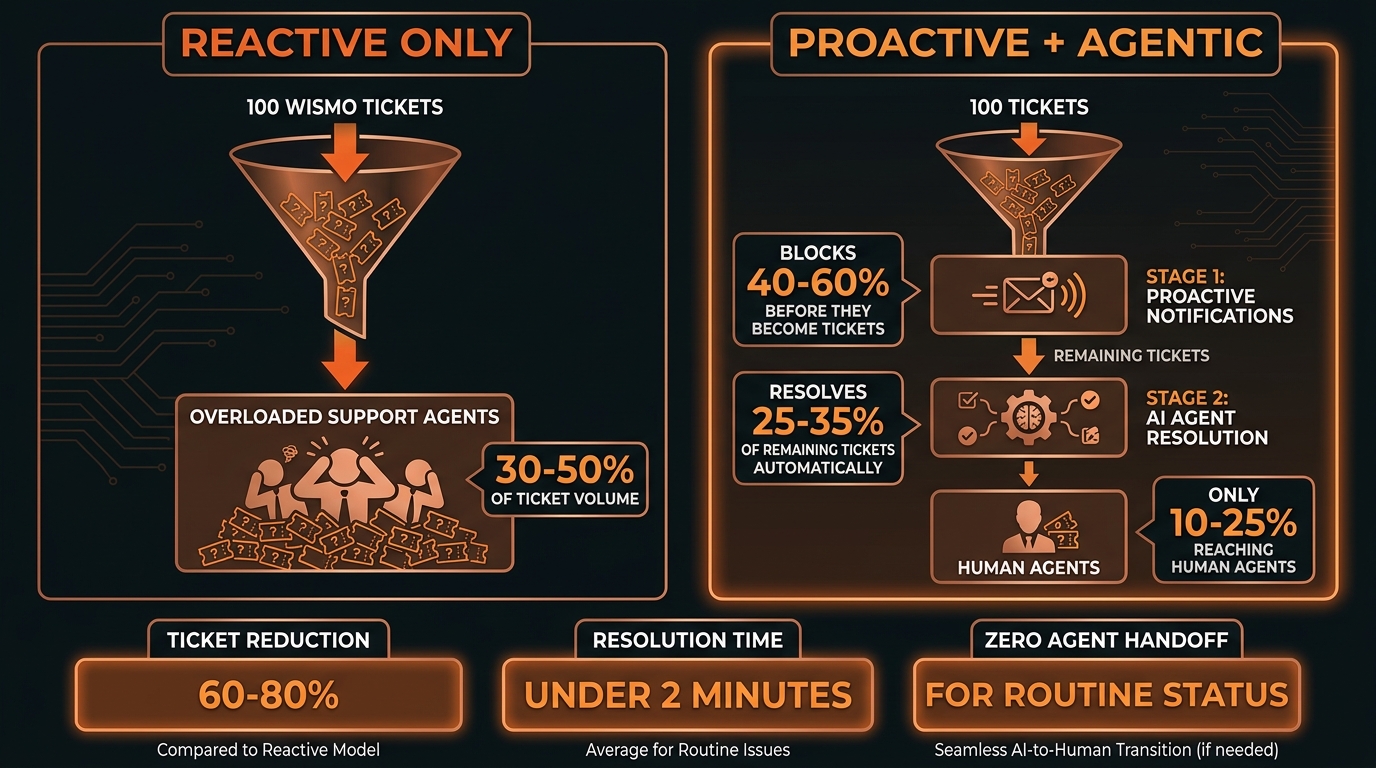
WISMO Automation: How to Cut "Where Is My Order?" Tickets by 70%
WISMO tickets — "Where Is My Order?" — make up 30–50% of all inbound e-commerce support volume and cost $5–$22 each when resolved by a human agent. Cutting that volume by 60–80% requires two stages working together: proactive carrier event notifications that prevent tickets from being submitted, and agentic AI resolution that handles the tickets that still come in. Neither stage alone achieves the 70% target.
TL;DR: Two-Stage WISMO Automation at a Glance
| Stage | What it does | Ticket reduction |
|---|---|---|
| Proactive notifications | Monitors carrier events; alerts customers before they ask | 40–60% prevented from submitting |
| Agentic inbound resolution | Queries live data; applies decision logic; closes tickets automatically | 60–80% of remaining tickets resolved without human |
| Combined result | Both stages running together | 60–80% total reduction in WISMO volume |
| Escalation path | Guardrails route edge cases — lost packages, high-value orders — to humans with full context | 10–20% of tickets reach a human agent |
What Is WISMO Automation and Why Does One Stage Not Work Alone?
WISMO automation is often described as a single thing — "set up a chatbot that responds to order status questions." That framing misses the two structurally different problems that drive WISMO ticket volume.
The first problem is timing. When a shipment is delayed or an exception occurs, most customers find out when they notice they have not received the package yet, not when the carrier first flags the event. That gap — sometimes 24 to 48 hours — is when customers submit WISMO tickets. Proactive notifications close that gap by pushing an update to the customer the moment the carrier event happens. The ticket never gets submitted because the customer already has the information.
The second problem is inbound volume. Even with proactive notifications running, a meaningful share of customers will still contact support — they missed the notification, they have a more specific question, or their shipment is in a status category (lost, damaged, exceptioned) where a notification alone is not enough. These tickets need resolution, not just response. Agentic resolution handles this: it queries live carrier and Shopify data, applies decision logic, and closes the ticket with the right answer or escalates to a human when a guardrail condition fires.
Why a chatbot alone does not reach 70%. A chatbot that responds to order status questions resolves some tickets faster — but it does not prevent them, and it cannot close them without human oversight if the data requires judgment. WISMO ticket automation at the decision-logic level handles the inbound side, but without proactive notifications the volume stays high. Combining both stages is what produces the 60–80% reduction cited in most vendor benchmarks.
How Do Proactive Notifications Prevent WISMO Tickets?
The proactive stage runs continuously in the background, monitoring carrier events across all open shipments. It does not wait for a customer to submit a ticket — it pushes information before the question is asked.
Which carrier events should trigger a proactive notification?
Not every carrier scan needs a customer notification. The events worth triggering on are the ones that correlate with inbound WISMO submission:
Delivery delay relative to the expected date. When the carrier data shows a shipment will not arrive by the committed delivery date, send a proactive update with the revised ETA before the original date passes. Most WISMO tickets about delayed orders are submitted in the 24-hour window after a missed delivery promise. An update sent 4–6 hours before that window closes dramatically reduces submission rates.
Failed delivery attempt. When a carrier logs a failed delivery attempt — no one home, access code needed, apartment buzzer unanswered — the customer needs to know before they submit a ticket asking where the package is. A proactive notification with the failed attempt reason and the carrier's redelivery options resolves this before it becomes a ticket.
Carrier exception code. Exceptions (weather hold, customs delay, address exception) are the highest-volume source of WISMO tickets after simple delay. The moment the carrier flags an exception, push a customer update with the reason and a realistic revised timeline. If the exception is carrier-caused (weather, facility), customers who receive a proactive explanation are significantly less likely to submit a ticket than customers who discover the delay by checking tracking.
Out-for-delivery on expected day. A proactive same-day notification when a shipment goes out for delivery is a low-cost, high-satisfaction touch that also reduces "is it coming today?" tickets.
How much of WISMO volume does the proactive stage prevent?
In practice, proactive notification programs reduce inbound WISMO ticket submission by 40–60% for brands that have not previously run them. The range depends on how high the baseline rate is (brands with older, manual notification processes see larger gains), how quickly carrier events are detected and acted on (faster detection means more tickets prevented), and the quality of carrier API coverage (missed events become missed notifications).
For a brand processing 500 WISMO tickets per week, a proactive stage that suppresses 50% of submissions reduces the inbound load to 250 tickets before the agentic resolution layer touches anything. That reduction alone saves roughly $6,000–$10,000 per week at a $12–$20 loaded cost per human-handled ticket.
How Does Agentic Resolution Handle the Remaining Tickets?
The tickets that reach the inbound queue despite proactive notifications are handled by the agentic resolution layer. This stage queries live data, applies decision logic, and closes tickets — or escalates them — without a human agent involved in routine cases.
How does agentic WISMO resolution differ from a ticket macro?
A macro speeds up an agent's reply by inserting templated text. An agentic resolution system takes action: it reads the customer's ticket, queries the Shopify Admin API for the order's fulfillment and tracking data, queries the carrier tracking API for real-time status, maps the current status to the correct customer response using your decision logic, checks guardrail conditions, and either sends the automated response and closes the ticket or routes to a human with full context pre-populated.
The output is a resolved ticket, not a faster draft. The five-step WISMO decision logic framework covers the inbound resolution mechanics in detail, including how to handle status-to-answer mapping and guardrail configuration.
What percentage of inbound WISMO tickets can agentic resolution close?
Across a typical routing mix — mostly routine status checks with a minority of edge cases — agentic resolution closes 60–80% of inbound WISMO tickets without human involvement. The tickets that fall outside automated resolution (lost packages, no-scan-for-72-hours, high-value orders, customer accounts with fraud flags) escalate to a human agent with full context, so those cases are handled faster than a cold-start manual ticket.
What guardrails protect the escalation quality?
Guardrails are the conditions that prevent the automation from auto-resolving cases that need human judgment. Without them, automation is indiscriminate — it would close a lost-package ticket with the same status response it gives an in-transit order, which produces a worse customer outcome than no automation at all.
Core guardrail conditions for WISMO:
- No carrier scan in more than 72 hours — escalate as possible lost shipment
- Carrier exception codes indicating loss, damage, or return-to-sender — always escalate
- Order value above your designated high-value threshold — human review required
- Customer account flagged for prior disputes or fraud — do not auto-resolve
- SLA window already breached — escalate immediately with breach timestamp
- Message tone indicating escalation (threatening chargeback, mentioning multiple contacts) — route to senior agent queue
Guardrails ensure the automation handles the high-volume, low-variance cases — and a human handles the cases that actually require judgment.
What Does the Combined 70% Reduction Look Like in Practice?
Take a brand processing 1,000 WISMO tickets per week at a weighted cost of $12 per ticket (mix of quick-resolve and complex cases). That is $12,000 per week in WISMO handling cost.
After proactive notifications: Suppression rate of 50% means 500 tickets per week do not get submitted. Cost for proactive notification at scale is low — API calls and an outbound message, not agent time. Inbound queue drops to 500 tickets.
After agentic resolution: 65% of the remaining 500 tickets are closed without human involvement. That handles 325 more tickets autonomously. Humans handle the remaining 175 tickets per week — the escalated cases, the edge cases, the ones that needed judgment.
Net result: 825 of 1,000 weekly tickets handled without human involvement. 82.5% reduction. Human agents focus entirely on the 175 cases that genuinely require their skills. At $12 per ticket, that is roughly $9,900 per week — $514,800 per year — no longer being spent on routine order-status resolution.
This math is why WISMO automation consistently delivers the highest ROI of any support automation investment for e-commerce brands that are scaling support. The ticket type is so high-volume and so routine that automation is both safe and effective.
How Should You Measure WISMO Automation Performance?
What metrics track proactive notification effectiveness?
- Notification delivery rate: Percentage of shipments with a qualifying carrier event that triggered a notification. Under 90% suggests a carrier API coverage gap.
- Ticket suppression rate: Percentage of shipments that received a proactive notification and did not generate an inbound WISMO ticket within 48 hours. This is the primary metric for the proactive stage.
- Notification open rate: Customer email open rate for proactive shipping updates. Under 35% suggests the subject line or timing needs adjustment; customers not reading the update will still submit tickets.
What metrics track agentic resolution effectiveness?
- Agentic resolution rate: Percentage of inbound WISMO tickets closed by the automation without human involvement. Target: above 60% within 30 days of deployment, above 70% within 90 days.
- Escalation quality rate: Of tickets escalated to a human, what percentage were correct escalations (a genuine edge case, not a ticket the automation should have closed)? Track this manually on a sample basis to identify over-escalation in your guardrail configuration.
- Re-contact rate on auto-resolved tickets: Percentage of tickets closed by automation where the customer contacts support again about the same order within 7 days. A rate above 10% signals the auto-resolution is sending incorrect or incomplete answers.
- Resolution time for automated cases: Time from ticket submission to closed status. For automated WISMO cases, this should be under 5 minutes. Consistent delays suggest an API query issue.
What Changes When You Have Both Stages Running?
The most visible change is that the WISMO queue no longer dominates agent time. Agents who previously spent 40–60% of their shift on order-status tickets — often their entire ticket queue on high-volume days — are free to handle the cases that benefit from their judgment: complex damage claims, high-value customer recovery, fraud investigations, and multi-step exceptions that require cross-platform coordination.
For CX leaders, this is the meaningful outcome: WISMO automation does not replace agents, it repositions them. The operational ceiling that prevented teams from improving response times on complex tickets — because agents were buried in WISMO — lifts. Median resolution time for complex cases improves not because complex-case automation gets better, but because agents have headspace to actually focus on them.
The true cost of an e-commerce support ticket accounts for this opportunity cost — when agents are cleared of high-volume routine work, the effective value per agent hour increases significantly, even before calculating the direct cost savings on WISMO resolution.
Mustafa Bayramoglu is the founder of CorePiper (YC W19). CorePiper builds SOP-driven AI agents for cross-platform case operations across Shopify, Zendesk, Gorgias, Salesforce, and Jira.
Automate WISMO End-to-End — Proactive and Reactive
CorePiper's SOP-driven agents monitor carrier events to send proactive updates before customers ask, and resolve inbound WISMO tickets across Gorgias, Zendesk, Freshdesk, and Salesforce without a human in the loop. Book a 30-minute walkthrough to see both stages live.