
Moveworks & Aisera Got Acquired: What It Means for Enterprise AI Buyers
ServiceNow bought Moveworks for $2.85B. Automation Anywhere acquired Aisera. Salesforce swallowed Informatica. Here's what the 2025 AI acquisition wave means for enterprise buyers evaluating AI agents — and why platform independence matters more than ever.
Three Acquisitions That Changed the Enterprise AI Map
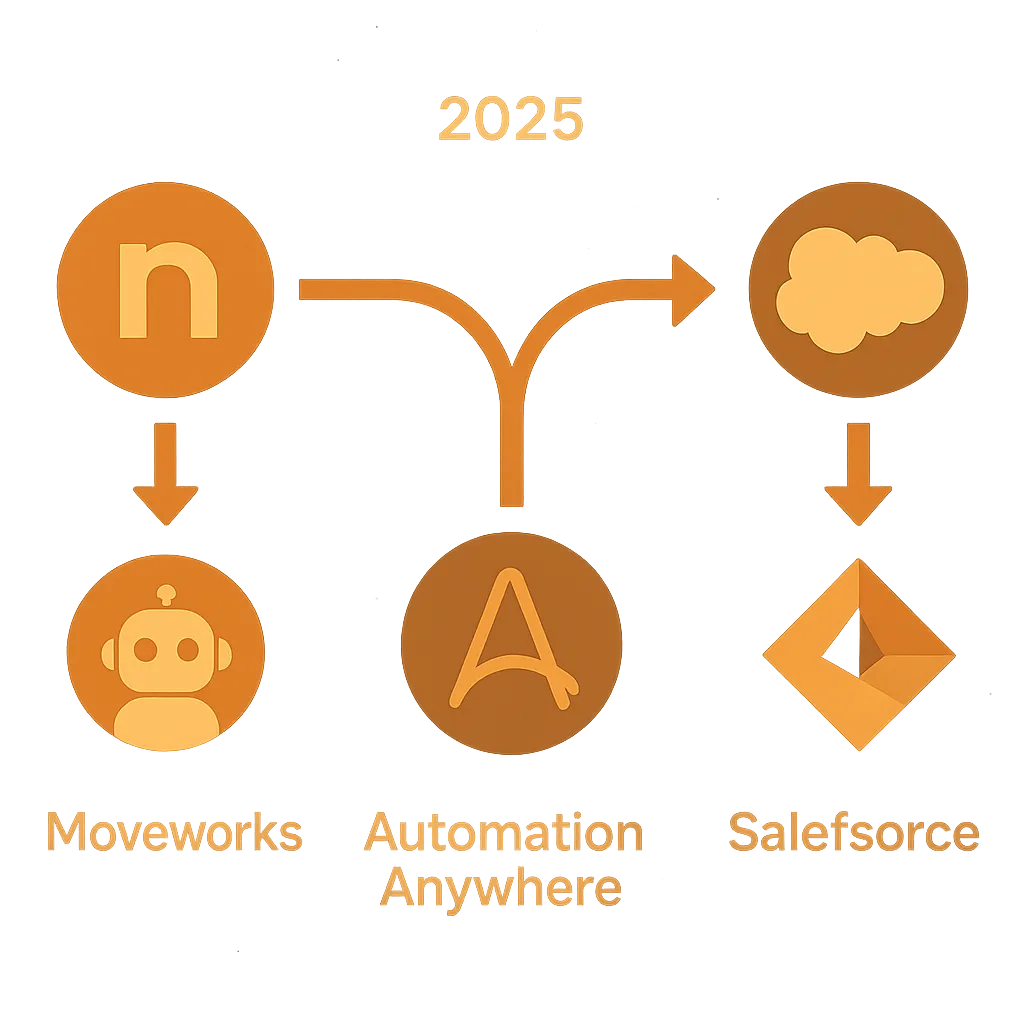
In less than nine months, three of the most prominent independent AI companies in enterprise operations disappeared from the market:
- March 2025: ServiceNow announces the acquisition of Moveworks for $2.85 billion (completed December 2025)
- May 2025: Salesforce announces the acquisition of Informatica for $8 billion (completed November 2025)
- November 2025: Automation Anywhere acquires Aisera (deal terms undisclosed)
These weren't small startups getting acqui-hired for their engineering talent. Moveworks had 350+ enterprise customers and 5.5 million active employee users. Aisera had raised $175 million from Goldman Sachs, Cisco Investments, and First Round Capital. Informatica was a publicly traded company processing data for thousands of enterprises worldwide.
All three are now subsidiaries of larger platform companies. And if you're an enterprise buyer evaluating AI agents for customer support, IT operations, or cross-platform workflows, that shift has direct consequences for your procurement decisions in 2026.
What Happened — And Why It Happened Now
The 2025 AI acquisition wave wasn't random. It was the inevitable result of three converging forces that had been building since GPT-4 changed the enterprise AI conversation in 2023.
Force 1: Platform Companies Need AI Moats
ServiceNow, Salesforce, and Automation Anywhere all faced the same strategic problem: their core platforms were being commoditized by AI-native competitors, and bolting on copilots wasn't differentiating fast enough.
ServiceNow's Now Assist was solid but not exceptional. Salesforce's Agentforce was ambitious but struggled with cross-platform scenarios. Automation Anywhere's RPA roots needed an AI layer that went beyond simple process automation.
Buying established AI companies with real customers, proven technology, and hundreds of AI engineers was faster than building from scratch. ServiceNow made this explicit — the $2.85 billion price tag represented more than 20x Moveworks' 2024 revenue. They weren't buying revenue. They were buying capability and time.
Force 2: Independent AI Companies Hit a Ceiling
Here's the uncomfortable truth about standalone enterprise AI companies: the go-to-market is brutal.
Moveworks' average deal cycle ran 6–12 months. Enterprise procurement teams wanted proof of ROI before committing. Integration complexity with existing ITSM platforms created implementation timelines of 2–3 months minimum. And competition from platform-native AI features (which came "free" with existing licenses) made the independent sales pitch harder every quarter.
Aisera faced similar dynamics. Despite strong technology and Gartner recognition, competing against "good enough" AI from your existing platform vendor requires extraordinary differentiation. When Automation Anywhere came knocking with an acquisition offer, the math made sense.
Force 3: The AI Infrastructure Arms Race Demanded Scale
More than 35 acquisitions took place in the broader AI agent and copilot space in 2025 alone. Global technology M&A deal values surged 15% even as deal volume declined 9%. AlixPartners projects software M&A could reach $600 billion in 2026 — up from $440 billion in 2025.
The message is clear: the era of standalone AI point solutions at the enterprise level is ending. The survivors will be platforms that can offer end-to-end AI capabilities, or highly specialized companies that solve problems the platforms can't.
The ServiceNow-Moveworks Deal: What It Actually Means
Let's break down the biggest acquisition first, because it has the most direct impact on enterprise support and operations teams.
What Moveworks Was
Moveworks built an AI platform that sat on top of enterprise service management tools — primarily ServiceNow, but also Jira, Salesforce, and others — to provide natural language search, automated ticket resolution, and employee self-service across IT, HR, finance, and facilities.
Key capabilities included:
- Enterprise search across knowledge bases, documents, and internal systems
- Conversational AI for employee support (Slack, Teams, web portal)
- Automated ticket resolution for common IT requests (password resets, software provisioning, access requests)
- Multi-system integration with 400+ enterprise connectors
Nearly 90% of Moveworks customers had deployed the technology to 100% of their employees. That's remarkable enterprise-wide adoption for an AI tool — and exactly why ServiceNow wanted it.
What Changes for Moveworks Customers
The integration is already underway, and the signals are concerning for anyone who valued Moveworks' platform independence.
Support migration is happening now. Moveworks' own support portal is being migrated from Salesforce to ServiceNow's Now Support platform. Case creation in Salesforce was disabled on March 16, 2026. Government cloud customers are being migrated to ServiceNow's HiWave instance targeting April/May 2026.
Platform priority is shifting. While ServiceNow claims Moveworks will continue supporting non-ServiceNow environments, the economic incentives tell a different story. Every Moveworks customer that isn't already on ServiceNow ITSM is now a ServiceNow upsell opportunity. The roadmap will inevitably favor deeper ServiceNow integrations at the expense of third-party platform support.
The "250 joint customers" framing is telling. ServiceNow's announcement highlighted that 250 of Moveworks' 350+ customers were already using both products. For the remaining 100+ customers who chose Moveworks specifically because it worked across multiple platforms, the future is uncertain.
As Atomicwork's analysis noted: "If you're in the segment that isn't on ServiceNow, you might face a tough choice down the line: either migrate to ServiceNow's ITSM to get the full benefit of Moveworks, or look for alternatives."
The Automation Anywhere-Aisera Deal: RPA Meets AI Agents
What Aisera Was
Aisera positioned itself as an "agentic AI" platform for autonomous IT and customer service operations. The company built its reputation on:
- AI Service Management (AISM) — a unified platform for IT, HR, and customer support automation
- Universal Bot technology that could understand and resolve requests across multiple enterprise systems
- Conversational AI and ticket intelligence with claimed 70%+ automation rates
- Pre-built integrations with ServiceNow, Jira, Salesforce, Zendesk, and 300+ enterprise tools
Aisera had raised $175 million from top-tier investors and was recognized by Gartner, Forrester, and IDC. The company served enterprise customers across financial services, healthcare, technology, and retail.
What the Automation Anywhere Acquisition Signals
Automation Anywhere's pitch is that combining Aisera's AI agents with their RPA (Robotic Process Automation) capabilities will "supercharge the autonomous enterprise" — automating "up to 80 percent of work."
For Aisera's existing customers, the implications are different from the Moveworks deal but equally significant:
RPA-first, AI-second. Automation Anywhere's DNA is process automation — bots that click buttons, fill forms, and move data between systems. Aisera's conversational AI and service management capabilities will likely be reframed through an RPA lens. If you chose Aisera for its AI-first approach to service management, the product direction may drift.
Customer overlap is thin. Unlike the ServiceNow-Moveworks deal where 250 of 350 customers were shared, Automation Anywhere and Aisera served largely different markets. That means more aggressive cross-selling and potential pressure to adopt the full Automation Anywhere platform.
Integration uncertainty. Merging an AI service management platform with an RPA platform is non-trivial. Expect 12–18 months before the combined product stabilizes. During that period, Aisera customers will likely see slower feature development on standalone capabilities.
The Salesforce-Informatica Deal: Data as the Missing Piece
While not directly about AI agents, Salesforce's $8 billion Informatica acquisition completes a pattern worth understanding.
Salesforce has been building its Agentforce platform as the AI layer for customer-facing operations. But AI agents are only as good as the data they can access. By acquiring Informatica — a leader in enterprise data management, data cataloging, and data integration — Salesforce is ensuring its AI agents have deep data access across the enterprise.
For buyers, this means Salesforce's AI strategy is increasingly a "full-stack" play: CRM data (Salesforce) + enterprise data (Informatica) + AI execution (Agentforce). If you're already on Salesforce, this is convenient. If you're running a multi-platform environment with Jira, Zendesk, and other tools, it's another reason to be cautious about single-vendor AI strategies.
The Consolidation Pattern: What Enterprise Buyers Should See
Step back from the individual deals, and the pattern is unmistakable:
Pattern 1: Every Major Platform Is Building an AI Walled Garden
| Platform Company | AI Acquisition (2025) | Strategic Intent |
|---|---|---|
| ServiceNow | Moveworks ($2.85B) | AI-powered enterprise search and service management |
| ServiceNow | Armis ($7.75B) | AI-powered security and asset intelligence |
| Salesforce | Informatica ($8B) | AI-ready data platform for Agentforce |
| Automation Anywhere | Aisera (undisclosed) | AI agents for "autonomous enterprise" |
Each acquisition follows the same logic: take a platform-independent AI capability and fold it into a platform-specific ecosystem. The AI becomes a feature of the platform, not an independent tool.
Pattern 2: Cross-Platform AI Is Being Deliberately Eliminated
This is the most important trend for operations teams to understand.
Before 2025, companies like Moveworks and Aisera offered a genuine cross-platform AI layer. You could deploy Moveworks on top of ServiceNow and Jira simultaneously. You could use Aisera with Salesforce, Zendesk, and ServiceNow in the same environment.
Post-acquisition, those cross-platform capabilities face an existential threat. ServiceNow has no incentive to maintain Moveworks' Jira integration at the same quality level as its ServiceNow integration. Automation Anywhere has no incentive to keep Aisera's ServiceNow connector as robust as its own platform integration.
The companies that championed "best-of-breed" AI across multiple enterprise platforms have been absorbed by the platforms themselves. The strategic implication is clear: platform companies want you all-in on their ecosystem, and AI is the lever.
Pattern 3: Enterprise Buyers Are Losing Negotiating Power
When Moveworks was independent, enterprises could negotiate pricing because there were alternatives. Aisera, Espressive (acquired by ServiceNow in 2023), Barracuda, and others all competed for the same IT service management AI budget.
Now, the competitive landscape looks like this:
- ServiceNow: Owns Moveworks, Espressive, and Now Assist
- Salesforce: Owns Informatica and Agentforce
- Automation Anywhere: Owns Aisera
If you're a ServiceNow shop evaluating AI for IT operations, your "independent" options have shrunk dramatically. The platform vendor's AI is the default, and the pricing leverage that came from multi-vendor evaluation is disappearing.
What This Means for Your 2026 AI Strategy
If you're a VP of Operations, Director of IT, or Head of Customer Support evaluating AI agents right now, the consolidation wave should change your evaluation criteria. Here's how.
1. Platform Independence Is Now a Critical Evaluation Factor
Before 2025, "works with our existing tools" was a nice-to-have. In 2026, it's existential.
Ask every AI vendor on your shortlist:
- Who owns you? If the answer is a platform company, assume the product roadmap will favor that platform.
- What happens if you get acquired? Look for contractual commitments to cross-platform support, not verbal reassurances.
- Is your architecture truly platform-agnostic? Can the AI agent work across Salesforce, Jira, and Zendesk simultaneously — not just connect to them through basic APIs?
2. Vendor Lock-in Risk Is Higher Than It's Ever Been
Gartner's latest enterprise AI procurement criteria now include "interoperability" and "vendor lock-in risk" as standard evaluation dimensions. There's a reason for that.
When you deploy ServiceNow's AI (powered by Moveworks), your AI learns from your ServiceNow data, builds workflows around ServiceNow processes, and optimizes for ServiceNow outcomes. Switching costs compound with every month of usage. After 12 months, migrating away from a platform-native AI agent isn't a technology project — it's an organizational transformation.
Enterprises adding vendor lock-in, model provenance, and data governance to their AI procurement checklists aren't being paranoid. They're learning from the companies that deployed Moveworks' "platform-independent" AI in 2024 and woke up in 2025 to find it was now a ServiceNow feature.
3. The "Good Enough" Trap Is Real — And Expensive
Platform companies will push the narrative that their built-in AI is "good enough" for most use cases. And for simple, single-platform scenarios, they might be right.
But "good enough" breaks down the moment your operations span multiple platforms:
- A customer complaint comes into Salesforce, requires a bug fix in Jira, and needs a knowledge base update in Zendesk
- An IT incident in ServiceNow triggers a security review in a separate GRC platform and a customer communication through your CRM
- A claims case requires data from your TMS, your CRM, and your project management tool simultaneously
Platform-native AI handles the first step. Cross-platform AI handles the entire workflow. The gap between those two capabilities is where enterprises lose $800K–$1.2M annually in context-switching costs alone (see our analysis of context-switching costs).
4. SOP-Driven Architecture Survives Vendor Consolidation
One of the key lessons from the acquisition wave is architectural. Moveworks and Aisera both built their intelligence into proprietary models and platform-specific integrations. When the platform changed owners, the intelligence became captive.
SOP-driven AI agents take a fundamentally different approach. Your operational knowledge lives in your Standard Operating Procedures — documents you own, control, and can port between platforms. The AI agent reads and executes your SOPs rather than building intelligence into a proprietary black box.
This means:
- Your operational intelligence stays with you, regardless of what happens to the AI vendor
- Platform migrations don't require retraining — the SOPs are platform-agnostic
- You can evaluate and switch AI vendors without losing months of accumulated learning
Wait — Are Moveworks and Aisera Even Your Competition?
Here's something worth saying plainly before we go further: Moveworks and Aisera were never in the same market as CorePiper. They compete with ServiceNow's native ITSM, with Freshservice, with internal IT helpdesk tooling. CorePiper competes with Agentforce, Freddy AI, Forethought, and Assembled. These are genuinely different problems.
Moveworks and Aisera automate inward. CorePiper automates outward.
Moveworks' core use case is an employee opening Slack and typing "I need access to Salesforce" or "How do I reset my VPN?" The AI intercepts that request, routes it to the right IT system, and resolves it — all without a human touching a ticket. Aisera did the same thing across IT and HR. Both platforms exist to deflect employee support load from internal helpdesks.
CorePiper's use case is the opposite direction entirely: a customer files a freight damage claim, and the system resolves it across Zendesk, Jira, and Salesforce using your company's specific SOP for that carrier and damage type. No employee typed anything. An external event triggered an automated workflow that spans multiple external-facing platforms and surfaces for human review when the case hits an exception.
They sell to different buyers in different markets.
Moveworks surpassed $100M ARR with 350+ large enterprises — more than 10% of the Fortune 500. Their buyers are CIOs and Heads of IT at companies with tens of thousands of employees, buying a platform to reduce internal helpdesk volume. Implementations run 2–3 months. Pricing is opaque and scales with employee count. Moveworks was acquired for $2.85 billion by ServiceNow — itself an enterprise ITSM company — because that's where Moveworks lived.
Aisera raised $90M in a Series D targeting Fortune 1000 clients like Zoom and McAfee, with the same ICP: large enterprises needing AI-native internal service management across IT and HR. Not logistics. Not freight claims. Not multi-platform customer case automation.
CorePiper starts at $250/month and is purpose-built for operations and support leaders at logistics and freight companies managing external customer claims. That's not a smaller version of Moveworks — it's a different product category.
If a prospect asks "how are you different from Moveworks?" the answer isn't feature-by-feature.
Moveworks would not know what to do with a freight damage claim that needs to be triaged across Zendesk and Jira using a company's specific SOP for a regional carrier — with a human-in-the-loop escalation path when the claim exceeds $5,000. That is not a problem Moveworks was built to solve. It's not a gap in their feature set. It's simply a different domain.
The real competitive set for CorePiper is the companies trying to automate the customer-facing support and operations layer on top of the same platforms CorePiper integrates with: Agentforce (Salesforce's native AI, limited to Salesforce-first scenarios), Freddy AI (Freshworks' AI, optimized for Freshdesk customers), Forethought (customer support AI with limited cross-platform depth), and Assembled (workforce and operations platform, not SOP-driven case resolution).
The strategic distinction is breadth vs. depth.
Moveworks and Aisera built broad — every department, every employee, every enterprise function. Their value was horizontal coverage across a large organization. CorePiper builds deep — one vertical (logistics and freight), one workflow type (external customer case resolution), going very deep on SOP execution and HITL learning. A company that needs horizontal employee support automation and a company that needs deep external claims automation are shopping in different aisles.
Understanding this framing matters as you evaluate your options after the acquisition wave. The Moveworks-to-ServiceNow transition is significant for IT teams. The Aisera-to-Automation Anywhere transition matters for operations teams with RPA investments. Neither transition directly affects companies evaluating external customer-facing case automation — that market still has real independent players, and that's the market to watch.
The Independent Alternative: Why It Matters Now
Let's be direct about what CorePiper is and why the acquisition wave matters to us — and to be precise, we're not an alternative to Moveworks or Aisera for their use case. We're the alternative to Agentforce, Freddy AI, Forethought, and Assembled for external customer-facing operations automation in logistics and freight.
CorePiper is an independent, cross-platform AI agent designed for operations teams that use Salesforce, Jira, and Zendesk — often simultaneously — to resolve external customer cases. We're not owned by ServiceNow, Salesforce, or any platform company. Our architecture is SOP-driven, meaning your operational knowledge lives in your documents, not our proprietary models.
We built CorePiper specifically because we saw the consolidation coming in the customer-facing operations layer. Agentforce locks you into Salesforce-first workflows. Freddy AI optimizes for Freshdesk. Forethought handles ticket deflection but not deep cross-platform case resolution. When operations teams running multi-platform freight environments needed an AI layer that wasn't optimized for a single vendor's ecosystem, there was a real gap.
Here's what independence means in practice:
No Platform Favoritism
When CorePiper routes a case from Salesforce to Jira, neither platform gets preferential treatment. The AI makes routing decisions based on your SOPs and the case context — not based on which platform owns the AI vendor.
This seems obvious, but it's the first thing that disappears when a platform company acquires an AI tool. ServiceNow's version of Moveworks will always prioritize ServiceNow workflows. That's not a conspiracy — it's economics.
Your Data, Your Models, Your Choice
CorePiper doesn't lock you into a specific LLM or data architecture. Your SOPs are plain documents. Your workflows are configurable. Your data stays in your systems.
If a better LLM comes along, we can use it. If you want to switch from Salesforce to HubSpot, your CorePiper workflows and SOPs transfer. If you want to bring CorePiper in-house eventually, your operational intelligence isn't trapped in our proprietary format.
Human-in-the-Loop by Design
Both Moveworks and Aisera emphasized automation rates — the percentage of tickets resolved without human intervention. That metric optimizes for platform companies because it justifies higher per-resolution pricing.
CorePiper optimizes for a different metric: correctness under human oversight. Our agents learn from corrections, surface edge cases for human review, and improve workflows based on feedback from the people who actually know the work. This isn't slower — it's more accurate, and it builds compounding value over time.
The Acquisition Scorecard: Who Won, Who Lost
Let's be honest about the outcomes:
Winners
- ServiceNow got Moveworks' NLU capabilities, 350+ enterprise customers, hundreds of AI engineers, and eliminated a competitor — all for $2.85B (roughly 3% of their market cap)
- Automation Anywhere got Aisera's AI service management platform and a credible "agentic AI" narrative for their RPA-heavy customer base
- Salesforce got Informatica's data infrastructure, completing the data-to-AI pipeline for Agentforce
- Moveworks and Aisera investors got liquidity events after years of grinding through enterprise sales cycles
Losers
- Enterprise buyers lost independent AI options, negotiating leverage, and cross-platform neutrality
- Non-ServiceNow Moveworks customers face platform migration pressure and uncertain long-term support
- External customer operations teams lost negotiating leverage against platform-native AI vendors — Moveworks and Aisera were never really serving this layer, and their absence does nothing to fill the gap for freight and logistics teams that need cross-platform case automation outside the internal helpdesk world
- The competitive market lost diversity — fewer independent voices pushing the boundaries of what enterprise AI can do
What to Do Right Now: A Buyer's Checklist
If you're in the middle of an AI evaluation or have recently deployed a tool from an acquired vendor, here are concrete steps:
If You're a Moveworks Customer
- Review your contract terms for platform support commitments and sunset clauses
- Assess your ServiceNow dependency — if you're not on ServiceNow ITSM, start planning for platform pressure
- Document your current workflows and integration points. You'll need this data if you decide to migrate
- Evaluate alternatives now, before your renewal. Negotiating leverage is highest before you're locked in
If You're an Aisera Customer
- Monitor product roadmap announcements for signs of RPA-first reprioritization
- Test your integrations with non-Automation Anywhere platforms — watch for degradation
- Assess whether your use case (AI service management) aligns with Automation Anywhere's core direction (process automation)
- Build contingency plans with a 12–18 month horizon for the integration to stabilize
If You're Evaluating AI Agents for the First Time
- Add "vendor independence" to your evaluation matrix with the same weight as features and pricing
- Ask about acquisition risk directly. If the vendor has raised $100M+ in VC funding, an exit is the expected outcome
- Prioritize SOP-driven architectures that keep your operational intelligence portable
- Demand cross-platform proof — not just API connectors, but real multi-platform workflow execution
- Evaluate total cost of switching, not just total cost of ownership. Platform-native AI is cheap to adopt but expensive to leave
The Future: Consolidation Accelerates
The 2025 acquisition wave was just the beginning. AlixPartners projects software M&A will surge 30–40% year-over-year in 2026, with deal values potentially reaching $600 billion.
Companies still independent in the enterprise AI space — Forethought, Capacity, Enjo, and others — will face the same pressures Moveworks and Aisera faced. Some will be acquired. Some will pivot. A few will survive by solving problems the platform companies can't.
The enterprises that navigate this well will be the ones that invest in:
- Platform-agnostic AI architectures that aren't dependent on a single vendor's ecosystem
- Portable operational intelligence (SOPs, not proprietary models) that survives vendor changes
- Cross-platform capabilities that treat Salesforce, Jira, and Zendesk as equal citizens
- Human-in-the-loop systems that compound value through corrections, not just automation rates
The era of independent enterprise AI point solutions is ending. What replaces it — walled gardens or truly cross-platform intelligence — depends on the choices enterprise buyers make right now.
Ready to Evaluate a Platform-Independent AI Agent?
If you're running operations across Salesforce, Jira, and Zendesk, CorePiper is the cross-platform AI agent built for teams that refuse to be locked into a single vendor's ecosystem.
See how SOP-driven AI agents work across your actual platforms:
→ Request a demo and bring your real workflows. We'll show you how cross-platform AI handles the cases that platform-native tools can't.
→ Read our pillar guide to cross-platform AI agents to understand why single-platform AI is a dead end.
→ Download our ROI framework to calculate the real cost of vendor lock-in vs. platform independence.