
What Is SOP-Driven AI Automation?
SOP-driven AI automation encodes your team's standard operating procedures into AI agents that execute cross-platform workflows from day one — no training data, no custom code. Here's the complete definition and how it differs from traditional AI.
 Mustafa BayramogluMay 15, 202610 min read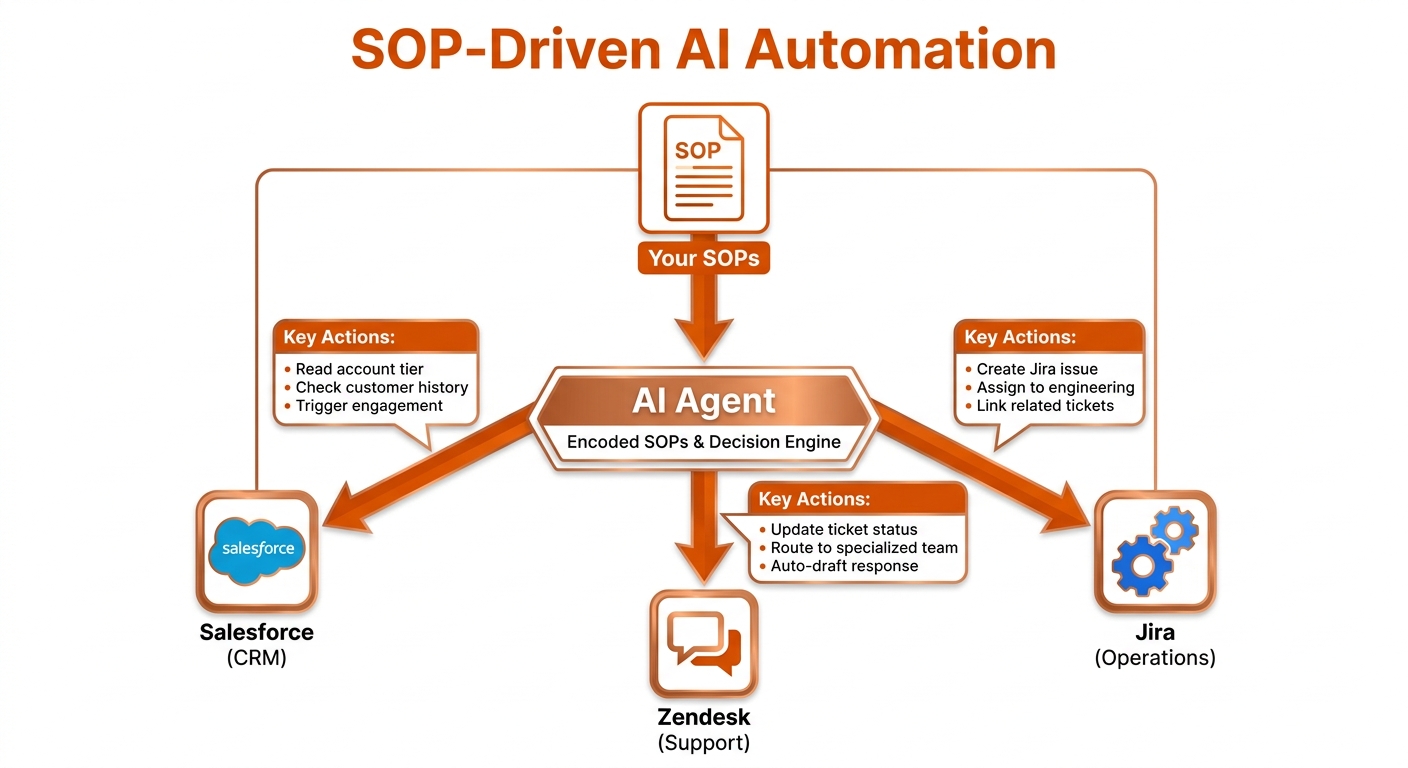
What Is SOP-Driven AI Automation?
SOP-driven AI automation is a system where AI agents execute your organization's standard operating procedures across enterprise software — Salesforce, Zendesk, Jira — without requiring historical training data or custom integration code. Unlike pattern-matching AI that needs months of ticket history, SOP-driven automation works from day one by treating your documented procedures as directly executable logic.
TL;DR: SOP-Driven AI Automation at a Glance
| Dimension | SOP-Driven AI Automation | Data-Trained AI Automation |
|---|---|---|
| What drives decisions | Documented SOPs | Historical ticket patterns |
| Time to first value | 3–5 business days | 3–6 months |
| Cross-platform scope | Salesforce + Zendesk + Jira | Typically one platform |
| Cold-start requirement | None | 10,000–50,000+ training examples |
| When processes change | Update the SOP | Retrain the model |
| Best for | Multi-system case operations | High-volume single-channel support |
| Audit trail | SOP step execution log | Black-box model inference |
How Does SOP-Driven AI Automation Work?
The core mechanism is straightforward: instead of training an AI model on past behavior, you encode what should happen into explicit SOPs, and an AI agent executes those SOPs against live system data.
A typical freight claims SOP might read: "When a new damage claim arrives in Zendesk, (1) query the Salesforce account record for customer tier and open contract value, (2) retrieve the shipment record from the TMS using the BOL number, (3) if account tier is Enterprise and claim value exceeds $5,000, create a priority Jira issue and notify the account executive within 15 minutes, (4) otherwise, send an automated acknowledgment and assign to the standard claims queue."
A SOP-driven AI agent executes each of those steps programmatically — reading from Salesforce, querying the TMS API, writing to Jira, sending the Zendesk reply — without a human touching the case. The agent's behavior is determined by the SOP, not by what happened in similar past cases.
This architecture has three practical implications:
Immediate utility. Because the automation follows SOPs rather than learned patterns, it is useful on day one — even with zero prior case history. A new operation deploying SOP-driven AI for the first time gets the same quality of automation as an organization that has been using it for three years. The limiting factor is the quality of the SOP, not the size of the training dataset.
Process fidelity. The automation does exactly what the SOP says — no more, no less. When your operations team changes a policy (for example, lowering the escalation threshold from $5,000 to $2,500 for Enterprise accounts), they update the SOP and the agent reflects the new policy immediately. There is no retraining lag, no model drift, no gap between policy intent and operational reality.
Full auditability. Every action the agent takes is traceable to a specific SOP step. When a freight claims manager asks "why did this case get escalated to Jira?" the answer is a precise citation: "SOP step 3 — account tier Enterprise, claim value $7,200, threshold $5,000." This level of auditability is impossible with pattern-matching AI, where the explanation is a probability distribution across training examples.
How Is SOP-Driven AI Automation Different From Traditional AI?
Traditional AI automation — including most helpdesk AI, LLM integrations, and ML-based routing tools — operates by identifying patterns in historical data and applying those patterns to new situations.
This works well at scale for predictable, high-volume interactions: routing identical password-reset questions to the same automated flow, classifying inbound emails by department, or predicting which knowledge-base article a customer should read. These are problems where historical patterns are stable and reliable predictors of correct future behavior.
SOP-driven AI automation targets a fundamentally different problem: multi-step, multi-system workflows where the correct action depends on business rules (the SOP), not historical frequency. Whether a freight claim should escalate to a priority Jira issue is not a pattern-matching question — it depends on account tier, claim value, claim type, and open contract status, all read from different systems. No amount of historical data about how similar claims were handled in the past captures this decision correctly when business conditions change.
The Salesforce, Zendesk, and Jira orchestration problem is the canonical example: enterprises need to execute case workflows across three separate platforms, each with its own data model, API surface, and update semantics. Stitching this together with trained AI models is fragile, slow to deploy, and opaque when decisions go wrong. SOP-driven AI executes the explicit workflow you define across all three systems with a clear audit trail.
What Business Problems Does SOP-Driven AI Automation Solve?
SOP-driven AI automation addresses three operational pain points that traditional automation consistently fails to resolve:
The cold-start problem. New operations, new product lines, or newly acquired teams cannot wait six months for an AI model to accumulate enough training data before automation becomes useful. SOP-driven automation starts with your existing documentation — even rough SOPs written in a Google Doc — and is operational within days.
The cross-platform orchestration problem. Enterprise case operations almost always span multiple systems. A logistics claim starts in a customer portal, requires a carrier API lookup, needs a Jira issue for the dispute team, and must update the Salesforce account's risk exposure. No single-platform AI tool handles this natively. SOP-driven automation is architected to span platforms because the SOP itself defines the cross-system workflow.
The policy-drift problem. Operations policies change frequently — new escalation thresholds, updated carrier SLAs, revised claims filing deadlines. With pattern-matching AI, policy changes require model retraining and produce a period of unreliable behavior while the new pattern establishes itself. With SOP-driven automation, updating a policy means editing the SOP; the agent reflects the change immediately on the next case it processes.
Which Industries Benefit Most From SOP-Driven AI Automation?
Logistics and freight operations are the primary beneficiary, and the reason is structural: freight claims processing is a multi-week, multi-system workflow with explicit regulatory requirements, carrier-specific procedures, and high financial stakes per case. Automating OS&D claims, managing carrier disputes, processing damage claims — all of these follow SOPs that teams have already documented because regulatory and contractual requirements force documentation. The SOP-driven AI model fits logistics claims perfectly because the SOPs already exist.
Enterprise SaaS operations teams are the second cluster. Their case workflows — cross-system escalations, renewal-risk triage, onboarding exception handling — span Salesforce, Zendesk, and Jira in exactly the pattern SOP-driven AI is designed for. Unlike logistics, SaaS ops teams often need to formalize their implicit procedures before automation, but the discipline of SOP documentation tends to improve the operations team's clarity about their own processes even before the AI goes live.
B2B manufacturing and distribution operations, insurance claims teams, and field service organizations are earlier-stage adopters where the operational profile — complex multi-week cases, multi-system workflows, explicit procedures — matches the architecture well.
How Does SOP-Driven AI Automation Compare to RPA?
Robotic process automation (RPA) executes scripts against user interfaces — clicking buttons, reading screen elements, filling forms. SOP-driven AI automation executes against native APIs and applies judgment at decision points defined in the SOP.
The practical differences are significant:
RPA breaks on UI changes. When Salesforce updates its Service Cloud interface, RPA scripts that click UI elements break. SOP-driven AI operates at the API level, which is stable across UI releases.
RPA has no judgment. An RPA script that hits an unexpected screen state halts and requires human intervention. A SOP-driven AI agent applies the contextual judgment defined in the SOP — for instance, "if claim type is not in the standard lookup table, flag for manual review and continue with default handling" — without halting.
RPA is per-task, not per-workflow. A Salesforce RPA script and a Zendesk RPA script are separate tools with no shared context. SOP-driven AI maintains full case context across all platform interactions within a single workflow execution, so the Jira issue created in step 3 reflects the Salesforce data read in step 1.
For operations teams that inherited RPA implementations alongside modern tooling, SOP-driven AI automation often becomes the coordination layer that gives RPA tasks the context they need to make better decisions — or replaces brittle UI scripts entirely with API-native execution.
What Does SOP-Driven AI Automation Look Like for Logistics Claims?
The LTL claims automation playbook covers the full workflow in detail, but the high-level pattern is consistent across claim types:
- A damage or shortage claim arrives via Zendesk ticket, email, EDI message, or portal submission
- The AI agent reads the associated shipment record via the TMS or carrier API using the BOL or PRO number
- The agent queries the Salesforce account record for customer tier, open revenue, and prior claims history
- Based on SOP logic, the agent either creates a Jira issue for the claims team with pre-populated fields, or routes to the automated resolution flow if the claim meets auto-settlement criteria
- The agent updates the Zendesk ticket with status, expected resolution date, and next steps
- As the claim progresses, the agent monitors for SLA breaches and triggers escalations per the defined SOP
The Salesforce Service Cloud AI agent integration is where most logistics operations connect their account management context to the claims workflow — ensuring the claims team always has revenue exposure visibility before making settlement decisions.
How Do You Implement SOP-Driven AI Automation?
The implementation sequence is consistent across industries and case types:
Document your SOPs before configuring the automation. The quality of the automation is directly proportional to the quality of the SOPs. Operations teams that attempt to configure automation against implicit, undocumented procedures find that the SOP-documentation discipline reveals policy inconsistencies and decision ambiguities that needed resolution regardless of the automation project.
Start with one case type. Pick the highest-volume, best-documented case type as the first automation target. A fully functioning single-workflow automation that handles 30% of your cases is more valuable — and safer — than a partially configured automation that nominally covers 100% of case types but fails unpredictably on edge cases.
Configure API access before configuring SOPs. The agent needs read and write access to Salesforce, Zendesk, and Jira before SOP logic can be tested end-to-end. Delays in API credential provisioning are the most common cause of implementation overruns — address these in the first 48 hours.
Test against 20 historical cases in a sandbox environment. Run the configured automation against real historical cases before go-live. This reveals both SOP logic gaps (cases the SOP didn't anticipate) and API permission issues (fields the agent needs but cannot access).
Monitor cycle time and escalation rate in the first two weeks. The signal that SOP-driven automation is working correctly is a reduction in average case cycle time alongside a stable or declining manual escalation rate. If escalation rate rises after go-live, the SOP logic has gaps that need revision before expanding to more case types.
SOP-driven AI automation is not a different version of existing AI automation — it is a different architecture, designed for the enterprise operations that traditional single-platform, data-first AI was not built to handle. The defining characteristic is that the automation follows your documented procedures, executing them across every system your operations team touches, without requiring historical training data to be useful from day one.
Mustafa Bayramoglu is the founder of CorePiper (YC W19). He writes about AI agents, enterprise case operations, and the logistics technology stack.