
The Ada AI alternative built for cross-platform case ops
Ada AI resolves chat tickets inside Zendesk and Intercom — but it has no Salesforce integration, no Jira support, and no story for logistics or freight claims. CorePiper is the SOP-driven Ada AI alternative that orchestrates cases across Salesforce, Zendesk, and Jira from day one.
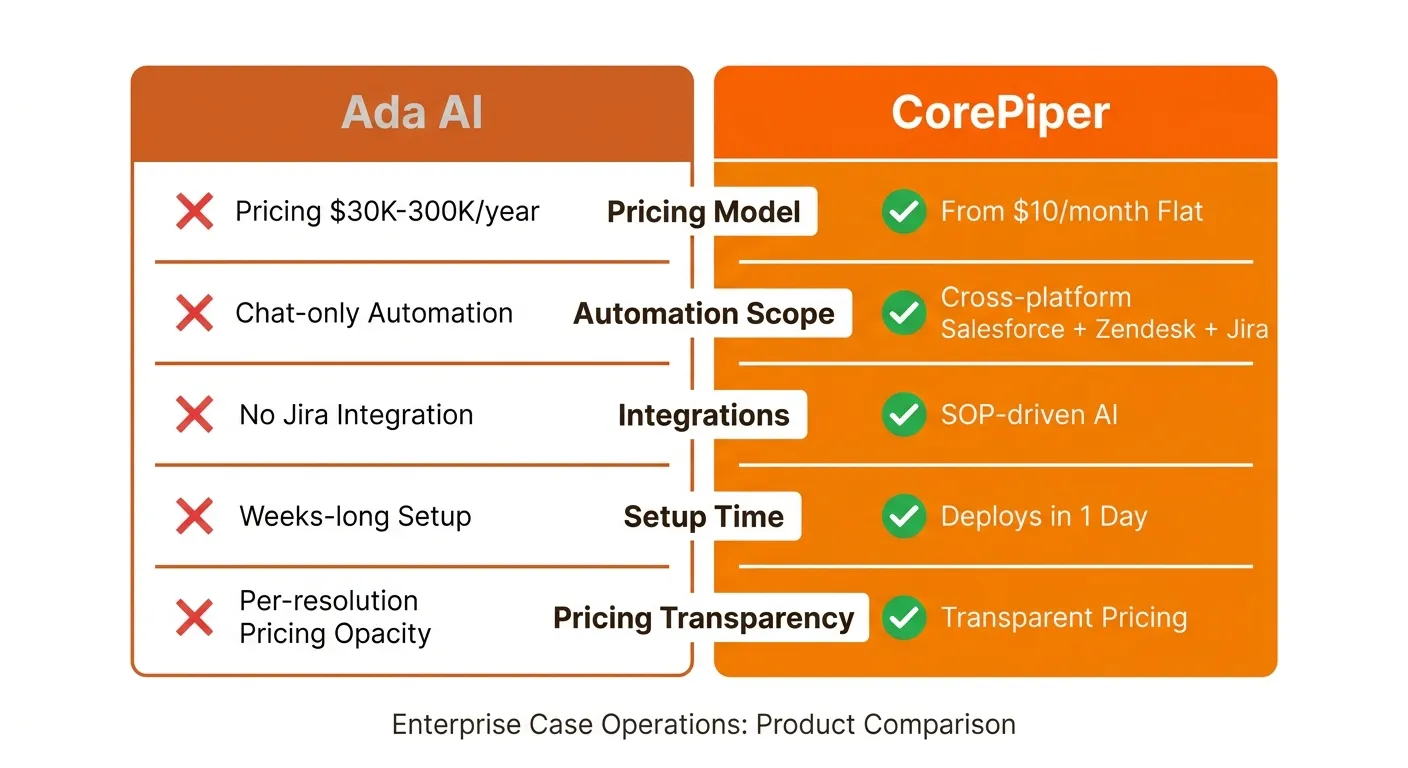
Ada AI vs CorePiper at a glance
The key differences between Ada AI and CorePiper across platform coverage, pricing, and use-case fit.
| Dimension | Ada AI | CorePiper |
|---|---|---|
| Primary use case | B2C chat & voice deflection | Multi-system case orchestration |
| Salesforce integration | None | Full Service Cloud support |
| Jira integration | None | Native bidirectional sync |
| Logistics / freight claims | No coverage | Core vertical |
| Pricing model | $30K–300K/year + per-resolution | From $10/month flat |
| Deployment time | Weeks to months | ~1 day per workflow |
How does CorePiper compare to Ada AI feature-by-feature?
A detailed breakdown of where Ada AI stops and where CorePiper picks up.
Why does Ada AI fall short for cross-platform case ops teams?
Ada AI was purpose-built for AI-native SaaS companies with high chat volume. That design leaves four critical gaps for enterprise operations teams.
No Salesforce integration — Ada AI stops at the helpdesk
Ada AI connects to Zendesk, Intercom, and Front. It has no native Salesforce Service Cloud integration. Operations teams that manage cases, opportunities, or account data inside Salesforce cannot automate those workflows with Ada. Every Salesforce action — case updates, escalation rules, account lookups — stays manual. For B2B operations teams, this is a dealbreaker: the CRM is the system of record, and AI that cannot touch it is AI that handles less than half the work.
Ticket-level thinking in a case-level world
Ada AI's architecture is built around a single resolution event: a customer sends a message, Ada resolves it, one resolution fee is charged. That model works for password resets and subscription lookups. It breaks down for a freight claim that spans 10 days, involves three carrier portals, requires a Jira escalation to the engineering team, and closes only when the shipper approves a settlement. CorePiper's primitive is the case — a multi-step, multi-day workflow across systems. Ada's primitive is the ticket. These are not the same product category.
Per-resolution pricing collapses on complex case ops
Ada charges per successful AI resolution. For a consumer chatbot handling simple queries, the math is clean. For a logistics team processing 2,000 freight claims per month — each one a 5–10 step process spanning a week — there is no clean resolution event. Does resolution mean the claim was filed? Acknowledged by the carrier? Settled? The ambiguity transfers financial risk to the buyer. CorePiper prices per case on flat monthly plans, giving ops teams predictable costs regardless of case complexity or duration.
Zero logistics or B2B operations coverage
Ada AI's named customer base is entirely AI-native SaaS companies: consumer apps, developer tools, productivity software. Their "tool calls" library covers Stripe refunds, Linear bug reports, and Slack approvals. There is no BOL lookup, no carrier API, no TMS integration, no proof-of-delivery retrieval, and no shortage/damage claim workflow. Logistics operations teams — 3PLs, freight brokers, shippers, and carriers — are simply not part of Ada's product roadmap.
What does a real Ada AI alternative need for case operations?
Not every 'Ada alternative' actually solves the problem. Here's the checklist that separates case ops platforms from chatbot replacements.
Native Salesforce Service Cloud integration
Cases in B2B operations live in Salesforce — not Zendesk. An Ada AI alternative must read and write Salesforce Cases, Accounts, Opportunities, and custom objects without middleware or a separate ETL layer.
Jira for engineering escalations
When a logistics case uncovers a system bug or requires product team input, the escalation path runs through Jira. A case ops platform that stops at the helpdesk misses 30–40% of the workflow.
SOP-driven agent configuration — not prompt engineering
Enterprise operations teams have documented SOPs. An Ada AI alternative should read those documents and execute against them — not require a separate prompt-engineering effort that duplicates and then diverges from the written process.
Predictable per-case pricing
Per-resolution pricing creates budget uncertainty at scale. A case ops platform should price per case — a defined business unit — regardless of how many steps, system calls, or days the resolution requires.
Logistics and freight domain readiness
BOL lookups, carrier portal integrations, OS&D claim formats, POD retrieval — these are table stakes for freight and 3PL operations. Most AI platforms treat this as a custom integration project. CorePiper ships it out of the box.
Which teams get the most value from switching to CorePiper?
CorePiper is a specific tool for a specific job. Here's where the ROI is clearest.
3PLs and freight brokers
Processing OS&D claims, carrier disputes, and damage reports across Salesforce and carrier portals. CorePiper automates the full claim lifecycle that Ada AI cannot touch.
B2B SaaS operations teams
Managing customer cases that span Salesforce, Zendesk, and Jira — contract changes, billing disputes, escalated bugs — where Ada's chat-only model leaves the back-office work manual.
Enterprise support operations
Teams with 5,000+ cases per year that need predictable per-case pricing, not per-resolution billing that fluctuates with AI resolution rates and definitional ambiguity.
Logistics and supply chain ops
Shippers and carriers running exception management, WISMO responses, and chargeback defense that require cross-system orchestration far beyond what a chat agent can execute.
Teams already on Salesforce Service Cloud
If your primary system of record is Salesforce and your helpdesk is Zendesk, you need AI that bridges both — not a chatbot that lives entirely in one.
Teams with documented SOPs
If your operations are already procedure-driven, CorePiper requires almost no new configuration. Point it at your SOPs, connect your integrations, and go live.
How much cheaper is CorePiper than Ada AI?
Ada AI's pricing is opaque by design. Here's the honest math at three common scale points.
| Scale | Ada AI (estimated) | CorePiper | Savings |
|---|---|---|---|
| 75 cases/month | ~$30,000+/year (Ada minimum) | $99/month (Pro) | ~96% less |
| 500–1,000 cases/month | ~$50,000–$120,000/year | Enterprise (custom volume) | ~70–85% less |
| 5,000+ cases/month | ~$150,000–$300,000/year | Enterprise (custom volume) | Significant savings |
Ada AI estimates based on Vendr median deal data ($70,001/year, 96 purchases) and published per-resolution cost of $1–$3.50. Full Ada AI pricing breakdown →

Mustafa Bayramoglu
Founder, CorePiper · YC W19 alum · Previously built enterprise automation for logistics and B2B ops teams across MENA and North America
Frequently asked questions
Common questions from teams evaluating Ada AI alternatives for case operations.
- What is the best Ada AI alternative for cross-platform case operations?
- CorePiper is the purpose-built Ada AI alternative for teams that need to orchestrate cases across Salesforce, Zendesk, and Jira. Unlike Ada, which resolves individual chat conversations inside Zendesk or Intercom, CorePiper executes SOP-driven workflows that span multiple systems — updating CRM records, creating Jira escalations, and filing logistics claims in a single automated run.
- Why can't Ada AI handle Salesforce Service Cloud case workflows?
- Ada AI has no native Salesforce Service Cloud integration. Ada connects to Zendesk, Intercom, and Front for consumer-facing chat and email, but cannot read or write Salesforce Cases, Opportunities, or Service Cloud data. Teams running case operations out of Salesforce need a different solution.
- How does CorePiper pricing compare to Ada AI in 2026?
- Ada AI's median contract is $70,001/year (Vendr data, 96 purchases), with per-resolution fees of $1–$3.50 on top. CorePiper starts at $10/month flat (Starter, 5 resolved cases) and $99/month (Pro, 75 resolved cases). At high volume, CorePiper Enterprise pricing — tuned to your operations — typically lands 70–80% below Ada's total cost.
- Can CorePiper handle freight claims and logistics workflows that Ada AI cannot?
- Yes. CorePiper was built specifically for logistics and freight operations — BOL lookups, carrier dispute filings, OS&D claim processing, and damage evidence gathering. Ada AI has no logistics integrations and no published case studies in freight, 3PL, or shipping. CorePiper runs these workflows end-to-end across Salesforce, Zendesk, and carrier portals.
- How long does migration from Ada AI to CorePiper take?
- Most teams go live with CorePiper in about one day per workflow. There is no SDK replacement or conversation-flow rebuild required — CorePiper reads your existing SOPs and connects to your existing systems via native APIs. The migration path from Ada is: document your SOPs, connect your integrations, run a pilot workflow.