
Ada AI Pricing in 2026: Full Cost Breakdown, Tiers, and What You Actually Pay
Ada AI pricing in 2026 starts at ~$30K/year platform fee plus $1–$3.50 per resolved interaction. Median deal is $70,001/year per Vendr data. Here's the full tier breakdown and what enterprise buyers actually pay.
 Mustafa BayramogluMay 6, 202610 min read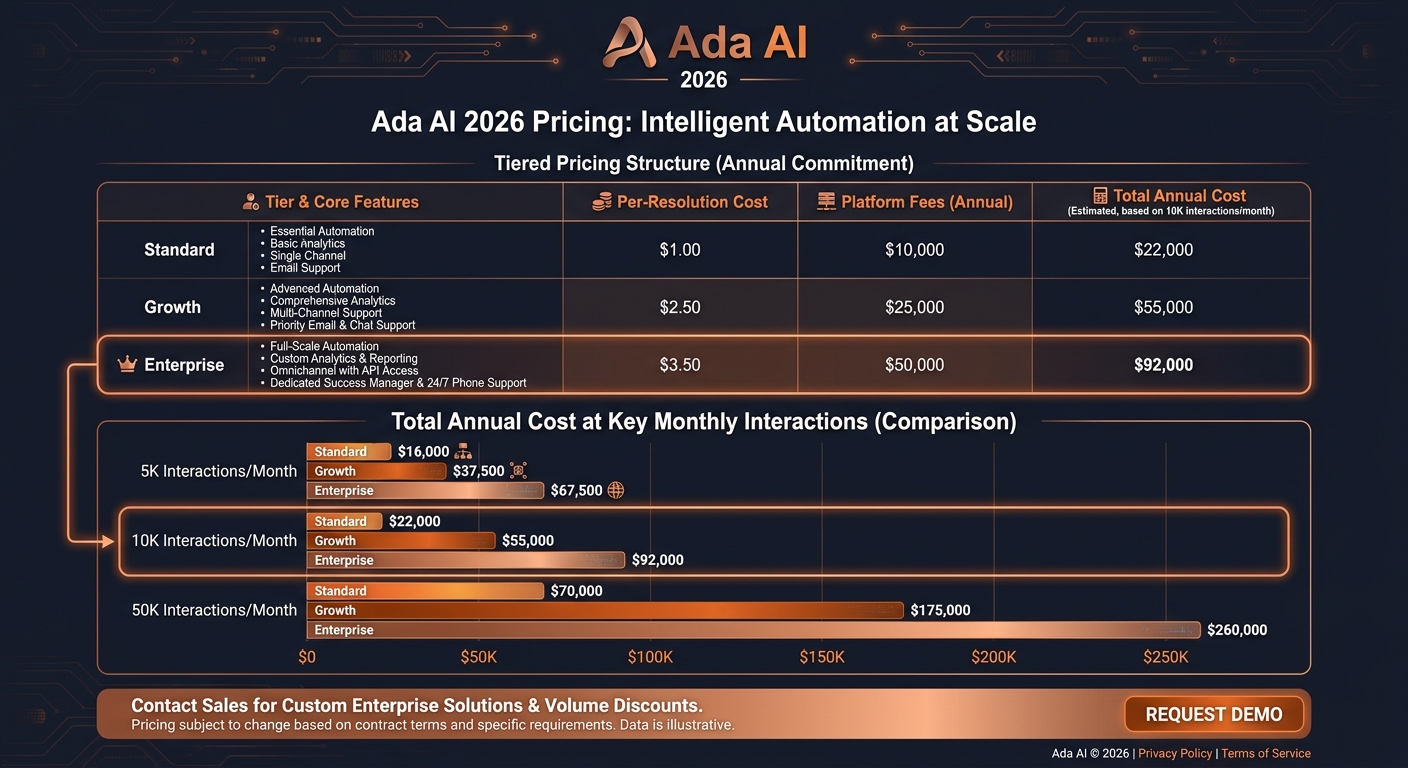
Ada AI Pricing in 2026: Full Cost Breakdown, Tiers, and What You Actually Pay
Ada AI pricing in 2026 combines a base platform fee of approximately $30,000/year with per-resolution charges of $1.00–$3.50 per AI-handled interaction, scaling to a median enterprise deal of $70,001/year according to Vendr's buyer data. High-volume contracts exceed $200K annually. No public rate card exists — all pricing is sales-gated and contract-negotiated.
TL;DR: Ada AI Pricing at a Glance
| Cost Component | Range | Notes |
|---|---|---|
| Base platform fee | ~$30K–$80K/year | Fixed, required; scales with tier |
| Per-resolution rate | $1.00–$3.50/interaction | Decreases with volume commitment |
| Implementation/onboarding | $10K–$30K | One-time; billed separately |
| Median enterprise deal | $70,001/year | Vendr data, 96 purchases |
| Enterprise range | $33K–$273K+/year | Based on actual buyer data |
| Primary use case | B2C chat automation | Web chat, SMS; not cross-platform |
| Public rate card | No | All pricing is sales-gated |
For the detailed per-scenario math — including exact cost calculations at 5K, 10K, and 50K monthly interactions — see the comprehensive Ada AI pricing breakdown.
How Much Does Ada AI Actually Cost in 2026?
The honest answer: Ada AI pricing in 2026 starts well above what most buyers expect when they request a demo.
Vendr's marketplace data from 96 real Ada purchases tells the clearest story:
- Median deal: $70,001/year
- Minimum observed: $33,700/year
- Maximum observed: $273,500/year
- Typical contract length: Annual
The $70K median obscures a wide range. Companies on older, pre-2025 pricing structures or lower volumes may sit closer to the $33K floor. Companies with 50K+ monthly interactions routinely land above $150K when resolution fees are factored in.
The two-part structure — fixed platform fee plus variable resolution cost — means total annual spend is highly sensitive to two numbers you likely won't know precisely before signing: your monthly interaction volume and your actual AI resolution rate.
What Are Ada AI's Pricing Tiers?
Ada does not publish named tiers. But based on contract structures visible from the buyer community, pricing behaves in three observable bands:
Standard (up to ~10,000 monthly interactions)
- Platform fee: ~$30,000/year
- Per-resolution rate: $2.00–$3.50/interaction
- Minimum annual commitment: ~$30K platform + volume-based resolution fees
- Best for: Companies with 3,000–10,000 monthly chat conversations, well-documented knowledge base, primarily Zendesk or Intercom stack
At 5,000 monthly interactions with a 55% AI resolution rate:
- Annual resolutions: 33,000
- Resolution cost at $2.50: $82,500/year
- Platform fee: $30,000/year
- Total (steady-state): ~$112,500/year
Growth (~10,000–50,000 monthly interactions)
- Platform fee: ~$50,000/year
- Per-resolution rate: $1.50–$2.50/interaction (volume discount applied)
- Minimum annual commitment: significantly above Vendr median
- Best for: Mid-market SaaS with mature support operations, high chat volume, dedicated conversation design resources
At 20,000 monthly interactions with a 65% resolution rate:
- Annual resolutions: 156,000
- Resolution cost at $2.00: $312,000/year
- Platform fee: $50,000/year
- Total (steady-state): ~$362,000/year
Enterprise (50,000+ monthly interactions)
- Platform fee: $80,000+/year
- Per-resolution rate: $1.00–$1.75/interaction (negotiated enterprise rate)
- Minimum annual commitment: custom; typically six figures before resolution fees
- Best for: Large consumer brands with 50K+ monthly interactions, dedicated CX operations team, multi-year contract horizon
Per-resolution rates can fall below $1.00 at very high committed volumes, but the base platform cost ensures enterprise contracts rarely land below $150K all-in.
What Does Ada AI's Per-Resolution Pricing Actually Mean?
"Per-resolution" pricing sounds simple: you pay when the AI successfully resolves a ticket. The complexity is in the definition of "resolved."
Ada's contracts define resolution differently across accounts. Common definitions include:
- Closed-without-escalation: Any conversation that ends without a human agent responding. This inflates resolution counts — a customer who stops responding (frustrated, not satisfied) may count as a resolution.
- Explicit customer confirmation: The customer indicates their issue was solved. More accurate but produces lower resolution rates, which can seem like underperformance.
- Session closure: The conversation window closes. Vulnerable to technical false-positives.
The resolution definition is the single most important contract term to negotiate before any pricing discussion. One definition can produce resolution rates 20–40 percentage points higher than another for identical conversation volumes — which means 20–40% higher annual cost for the same support outcomes.
Always ask during the sales process: "If a customer opens a second conversation about the same issue within 72 hours of a 'resolved' session, does that first conversation remain resolved in billing? What is your dispute resolution process for contested resolution counts?"
What Hidden Costs Should Ada AI Buyers Expect?
Implementation and Onboarding
Ada is not a plug-and-play tool. Production deployment requires conversation design (mapping your customer journey to Ada's intent structure), integration setup with your helpdesk and CRM, training the AI on your product vocabulary, and QA testing across all intent categories.
This work runs $10,000–$30,000 depending on complexity, whether you use Ada's professional services team or a certified Ada implementation partner. It is consistently underbudgeted.
ACX Consulting Layer
Ada offers an optional ACX (AI Customer Experience) managed services layer where Ada's team runs your conversational AI program. For complex deployments, this adds a meaningful ongoing cost — sometimes comparable to a fractional headcount — on top of the software license.
Channel Expansion Fees
Ada's base pricing typically covers web chat. Adding email automation, SMS, or voice channels often involves separate per-channel fees. If your support operation uses multiple channels (chat + email + SMS), budget for each channel addition.
Overage Charges
Contracts include committed monthly interaction minimums. Exceeding those minimums triggers overage billing at rates often higher than the contracted per-resolution rate. Businesses experiencing rapid growth should model overage scenarios before committing to a volume minimum.
Escalation Clauses
Many Ada contracts include rate escalation clauses that increase the per-resolution rate or platform fee at renewal based on volume growth or CPI adjustments. A 15% growth in interaction volume can trigger tier reclassification that costs more than the growth saves in human support costs.
How Does Ada AI Pricing Compare to Alternatives?
| Platform | Annual Cost Model | Primary Use Case | Cross-Platform | Setup Time |
|---|---|---|---|---|
| Ada AI | $70K median + $1–$3.50/resolution | B2C chat at volume | Chat/SMS only | Months |
| Intercom Fin | ~$0.99/resolution committed | Intercom-native chat | Intercom only | Days–weeks |
| Zendesk AI | $1.50/resolution (Zendesk add-on) | Zendesk-native tickets | Zendesk only | Weeks |
| Decagon | High five figures + per-resolution | AI-native SaaS tickets | Zendesk/Intercom | Days–weeks |
| Sierra | Six figures+/year | Consumer brand voice | Voice-primary | Months |
| CorePiper | Per-case + no platform minimum | Cross-platform ops | SF + ZD + Jira | Days |
The critical distinction is use-case fit, not price-per-resolution. Ada's pricing is competitive at very high volumes of standardized chat conversations. It becomes economically irrational for:
- Operations teams whose workflows span multiple platforms: A freight damage claim requiring data from a TMS, a Salesforce Case update, a Jira escalation, and a Zendesk customer reply cannot be priced as "one resolution" — it is four system interactions. Ada cannot execute this natively, and per-resolution pricing doesn't meter it accurately regardless.
- Mid-market companies below ~5,000 monthly interactions: The $30K+ platform fee creates a cost floor that makes the economics poor at low volume. Intercom Fin or Zendesk AI's usage-based-only model is more appropriate at lower scale.
- Teams with non-standard case workflows: Ada's strength is documented, repeatable chat Q&A. Custom escalation matrices, multi-system lookups, and case orchestration require significant AOP configuration work that adds to implementation cost and time.
For operations teams managing freight claims, carrier disputes, or B2B case workflows across Salesforce, Zendesk, and Jira — the use case analyzed in the 2026 State of Freight Claims Report — Ada's architecture is a category mismatch, not a pricing problem.
When Does Ada AI Pricing Make Sense?
Ada AI delivers genuine ROI for a specific buyer profile:
Ada AI pricing makes sense if:
- Monthly chat interaction volume exceeds 20,000 (the point where per-resolution rates become competitive after platform fee amortization)
- Your support flows are primarily B2C and standardized (subscription management, account access, order status)
- Chat is your dominant support channel — not email-heavy or voice-heavy operations
- Your team has dedicated conversation design resources or budget for Ada's professional services
- You operate within a single helpdesk ecosystem (Zendesk, Intercom, or Front)
Ada AI pricing does not make sense if:
- Your support workflows span Salesforce Cases, Jira tickets, and a helpdesk simultaneously
- Monthly interaction volume is below 5,000 (platform fee dominates; unit economics are poor)
- Your cases require multi-step, multi-day resolution rather than single-session closure
- Your primary support channel is phone or email, not chat
- You need logistics, claims, or B2B operations automation — Ada has no native connectors for TMS, WMS, or freight carrier APIs
For teams in the second category, the Ada AI alternative comparison details where cross-platform case operations platforms differ architecturally from Ada's chat-resolution model.
What Should You Negotiate Before Signing With Ada?
If Ada is the right fit, these contract terms matter most:
1. Resolution definition in writing. Nail down exactly what counts as resolved before price is discussed. Get language around re-contact windows (if a customer re-contacts within X days, the prior conversation is retroactively unresolved and not billed).
2. Cap on escalation clauses. A 5% annual cap on rate increases regardless of volume growth is reasonable on a multi-year contract. Without a cap, growth works against you.
3. Implementation included. On contracts above $100K, Ada should include professional services and initial AOP configuration rather than billing separately.
4. Channel expansion pricing locked. If you plan to add email or voice channels in Year 2, get that pricing locked in Year 1 contract language rather than negotiating separately when you have less leverage.
5. Committed minimum at your downside case. Model three scenarios (optimistic, base, downside). Your committed monthly minimum should match your downside interaction volume, not your expected volume. Overages are cheaper than paying for volume you don't generate.
Bottom Line: What Ada AI Pricing Means for Your Decision
Ada AI pricing in 2026 is fair for what it delivers: best-in-class conversational chat AI at high volume, with a platform fee structure that amortizes well above ~20,000 monthly interactions. The Vendr median of $70,001/year is a realistic starting point, not a ceiling — most buyers end up above it once implementation and resolution fees are fully accounted for.
The cases where Ada pricing is a problem are not pricing problems: they are use-case mismatches. If your operations require cross-platform case automation, multi-step workflows, or Salesforce/Jira integration, no pricing negotiation with Ada resolves the architectural gap. The right question before requesting an Ada quote is whether your top five support workflows fit Ada's single-helpdesk, single-session, chat-first architecture — or whether they require something built for operational orchestration across systems.
Mustafa Bayramoglu is the founder of CorePiper (YC W19), a cross-platform AI case operations platform for logistics and enterprise teams. CorePiper integrates natively with Salesforce, Zendesk, and Jira — the systems Ada's per-resolution pricing model cannot span.