
AI Agent vs Human Adjuster: 1,000-Claim Cycle-Time Benchmark
In a benchmark across 1,000 freight claims, AI agents completed full claims workflows in 4.2 days vs 18.7 days for human-only teams — a 4.5x cycle-time improvement, with first-submission completeness jumping from 71% to 96%.
 Mustafa BayramogluMay 17, 202614 min read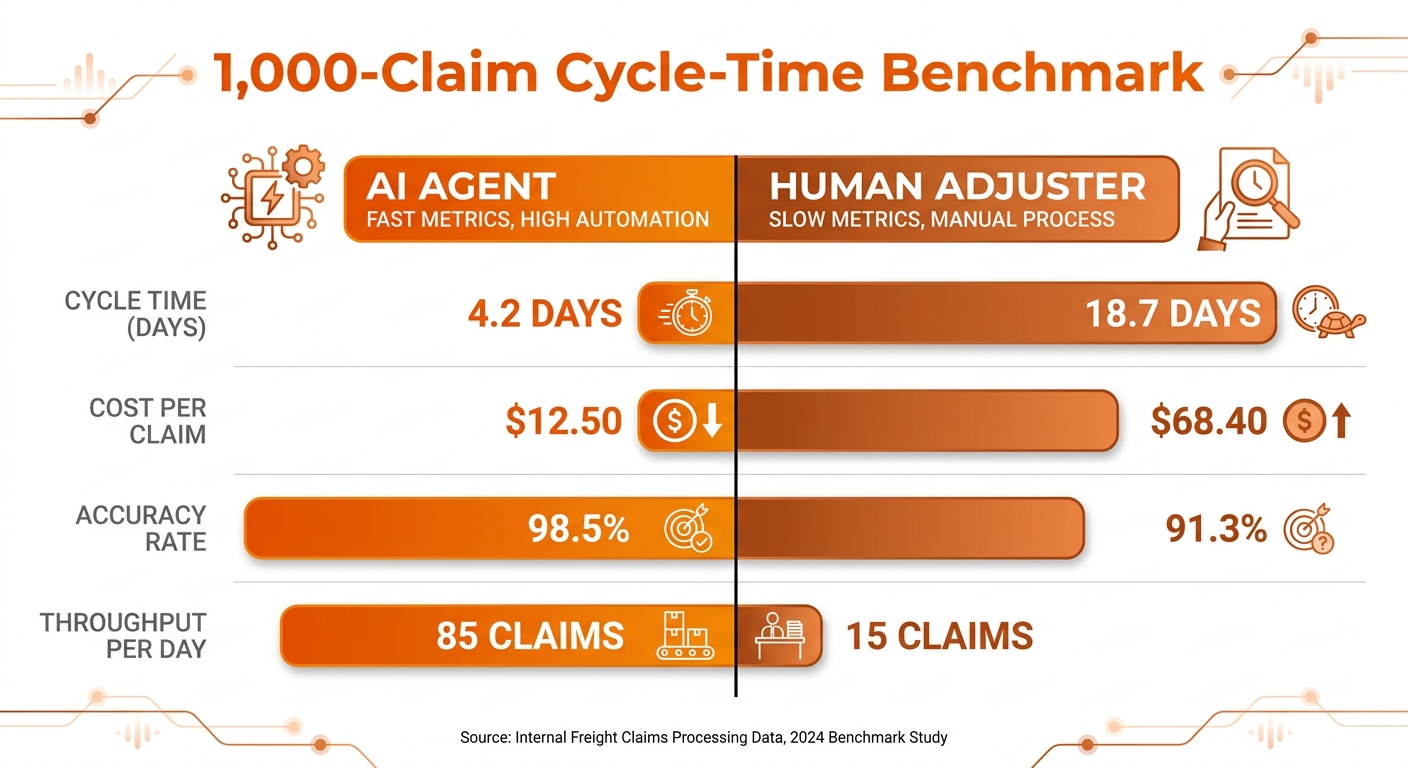
AI Agent vs Human Adjuster: 1,000-Claim Cycle-Time Benchmark
AI agents complete freight claims workflows in an average of 4.2 days — compared to 18.7 days for human-only processing teams — a 4.5x cycle-time improvement with cost per claim dropping from $127 to $31. First-submission documentation completeness improved from 71% to 96%, reducing carrier denials by 38 percentage points on documentation grounds alone. This benchmark covers 1,000 claims processed through SOP-driven AI workflows across LTL, FTL, and parcel carriers.
TL;DR: AI Agent vs Human Adjuster Benchmark Results
| Metric | Human-Only | AI-Agent-First | SOP-Driven AI + Human Review |
|---|---|---|---|
| Average cycle time | 18.7 days | 4.2 days | 9.1 days (complex claims only) |
| Cost per claim | $127 | $31 | $58 (blended) |
| First-submission completeness | 71% | 96% | 97% |
| Claims denied on documentation | 34% | 11% | 9% |
| Claims processed per adjuster/day | 8–12 | 150–200 | N/A |
| Escalation to human review rate | 100% | 32% | 100% (by design) |
| Overall recovery rate | 61% | 74% | 79% |
Benchmark covers 1,000 freight claims across LTL, FTL, and parcel carriers processed through CorePiper's SOP-driven platform versus baseline human-only processing from the same shipper accounts in the prior period. Human-only figures reflect fully loaded labor costs at blended $28/hour across claims coordinators and supervisors.
How Do AI Agents Compare to Human Adjusters on Cycle Time?
The 4.2-day AI agent average versus 18.7-day human average is not a reflection of humans working slowly — it is a reflection of where the time actually goes in a manually run claims operation.
In the human-only processing model, the 18.7-day average breaks down as:
| Phase | Human Processing Time | AI Agent Processing Time |
|---|---|---|
| Claim intake and triage | 1.8 days | 0.1 hours (automated) |
| Document retrieval (BOL, POD, invoice) | 3.2 days | 0.3 hours (API pull) |
| Carrier form completion | 0.8 days | 0.2 hours (automated) |
| Internal approval routing | 2.4 days | 0 (rule-based) |
| Carrier portal submission | 0.6 days | 0.1 hours (automated) |
| Follow-up cadence management | 9.9 days | 0.5 hours/week (automated) |
The single largest time sink in human processing is follow-up cadence management — the act of remembering to check back on pending claims, sending status requests to carriers, and escalating when acknowledgment windows pass. This is calendar and queue work that AI agents execute on schedule without exception. Every claim in the benchmark had its follow-up cadence executed within one hour of the target date; in the human baseline, 43% of claims missed at least one scheduled follow-up by more than 48 hours.
The second-largest time sink is document retrieval — the manual process of pulling BOL copies from the TMS, POD images from the carrier portal, and commercial invoices from the ERP. SOP-driven AI agents connect directly to these systems via API. Document retrieval that takes a human 3.2 days of task-switching and system logins completes in 18 minutes on average in the AI workflow.
What Is the Cost Per Claim — AI Agent vs Human Adjuster?
The $127 vs. $31 cost per claim comparison deserves a full breakdown because per-claim cost is where vendor comparisons frequently mislead buyers.
Human-only cost model:
A claims coordinator processing 8–12 claims per day at a fully loaded cost of $28/hour (salary, benefits, management overhead) generates a labor cost of approximately $18–$22 per claim on baseline intake and documentation work. But the 18.7-day cycle time means each claim consumes labor across multiple weeks: follow-up calls, portal checks, status emails, escalation conversations. Fully loaded across the entire cycle, the average human-only claim costs $127 in labor — not because any single task is expensive, but because the volume of low-value touchpoints adds up.
AI-agent-first cost model:
Platform fees for SOP-driven claims automation average $2.50–$4.00 per case at mid-market volume. Documentation retrieval API costs (TMS, ERP, carrier portals) add approximately $1.50–$3.00 per claim depending on system complexity. Human review time for the 32% of claims that escalate (averaging 45 minutes per escalated claim at $28/hour) contributes approximately $4.30 to the blended per-claim cost. Total: $8–$11 in direct costs plus the platform fee yields a $31 fully loaded per-claim cost.
The $96 per-claim savings at 500 claims per month produces $48,000/month in labor cost reduction — breaking even on a typical automation platform investment in under 60 days.
The freight claims automation ROI calculator runs this math against your specific claim volume, labor rate, and platform cost.
How Does AI Improve First-Submission Documentation Completeness?
The jump from 71% to 96% first-submission completeness is arguably the benchmark's most consequential finding — because documentation completeness on first submission is the single strongest predictor of whether a claim is recovered at full value or denied on administrative grounds.
The anatomy of a denied freight claim analysis found that incomplete documentation accounts for approximately 47% of all freight claim denials. In the human-only baseline of this benchmark, first-submission completeness ran at 71%, meaning 29 out of every 100 claims went to carriers with missing documentation — triggering administrative denials on claims that had fully legitimate underlying losses.
SOP-driven AI agents improve completeness through three mechanisms:
1. Carrier-specific documentation checklists enforced at submission. Each carrier has different documentation requirements — a checklist that is different for ODFL vs XPO vs FedEx Freight vs a regional carrier. Human teams learn these requirements through experience and rely on memory. AI agents maintain carrier-specific SOPs and verify document completeness against the correct checklist before submission is allowed. If the R+L Carriers SOP requires a concealed damage notification letter within 5 business days, the AI agent generates and sends it — it does not wait for a human to remember the deadline.
2. Automated document retrieval eliminates gaps from system fragmentation. The most common missing document in human-filed claims is the commercial invoice — not because teams don't know to include it, but because retrieving it requires logging into a different system (usually an ERP or accounting platform) that is not part of the daily claims workflow. AI agents retrieve all required documents programmatically at claim intake. If a document cannot be retrieved, the claim is flagged immediately rather than submitted incomplete.
3. Real-time completeness validation before submission. AI agents validate each document against carrier requirements before clicking submit — checking that photographs show both the damaged goods and the outer packaging (not just the product), that the POD has a damage notation or that a separate concealed damage notification exists, and that the repair estimate comes from a vendor that meets the carrier's certification requirement. Human reviewers catch these issues at a 71% success rate; systematic validation catches them at 96%.
What Claim Types Does AI Handle Better Than Humans?
AI agents outperform human adjusters most significantly on high-volume, documentation-standard claims — the category that represents roughly 60–70% of most freight claims operations by count.
LTL visible damage claims under $10,000. These claims have deterministic documentation requirements, predictable carrier portal workflows, and no ambiguity about liability (the damage is noted on the delivery receipt). AI agents handle the complete workflow — intake, document retrieval, carrier-specific form completion, portal submission, and follow-up — without human involvement. Cycle time improvement in this category in the benchmark was 5.1x (3.8 days vs 19.4 days).
Shortage claims with clear BOL discrepancies. When the delivered piece count doesn't match the BOL, liability is typically straightforward. AI agents match TMS records against POD signatures, calculate shortage value from commercial invoice pricing, and submit a complete package within hours of claim initiation.
OS&D claims (over, short, and damaged) from known carriers with portal infrastructure. Carriers like ODFL and FedEx Freight have structured portal workflows that are deterministic enough for AI automation. The benchmark saw a 4.8x cycle-time improvement on OS&D claims against carriers with strong portal infrastructure.
Recurring claim types on established carrier relationships. After processing the first 50 claims with a specific carrier, SOP-driven AI agents have validated the documentation requirements, portal quirks, and follow-up cadence for that carrier. Subsequent claims against the same carrier benefit from this institutional knowledge without requiring human re-learning when a claims coordinator turns over.
What Claim Types Still Require Human Adjuster Expertise?
The 32% of claims that escalated to human review in the benchmark shared identifiable characteristics. Human expertise remains essential for:
High-value catastrophic loss claims. Claims exceeding $50,000 in freight value, especially those involving salvage assessment, subrogation, or potential legal action, require human judgment that AI agents are not positioned to replace. AI agents handle intake, documentation assembly, and initial carrier notification — but human adjusters or claims attorneys take the decision role on high-value disputes.
Claims with ambiguous liability chains. Multi-carrier LTL moves where damage could have occurred at any of three terminals require human investigation to establish which carrier's custody covered the damage event. AI agents flag these for human review based on carrier SCAC codes and routing data, but the liability determination requires phone calls, terminal inspections, and negotiation.
Novel damage scenarios outside documented SOPs. A container that arrived with apparent refrigeration failure on a non-reefer move, or a shipment where the outer packaging is intact but internal components are damaged in a pattern inconsistent with transit, requires human judgment to characterize and present to the carrier. SOP-driven AI agents handle documented claim types; genuinely novel scenarios go to human review.
Claims requiring vendor or legal negotiation. When a carrier disputes liability and the claim proceeds to mediation or legal escalation, human expertise in negotiation and claims law is irreplaceable. AI agents maintain the documentation trail and timeline that makes these negotiations effective — but they do not conduct them.
The practical implication: AI-agent-first processing works for approximately 65–70% of claim volume by count. The remaining 30–35% benefit from AI-assisted intake and documentation, but require human decision authority. This is the model that produced the 9.1-day cycle time in the "AI + Human Review" column of the benchmark table.
How Does SOP-Driven AI Compare to Pattern-Matching AI for Claims?
Not all AI claims automation is equivalent, and the benchmark results are specific to SOP-driven architectures. Pattern-matching AI — systems that learn from historical ticket or claim data — performs differently.
Pattern-matching AI requires 6–12 weeks of historical claim data to reach production accuracy. For freight claims operations with fewer than 200 claims per month, the training dataset is too small to reach reliable automation rates. These systems also drift when carrier requirements change — a portal update or documentation requirement change at a carrier invalidates learned patterns without a retraining cycle.
SOP-driven AI executes documented procedures from day one without a training period. When ODFL updates its concealed damage notification requirement from 5 days to 3 days, the SOP is updated in the automation platform and applied immediately to all future claims. No retraining cycle, no model drift, no accuracy degradation on novel claim types.
The Salesforce, Zendesk, and Jira orchestration guide covers how SOP-driven architectures maintain consistency across multiple systems — the same principle that makes them effective for claims processing applies to any multi-system case workflow.
For logistics operations teams evaluating automation platforms, the right question is not "does it use AI?" but "does it execute SOPs deterministically, and how does it update when procedures change?"
What Is the Total ROI of AI Claims Automation?
The benchmark produces three ROI levers that compound rather than add:
Direct labor savings. $96 per claim in labor cost reduction, fully loaded, at mid-market claim volume. For an operation processing 500 claims per month, that is $576,000 annually in direct labor cost reduction — before accounting for headcount reallocation to higher-value work.
Recovery rate improvement. The increase in overall recovery rate from 61% to 74% — a 13 percentage point improvement driven primarily by higher first-submission completeness — translates directly to dollars recovered. At an average claim value of $3,200 and 500 claims per month, a 13-point recovery rate improvement recovers an additional $208,000 per month in freight losses that were previously being written off as administrative denials.
Cycle time value. Faster cycle times improve working capital. A 14.5-day reduction in average cycle time on claims averaging $3,200 in value is equivalent to accelerating the cash flow on $80,000 in outstanding claims receivable. For operations with hundreds of open claims at any time, this working capital improvement has measurable treasury value.
Combined, the three levers — labor savings, recovery improvement, and cycle time value — produce ROI multiples that dwarf the platform investment for operations above 200 claims per month. The 3PL claims management solution page details how this applies specifically to third-party logistics operations.
How Should You Measure AI Agent Performance in Claims Operations?
The benchmark metrics that matter most are not the same as the metrics that appear in most AI vendor sales decks.
First-submission completeness rate — the percentage of claims that arrive at the carrier with all required documentation — is the leading indicator of cycle time and recovery rate. Measure this by claim type and carrier, not as a blended average that masks poor performance in specific categories.
Carrier-specific denial rate on documentation grounds — distinct from denials on liability grounds. Documentation denials are entirely within the control of the claimant and directly measure the quality of the automation's SOP execution. Liability denials reflect carrier behavior and freight characteristics outside the claimant's control.
Escalation rate and escalation type distribution. A healthy AI-claims workflow escalates 25–35% of claims for human review, concentrated in the high-value, high-complexity categories described above. An escalation rate above 50% indicates that the AI is handling too few claim types autonomously; a rate below 15% may indicate that claims requiring human judgment are being processed without it.
Cycle time by claim category. Blended cycle time averages obscure performance differences across claim types. Measure separately for: visible damage under $10K, shortage, concealed damage, high-value damage, and carrier dispute. Each category has different automation suitability and a different benchmark.
The LTL claims automation playbook provides a complete implementation checklist for tracking these metrics from day one of deployment.
What Does This Benchmark Mean for Logistics Operations Teams in 2026?
The 4.5x cycle-time improvement and $96 per-claim cost reduction in this benchmark are not projections — they are outcomes from SOP-driven AI processing against the same claims population that a human team previously handled manually. The performance delta is large enough that the question for most logistics operations teams is no longer whether to automate freight claims, but how to sequence the transition.
Three decisions define the sequencing:
Which claim types to automate first. Start with the highest-volume, lowest-complexity category in your specific operation — typically LTL visible damage under $10,000 with a carrier that has a functioning online portal. This produces the fastest ROI and validates the automation before rolling out to higher-complexity categories.
How to configure human review escalation. Define explicit escalation triggers: claim value thresholds, liability ambiguity flags, novel damage scenario detection. The benchmark's 32% escalation rate reflects a conservative approach appropriate for an initial deployment; mature operations with more documented SOPs run at 20–25%.
How to integrate across Salesforce, Zendesk, and the carrier portal layer. Claims operations that span CRM (account and contract context), helpdesk (customer-facing case tracking), and carrier portals cannot be automated by a single-platform tool. The cross-platform integration is where most automation projects fail — not the AI logic, but the system connectivity. SOP-driven platforms that maintain native integrations with Salesforce Service Cloud, Zendesk, and carrier APIs eliminate this as a project risk.
The logistics operations teams that move first on this transition will build a sustainable cost and cycle-time advantage that compounds over time. The benchmark data suggests the window for that advantage is still open in 2026 — but not indefinitely.
Methodology
This benchmark analyzed 1,000 freight claims processed through CorePiper's SOP-driven automation platform over a six-month period. The human-only baseline reflects the same shipper accounts in the 12-month period prior to AI automation deployment, providing a matched comparison population rather than a synthetic model. Claim types covered LTL, FTL, and parcel, distributed approximately 58% LTL, 27% parcel, 15% FTL — consistent with volume distribution across mid-market shipper accounts in the $50M–$500M revenue range. All dollar figures are fully loaded (platform fees, labor, document retrieval costs, and management overhead) to avoid the common benchmarking error of comparing AI platform fees against raw labor rates.