
Salesforce Agentforce vs Ada AI: Neutral 2026 Comparison
Agentforce is the CRM-native AI agent for Salesforce-centric enterprises. Ada AI is the platform-agnostic resolution agent for teams running any helpdesk. This neutral 2026 comparison covers pricing, integrations, use-case fit, and where each falls short.
 Mustafa BayramogluMay 22, 202615 min read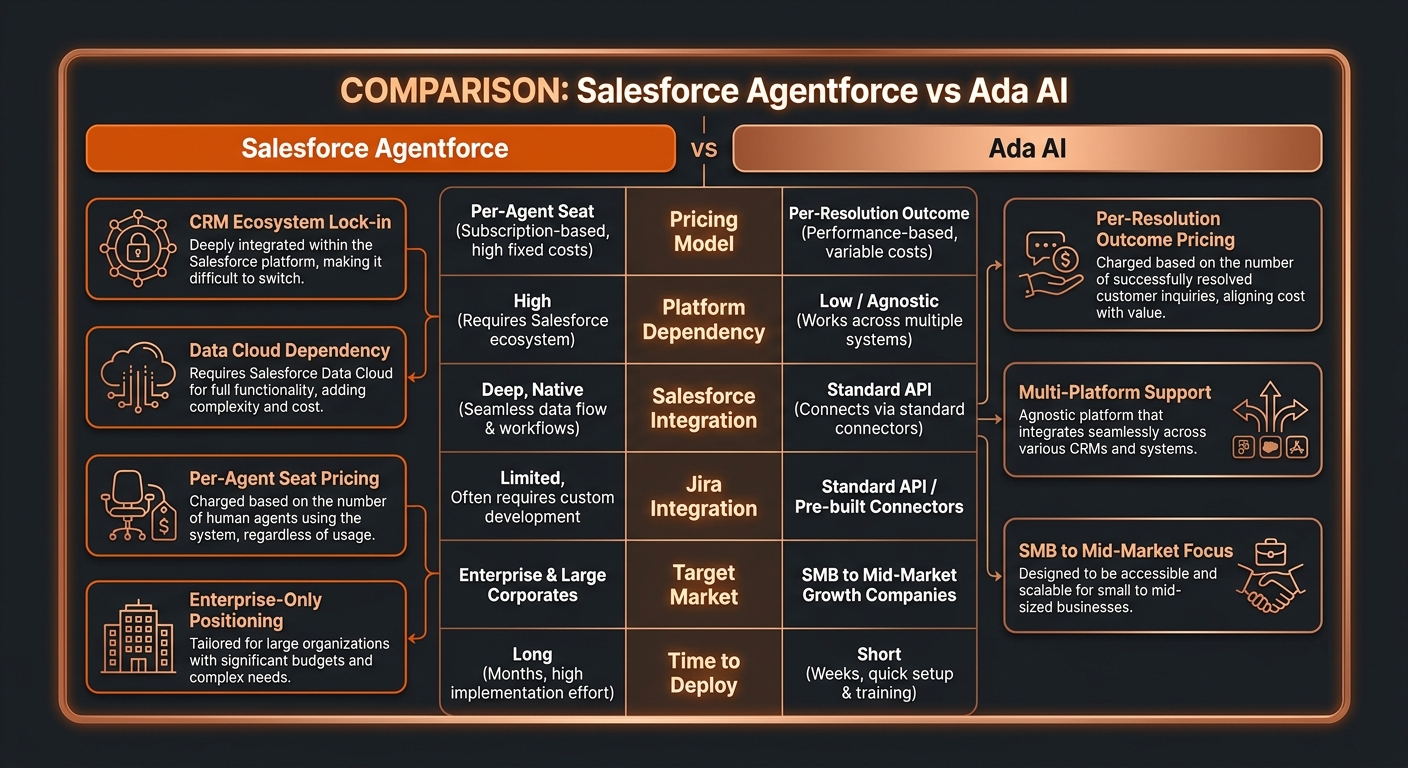
Salesforce Agentforce vs Ada AI: Neutral 2026 Comparison
Salesforce Agentforce and Ada AI are both enterprise AI agent platforms, but they solve different versions of the same problem. Agentforce is the AI layer baked into the Salesforce ecosystem — powerful within that orbit, limited outside it. Ada is a CRM-agnostic agent that deploys across any helpdesk. Neither is universally superior; the right choice depends entirely on your existing stack, case complexity, and budget structure.
TL;DR: Agentforce vs Ada AI at a Glance
| Dimension | Salesforce Agentforce | Ada AI |
|---|---|---|
| Founded | Launched 2024 (Dreamforce) | 2016 |
| Architecture | Salesforce-native | Platform-agnostic |
| Requires Salesforce | Yes (org + Data Cloud for full features) | No |
| Pricing model | $2/conversation (public) | Per-resolution (sales-gated) |
| Published rate card | Yes ($2/conversation) | No |
| Channels | Chat, email, voice (via Salesforce) | Chat, email, phone, SMS, social |
| Salesforce integration | Native (system of record) | Documented connector |
| Zendesk integration | Via connector | Native |
| Jira integration | Not documented | Not documented |
| Deployment time | Weeks to months | Days to weeks |
| Best for | Salesforce-centric enterprise ops | Multi-helpdesk, platform-agnostic teams |
| Logistics / claims support | Not designed for it | Not designed for it |
What Is Salesforce Agentforce?
Salesforce Agentforce is the autonomous AI agent platform Salesforce unveiled at Dreamforce 2024. It is not a chatbot add-on or a co-pilot — it is a fully autonomous agent layer designed to take action within Salesforce workflows without human approval at each step. Agentforce agents can resolve service cases, qualify leads, schedule meetings, update records, and execute multi-step Salesforce processes based on natural language instructions.
The platform is built on two Salesforce-native foundations: Data Cloud (Salesforce's customer data platform that unifies records, interaction history, and external data into a single profile) and the Atlas Reasoning Engine (the inference layer that determines what the agent should do at each step). Together they give Agentforce agents something most competitors lack: genuine, real-time context about a customer's full Salesforce history — cases, opportunities, contracts, activity history — at resolution time.
Agentforce 2.0, released in Winter 2025, expanded the platform's action library to over 200 out-of-box actions across the Lightning catalog, added multi-agent orchestration (agents that hand work to other specialized agents), and deepened integration with Slack for internal coordination workflows.
How Agentforce's Technology Works
Agentforce agents are built in Agent Builder, a no-code configuration interface inside Salesforce. You define the agent's topic areas (what it's allowed to handle), the actions it can take (from the Lightning catalog or custom Apex/Flow actions), and the guardrails for when it should escalate to a human. No machine learning training is required — the agent reasons over your configured instructions and the live Salesforce data available through Data Cloud.
This architecture has a meaningful advantage for teams already in Salesforce: the agent sees the full CRM context — account tier, open cases, active contracts, product usage, renewal dates — without any additional data pipeline work. That context makes Agentforce agents considerably more accurate for Salesforce-native workflows than general-purpose agents connecting to Salesforce through an API.
The dependency cuts both ways. Teams without Salesforce Data Cloud get a limited version of this context. Teams running their customer operations outside Salesforce — in Zendesk, Freshdesk, or HubSpot — cannot access Agentforce without migrating their helpdesk operations into Salesforce Service Cloud first.
Where Agentforce Excels
- Salesforce-native context: No other AI agent platform reads Salesforce Case, Account, Opportunity, and Contract data with the same depth and freshness as Agentforce. For teams where Salesforce is the true system of record, this matters.
- Action breadth within Salesforce: The Lightning action catalog and Flow integration mean Agentforce can trigger virtually any Salesforce process an admin has built, without custom development.
- Multi-agent orchestration: The ability to chain specialized agents — one handling initial case triage, another handling billing lookups, a third drafting customer responses — is a genuine architectural advantage for complex Salesforce workflows.
- Enterprise trust: Salesforce's existing enterprise relationships, security certifications (SOC 2 Type II, HIPAA, GDPR), and support infrastructure reduce the procurement friction for IT and legal teams already in the Salesforce ecosystem.
Where Agentforce Falls Short
- Data Cloud dependency: Full Agentforce capability requires Data Cloud, which adds meaningful cost beyond the $2/conversation base price. Teams evaluating Agentforce need to budget for Data Cloud credits alongside agent conversations.
- Ecosystem lock-in: Agentforce cannot natively pull context from Zendesk tickets, Jira issues, or external logistics platforms. If your case workflow spans multiple systems beyond Salesforce, Agentforce sees only the Salesforce slice.
- No published Jira integration: For operations teams that route engineering escalations or internal work orders through Jira, Agentforce provides no native path. Cross-platform orchestration requires custom Apex development or middleware.
- Longer deployment for non-standard workflows: Out-of-box Agentforce actions cover standard Salesforce workflows well. Customizing agents for logistics, freight, or operations-specific workflows requires Salesforce admin and developer resources.
What Is Ada AI?
Ada AI (formerly Ada Support) is a Toronto-based AI agent platform founded in 2016 — one of the older and better-established names in the automated support category. Ada's core product is an AI agent that resolves customer service interactions end-to-end across multiple channels: chat, email, phone, SMS, and social. Unlike Agentforce, Ada does not require any specific underlying CRM — it connects to Salesforce, Zendesk, Intercom, Freshdesk, and dozens of other platforms through API integrations.
Ada has deployed at enterprise scale for customers including AirAsia, Verizon, Meta, and Square. Its customer base spans consumer tech, telecoms, financial services, and retail — industries with high interaction volumes where even a 40% resolution rate on tier-1 inquiries generates significant cost savings.
The platform's most recent evolution, Ada Reasoning, applies LLM-based inference to agent responses rather than the rule-based intent detection Ada originally used. This shift from rule trees to reasoning models has improved resolution rates on ambiguous queries but introduced new reliability challenges for highly regulated industries where deterministic behavior is required.
How Ada's Technology Works
Ada agents are configured through a no-code builder where support teams define topics, knowledge sources, escalation conditions, and channel behaviors. Ada ingests your existing help content — knowledge base articles, policy documents, macros — and uses it to power agent responses. Unlike Decagon's AOP model (covered in the Decagon vs Sierra comparison), Ada's approach combines knowledge retrieval with reasoning, producing more conversational responses at the cost of slightly less auditable behavior.
The AI Coach feature — Ada's automated continuous improvement layer — surfaces cases where the agent underperformed, suggests training content gaps, and proposes response adjustments. For support operations teams managing a live agent without dedicated ML engineering resources, AI Coach reduces the tuning burden considerably.
Ada's channel breadth is a genuine differentiator. The ability to maintain a consistent AI agent persona and policy across chat, email, phone (via integration), and social reduces the fragmentation that typically occurs when different channels use different automation tools.
Where Ada Excels
- Platform agnosticism: Ada works with whatever CRM and helpdesk your team uses. This flexibility makes it the lower-risk choice for teams with mixed stacks or teams that are not fully committed to the Salesforce ecosystem.
- Multi-channel coverage: Ada handles chat, email, phone (via partner integrations), SMS, and social from a single configuration layer. Maintaining one AI policy across all channels reduces inconsistency in customer experience.
- Established enterprise track record: Ada has been deploying at enterprise scale since 2016. The platform has gone through multiple generations of the AI market — from rule-based bots to LLMs — and has the operational maturity that comes with that history.
- Salesforce connector: Ada's documented Salesforce integration allows agents to read Account and Case data during interactions, giving it useful CRM context without requiring Agentforce.
Where Ada Falls Short
- Per-resolution opacity: Ada's lack of a public rate card makes cost modeling difficult before a sales conversation. At the scale of enterprise support operations, unpredictable per-resolution pricing introduces budget risk that flat-subscription tools avoid.
- Single-session architecture: Ada is optimized for single-session ticket resolution — an interaction that starts, resolves, and closes within one conversation. Multi-day, multi-system case workflows are not what the platform was designed for.
- No Jira integration: Like Agentforce, Ada does not publish a native Jira integration. Teams that route internal escalations through Jira must build and maintain that bridge separately.
- LLM reasoning reliability: Ada Reasoning's shift away from deterministic rule trees has created edge cases where agent behavior is difficult to predict. For regulated industries where audit trails matter, this is a real concern.
How Does Pricing Compare Between Agentforce and Ada?
Agentforce Pricing
Salesforce published a $2 per conversation price for Agentforce Service and Sales agents — one of the only explicit rate cards in the enterprise AI agent market. This transparency is valuable, but the number requires important context:
- Data Cloud is almost always required for full agent capability. Data Cloud pricing is credit-based and volume-dependent, typically adding thousands of dollars monthly to the effective Agentforce cost.
- Salesforce platform licenses must already be in place. Agentforce is an add-on to existing Salesforce orgs, not a standalone product.
- Volume discounts apply at enterprise scale through sales-negotiated Enterprise License Agreements (ELAs).
At high volumes — say, 100,000 support conversations per month — Agentforce at $2/conversation is $200,000/month in agent fees alone, before Data Cloud and platform license costs. Enterprise customers negotiating ELAs may land significantly below this, but the $2/conversation figure is the public starting point.
Ada AI Pricing
Ada does not publish pricing. The per-resolution model means Ada charges when the agent successfully closes an interaction without human escalation. Industry-sourced estimates place Ada's per-resolution rate in the $1–$3.50 range, with median annual contract values reported around $70,000 for mid-market deployments.
The practical challenge with per-resolution pricing — documented in the CorePiper analysis of Ada's pricing structure — is that "resolution" is a definition, not a fact. What counts as a successful resolution, how partial escalations are metered, and how refund or dispute interactions are classified are all contract-level negotiation points that affect the actual cost at scale.
Which Platform Handles Which Use Cases Better?
Salesforce-Native Enterprise Support → Agentforce
For organizations where Salesforce Service Cloud is the primary case management system, Agentforce is the natural choice. The depth of native context — reading Case history, Account tier, Contract status, Opportunity stage, and product usage simultaneously — gives Agentforce agents a quality advantage on Salesforce-native workflows that Ada's connector approach cannot fully replicate.
If your operations team is already running Salesforce and the cases being automated are primarily Salesforce Cases (not Zendesk tickets or Jira issues), Agentforce is worth the Data Cloud investment.
Multi-Helpdesk or CRM-Agnostic Teams → Ada
For teams running Zendesk as the primary helpdesk — with Salesforce as a secondary CRM, not the case management layer — Ada's flexibility is a meaningful advantage. Shopify-centric brands choosing between helpdesks can start with our best AI customer service tools for e-commerce comparison. Ada can read Salesforce Account data via API during an interaction while the ticket itself lives in Zendesk, a hybrid architecture that Agentforce cannot support without significant custom development.
Ada is also the more defensible choice for teams not yet committed to the full Salesforce ecosystem — those where migrating case management into Salesforce Service Cloud would be a multi-year project, not a switch.
Multi-Step Case Operations Across Platforms → Neither
Both Agentforce and Ada were designed for the same fundamental use case: resolve a customer support interaction end-to-end within a single session. Agentforce resolves it within the Salesforce ecosystem; Ada resolves it within whatever helpdesk is primary. Neither platform was designed for cases that require:
- Pulling BOL and POD documents from a TMS
- Creating and updating a Salesforce Case with carrier dispute tracking
- Opening a Jira issue for warehouse investigation
- Notifying the customer via Zendesk while tracking carrier response over multiple days
This is the case workflow for a freight damage claim — and it is representative of the broader class of multi-system, multi-day case operations that enterprise logistics, operations, and B2B services teams run every day. Both Agentforce and Ada would require significant custom development to participate in these workflows, if they could be made to participate at all.
For teams running this kind of cross-platform case orchestration — explored in detail in the Salesforce, Zendesk, and Jira orchestration guide — the evaluation criteria are different from what Agentforce and Ada optimize for.
What Are the Key Integration Differences?
| Integration | Salesforce Agentforce | Ada AI |
|---|---|---|
| Salesforce Service Cloud | Native (system of record) | Documented connector |
| Zendesk | Via connector | Native |
| Intercom | Via connector | Native |
| Jira | Not documented | Not documented |
| Freshdesk | Not documented | Native |
| Voice channels | Via Salesforce (limited) | Via partner integrations |
| SMS | Via Salesforce Marketing | Supported |
| TMS / WMS | Not documented | Not documented |
| External carrier APIs | Not documented | Not documented |
The integration table exposes the core architectural difference: Agentforce treats Salesforce as the center of gravity and connects outward; Ada treats the helpdesk as the center of gravity and reads CRM data in. Neither architecture is wrong — they reflect different beliefs about where the case management source of truth should live.
For teams evaluating either platform, the integration map should be the first filter. Map your top five case types against the systems they touch. If every case starts and ends in Salesforce, Agentforce wins on native capability. If cases start in Zendesk and require occasional Salesforce data, Ada's connector approach is sufficient and more flexible.
Who Should Choose Agentforce in 2026?
Agentforce is the right choice if:
- Your enterprise is deeply invested in the Salesforce ecosystem — Service Cloud is the case management layer, Data Cloud is either active or on the roadmap
- Your cases primarily involve Salesforce-native data: Account records, Cases, Opportunities, Contracts
- You need enterprise-grade security and compliance certifications already recognized by your legal and IT teams
- Custom Salesforce development resources (admins, developers) are available to extend agent actions beyond out-of-box catalog items
- You want the platform with the deepest native Salesforce context at resolution time
Agentforce is not the right choice for teams whose helpdesk is Zendesk or Freshdesk without a near-term plan to migrate case management into Salesforce, teams needing Jira integration for engineering escalations, or organizations running operations workflows that span multiple platforms outside the Salesforce orbit.
Who Should Choose Ada AI in 2026?
Ada is the right choice if:
- Your support stack is multi-platform: Zendesk or Intercom for customer communication, Salesforce for CRM context, with no single platform holding all case data
- You need voice, SMS, and social channel coverage under a single AI policy
- Your team values the flexibility of CRM-agnostic deployment over the depth of Salesforce-native context
- You need to go live quickly without migrating your helpdesk infrastructure
- Per-resolution pricing fits your cost model and you have visibility into your resolution volumes
Ada is not the right choice for teams where Salesforce Cases are the primary record of operational truth, teams requiring auditable deterministic agent behavior for compliance, or teams running multi-step case operations that inherently span multiple systems over multiple days.
The Bottom Line: Two Platforms for Different Salesforce Relationships
Agentforce and Ada AI are not direct substitutes — they reflect different assumptions about the enterprise technology stack.
Agentforce bets that Salesforce is (or should be) the center of your operation. If that bet matches your reality, Agentforce offers native depth that no external AI agent can replicate. The cost is real — Data Cloud, platform licenses, and $2/conversation add up — but for Salesforce-centric enterprises, the integration quality justifies the investment.
Ada bets that the helpdesk, not the CRM, is the center of customer operations. If your team runs Zendesk as the primary interaction layer and pulls Salesforce data in as needed, Ada's flexibility and channel breadth are genuine advantages over the Salesforce-locked alternative.
Neither platform is the answer for the growing class of enterprise operations teams running case workflows that inherently span CRM, helpdesk, and project management simultaneously. The CorePiper Salesforce Service Cloud AI agent page details the architecture that handles that specific use case — cross-platform case orchestration for operations teams that cannot afford to have their workflow start and end inside a single platform.
Mustafa Bayramoglu is the founder of CorePiper (YC W19), a cross-platform AI case operations platform for logistics and enterprise teams. CorePiper integrates natively with Salesforce, Zendesk, and Jira — the cross-platform stack that single-platform agents like Agentforce and Ada consistently leave outside scope.
Need Cross-Platform Case Ops Beyond Either Platform?
Agentforce is locked to the Salesforce ecosystem. Ada AI resolves tickets inside a single helpdesk. CorePiper orchestrates multi-step cases across Salesforce, Zendesk, and Jira simultaneously — built for logistics, claims, and enterprise operations teams.