
Zendesk AI Agent Pricing Per Resolution in 2026: Complete Guide
Zendesk AI agent pricing in 2026 charges $1.50–$2.00 per automated resolution plus a $50/agent/month Advanced AI add-on. A 20-agent team resolving 3,000 tickets/month realistically spends $6,000–$8,000/month all-in. Full tier breakdown, cost scenarios, and decision framework.
 Mustafa BayramogluMay 7, 202611 min read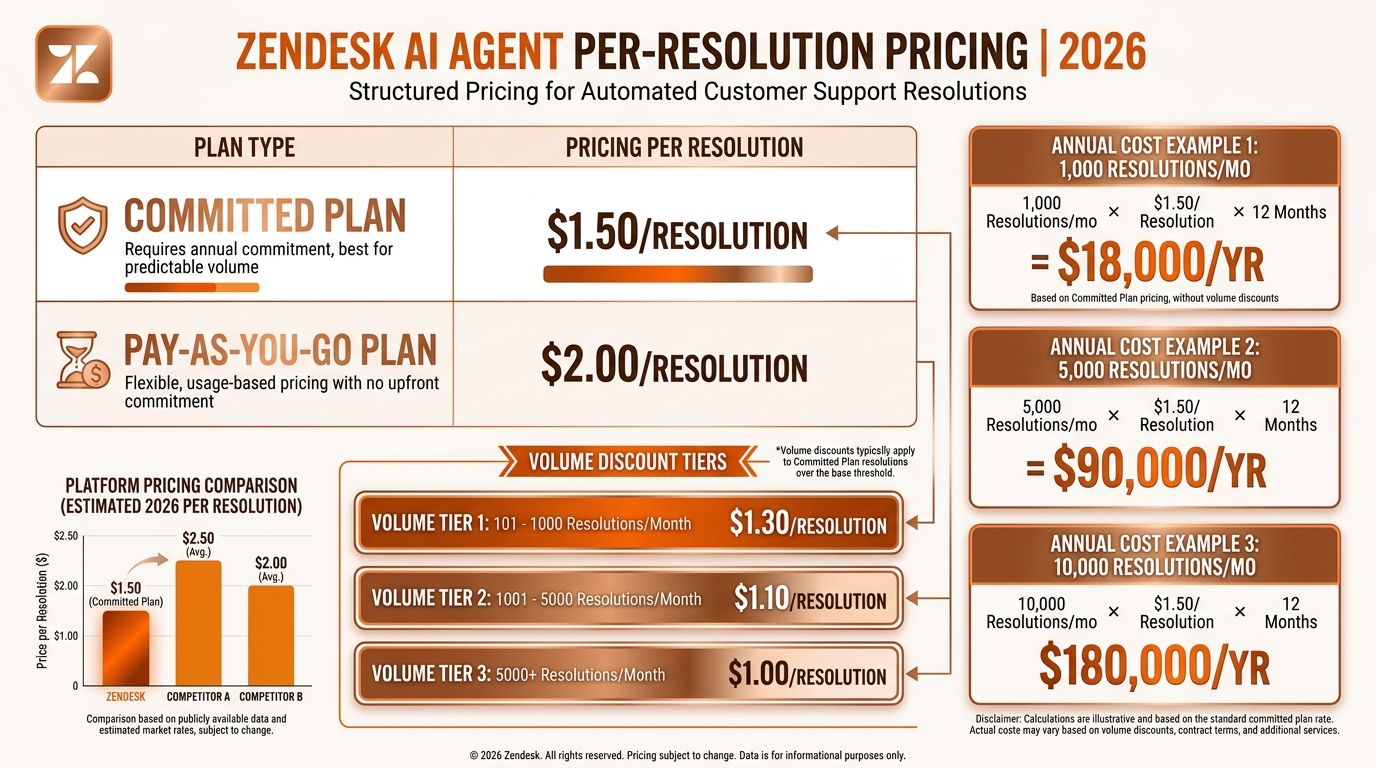
Zendesk AI Agent Pricing Per Resolution in 2026: Complete Guide
Zendesk AI agent pricing in 2026 costs $1.50–$2.00 per automated resolution, plus a mandatory $50/agent/month Advanced AI add-on and your existing Zendesk plan. A 20-agent team resolving 3,000 conversations per month all-in pays approximately $80,000 per year. Per-resolution fees auto-bill for overages since January 2026, with no prior warning.
TL;DR: Zendesk AI Pricing Snapshot
| Cost Component | Rate | Notes |
|---|---|---|
| Per-resolution (committed) | $1.50 | Drops to $1.00 at 5,001+/month |
| Per-resolution (PAYG) | $2.00 | No volume discount applies |
| Advanced AI add-on | $50/agent/month | Required for full AI agent features |
| Base plan (Suite Growth) | $89/agent/month | Minimum recommended tier for AI |
| QA add-on (optional) | $25/agent/month | Conversation quality scoring |
| WFM add-on (optional) | $25/agent/month | Workforce management forecasting |
| Overage billing (2026) | Auto-billed | No manual activation required since Jan 2026 |
| Resolution definition | 72-hour inactivity | Inflates count vs. true resolution |
What Is Zendesk AI Agent Pricing Per Resolution?
Zendesk's AI agent pricing model has two components: a fixed per-agent platform cost and a variable per-resolution charge.
The per-resolution model means Zendesk charges you every time its AI agent closes a conversation without a human stepping in. The theory is sound — you pay for outcomes, not seats. The practice is more complicated, for reasons covered in the sections below.
This pricing structure went live across Zendesk's product line following the 2025 Relate Conference announcement and is now the default for any team purchasing the Advanced AI add-on. It applies to the AI agent (formerly Zendesk Bot), the intelligent triage feature, and the autonomous conversation handling layer — all of which require the Advanced AI add-on to operate.
What Are Zendesk AI's Pricing Tiers in 2026?
Per-Resolution Rate Tiers
Zendesk's committed per-resolution rate scales with monthly volume:
| Monthly Resolution Volume | Committed Rate | Annual Resolution Cost (at midpoint) |
|---|---|---|
| 1–100 resolutions/month | $1.50 | $900–$1,800/year |
| 101–1,000 resolutions/month | $1.30 | $1,560–$15,600/year |
| 1,001–5,000 resolutions/month | $1.10 | $13,212–$66,000/year |
| 5,001+ resolutions/month | $1.00 | $60,012+/year |
| Pay-as-you-go (no commitment) | $2.00 | 33% premium over committed rate |
Each Zendesk agent seat includes a small complimentary monthly resolution allowance (typically 5–15 resolutions per seat depending on plan tier) before per-resolution billing begins.
Base Plan Tiers
Per-resolution charges layer on top of your Zendesk plan:
| Plan | Price/Agent/Month | AI Agent Features Included |
|---|---|---|
| Suite Team | $55 | Basic bot (no Advanced AI) |
| Suite Growth | $89 | Basic bot; Advanced AI add-on required |
| Suite Professional | $115 | Basic bot; Advanced AI add-on required |
| Suite Enterprise | $169+ | Custom; Advanced AI add-on negotiated |
The Advanced AI add-on at $50/agent/month is required to unlock automated resolutions, AI triage, and intelligent intent detection. Without it, you get a rule-based flow builder, not an AI agent. Nearly every team deploying Zendesk AI for meaningful automation will need this add-on.
What Does a Typical Zendesk AI Deployment Really Cost?
Three real-world scenarios illustrate the total cost spread:
Scenario A — Small Team, Moderate Volume
- Team size: 8 agents on Suite Growth
- Monthly AI resolutions: 800
- Base plan: 8 × $89 = $712/month
- Advanced AI add-on: 8 × $50 = $400/month
- Resolution fees: 800 × $1.30 = $1,040/month
- Monthly total: $2,152
- Annual total: $25,824/year
Scenario B — Mid-Market Team, High Volume
- Team size: 25 agents on Suite Professional
- Monthly AI resolutions: 4,000
- Base plan: 25 × $115 = $2,875/month
- Advanced AI add-on: 25 × $50 = $1,250/month
- Resolution fees: 4,000 × $1.10 = $4,400/month
- Monthly total: $8,525
- Annual total: $102,300/year
Scenario C — Enterprise Team, Very High Volume
- Team size: 60 agents on Suite Enterprise
- Monthly AI resolutions: 12,000
- Base plan: 60 × $169 = $10,140/month
- Advanced AI add-on: negotiated, ~$40/agent = $2,400/month
- Resolution fees: 12,000 × $1.00 = $12,000/month
- Monthly total: $24,540
- Annual total: $294,480/year
These figures exclude the QA add-on ($25/agent/month) and WFM add-on ($25/agent/month), which operational teams commonly add. For the context behind comparable costs at other platforms, the Intercom Fin alternative analysis runs similar math across Intercom's per-resolution model.
What Changed About Zendesk AI Pricing in January 2026?
January 2026 introduced a critical billing change: automatic overage billing with no prior notification.
Before January 2026, resolution overages above your committed monthly volume required manual activation — your account sat capped at the committed amount until you opted into overage billing. This gave finance teams predictable invoice ceilings.
Since January 2026, Zendesk automatically bills for every resolution above your committed volume at your per-resolution rate (not a discounted overage rate). There is no cap, no grace period, and no prior-month warning. The change appeared in updated contract terms and was communicated via a product announcement email, but many teams operating on older contracts only discovered it on their first unexpectedly large invoice.
What this means in practice: If you committed to 2,000 monthly resolutions at $1.10 and your AI agent resolves 2,800 in a given month, you receive an automatic charge for 800 additional resolutions — $880 — on your next invoice with no pre-approval required.
For teams running the freight claims automation ROI calculator to model automation payback, factor January 2026 overage auto-billing into your Zendesk cost assumption, not just the committed-rate scenario.
How Does the Automated Resolution Definition Affect Your Cost?
The 72-hour inactivity verification window is the single most financially consequential aspect of Zendesk's resolution definition.
Here is how it works: when an AI-handled conversation closes, Zendesk waits 72 hours. If the customer has not re-opened the ticket within that window, the conversation is confirmed as an "automated resolution" and billed accordingly.
The problem: a customer who stops engaging is not the same as a customer whose issue was solved. Frustrated customers who give up, customers who escalate through a different channel (calling your main line, emailing your account manager), and customers whose questions remained unanswered all close the 72-hour window in Zendesk's favor.
Industry estimates based on buyer reports suggest the 72-hour definition overcounts true resolutions by 15–30% compared to definitions requiring explicit customer confirmation. At $1.10/resolution, that overcount costs a team resolving 2,000 tickets per month an additional $330–$660/month — $3,960–$7,920/year for a billing artifact, not a support outcome.
For a deeper analysis of how resolution definitions inflate per-resolution costs across platforms, see the existing Zendesk AI pricing breakdown and the Ada AI pricing comparison — Ada uses a similar 72-hour mechanism with comparable financial implications.
When Does Zendesk AI Per-Resolution Pricing Make Sense?
Zendesk AI delivers genuine cost savings for a specific operational profile:
Zendesk AI pricing works when:
- Your team handles 1,000+ monthly AI-resolvable conversations (the break-even point where resolution fees amortize below saved human labor)
- Your support workflows are primarily single-session chat — a customer asks, the AI answers, the ticket closes
- You operate inside Zendesk already — adding the Advanced AI add-on to an existing deployment is operationally low-friction
- Your knowledge base is well-documented and regularly updated — Zendesk AI performs best on factual Q&A against static content
- Your primary support channel is web chat or email, with predictable conversation patterns
- You have minimal multi-system dependencies — no Salesforce Cases, no Jira escalations, no TMS or ERP lookups required to resolve a ticket
At 5,000+ monthly resolutions, the $1.00/resolution volume rate becomes genuinely competitive with most alternatives. The economic case for Zendesk AI strengthens the more standardized and single-platform your support operation is.
When Does Zendesk AI Per-Resolution Pricing Not Make Sense?
Zendesk AI pricing breaks down when:
Your workflows span multiple platforms. Zendesk AI cannot look up a Salesforce Case, update a Jira ticket, or query a TMS for shipment status within the same resolution flow. If your agents regularly switch between Zendesk and Salesforce to handle a single case, Zendesk AI resolves the Zendesk-side action but cannot complete the Salesforce-side action — the "resolution" is partial, yet it bills as complete.
Your cases are multi-step and multi-day. Zendesk's 72-hour window creates a billing timeline built for single-session Q&A. A freight damage claim requiring carrier notification, inspection scheduling, documentation assembly, and a formal claim filing over 7–14 days is not a "resolution" in any meaningful sense within 72 hours. Zendesk AI cannot execute this workflow, and its per-resolution billing model does not meter it accurately regardless.
You handle B2B operational cases. Enterprise operations teams — logistics, supply chain, procurement, carrier management — create cases that require domain-specific integrations (carrier portals, BOL lookup, ERP stock data) that Zendesk AI has no native connectors for. The Advanced AI add-on does not add these connectors; it enhances conversation intelligence within the Zendesk ecosystem only.
Your volumes are below 500 monthly AI-resolvable conversations. The Advanced AI add-on ($50/agent/month) creates a significant fixed cost that only amortizes at meaningful resolution volume. A 10-agent team adding the AI add-on commits $500/month before a single resolution — at 200 monthly resolutions, the all-in cost per resolution approaches $3.50, well above alternatives.
For operations teams running cross-platform case workflows, the Salesforce Service Cloud AI agent guide and the Zendesk freight claims automation page outline where Zendesk fits as one component of a multi-platform workflow rather than the resolution layer.
How Does Zendesk AI Pricing Compare to Alternatives?
| Platform | Per-Resolution Rate | Add-On Requirement | Cross-Platform | Best For |
|---|---|---|---|---|
| Zendesk AI | $1.00–$2.00 | $50/agent/month (required) | Zendesk-only | High-volume Zendesk-native chat |
| Intercom Fin | ~$0.99 committed | Included in Fin plan | Intercom-only | Intercom-native SMB/mid-market |
| Ada AI | $1.00–$3.50 + $30K+ platform fee | Included | Chat/SMS only | High-volume B2C chat at 20K+/month |
| Decagon | High five figures+ | Included | Zendesk/Intercom | AI-native SaaS companies |
| Sierra | Six figures+/year | Included | Voice-primary | Consumer brand voice at enterprise scale |
| CorePiper | Per-case, no add-on fee | No required add-on | SF + ZD + Jira | Cross-platform B2B case ops |
The comparison that matters most is not the per-resolution headline rate but the architectural fit. Zendesk AI at $1.00/resolution is a compelling number — but only if your workflows can complete inside Zendesk. For the decagon vs sierra comparison or the Ada pricing math, the same architecture constraint applies: single-platform resolution models price operations teams out of the workflows that span multiple systems.
What Should You Negotiate Before Signing a Zendesk AI Contract?
If Zendesk AI fits your use case, five contract terms determine your actual cost:
1. Resolution definition in writing. Negotiate a resolution definition that requires explicit customer confirmation (or at minimum a re-contact window of 5+ days rather than 72 hours). The 72-hour default inflates billing by 15–30% in most deployments.
2. Committed volume at your downside scenario. Model optimistic, base, and downside monthly interaction volumes. Set your committed minimum at the downside — overages are cheaper than paying for volume you under-generate.
3. Auto-billing notification opt-in. Request a contractual notification threshold (e.g., a billing alert when your current-month resolution count reaches 90% of committed volume) so finance teams see overages coming. Zendesk's standard terms do not include this; it must be requested.
4. Advanced AI add-on locked pricing. If you plan to scale agent headcount in Year 2, lock the $50/agent/month add-on rate in your Year 1 contract. Expansion pricing is often renegotiated at renewal without a lock.
5. Channel scope explicitly defined. Confirm whether the per-resolution rate covers email automation, in addition to web chat — and at what rate. Some Zendesk AI contracts scope per-resolution billing to chat-originated tickets only; email requires a separate addendum.
Bottom Line: Is Zendesk AI Agent Pricing Worth It in 2026?
Zendesk AI's per-resolution pricing is one of the more transparent cost models in enterprise support AI — the $1.50 committed rate is clearly published, the volume tiers are documented, and the January 2026 auto-billing change is at least disclosed in contract terms. The challenges are structural rather than deceptive: the 72-hour resolution window inflates costs, the Advanced AI add-on creates a fixed overhead floor, and the architecture cannot span multi-system workflows.
For Zendesk-native teams handling standardized chat at 2,000+ monthly resolutions, the math works. For operations teams whose cases require Salesforce, Jira, or logistics carrier data, Zendesk AI is not the wrong price — it is the wrong category.
Mustafa Bayramoglu is the founder of CorePiper (YC W19), a cross-platform AI case operations platform for logistics and enterprise teams. CorePiper integrates natively with Salesforce, Zendesk, and Jira, handling multi-system case workflows that Zendesk AI's per-resolution model cannot reach.