
The Assembled alternative built for cross-platform case ops
Assembled started as a workforce management platform and added AI on top — but Assembled Omni still lives inside a single helpdesk with no Salesforce orchestration, no Jira integration, and no story for logistics or freight claims. CorePiper is the alternative: SOP-driven case automation across Salesforce, Zendesk, and Jira with no WFM layer bundled in.
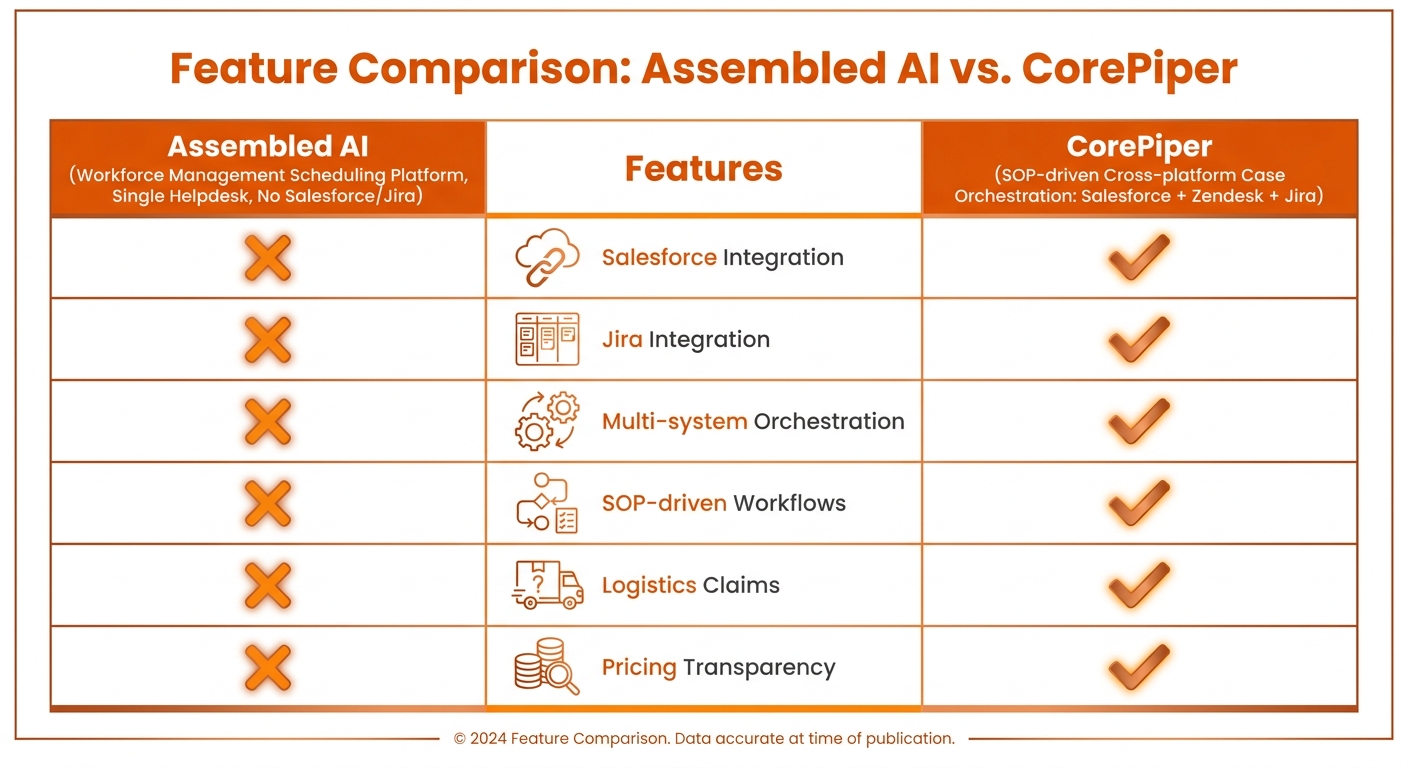
Assembled vs CorePiper at a glance
The key differences between Assembled and CorePiper across product architecture, platform coverage, pricing, and deployment speed.
| Dimension | Assembled | CorePiper |
|---|---|---|
| Product origin | Workforce management platform with AI layer added | Purpose-built SOP-driven case orchestration platform |
| Salesforce integration | WFM context only; Omni stays in helpdesk layer | Full Service Cloud native integration |
| Jira integration | Not a core capability | Bidirectional sync, auto-create issues |
| Cross-platform workflows | Single helpdesk channel per interaction | Salesforce + Zendesk + Jira in one SOP workflow |
| Logistics / freight claims | No logistics-specific workflows | Core vertical with pre-built SOP workflows |
| Pricing model | Seat-based WFM + AI tier (sales-gated) | From $10/month flat; per-case pricing |
| Deployment time | 8–16 weeks (WFM model training + seat config) | ~1 day per workflow |
How does CorePiper compare to Assembled feature-by-feature?
A detailed breakdown of where Assembled's WFM-plus-AI architecture stops and where CorePiper's SOP-driven case orchestration platform picks up for enterprise operations teams.
Why does Assembled fall short for teams that need multi-system case automation?
Assembled's workforce management roots create four specific gaps when operations teams need SOP-driven workflow execution across Salesforce, Zendesk, and Jira.
Assembled Omni resolves tickets inside a single helpdesk — it cannot orchestrate across systems
Assembled Omni is a conversational AI layer added to Assembled's workforce management platform. It answers support tickets within Zendesk, Intercom, or Assembled's own inbox — but it cannot read a Salesforce Case record, create a Jira escalation, or execute a multi-step SOP that spans more than one system. For operations teams where a case touches Salesforce, a ticketing platform, and Jira before it is resolved, Assembled Omni handles only the first step and leaves the rest to manual effort.
Assembled was designed for scheduling, not case orchestration
Assembled's core product is workforce management — forecasting ticket volume, scheduling support agents, and tracking queue metrics. The AI layer was added to answer tickets, but the underlying architecture was never built for workflow execution across enterprise systems. CorePiper was designed from the ground up for multi-system case orchestration: Salesforce, Zendesk, and Jira are first-class integrations, not afterthoughts bolted onto a scheduling platform.
WFM-bundled pricing makes pure automation cost impossible to isolate
Assembled's pricing bundles workforce management (seat licences, forecasting, scheduling) with AI resolution (Omni) into a single contract. Operations teams that want AI case automation but do not need WFM scheduling cannot purchase the AI layer standalone. CorePiper's published rate card starts at $10/month and scales by resolved cases — you pay for automation delivered, not for seat headcount or scheduling features your team does not use.
8–16 week onboarding is driven by WFM model training, not workflow deployment
Standing up Assembled requires ingesting historical ticket data to train forecasting models, configuring agent seats and skill routing rules, and calibrating the WFM model before Omni can operate. If your goal is to automate case workflows — not to optimise agent scheduling — you spend weeks on capabilities you do not need before reaching the automation you actually want. CorePiper deploys a workflow in a day: connect your systems, upload your SOPs, run the automation.
What makes CorePiper architecturally different from Assembled?
CorePiper was built for a different job than Assembled — not workforce scheduling optimisation, but SOP-driven multi-system case automation your operations team owns and controls.
Cross-platform from the ground up — Salesforce, Zendesk, and Jira in one workflow
CorePiper was built for the reality that enterprise cases do not live in one system. A freight exception arrives in Zendesk, the account context is in Salesforce, the engineering escalation belongs in Jira, and the carrier dispute touches a TMS. CorePiper executes the SOP across all four systems in a single automated workflow — not a conversational AI response followed by four manual steps.
SOP-driven: your documented procedures become the automation logic
CorePiper reads your existing Standard Operating Procedures and turns them into executable multi-step case workflows. There is no WFM model to train, no forecasting calibration to run, and no agent scheduling layer to configure first. When your SOP changes, you update the document — not a vendor contract or a training pipeline.
Logistics-first: freight claims, carrier disputes, and OS&D workflows on day one
CorePiper ships with pre-built workflows for freight damage claims, OS&D exception processing, carrier dispute management, and POD evidence gathering. Logistics and 3PL operations teams can automate a claims workflow the same day — a use case Assembled's WFM-rooted architecture has never addressed.
Transparent per-case pricing with no WFM seat overhead
CorePiper's Starter plan is $10/month for 5 resolved cases. Pro is $99/month for 75 resolved cases. Enterprise pricing is per-case at negotiated volume — no per-agent-seat fees, no workforce scheduling licences bundled in, and no AI-tier upsell layered on top of a WFM base contract. You pay for case automation delivered.
What is the difference between a workforce management AI layer and a case orchestration platform?
The architectural distinction explains why teams building durable multi-system automation need a different category of tool than Assembled provides.
Assembled: WFM platform with conversational AI layer
A support ticket arrives. Assembled's WFM layer has already predicted the queue volume and scheduled the right agent mix for this hour. Assembled Omni attempts to answer the ticket within the helpdesk. If it cannot, the ticket routes to the next available human agent based on the WFM schedule.
This model excels when your bottleneck is agent scheduling and queue forecasting — large consumer support operations where the AI deflects routine tickets and the WFM layer ensures the right humans are online for the rest.
It does not work when the ticket requires reading a Salesforce Account, creating a Jira escalation, querying a TMS for a BOL, or executing any workflow that crosses system boundaries. Assembled Omni resolves within one system; your operations team handles the rest manually.
CorePiper: SOP-driven multi-system case orchestration
A freight exception arrives in Zendesk. CorePiper reads the ticket, pulls the associated Salesforce Case and Account records, retrieves the BOL and POD from the TMS, assembles the documentation package, and creates a Jira sub-task for the claims analyst — all within one SOP-defined automated workflow.
Your operations team defines the SOP. CorePiper executes it across every system in the workflow. If the claim exceeds your approval threshold, a human gate fires before the next step. If the carrier responds outside SLA, the escalation SOP automatically triggers the next stage.
No scheduling model to calibrate. No seat licences to manage. No WFM transition period. Your team owns the process; CorePiper runs the automation at a per-case rate with full transparency.
How does Assembled pricing compare to CorePiper for enterprise operations teams?
Assembled's seat-based WFM pricing bundles workforce management with AI resolution into a single contract. Here is the honest comparison for teams that need case automation, not scheduling.
| Scale | Assembled (estimated) | CorePiper | Savings |
|---|---|---|---|
| 75 cases/month | ~$50,000–$80,000/year (est., includes WFM seats + Omni AI) | $99/month (Pro) | ~94–98% less |
| 500–1,000 cases/month | ~$80,000–$150,000/year (est., WFM + Omni at volume) | Enterprise (custom volume) | ~75–90% less |
| 5,000+ cases/month | ~$150,000–$400,000+/year (est.) | Enterprise (custom volume) | Significant savings |
Assembled pricing estimates based on publicly available WFM platform pricing benchmarks and buyer reports. No public rate card exists. See CorePiper pricing →
When should you choose Assembled instead of CorePiper?
We believe CorePiper is the right choice for most enterprise operations teams — but Assembled genuinely fits a specific type of buyer.
Assembled is the right choice — and possibly the best one — in these scenarios:
- Your primary problem is scheduling and forecasting for a large human support team and you want the AI layer bundled into the same vendor
- Your support operation is high-volume, agent-heavy, and the bottleneck is queue management rather than multi-system workflow automation
- You are already deep in the Assembled WFM platform and want incremental AI deflection without a separate vendor
- Your cases are confined to a single helpdesk channel and never require reads or writes to Salesforce or Jira
- Your budget is structured around per-agent-seat WFM licensing and adding Omni is a natural line extension
If you recognise your operation in that list, Assembled is a legitimate platform for WFM-plus-AI support. If you need automation that spans Salesforce, Zendesk, and Jira in a single workflow, logistics-specific case processing, SOP-driven multi-step orchestration, or transparent per-case pricing without per-seat WFM overhead, keep reading.
Which teams get the most value from CorePiper over Assembled?
CorePiper is a specific tool for a specific job. Here is where the ROI is clearest when moving away from a WFM-plus-AI model.
3PLs and freight brokers
Processing OS&D claims, carrier disputes, and damage reports across Salesforce and carrier portals. CorePiper automates the full claim lifecycle that Assembled's WFM-rooted AI was never built to handle.
Enterprise ops teams on Salesforce + Jira
Teams whose cases require reading Salesforce Account and Case data, creating Jira escalations, and updating records across both systems in a single automated workflow — not a conversational AI response followed by four manual steps.
B2B SaaS operations teams
Managing customer cases that span Salesforce, Zendesk, and Jira — contract changes, billing disputes, escalated bugs — where a WFM platform creates scheduling overhead your ops team does not need.
Logistics and supply chain ops
Shippers and carriers running exception management, WISMO responses, and chargeback defence that require TMS, WMS, ERP, and Salesforce integration that Assembled has never documented a customer success in.
Teams evaluating AI without WFM overhead
If your organisation already has workforce scheduling covered and you just need case automation, Assembled forces you to pay for and configure a full WFM platform before the AI features become accessible. CorePiper starts with the automation, day one.
Teams burned by long vendor onboarding timelines
Assembled's 8–16 week WFM implementation is required before Omni can operate at full capability. CorePiper deploys a workflow in a day — you validate the automation before spending weeks on a platform configuration that may not fit your case volume.

Mustafa Bayramoglu
Founder, CorePiper · YC W19 alum · Previously built enterprise automation for logistics and B2B ops teams across MENA and North America
Frequently asked questions
What enterprise operations teams ask when evaluating Assembled alternatives for SOP-driven cross-platform case automation.
- What is the best Assembled alternative for AI-first support operations?
- CorePiper is the purpose-built Assembled alternative for operations teams that need cross-platform case orchestration across Salesforce, Zendesk, and Jira — not just workforce scheduling. Assembled began as a workforce management tool and layered on AI support features (Assembled Omni) that remain confined to a single helpdesk layer. CorePiper executes SOP-driven workflows that span multiple enterprise systems from day one.
- Can Assembled handle Salesforce Service Cloud or Jira integrations for case operations?
- Assembled focuses on workforce management scheduling and forecasting within support platforms like Zendesk, Intercom, and Salesforce Service Cloud — but its AI support product (Omni) does not orchestrate multi-system workflows. Assembled Omni answers customer queries within a single helpdesk channel; it cannot read Salesforce Case records, create Jira escalations, or execute multi-step SOP workflows that cross system boundaries. CorePiper was built for exactly this multi-system choreography.
- How does Assembled pricing compare to CorePiper?
- Assembled pricing is sales-gated with no published rate card. Workforce management contracts typically start around $50,000–$150,000/year depending on agent seats and AI feature tier. CorePiper starts at $10/month (Starter, 5 resolved cases) and $99/month (Pro, 75 resolved cases). At enterprise volume, CorePiper's per-case model typically lands 60–85% below Assembled's total contract value because there is no per-seat WFM component inflating the price.
- What makes CorePiper architecturally different from Assembled Omni?
- Assembled Omni is a conversational AI layer added to a workforce management platform — it answers support tickets within a single helpdesk and uses Assembled's existing agent scheduling context. CorePiper is a case orchestration platform built specifically to execute SOP-driven workflows across Salesforce, Zendesk, and Jira simultaneously. The two products solve different problems: Assembled optimises how your human agents spend their time; CorePiper automates the multi-system workflows those agents currently run manually.
- Can CorePiper handle freight claims and logistics workflows that Assembled cannot?
- Yes. CorePiper ships with pre-built SOP workflows for freight damage claims, OS&D exception processing, carrier dispute management, and BOL/POD evidence gathering. Assembled has no logistics integrations and no published customer success stories in freight, 3PL, or supply chain operations. CorePiper runs these workflows end-to-end across Salesforce, Zendesk, and carrier portals without routing them through a workforce management scheduling layer.
- How long does it take to deploy CorePiper as an Assembled alternative?
- Most teams go live with their first CorePiper workflow in about one day. CorePiper reads your existing SOPs, connects to your Salesforce, Zendesk, and Jira instances via native APIs, and executes the workflow immediately — no agent seat management, no forecasting model calibration, and no WFM migration required. Assembled implementations typically take eight to sixteen weeks because they require historical ticket data ingestion, scheduling model training, and agent seat configuration before the AI features become useful.