
The Crescendo AI alternative without the BPO bundle
Crescendo bundles AI with outsourced human agents in a managed service you cannot unbundle — but most enterprise operations teams do not want to outsource their workflows, they want to automate them. CorePiper is the pure software alternative: SOP-driven case orchestration across Salesforce, Zendesk, and Jira with no BPO layer required.
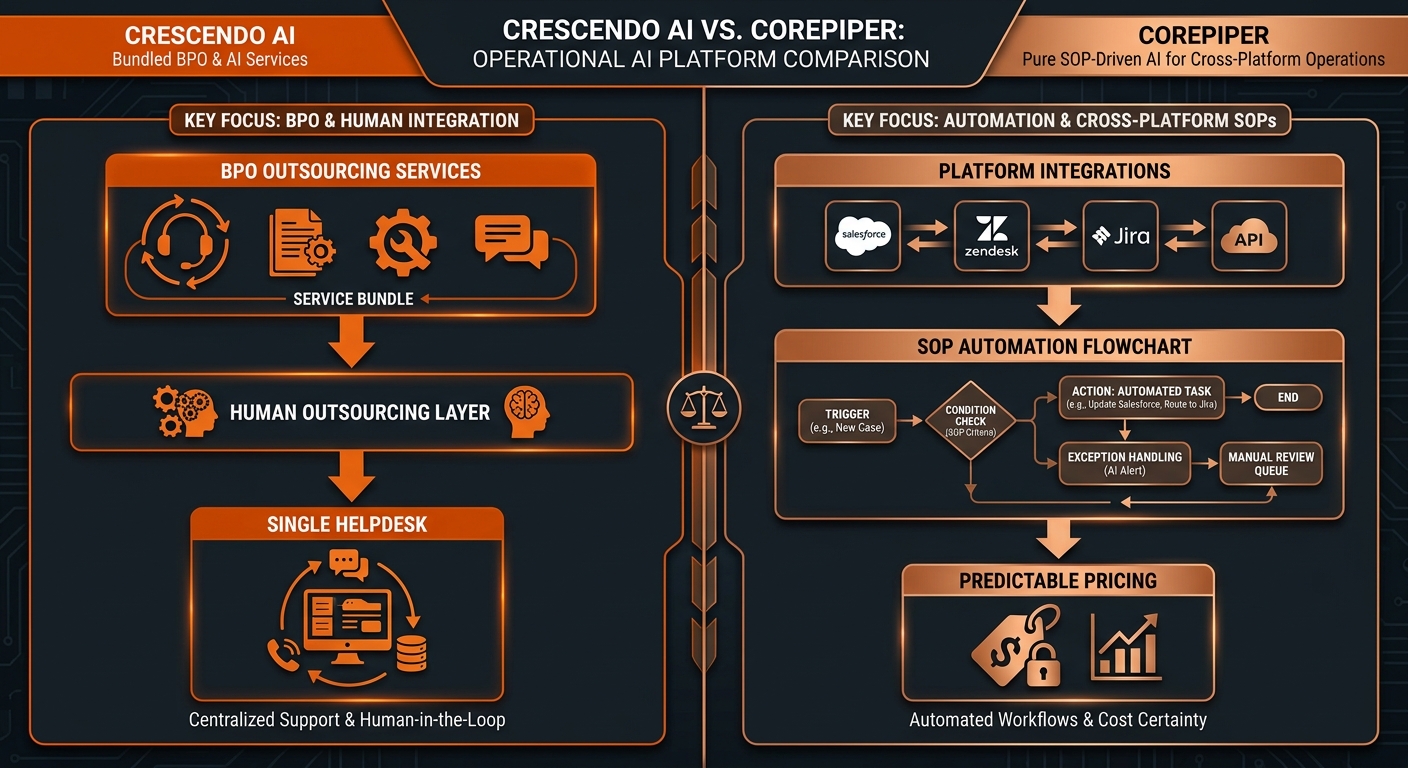
Crescendo AI vs CorePiper at a glance
The key differences between Crescendo AI and CorePiper across product model, platform coverage, pricing, and deployment approach.
| Dimension | Crescendo AI | CorePiper |
|---|---|---|
| Product model | AI + managed BPO service (bundled) | Pure software platform — your team, our automation |
| Salesforce integration | Varies by managed service scope | Full Service Cloud native integration |
| Jira integration | Not a core capability | Bidirectional sync, auto-create issues |
| Logistics / freight claims | No logistics-specific workflows | Core vertical with pre-built SOP workflows |
| Pricing model | $100K–$300K+/year (bundled AI + labor) | From $10/month flat; per-case pricing |
| BPO outsourcing required | Yes — AI and human agents are bundled | No — software only, your team stays in control |
| Deployment time | 4–8 weeks (agent onboarding + training) | ~1 day per workflow |
How does CorePiper compare to Crescendo AI feature-by-feature?
A detailed breakdown of where Crescendo AI's managed service model stops and where CorePiper's software platform picks up for enterprise operations teams.
Why does Crescendo AI fall short for enterprise operations teams that want software, not outsourcing?
Crescendo AI's hybrid managed service model creates four specific gaps for operations teams that need automation they own and control.
You cannot buy Crescendo AI without the BPO labor bundle
Crescendo's core proposition is a hybrid AI-plus-human managed service: their AI routes and resolves tickets, their managed agents handle escalations, and you pay for both as a single contract. Operations teams that want AI automation without outsourcing their workflows cannot purchase a Crescendo software license standalone. CorePiper is a pure software platform — your team stays on payroll, your SOPs define the automation logic, and CorePiper handles the multi-system execution.
Crescendo has no story for Salesforce-Jira-Zendesk cross-platform orchestration
Crescendo's managed service operates primarily within a single helpdesk layer. Cases that require reading a Salesforce Account record, creating a Jira sub-task, and filing a carrier dispute through a TMS integration cannot be handled within the Crescendo managed service architecture. CorePiper was built for exactly this multi-system choreography — Salesforce, Zendesk, and Jira are all first-class integrations, not add-ons.
BPO-bundled pricing makes cost comparison impossible
Crescendo's $100,000–$300,000+/year price tag bundles AI software with managed human agent labor into a single line item. You cannot see what you are paying for software versus outsourced headcount — and you cannot negotiate them separately. CorePiper's published rate card starts at $10/month and scales by resolved cases. Enterprise teams can see exactly what automation costs without embedded labor costs inflating the number.
4–8 week onboarding locks you in before you have validated the workflow
Crescendo's managed service requires staffing and training outsourced agents before you can go live, which extends onboarding to four to eight weeks minimum. If the workflow does not perform as expected, you have already spent weeks and significant budget on a managed transition. CorePiper deploys in a day per workflow — you validate the automation before committing, and you can adjust SOPs without renegotiating a managed service contract.
What makes CorePiper architecturally different from Crescendo AI?
CorePiper is built for a different job than Crescendo — not a managed service outcome, but software automation your team owns across all your existing enterprise systems.
Pure software — no outsourcing layer, no labor bundle
CorePiper is a SaaS platform, not a managed service. Your operations team stays in control. CorePiper's AI executes the SOP-driven workflows — updating Salesforce records, creating Jira tickets, filing carrier disputes — without routing cases through outsourced agents or adding a BPO contract to your vendor stack.
SOP-driven: your procedures become the automation logic
CorePiper reads your existing Standard Operating Procedures and turns them into executable multi-step workflows. There is no AI training on historical ticket data, no conversation-flow rebuild, and no managed agent playbook to configure. When your process changes, you update the SOP — not a vendor contract.
Logistics-first: freight claims, carrier disputes, OS&D
CorePiper ships with pre-built workflows for freight damage claims, OS&D exception processing, carrier dispute management, and POD evidence gathering. Logistics and 3PL operations teams can deploy a claims automation workflow the same day — a use case Crescendo's consumer-support-focused managed service has never addressed.
Transparent per-case pricing with no hidden labor costs
CorePiper's Starter plan is $10/month for 5 resolved cases. Pro is $99/month for 75 resolved cases ($2/case overage). Enterprise pricing is per-case at negotiated volume — no embedded BPO labor, no managed service markup. You always know exactly what the automation costs.
What is the difference between a managed AI service and a case orchestration platform?
The distinction explains why enterprise operations teams building durable automation capability need a different category of tool than Crescendo AI provides.
Crescendo AI: AI + human managed service
A support ticket arrives. Crescendo's AI layer triages and attempts to resolve it. If the AI cannot resolve it, a managed human agent from Crescendo's outsourced team takes over. You pay a single managed service contract covering both the AI software and the outsourced agent labor.
This model works well for operations teams that want to fully outsource a tier of support — consumer-facing interactions where the outcome metric is tickets closed and the buyer does not need visibility into how each step was executed.
It does not work for operations teams that need to keep control of their workflows, integrate deeply with Salesforce and Jira, process logistics claims through carrier APIs, or build institutional automation capability they can modify without renegotiating a vendor contract.
CorePiper: SOP-driven multi-system case orchestration
A freight exception arrives in Zendesk. CorePiper reads the ticket, pulls the associated Salesforce Case and Account records, retrieves the BOL and POD from the TMS, assembles the documentation package, and creates a Jira sub-task for the claims analyst — all within one SOP-defined automated workflow.
Your operations team defines the SOP. CorePiper executes it. If the claim exceeds your approval threshold, a human gate fires before the next step proceeds. If the carrier responds outside SLA, the escalation SOP automatically triggers the next stage.
No outsourced agents. No managed service contract. No vendor dependency for workflow changes. Your team owns the process; CorePiper runs the automation at a per-case rate with full transparency.
How does Crescendo AI pricing compare to CorePiper for enterprise operations teams?
Crescendo AI's managed service pricing bundles AI and outsourced labor into a single opaque contract. Here is the honest comparison.
| Scale | Crescendo AI (estimated) | CorePiper | Savings |
|---|---|---|---|
| 75 cases/month | ~$100,000+/year (est. minimum, includes labor) | $99/month (Pro) | ~98% less |
| 500–1,000 cases/month | ~$150,000–$250,000/year (est., AI + managed agents) | Enterprise (custom volume) | ~80–92% less |
| 5,000+ cases/month | ~$300,000–$600,000+/year (est.) | Enterprise (custom volume) | Significant savings |
Crescendo AI pricing estimates based on publicly available enterprise managed service pricing benchmarks. No public rate card exists. See CorePiper pricing →
When should you choose Crescendo AI instead of CorePiper?
We believe CorePiper is the right choice for most enterprise operations teams — but Crescendo AI genuinely fits a specific type of buyer.
Crescendo AI is the right choice — and possibly the only viable one — in these scenarios:
- Your primary goal is to reduce headcount by fully outsourcing a tier of customer support to a managed service provider
- Your support operation is high-volume consumer-facing and you want a hybrid AI+human model where the vendor manages both layers
- You do not have internal operations capacity to run and maintain automation workflows — you want a fully managed outcome
- Your helpdesk is already Zendesk or Salesforce Service Cloud and you want the vendor to operate within it on your behalf
- Your procurement process prefers a single managed service vendor over separate platform and headcount investments
If you recognize your use case in that list, Crescendo AI is a legitimate managed service option. If you need automation you own, cross-platform orchestration across Salesforce and Jira, logistics-specific workflows, or transparent per-case pricing without a BPO labor bundle, keep reading.
Which teams get the most value from CorePiper over Crescendo AI?
CorePiper is a specific tool for a specific job. Here is where the ROI is clearest when switching from a managed service model.
3PLs and freight brokers
Processing OS&D claims, carrier disputes, and damage reports across Salesforce and carrier portals. CorePiper automates the full claim lifecycle that Crescendo AI's managed service was never built to handle.
Enterprise operations teams that own their SOPs
Teams with documented procedures that want to automate workflow execution without outsourcing the work. CorePiper turns your existing SOPs into automated multi-system workflows — you keep the institutional knowledge inside your organization.
B2B SaaS operations teams
Managing customer cases that span Salesforce, Zendesk, and Jira — contract changes, billing disputes, escalated bugs — where a managed BPO service creates a vendor dependency on workflows your team should own.
Logistics and supply chain ops
Shippers and carriers running exception management, WISMO responses, and chargeback defense that require integration with ERP, TMS, WMS, and Salesforce that Crescendo's managed service model has no documented capability for.
Teams on Salesforce + Zendesk + Jira
If your workflow touches all three platforms, you need cross-system orchestration — not a managed agent that resolves cases within a single helpdesk layer while your Salesforce records stay stale and your Jira backlog stays manual.
Teams that have been burned by BPO transition costs
Onboarding a managed service vendor takes four to eight weeks and creates switching costs that software never does. CorePiper deploys in a day and can be replaced just as quickly — the automation lives in your SOPs, not in a vendor's agent playbooks.

Mustafa Bayramoglu
Founder, CorePiper · YC W19 alum · Previously built enterprise automation for logistics and B2B ops teams across MENA and North America
Frequently asked questions
What enterprise operations teams ask when evaluating Crescendo AI alternatives for SOP-driven cross-platform case automation.
- What is the best Crescendo AI alternative for enterprise case operations?
- CorePiper is the purpose-built Crescendo AI alternative for operations teams that need to orchestrate cases across Salesforce, Zendesk, and Jira without purchasing a managed BPO bundle. Unlike Crescendo, which pairs AI with outsourced human agents as a packaged managed service, CorePiper is a pure software platform — your team runs the operations, CorePiper's SOP-driven AI handles the multi-system workflow execution.
- Does Crescendo AI require you to use their managed service and outsourced agents?
- Yes. Crescendo's model bundles AI technology with managed human agent capacity as a combined service offering. You cannot purchase the AI layer standalone — the product is the hybrid managed service. CorePiper sells software only: you keep your existing operations team, connect your existing systems, and CorePiper automates the workflow execution without requiring you to route cases through an outsourced BPO layer.
- How does Crescendo AI pricing compare to CorePiper?
- Crescendo AI pricing is fully sales-gated with no public rate card. Enterprise contracts are typically in the $100,000–$300,000+/year range because the price includes both AI software and managed agent labor. CorePiper starts at $10/month (Starter, 5 resolved cases) and $99/month (Pro, 75 resolved cases). At enterprise volume, CorePiper typically delivers 70–90% lower total cost because there is no BPO labor component in the price.
- Can CorePiper handle logistics and freight workflows that Crescendo AI does not support?
- Yes. CorePiper ships with pre-built SOP workflows for freight damage claims, OS&D processing, carrier dispute management, and BOL/POD evidence gathering — case types Crescendo AI has never documented a customer success in. Crescendo targets high-volume consumer support operations; CorePiper targets B2B enterprise operations teams with complex multi-system case workflows in logistics, 3PL, and supply chain operations.
- What makes CorePiper architecturally different from Crescendo AI?
- Crescendo AI is a managed service that routes tickets through an AI+human hybrid layer — the customer outsources a portion of their support operation. CorePiper is a case orchestration platform that executes SOP-driven workflows across Salesforce, Zendesk, and Jira without replacing or augmenting your team with outsourced labor. CorePiper's primitive is the SOP; Crescendo's primitive is the managed service contract.
- How long does it take to deploy CorePiper as a Crescendo AI alternative?
- Most teams deploy their first CorePiper workflow in a single day. CorePiper reads your existing SOPs, connects to your existing Salesforce, Zendesk, and Jira instances via native APIs, and runs the workflow with no outsourcing contract, no agent onboarding, and no BPO transition period. Crescendo onboarding typically takes four to eight weeks because managed agent capacity must be staffed and trained.