
14 Best AI Agents for Customer Support (2026)
Compare 14 AI customer support agents for 2026 by coverage, pricing model and fit, from Zendesk AI and Intercom Fin to Agentforce and CorePiper.
 Mustafa BayramogluMay 16, 202621 min read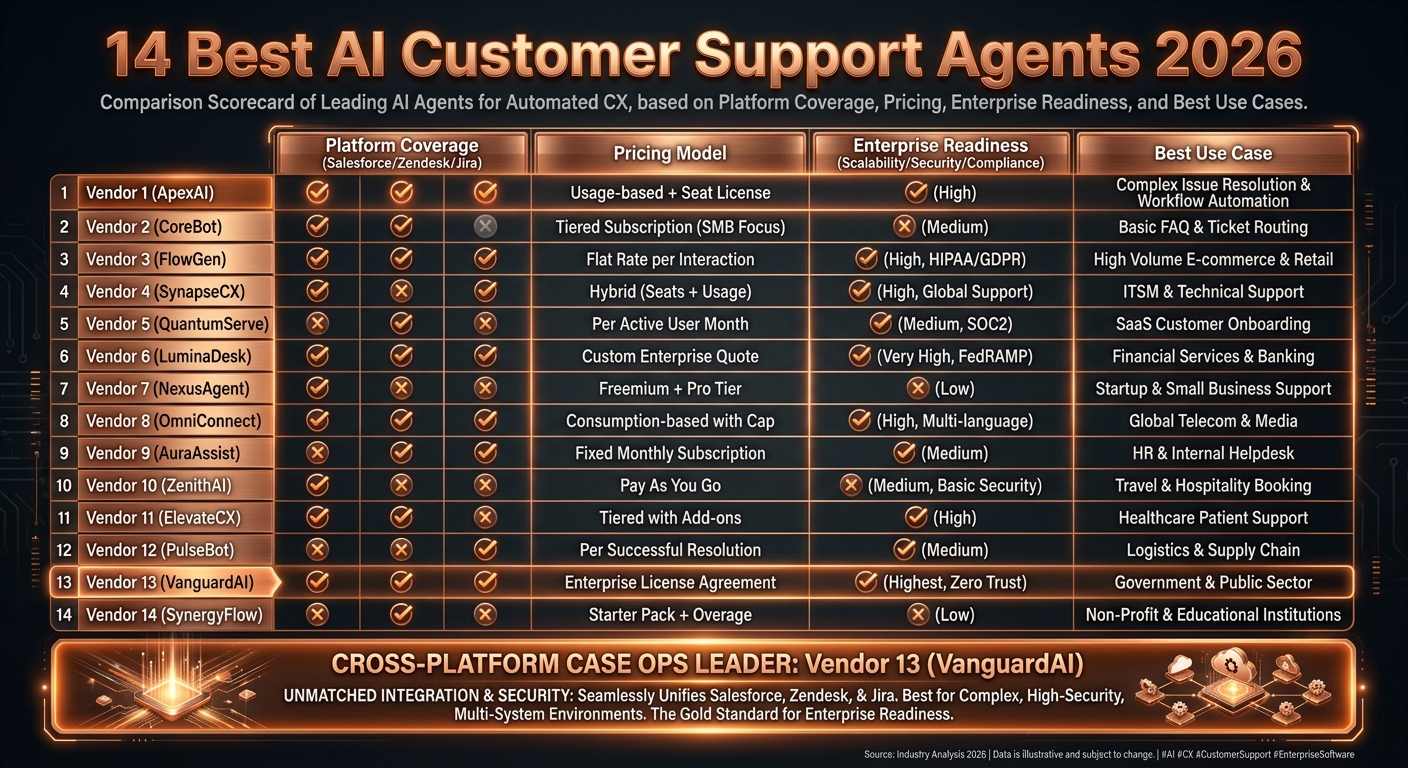
The 14 Best AI Agents for Customer Support in 2026
The best AI agents for customer support in 2026 divide into two distinct categories: helpdesk-native resolution agents that handle tickets inside a single platform (Intercom, Zendesk, Salesforce), and cross-platform case operations agents that orchestrate multi-step workflows across Salesforce, Zendesk, Jira, carrier portals, and ERP systems. Matching the right architecture to your support model matters more than any feature comparison within a category. This guide ranks 14 vendors by platform coverage, pricing transparency, and enterprise readiness — with a clear best-fit call for each.
TL;DR: The 14 Best AI Customer Support Agents at a Glance
| # | Vendor | Best For | Platform Coverage | Pricing Model |
|---|---|---|---|---|
| 1 | CorePiper | Cross-platform case ops, logistics | Salesforce + Zendesk + Jira (Enterprise) | Starter $10/mo, Pro $99/mo, Enterprise custom |
| 2 | Decagon | Enterprise policy-complex support | Intercom, Salesforce, Slack | Per-resolution (sales-gated) |
| 3 | Sierra AI | Fortune 500 conversational CX | Voice + chat, multi-channel | Outcome-based |
| 4 | Ada CX | Mid-market multi-channel deflection | Email, chat, voice | $1–$3.50/resolution |
| 5 | Intercom Fin | SaaS companies on Intercom | Intercom, Salesforce, HubSpot and more | $0.99 per outcome |
| 6 | Zendesk AI | Companies already on Zendesk | Zendesk-native | $1.50 committed, $2.00 PAYG per resolution |
| 7 | Salesforce Agentforce | Salesforce Service Cloud orgs | Salesforce + Data Cloud | $2/conversation or Flex Credits |
| 8 | Parahelp | AI-native SaaS startups | Zendesk, Intercom, Front | Outcome-based (sales) |
| 9 | Kognitos | Finance and operations workflow automation | Cross-app automation | Subscription |
| 10 | Assembled | Workforce management + AI deflection | Zendesk, Salesforce | Per-seat + usage |
| 11 | Capacity | Internal + external helpdesk knowledge AI | Knowledge base + ticketing | Subscription |
| 12 | Yuma AI | Shopify e-commerce ticket automation | Shopify + Gorgias | Per-resolution |
| 13 | Siena AI | D2C brand CX with empathy | Gorgias, Shopify, email | Subscription |
| 14 | Lorikeet | Complex policy enterprise support (APAC) | Multi-channel | Outcome-based |
What Makes an AI Agent Good for Customer Support in 2026?
Three dimensions now define enterprise buyer evaluations — a shift from the 2024 framework that weighted accuracy and deflection rate above everything else.
Platform coverage. The question is no longer "does it automate tickets?" but "does it work across the systems my operations team actually uses?" For B2B operations teams, that almost always means Salesforce (account context), Zendesk or Intercom (customer-facing tickets), and Jira (internal escalations and engineering work items). Agents that work in only one of these platforms create a new coordination problem alongside the old manual one.
Pricing predictability. Per-resolution pricing works cleanly for single-platform ticket deflection where resolution is a binary event. It breaks for multi-system case workflows where "resolution" is ambiguous — a freight claim spanning 45 days across five systems has no clear resolution event. Enterprise operations buyers are increasingly requesting per-case or per-workflow pricing to model cost predictably against operational volume before signing.
Time to value. The gap between "signed contract" and "first automated case handled" determines whether an AI agent project survives its first quarter review. Agents requiring 6-month model training periods or extensive custom engineering lose budget cycles before they prove ROI. The 2026 enterprise buyer expects an operational agent within days, not quarters — and procurement now asks "what does your agent do on day one with zero prior ticket history?" before any other question.
The 14 Best AI Agents for Customer Support in 2026
1. CorePiper — Best for Cross-Platform Case Operations and Logistics Claims
Best fit: Logistics companies, 3PLs, freight brokers, and enterprise operations teams whose cases span Salesforce, Zendesk, and Jira simultaneously.
CorePiper is a SOP-driven AI agent platform built for multi-system case operations, not single-platform ticket resolution. Teams drop in their SOPs, policies and runbooks, and CorePiper reads them and builds the agents, then runs one workflow across Shopify, Zendesk, Freshdesk, Salesforce and Jira. The Salesforce, Zendesk and Jira integrations are part of Enterprise.
CorePiper handles damage claims, returns, lost packages, size exchanges and order-status questions, from the incoming ticket to the replacement order. It serves e-commerce, logistics, insurance and field services. Routine cases run on their own, and people approve exceptions and high-impact actions; Enterprise adds audit logs.
Enterprise pricing is custom and includes the Salesforce, Zendesk, Freshdesk and Jira integrations. Starter is $10 a month billed annually with 5 resolved cases included and $3.00 per resolved case beyond that, and includes the Shopify integration; Pro is $99 a month billed annually with 75 resolved cases included and $2.00 per resolved case beyond that. A resolved case is a workflow run that completes end-to-end against the defined SOP and is not taken over by a human within 24 hours, with no per-message, per-token or per-step fees.
Strengths: Builds agents from your SOPs, policies and runbooks and can onboard in about a day; one workflow across Shopify, Zendesk, Freshdesk, Salesforce and Jira; people approve exceptions and high-impact actions while routine cases run on their own; audit logs on Enterprise.
Limitations: The Salesforce, Zendesk, Freshdesk and Jira integrations require Enterprise, which has custom pricing; Starter includes the Shopify integration. Best suited for organizations whose cases span multiple systems and need an action taken in those systems.
2. Decagon — Best for Enterprise Policy-Complex Support
Best fit: Enterprise companies with complex, multi-document policy sets and multi-step internal escalation workflows, particularly in fintech, SaaS, and marketplace operations.
Decagon raised a $250M Series D in 2025, establishing it as a tier-one enterprise AI support vendor. Its core differentiator is policy reasoning depth: the platform can execute support decisions against layered, conditional policy documentation that simpler LLM-based agents misread or oversimplify.
Named customers include Notion, Rippling, and Faire — companies with enterprise account tiers, layered pricing policies, and complex internal escalation paths. Decagon integrates with Salesforce, Intercom, and Slack, with the Slack integration enabling native internal escalation flows directly from customer-facing case decisions.
Strengths: Deep multi-document policy reasoning; enterprise-grade security and compliance posture; strong Slack integration for internal escalations; proven with marketplace and fintech use cases at scale.
Limitations: No logistics or claims-specific capabilities documented publicly; sales-gated pricing with no public rate card; implementation requires significant forward-deployed engineering involvement.
3. Sierra AI — Best for Fortune 500 Conversational CX
Best fit: Large enterprises seeking a premium conversational AI platform with voice and chat coverage for consumer-facing support at scale, where accuracy per interaction carries significant brand or regulatory risk.
Founded by Bret Taylor (former Salesforce co-CEO and OpenAI board chair) and Clay Bavor (former Google VP), Sierra AI targets the top tier of the enterprise market. The platform uses a multi-model foundation approach, routing each query to the most appropriate model based on task complexity and compliance requirements.
Sierra's customer profile centers on enterprises running tens of millions of annual customer interactions where a conversation quality floor must be maintained across all channels simultaneously — voice, chat, and email.
Strengths: Premium brand with high-profile founders; voice + chat + email coverage; enterprise security posture built into the product architecture; strong multi-model routing for accuracy at scale.
Limitations: Pricing targets large enterprise budgets; not a fit for mid-market logistics or B2B case operations teams; no specific logistics or freight claims functionality documented publicly.
4. Ada CX — Best for Mid-Market Multi-Channel AI Deflection
Best fit: Mid-market companies (500–5,000 employees) running support across email, chat, and voice who need measurable ticket deflection across channels without a heavy implementation lift.
Ada CX is a Canadian AI company with one of the longer production track records in AI customer support, having shipped conversational AI into enterprise environments well before the current LLM cycle. Its Ada Reasoning Engine handles complex multi-turn conversations across email, chat, and voice. Named customers include Verizon, indicating proven capability at enterprise scale.
Pricing follows a per-resolution model with publicly reported ranges of approximately $1.00–$3.50 per resolution depending on channel and volume tier — a spread that makes budget modeling for variable-volume operations challenging, though the low-end entry point is attractive for initial pilots.
Strengths: Mature platform with enterprise reference accounts; multi-channel coverage including voice; strong mid-market track record; transparent per-resolution model at entry tiers.
Limitations: Per-resolution pricing becomes harder to model at variable volumes; primarily single-platform per channel rather than cross-platform case orchestration; no specific logistics or claims functionality.
5. Intercom Fin — Best for SaaS Companies Already on Intercom
Best fit: SaaS companies using Intercom as their primary support channel with predominantly chat and email ticket types and predictable, knowledge-base-answerable query distribution.
Intercom Fin is the AI resolution layer built natively into Intercom's messaging platform. Its public price is $0.99 per outcome, with minimum commitments, which makes it the most accessible outcome-based AI agent on this list. Fin is also sold for use with other helpdesks, including Salesforce, HubSpot and Freshworks.
Fin operates within Intercom's conversation flow, making it the path of least resistance for teams already using Intercom. It handles knowledge-base-answerable queries effectively and can be configured with product-specific policies for common SaaS scenarios: refunds, subscription changes, account upgrades, and cancellation flows.
Strengths: Lowest entry price point on per-resolution pricing; native Intercom integration with zero additional middleware; minimal setup time for Intercom-native teams.
Limitations: Minimum commitments apply; Fin works inside a helpdesk conversation, so it is not suited for multi-system case workflows; B2B enterprise case operations require workarounds that negate the simplicity benefit. For teams considering alternatives to Intercom Fin with cross-platform requirements, the category is different.
6. Zendesk AI — Best for Companies Already on Zendesk
Best fit: Organizations where Zendesk is the primary support platform and AI deflection within the Zendesk ecosystem is the primary automation objective.
Zendesk AI (AI Agents) is the automated resolution layer within the Zendesk platform. Pricing is $1.50 per automated resolution on committed plans and $2.00 PAYG, part of the outcome-based pricing for AI agents that Zendesk introduced in August 2024. Zendesk also sells Forethought AI agents by Zendesk, whose plans include no default resolution allowance. This pricing applies to resolutions completed within the Zendesk ticket flow without a human agent response. Zendesk per-resolution pricing covers the allowance in detail.
Zendesk AI performs well for organizations whose support workflows are primarily contained within Zendesk and whose ticket types map cleanly to knowledge base answers or policy responses. The 2026 Zendesk AI agent pricing breakdown covers the full cost model with worked examples at 1,000, 5,000, and 20,000 monthly resolution volumes.
Strengths: Zero additional integration required for Zendesk-native teams; improving accuracy on policy-complex tickets with knowledge base grounding; broad language support.
Limitations: Zendesk-native only; per-resolution billing compounds at moderate volumes; does not cover Salesforce or Jira interactions within the same workflow execution.
7. Salesforce Agentforce — Best for Salesforce Service Cloud Orgs
Best fit: Enterprises running Salesforce Service Cloud as their primary case management system and already invested in the Salesforce Data Cloud for AI grounding.
Agentforce is Salesforce's AI agent platform, designed to automate support conversations and service actions within the Salesforce ecosystem. Pricing is $2 per conversation, with Flex Credits at $500 per 100,000 credits paid per action and a $5 per user per month license that requires Flex Credits. Full capability, however, requires Salesforce Data Cloud (approximately $25/user/month), which grounds agent responses against enterprise CRM data and is required for reliable account-context-aware responses.
For organizations already operating in Salesforce Service Cloud, Agentforce offers the tightest integration with existing case records, account history, and opportunity data. For teams that need to bridge Salesforce with Zendesk or Jira in a single workflow, Agentforce alone does not cover the cross-platform gap without additional middleware.
Strengths: Native Salesforce integration; full CRM context access in agent decisions; no additional middleware required for Salesforce-first teams; strong Salesforce roadmap investment.
Limitations: Data Cloud dependency adds meaningful cost to TCO; limited to Salesforce ecosystem natively; some enterprise configurations impose agent count limits per org.
8. Parahelp — Best for AI-Native SaaS Startups
Best fit: AI-native software companies (SaaS, AI tools, developer platforms) running Zendesk, Intercom, or Front as their primary support stack and prioritizing speed of deployment over cross-platform coverage.
Parahelp (YC S24) raised $21.2M through a combined seed and Series A led by Alt Capital, with angels including Zendesk co-founder Morten Primdahl. Its two-layer architecture — a primary resolution agent plus a "manager agent" that verifies each tool call against policy before execution — generated significant attention in AI engineering circles after Parahelp open-sourced its production prompt design.
Named customers are exclusively AI-native software: Perplexity, Replit, Cursor, Framer, Bolt.new, ElevenLabs, HeyGen. Setup is genuinely fast — a 1-day onboarding and 3-hour AI build process requiring no engineering involvement, the shortest time-to-live of any platform on this list for compatible helpdesks. Published case studies report 46% of tickets resolved end-to-end within 7 days at Captions.
Strengths: Exceptional speed to value (1-day setup); proven with AI-native SaaS customer base; manager agent verification layer for policy compliance; zero churn on onboarded customers reported publicly.
Limitations: Integrates with Zendesk, Intercom, and Front only — no Salesforce or Jira integration documented; pricing is outcome-based and sales-gated with no public rate card; customer base is AI-native consumer SaaS rather than enterprise logistics or B2B case operations.
9. Kognitos — Best for Finance and Operations Workflow Automation
Best fit: Finance, procurement, and operations teams that need to automate cross-application workflows by describing them in business language, without writing code or maintaining RPA scripts.
Kognitos takes a distinctive approach to enterprise automation: users describe workflows in plain English, and the platform converts those descriptions into automated processes that execute across connected business applications. It occupies a space between traditional RPA and LLM-native automation, targeting finance and operations workflows that don't map cleanly into either category.
Strengths: No-code workflow description in business language; reduces RPA maintenance overhead; suitable for complex multi-application finance and procurement processes.
Limitations: Not a customer-support-native platform; no specific logistics or claims capabilities documented publicly; best suited for internal operations automation rather than customer-facing case management at scale.
10. Assembled — Best for Workforce Management Plus AI Deflection
Best fit: Contact centers that need to address both scheduling optimization and AI ticket deflection from a single vendor, and whose operations leaders need to model staffing and automation rates together.
Assembled combines workforce management tooling — scheduling, capacity forecasting, SLA tracking — with AI-based ticket deflection and agent assist capabilities. This combination makes it uniquely valuable for operations leaders who need to present a unified model of human capacity and AI coverage to finance, rather than treating workforce planning and AI deflection as separate budget items with separate vendors.
Strengths: WFM plus AI deflection in one platform; meaningful for integrated capacity planning decisions; integrates with Zendesk and Salesforce for data access.
Limitations: AI deflection is secondary to the workforce management core product; not suited for deep case orchestration across multiple enterprise platforms; limited cross-platform workflow execution capability.
11. Capacity — Best for Internal and External Helpdesk Knowledge AI
Best fit: Companies seeking to automate both internal IT helpdesk and external customer-facing FAQ support from a shared knowledge management platform, reducing the overhead of maintaining separate systems for each.
Capacity positions itself around the knowledge management layer: centralized knowledge bases, AI-powered FAQ resolution, and escalation routing serving both employee helpdesk and customer support use cases. Its breadth across internal and external support is a differentiator for organizations that want a single knowledge platform rather than separate tools for IT and CX.
Strengths: Internal plus external helpdesk from one platform; knowledge management focus reduces content duplication overhead; good for FAQ-heavy support operations with well-documented policies.
Limitations: Not designed for complex multi-step case orchestration; limited cross-platform workflow execution; best fit is knowledge retrieval and FAQ automation rather than SOP-driven case execution across multiple enterprise systems.
12. Yuma AI — Best for Shopify E-Commerce Ticket Automation
Best fit: Direct-to-consumer e-commerce brands on Shopify that need to automate WISMO (where is my order), return, and exchange tickets at high volume without engineering overhead.
Yuma AI is purpose-built for Shopify merchants, with deep native integration into Shopify's order management data and Gorgias (the dominant helpdesk for Shopify brands). For a wider look at Shopify-focused options, see our guide to the best AI customer service tools for e-commerce. It handles the high-volume, low-complexity ticket types that dominate e-commerce support queues: order status inquiries, tracking updates, refund requests, and exchange flows — automating the queries that account for the majority of D2C support volume.
Strengths: Purpose-built for Shopify; fast setup for e-commerce teams already on Gorgias; handles WISMO and returns at volume without custom configuration.
Limitations: Shopify and Gorgias-specific — not applicable to enterprise or B2B case operations; no documented Salesforce, Zendesk, or Jira integration; not a fit for logistics companies or freight operations teams.
13. Siena AI — Best for D2C Brand CX with Empathy
Best fit: D2C e-commerce brands prioritizing brand voice consistency and empathic response quality over raw deflection rate metrics, particularly for return and exchange workflows where customer sentiment risk is highest.
Siena AI differentiates on quality rather than scale: it trains on brand voice documentation alongside product and policy data, allowing automated interactions to maintain the specific tone, empathy level, and personality that premium D2C brands invest in building. Returns, exchanges, and shipping issue resolution are the primary workflow targets.
Strengths: Brand voice preservation at scale; empathic response quality measurably higher than generic LLM outputs; returns and exchange workflow depth; suited for lifestyle and premium D2C brand personas.
Limitations: E-commerce focused with no documented path to B2B, logistics, or enterprise case operations; no Salesforce or Jira integration documented; not applicable to freight or claims workflows.
14. Lorikeet — Best for Complex Policy Enterprise Support in APAC
Best fit: Enterprise companies in the Asia-Pacific market with complex regulatory or policy-based support workflows requiring multi-step policy reasoning and reliable escalation routing based on account or regulatory status.
Lorikeet is an Australian AI support agent that has built a reputation for handling policy-complex enterprise support scenarios — workflows where correct action depends on multiple document lookups, conditional logic, and escalation routing that varies by customer tier or regulatory classification. It is growing its presence in Australian financial services, insurance, and enterprise SaaS operations.
Strengths: Multi-step policy reasoning for compliance-adjacent workflows; enterprise-grade; strong APAC presence; handles regulatory-aware support scenarios effectively.
Limitations: Lower brand recognition outside the APAC market; limited public pricing transparency; not purpose-built for logistics or freight claims operations; smaller published customer base than North American competitors.
Other AI Agents Worth a Look
The 14 entries above lean toward cross-system case work. Three other helpdesk-native agents are worth a look: Freshworks (Freddy AI Agent), HubSpot Customer Agent and Help Scout (AI Answers). Each ships with its own helpdesk. This guide does not rank them. Treat them like any helpdesk-native agent: count the systems a case touches, check how "resolved" is defined and billed, and ask what the agent does on day one. If your cases stay inside one of those products, the agent that ships with it belongs on your shortlist.
How Do You Choose the Right AI Agent for Your Support Operation?
The evaluation framework starts with three diagnostic questions — answering them correctly narrows 14 options to 2 or 3.
How many systems does a case touch? If a typical case resolution requires reading from or writing to more than one enterprise system — a Salesforce account record, a Zendesk ticket, a Jira issue, a carrier portal — you need a cross-platform case operations agent. Helpdesk-native resolution agents are architecturally incompatible with this requirement; buying the wrong category creates a new integration project rather than solving the original workflow problem.
What does "resolved" mean for your case type? For consumer SaaS support, resolution is binary: did the AI close the ticket without human escalation? Per-resolution pricing models this accurately. For multi-week freight claims, logistics disputes, or complex B2B case workflows, "resolved" may take 45–90 days and involve 12 or more system actions across multiple platforms. Flat per-case pricing models operational cost predictably in these scenarios; per-resolution pricing does not.
How quickly do you need value from the automation? If your organization is in a 90-day automation sprint with a board-level ROI expectation, an agent requiring months of model training is not viable. CorePiper, which can onboard in about a day, or helpdesk-native agents with 1-day setup (Parahelp, Intercom Fin) are the only options that fit time-constrained deployment windows.
Which AI Agents Work Across Salesforce, Zendesk, and Jira?
Of the 14 agents on this list, only two have documented native integration across all three of Salesforce, Zendesk, and Jira: CorePiper (purpose-built for exactly this architecture, on Enterprise) and, through enterprise-grade custom middleware, Decagon (for deployments with sufficient integration budget and implementation resourcing).
Most helpdesk-native agents — Intercom Fin, Zendesk AI, Parahelp — work within a single helpdesk and treat Salesforce and Jira as out-of-scope systems. Salesforce Agentforce works natively within Salesforce but requires additional tooling to bridge Zendesk or Jira into the same workflow. How to orchestrate Salesforce, Zendesk, and Jira together with AI covers the technical architecture in detail for teams evaluating this requirement.
What Should You Watch Out for When Evaluating AI Support Agents?
Hidden training data requirements. Most pattern-matching AI agents improve significantly with historical ticket data, and some require tens of thousands of labeled examples before performing reliably on novel query types. Ask every vendor: "What does your agent do on day one with zero prior tickets?" If the answer involves a training period measured in months, model the delay cost against your automation ROI timeline before signing.
Per-resolution pricing with ambiguous resolution definitions. Per-resolution pricing looks inexpensive at low volume and compounds quickly as ticket volume grows or if the contract defines "resolution" broadly enough to capture interactions you did not expect to pay for. Request contract language specifying exactly what constitutes a billable resolution event and whether failed or partial resolution attempts are billable.
Platform lock-in at the helpdesk layer. Helpdesk-native agents create a tight dependency: if your organization migrates from Zendesk to Salesforce Service Cloud in 18 months — a common evolution as B2B operations mature — a Zendesk AI investment does not migrate with you. Cross-platform and SOP-driven platforms decouple the automation layer from any single helpdesk, preserving flexibility when infrastructure decisions change under new leadership or acquisition.
"AI-first" positioning without escalation transparency. Vendors emphasizing model sophistication without clarifying how their agent handles novel case types or policy exceptions should be pressed on escalation behavior before you sign. An agent that handles 80% of tickets accurately and fails silently on the remaining 20% creates a worse customer experience than a consistent manual process. Ask for escalation rate data from comparable deployments — specifically the rate at which the agent passes a case to a human versus closes it.
AI agents for customer support in 2026 are not a commodity, and architecture choices made at the platform selection stage determine whether the automation compounds into a durable operational advantage or creates a new set of integration problems. For teams whose support workflows live inside a single helpdesk, the helpdesk-native resolution agents — Zendesk AI, Intercom Fin, Agentforce — are the lowest-friction path. For teams whose cases span Salesforce, Zendesk, Jira, and external systems across multi-day workflows — logistics claims, B2B case operations, cross-platform enterprise support — SOP-driven cross-platform platforms are the only architecture that addresses the actual problem rather than adding a new layer on top of it.
Mustafa Bayramoglu is the founder of CorePiper. He writes about AI agents, enterprise case operations, and the logistics technology stack.