
How to Handle Returns During Peak Season (Without a Refund Backlog)
Post-Christmas returns spike 25–45%. Here's how to automate your RMA flow, apply exchange-first logic, and clear the backlog without hiring extra agents for peak season.
 Mustafa BayramogluJune 22, 202611 min read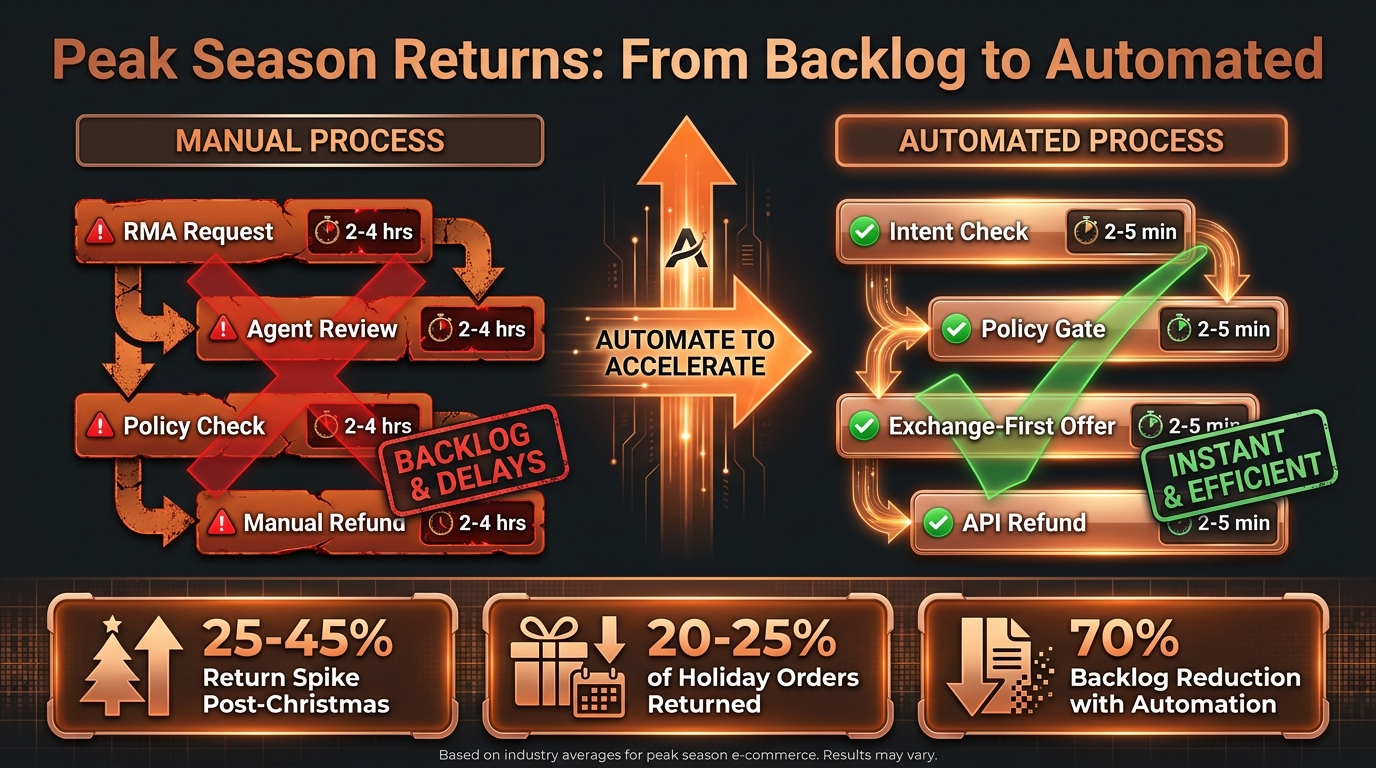
How to Handle Returns During Peak Season (Without a Refund Backlog)
Post-Christmas returns spike 25–45% above baseline, and 20–25% of all holiday orders come back within 30 days. A manual return queue that works adequately the rest of the year collapses under that volume. The fix is automating the RMA flow — intent classification, policy gate, exchange-first routing, and API-level refund execution — before peak season arrives, not during it.
TL;DR: Peak Season Returns Automation Decision Points
| Step | Manual process | Automated process |
|---|---|---|
| RMA intake | Agent reads ticket, verifies order | AI classifies intent, pulls order data |
| Policy check | Agent reviews policy doc | Encoded SOP logic evaluates eligibility in seconds |
| Exchange offer | Often skipped under time pressure | Always presented before refund path |
| Label generation | Agent creates label manually | API call generates and emails label automatically |
| Refund execution | Agent initiates in Shopify | Shopify Admin API executes on eligible requests |
| Time per return | 2–4 hours in queue | 2–5 minutes end-to-end |
Why Are Peak Season Returns Different From the Rest of the Year?
The volume is not the only problem — the composition changes too. Holiday return queues have a different mix than typical returns, and that mix is harder to process at speed.
Higher gift-purchase return rate. Gifts have a structurally elevated return rate. Size mismatches, duplicate gifts, and unwanted items all flow in during the post-holiday window. Unlike a shopper returning their own purchase, gift returns often involve different shipping addresses, gift receipts instead of order numbers, and less clarity about which resolution the customer wants.
Extended return windows create a long tail. Many brands extend their holiday return window to 60–90 days to encourage gift purchases. That's good for conversion — and it means returns from BFCM purchases arrive in January and February, not just in the two-week window after Christmas. The backlog does not clear quickly.
Elevated reverse logistics costs. Carrier capacity is constrained post-peak. Return shipping costs rise. If your automation does not aggressively route returns to exchanges and store credit, you pay more per return in reverse logistics than you would at any other time of year.
Fraud spikes alongside volume. Per Appriss Retail's 2024 returns fraud report, approximately 15% of returns are fraudulent — and the rate climbs during high-volume periods when fraudulent requests are harder to flag individually. Manual queues under peak pressure are more likely to approve returns they should escalate.
What Does the Backlog Actually Cost?
A return backlog is not just an operations problem — it is a revenue and CSAT problem.
Customer re-contact rate compounds the ticket volume. When a customer submits a return request and does not receive a response within 24–48 hours, they contact support again. Each re-contact generates a new ticket about the same underlying issue. During peak season, a backlog of 1,000 unresolved return requests can generate 400–600 additional contacts by the end of the week as customers follow up. That doubles the apparent ticket volume from returns without adding a single new return request.
Refund delays trigger chargebacks. Customers who wait more than 5–7 business days for a refund they consider approved — even if it is in a manual queue — are significantly more likely to initiate a chargeback with their bank. Chargebacks cost more per instance than the original refund and add a fee. A backlogged return queue is a chargeback risk.
Agent burnout at peak compounds post-peak hiring problems. The most experienced support agents carry the most institutional knowledge about your return policies and edge cases. If peak season overloads them for two to four weeks, they leave in Q1. The exit compounds the next year's capacity problem.
How Does Automated RMA Processing Work?
An automated returns flow does not simply approve every return faster. It executes a decision tree that your policy already implies — but that currently requires a human to apply to each ticket.
How does intent classification handle the range of peak-season return types?
Before any policy check or API call, the automated agent determines what the customer actually wants:
- Standard return: Customer wants to send the item back for a refund. Route to the RMA + policy gate flow.
- Exchange: Customer wants a different size, color, or product. Route to exchange-first flow.
- Damaged item: Customer received a damaged product. Route to damage claim flow, which may involve a replacement, refund, or carrier claim depending on your policy and the item value.
- Wrong item received: Fulfillment error, not a customer-initiated return. Route to a replacement flow; this is a cost-of-goods issue, not a return policy question.
- Gift return without order number: Gift recipient returning a purchased gift. Route to a gift receipt lookup or email-verification flow.
Each of these has a different execution path. Classifying them correctly at intake is what separates a fast automated queue from a fast automated queue that approves things it should not.
Why should you always run a policy gate before any API call?
The policy gate checks the conditions under which you will process a return automatically. Running it before any execution step prevents the automation from approving returns that fall outside your policy:
- Return window: Is the request within the eligible return period? Holiday extended windows need to be encoded here — the gate should check whether the order qualifies for the extended window, not just the standard one.
- Item eligibility: Is the item in a non-returnable category (digital goods, final-sale items, personalized or engraved products)?
- Account flags: Does the customer have a prior fraud flag, chargeback history, or an unusual return frequency that warrants human review?
- Order value threshold: Is the order above a dollar amount where you want a human to approve the return?
Requests that fail the policy gate are escalated to a human agent with the reason pre-populated in the ticket. They do not wait in the general queue — they route to a specific review queue so the escalation does not re-enter the backlog.
How does exchange-first logic work during peak season?
For every return request that clears the policy gate, the automated agent presents an exchange option before reaching the refund path. During peak season, this is worth configuring specifically:
Inventory-aware exchange offers. If you have excess holiday inventory in specific categories, configure the agent to surface those items in the exchange offer — not just the same item in a different size. A customer returning a blue sweater that did not fit may accept a red one at a discount, clearing your post-holiday inventory while retaining the revenue.
Store credit as the middle option. Between "exchange for a specific item" and "full refund," store credit is often underused. Present it explicitly: "We can send you a return label and process a full refund, or issue $X in store credit immediately — no need to wait for the return to arrive." Store credit is instant, has no reverse logistics cost, and a meaningful share of customers prefer the speed. Per common e-commerce benchmarks, immediate store credit acceptance runs 15–25% when presented explicitly.
Acceptance capture. The agent presents the exchange or store credit option, waits for the customer's response, and routes to the correct execution path based on that response. This is a two-message interaction, not a multi-day email thread.
What Guardrails Prevent Fraud and Abuse During the Surge?
Peak-season automation requires tighter guardrails than off-peak automation — the volume makes individual fraud detection harder, and the pressure to clear the queue can cause manual reviewers to approve things they would otherwise flag. Encoding guardrails in the automated flow means they run on every request, consistently.
Chargeback and fraud history check. Any customer account with a prior chargeback or confirmed fraud flag should route to human review, not automated processing. During peak season, this flag check becomes more important, not less.
Return frequency limit. A customer who has made five returns in 60 days is a different risk profile from a first-time returner. Configuring a return frequency threshold (e.g., auto-escalate after three returns in a rolling 60-day window) catches serial returners before they exploit peak-season processing speed.
Returnless refund eligibility gate. For low-value items where reverse logistics cost exceeds the item value, returnless refunds (refund without requiring the item back) are operationally sensible. But during peak season, when returnless refund policies are sometimes exploited, limit returnless refund automation to items below a specific dollar threshold and exclude high-fraud categories.
Final-sale enforcement. Holiday clearance items marked final-sale should have that tag enforced in the policy gate. The automation should not process returns for final-sale items — it should escalate them with the reason noted. An agent can then communicate the policy to the customer directly, which is a better customer experience than an automated rejection.
How Do You Scale This Without Rebuilding Your Stack?
The returns automation described here does not require replacing your helpdesk or your Shopify store. It layers a cross-platform resolution agent on top of the tools you already use.
The agent reads return requests from your existing helpdesk tickets — whether that is Zendesk, Gorgias, or Freshdesk — executes the policy gate and exchange-first logic, then calls the Shopify Admin API to generate the RMA, issue the label, and initiate the refund or exchange. The helpdesk ticket is updated with the resolution status, so the customer receives a single confirmation message and your team has a full audit trail.
This is the same architecture used for WISMO automation and general Shopify refund automation — the return-specific flow adds intent classification and exchange-first routing on top of the refund execution layer. If you have already automated refunds, adding peak-season return handling is a configuration change, not an infrastructure rebuild.
For teams thinking about how to scale e-commerce support without adding headcount, peak season returns automation is the highest-leverage use case: it addresses the ticket type that spikes hardest, requires the most repetitive decision-making, and generates the most re-contact volume when delayed.
What Should You Measure After Peak Season?
Five metrics tell you whether your peak-season returns handling worked:
Return request-to-RMA time. How long from the customer's first ticket submission to the return label in their inbox? For automated cases, this should be under 5 minutes. If it is consistently longer, check whether the policy gate is routing too many requests to human review.
Exchange acceptance rate. What percentage of return requests converted to exchanges? A rate below 10% suggests the exchange offer is not being presented effectively or the inventory selection is not compelling. Above 25% is strong for peak season.
Refund processing time. Time from RMA approval to refund initiation in Shopify. For automated cases, this should be near-instant. Delays signal an API connection issue or a policy gate misconfiguration.
Return backlog depth. How many open return tickets remained unresolved at the end of each day during the peak window? Trending this daily shows whether the automation is keeping pace with volume or falling behind.
Re-contact rate on return tickets. What percentage of customers who submitted a return request contacted support again about the same return? A rate above 15% signals resolution quality problems — customers are not getting confirmation fast enough or the resolution itself is unclear.
These metrics, tracked against your pre-automation baseline, give you a precise picture of how much the automation moved the needle — and where to tune the configuration before the next peak season.
Mustafa Bayramoglu is the founder of CorePiper (YC W19). CorePiper builds SOP-driven AI agents for cross-platform case operations across Shopify, Zendesk, Gorgias, Salesforce, and Jira.
Eliminate Your Peak Season Returns Backlog Before It Starts
CorePiper's SOP-driven agents process RMA requests, apply exchange-first logic, and execute API-level refunds across Shopify and your helpdesk — in minutes, not days. Set the guardrails once before BFCM; the agent handles every return without a ticket backlog. Book a walkthrough to see how.