
How to Scale E-commerce Support Without Hiring (BFCM-Proof Playbook)
Scale e-commerce customer support without adding headcount — even through BFCM — by automating 60–80% of tier-1 tickets with agentic AI. Staffing math, BFCM prep checklist, and a step-by-step playbook for elastic capacity.
 Mustafa BayramogluJune 18, 202610 min read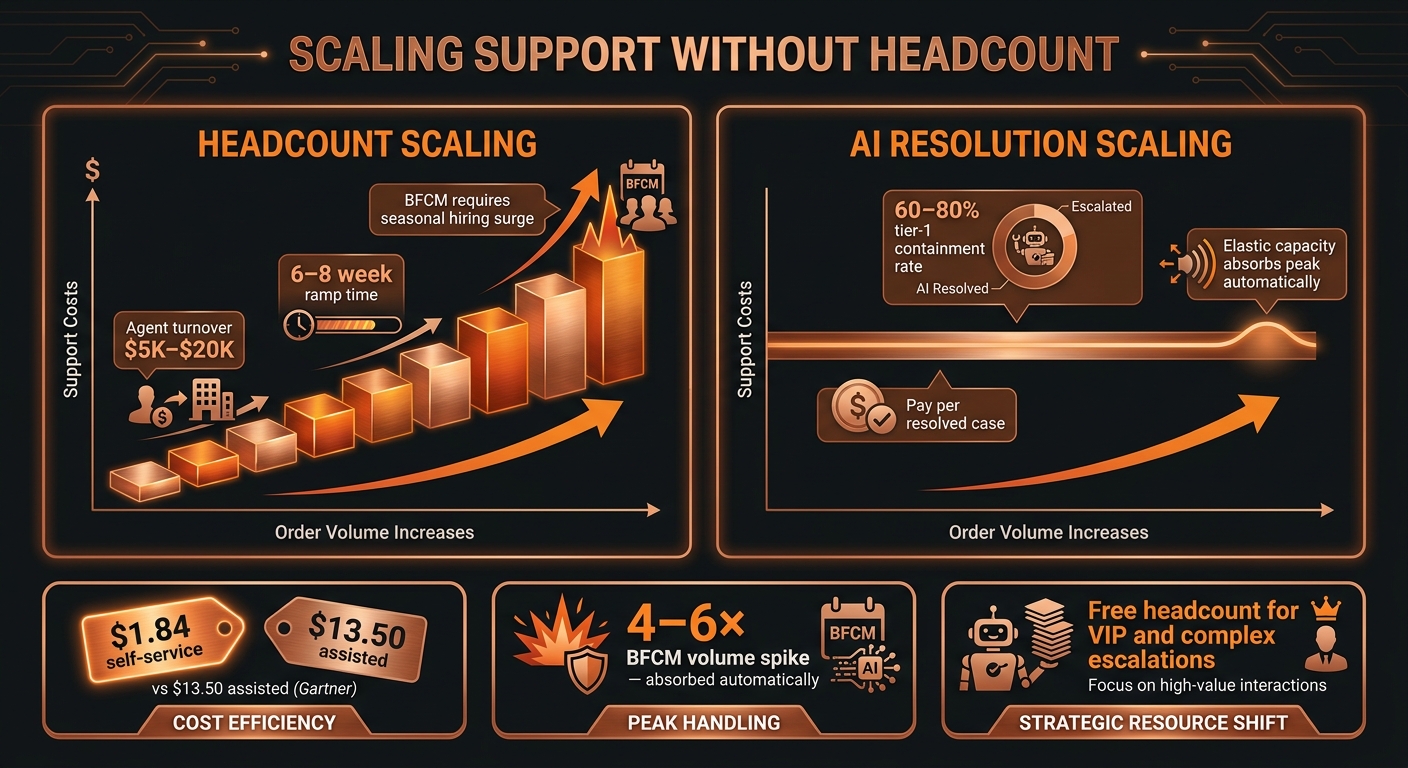
How to Scale E-commerce Support Without Hiring (BFCM-Proof Playbook)
Scaling e-commerce support without hiring means automating the 60–80% of tickets that follow defined resolution paths — WISMO inquiries, refunds, cancellations, address changes — with agentic AI that reads your systems, executes resolutions, and closes tickets without human approval, so headcount stays flat while order volume grows through BFCM and beyond.
TL;DR: Headcount Model vs. Agentic AI Model
| Traditional Headcount Scaling | Agentic AI Scaling | |
|---|---|---|
| Cost structure | Linear — more volume = more agents = more cost | Per-resolved-case — flat cost regardless of volume |
| BFCM readiness | Requires seasonal hiring 6–8 weeks before peak | Elastic capacity absorbs 4–6× spikes with zero ramp |
| Tier-1 containment | 0% — every ticket needs a human | 60–80% resolved without any human action |
| Turnover exposure | $5K–$20K per replacement, 30–45% annual rate | Zero — no headcount to turn over |
| Ramp time | 6–8 weeks to full productivity per hire | New policies live in days after SOP update |
| Peak-season CSAT | Drops under volume pressure | Flat — AI performance does not degrade with volume |
Why Does Support Cost Scale With Headcount — and When Does That Break?
The economics of human-staffed support are fundamentally linear: every increment in ticket volume eventually requires an increment in headcount, which means recruiting cost, salary, benefits, management overhead, and training. Per Gartner's published benchmark, the median cost per contact is $1.84 for self-service channels and $13.50 for assisted channels (phone, chat, email). For most growing e-commerce brands, the blended true cost runs $3–$8 per ticket once you factor in turnover and training — higher than most founders estimate. The True Cost of a Support Ticket in E-commerce covers the full math, including the 2.3× repeat-contact multiplier that inflates nominal costs.
The model breaks at two inflection points.
The first is BFCM. Retailers see 4–6× normal ticket volume across the November–December peak. You cannot hire and fully ramp six months of support capacity for a four-week surge. Seasonal hiring compresses into a few weeks, which means undertrained agents, quality regressions, and a January offboarding event that leaves you understaffed entering Q1.
The second inflection point is sustained growth. Every 2× in order volume means a near-proportional increase in support headcount if your queue is staffed by humans — support costs never improve as a percentage of revenue; they just track order growth. The structural fix is not better hiring or smarter scheduling. It is removing the proportional relationship between ticket volume and human labor for the tier-1 work that does not require human judgment.
What Does It Actually Cost to Hire and Retain a Support Agent?
Most founders undercount the true cost of a support hire. The full loaded picture:
- Recruiting cost: job posting, time-to-hire (3–5 weeks average for support roles), optional agency fee
- Salary: $35,000–$60,000 for US-based support roles (offshore BPO is lower, but quality and oversight costs offset some of the gap)
- Onboarding and training: 6–8 weeks to full productivity, during which the agent works slower and requires QA coverage
- Annual turnover: support roles average 30–45% annual churn across industries
- Replacement cost: $5,000–$20,000 per replacement, depending on seniority and the institutional knowledge lost in the gap
The compound effect: a 10-person support team at 40% annual turnover means 4 replacements per year. At $10,000 per replacement in loaded cost, that is $40,000 per year in churn-driven overhead before accounting for CSAT degradation during the ramp period. For tickets that follow a repeatable resolution path — order status, standard refund, address change — every dollar spent on turnover is avoidable.
How Does Agentic AI Replace Headcount for Tier-1 Tickets?
Agentic AI resolves tickets by taking actions, not by generating text for a human to send. The distinction matters: when a customer asks where their order is, an agentic system does not draft a response and wait for approval. It:
- Reads the helpdesk ticket (Zendesk, Gorgias, Freshdesk)
- Queries your Shopify order data for order status, tracking number, and carrier
- Calls the carrier's tracking API for real-time shipment status
- Evaluates the status against your SOP (delay threshold, exception protocol, delivered-not-received policy)
- Sends the customer a resolution response with the tracking link and next step
- Marks the helpdesk ticket "Resolved" with a full audit trail
No human touches that case. The AI does not draft for review — it closes the ticket.
This is categorically different from a chatbot that generates FAQ suggestions for an agent to copy, or a macro system that reduces typing time. For a full breakdown of how agentic systems differ architecturally, see Agentic AI for Customer Support: What It Is and Why 2026 Is the Inflection Point.
The tier-1 ticket types that fall cleanly into the automation model — and make up 60–80% of most e-commerce queues — are:
- WISMO ("Where is my order?"): order status, tracking updates, delivery confirmations — typically 30–50% of total tickets
- Refund and return requests: policy eligibility check, exchange-first logic, API-level refund execution
- Order cancellations: within-window policy check, Shopify order cancellation, confirmation
- Address changes: pre-fulfillment window check, Shopify order update, confirmation
- Subscription and billing questions: lookup and response from subscription platform data
- Shipping exception updates: proactive notification or resolution routing based on carrier exception codes
What stays with your human team: complex complaints requiring judgment, account disputes, VIP customer escalations, fraud investigations, and multi-system cases that fall outside defined SOP paths. For most stores, that is 20–40% of tickets — and it is exactly where experienced agents create value. The goal is not to eliminate your support team; it is to stop paying humans $13.50 per contact to answer "your order ships Wednesday."
For the detailed WISMO automation decision logic — filtering non-WISMO, fraud screening, status-to-answer mapping — see How to Automate WISMO Tickets on Shopify.
How Do You Absorb BFCM's 4–6× Volume Spike Without a Seasonal Hire?
BFCM is the proof case for elastic support capacity. A Shopify brand handling 500 tickets per week in September will face 2,000–3,000 tickets per week in the final days of November. No human-staffed model absorbs that cleanly without painful seasonal hiring or a CSAT collapse during peak.
Agentic AI absorbs the spike because the cost model is per-resolved-case, not per-seat. Whether your AI resolves 500 tickets this week or 3,000 next week, the architecture is identical — no additional seats to provision, no ramp time, no quality degradation from overloaded agents. The bottleneck moves from "do we have enough staff?" to "is the AI configured correctly for peak-season policies?"
That configuration work must happen before Black Friday. The five steps:
1. Extend your return window in the AI's SOP. Peak-season purchases typically qualify for returns through January 31. Update the return-window parameter so the AI does not decline December return requests for November orders.
2. Configure gift-order handling. Orders placed by one person and delivered to another need their own resolution path. Define how the AI handles return requests from gift recipients — typically: verify the order is gift-eligible, issue store credit to the gift recipient rather than refunding the original purchaser's payment method.
3. Tighten carrier exception thresholds. Delay tolerances in October (1–2 business days) are not tolerable in December. Update exception escalation logic and configure proactive delay notifications — do not wait for the customer to ask.
4. Set high-value order escalation rules. BFCM generates a higher share of large gift orders. Define an order-value threshold above which every ticket gets human review regardless of type, protecting against automated decisions on high-stakes transactions.
5. Run a test pass on your top-10 BFCM ticket types. Before live traffic, simulate each scenario through the AI: WISMO for delayed shipment, WISMO for delivered-not-received, return within window, return after window, gift return, cancellation, address change, high-value order, shipping exception, and duplicate charge. Verify the AI resolves each correctly.
The BFCM preparation window is September–October. An agentic AI system configured in November will not perform well during peak. The SOP configuration, integration testing, and policy validation need 3–6 weeks before the first November traffic arrives.
What Does a Headcount-Free Support Stack Look Like?
A practical implementation for a mid-market Shopify brand handling 200–1,000 tickets per day:
Layer 1 — Agentic AI (automated resolution) Handles WISMO, refunds, returns, cancellations, address changes, status updates. Tools connected: Shopify Admin API, carrier APIs, helpdesk read/write, returns platform (Loop, AfterShip). Containment target: 65–75% of total ticket volume. Human involvement: zero for these ticket types after SOP sign-off.
Layer 2 — Human agents (escalation handling) Handles complex complaints, fraud, VIP accounts, policy exceptions, multi-system disputes. Volume: 25–35% of total tickets after AI containment. With AI containing 70%, you need roughly one-third the headcount required for an equivalent purely human-staffed operation.
Layer 3 — Assisted escalation (hybrid) For tickets the AI cannot fully resolve: AI pre-populates the case with pulled data (order details, tracking history, prior contacts, account tier) before routing to a human. The agent does not start from a blank ticket — they start from a pre-researched context. This reduces human handle time on escalations by 40–60% even for cases AI cannot close.
For a comparison of tools that support this layered model — covering resolution depth, integration breadth, setup time, and pricing — see Best AI Agents for Customer Support in 2026.
Which Metrics Tell You the Model Is Working?
Containment rate — the percentage of total tickets fully resolved by AI without human action. Target: 60% within 90 days, 70–75% at steady state. Warning signal: below 50% after 60 days means SOP coverage is incomplete — the AI is escalating tickets it should be resolving because the policy for that ticket type has not been configured.
Cost-per-resolution — total support cost (AI plus human labor) divided by total tickets resolved. Target: flat or declining as ticket volume grows. Warning signal: cost-per-resolution rising with volume means AI is not absorbing growth; it is adding overhead while humans still handle most cases.
Peak-to-off-peak CSAT delta — the difference between your CSAT score during BFCM and your CSAT score in a normal September week. In a human-staffed model, CSAT drops at peak because agents handle more volume under more pressure. In an AI-first model, CSAT should be flat across the year — AI performance does not degrade with volume the way human teams do. A flat CSAT curve through November–December is the clearest single proof-point for headcount-free scaling.
AI-to-human ticket ratio — AI resolutions as a share of total resolutions, tracked monthly. Should increase over time as AI handles more of the growing base volume while the human team handles a roughly constant escalation count. If this ratio is not improving after the first quarter, it signals the AI's SOP coverage needs to expand to handle more ticket types.
Mustafa Bayramoglu is the founder of CorePiper (YC W19). He writes on support operations, agentic AI, and the economics of autonomous customer resolution.
See how CorePiper automates tier-1 support across Shopify, Zendesk, and Salesforce →
Scale Support Through BFCM Without Adding Headcount
CorePiper's agentic AI resolves tier-1 tickets end-to-end across Shopify, Zendesk, Freshdesk, Salesforce, and Jira — so your team handles order volume growth without every new order generating a new hire. Book a 30-minute walkthrough to map your support volume to a headcount-free model before peak season.