
Exchange-First Returns: The Economics That Recover 20–40% of Refund Revenue
Exchange-first returns routing routes customers to an exchange offer before the refund path. Brands that implement it correctly recover 20–40% of refund revenue and reduce reverse logistics costs. Here's the full unit economics breakdown.
 Mustafa BayramogluAugust 23, 202611 min read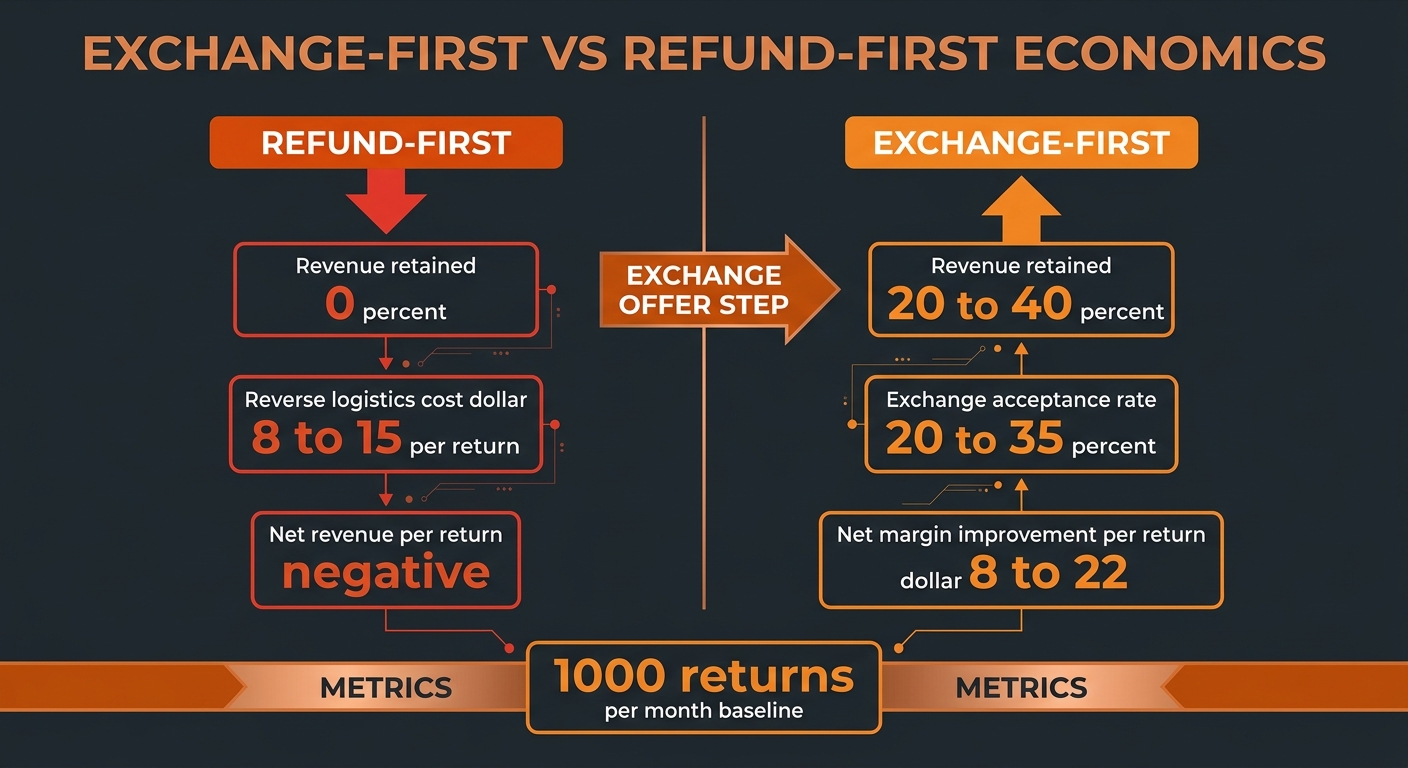
Exchange-First Returns: The Economics That Recover 20–40% of Refund Revenue
Exchange-first returns routing presents customers with an exchange offer before the refund path. When implemented correctly — with relevant alternatives, policy-gate checks, and automated execution — brands recover 20–40% of refund revenue, reduce net return costs, and increase customer lifetime value compared to refund-first policies that treat every return as a loss.
TL;DR: Exchange-First vs. Refund-First Unit Economics
| Metric | Refund-first | Exchange-first (25% acceptance) |
|---|---|---|
| Revenue retained per return | $0 | $21.25 (at $85 AOV) |
| Reverse logistics cost | $8–$15 (parcel) | Same — applies to both paths |
| Net revenue impact per 1,000 returns | −$85,000 | −$63,750 |
| Exchange acceptance rate | N/A | 15–40% depending on category |
| Gross margin recovery vs. refund-first | 0% | 25–40% of refund volume |
| Automation dependency | Optional | Required for consistent presentation |
At 1,000 monthly returns and an $85 average order value, exchange-first routing with a 25% acceptance rate recovers approximately $21,250 in revenue per month that would otherwise leave as refunds. That figure compounds: over 12 months, it represents $255,000 in retained revenue — without acquiring a single new customer.
What Is Exchange-First Returns Routing?
Exchange-first routing is a policy enforcement pattern applied at the start of the return resolution flow. When a customer submits a return request, the automated system:
- Classifies the intent — is this a size issue, unwanted gift, defective item, or change of mind?
- Gates on policy eligibility — is the order within the return window and eligible under your return terms?
- Presents an exchange offer before routing to the refund path — alternative sizes, a replacement unit, or store credit
- Routes based on the customer's response — accepted exchanges proceed to exchange execution; declined exchanges proceed to the standard refund
The key distinction from a standard return flow is step 3. Most return processes present refund as the default path, with exchange as an opt-in the customer must discover. Exchange-first reverses that default: the exchange offer is the first presented option for all eligible requests, and refund is what happens when the customer declines.
This is not the same as blocking refunds. Customers who decline the exchange proceed to the refund path without additional friction. The policy is about sequencing, not coercion.
How Much Revenue Does Exchange-First Actually Recover?
The revenue recovery depends on three variables: return volume, average order value, and exchange acceptance rate. The math is straightforward.
Refund-first baseline: Every return in the eligible window results in a refund. Revenue impact equals negative return volume × average order value. On 1,000 monthly returns at $85 AOV, that is −$85,000 per month before reverse logistics costs.
Exchange-first scenario: Apply exchange-first routing to all eligible returns. Assume a 25% exchange acceptance rate — conservative for apparel, realistic for general merchandise. 250 returns convert to exchanges; 750 proceed to refunds.
- Revenue retained via exchanges: 250 × $85 = $21,250
- Revenue lost via refunds: 750 × $85 = $63,750
- Net revenue impact: −$63,750 (vs. −$85,000 refund-first)
- Monthly recovery: $21,250
- Annual recovery: $255,000
Reverse logistics costs are similar across both scenarios for the 25% that exchange — the original item still comes back. The difference is the revenue on the outbound exchange order, which offsets the cost of the return.
For brands with high-margin products, the recovery is even more pronounced. A 60% gross-margin brand recovering $21,250 in monthly exchange revenue retains approximately $12,750 in gross profit that would otherwise be zero.
What Is a Realistic Exchange Acceptance Rate?
Exchange acceptance rates vary by category, how the offer is presented, and whether the exchange is automated or agent-dependent.
Category benchmarks:
- Apparel (size exchanges): 30–45% acceptance when the correct size is available and offered immediately
- Footwear: 25–35% — similar dynamics to apparel
- Electronics and accessories: 15–20% — customers returning electronics more often want cash back
- General merchandise: 15–25% — lower because exchange relevance is harder to determine
- Gifts: 20–30% — customers often want a different item rather than cash
Presentation factors that move acceptance rate:
- Pre-populated alternatives (correct size, same SKU in a different color) convert 2–3× better than generic "select an exchange" prompts
- Offer timing matters — acceptance is highest when the offer appears immediately, before the customer has started the mental process of receiving their refund
- Store credit with a small uplift (offer $90 credit on an $85 return) converts meaningfully better than a direct-SKU exchange for some categories
- Agent-presented offers underperform automated offers — agents forget to present, present incorrectly, or present too late in the conversation
Automated vs. manual presentation: Brands that implement exchange-first in automated return flows — where the offer runs on every eligible ticket — consistently see 1.4–2× higher acceptance rates than brands relying on human agents to present the option. The reason is consistency: agents present when they remember and when the customer doesn't seem determined; automation presents every time.
How Do You Calculate the ROI of Exchange-First Routing?
The ROI calculation requires four inputs: return volume, average order value, exchange acceptance rate, and implementation cost.
Step 1: Establish the refund baseline Monthly returns × AOV = monthly refund revenue loss (before reverse logistics). This is your baseline cost.
Step 2: Apply the exchange acceptance rate Monthly returns × acceptance rate × AOV = monthly revenue recovered via exchanges. This is the exchange-first benefit.
Step 3: Account for reverse logistics (same across both paths) Reverse logistics cost applies to both scenarios — the returned item comes back regardless of whether the resolution is a refund or an exchange. Net logistics impact is approximately neutral unless the exchange acceptance rate meaningfully reduces the volume of items returned (rare — most exchanges still involve returning the original item).
Step 4: Add implementation cost Automated exchange-first routing implemented via an SOP-driven AI agent typically costs significantly less than the first month's revenue recovery when deployed at meaningful return volume. Manual policy updates to an existing return portal cost less but deliver lower acceptance rates.
Step 5: Calculate payback period Monthly revenue recovery ÷ implementation cost = payback period in months. At the revenue recovery rates in the scenario above, payback is typically under 60 days for brands processing more than 500 returns per month.
What Does Exchange-First Automation Look Like in Practice?
Implementing exchange-first correctly requires automation — not just a policy. The manual alternative (train agents to present exchanges) is too inconsistent and too slow to capture the full acceptance rate opportunity.
A working automated flow looks like this:
Intent classification: The return request arrives via helpdesk ticket or return portal submission. An AI agent classifies the intent — size issue, unwanted, defective, wrong item — to determine whether an exchange is likely to be relevant. A defective-item claim should route differently than a size exchange request.
Policy gate: Before presenting the exchange offer, the system checks eligibility: is the order within the return window? Is the item on the non-returnable list? Does the customer have a fraud or chargeback flag? Ineligible requests route to human review rather than the exchange-first path.
Exchange offer presentation: For eligible requests, the agent presents pre-populated alternatives — the correct size, a replacement unit, or a store credit amount — before routing to the refund path. The offer is presented in the same channel where the return request arrived (helpdesk reply, return portal modal, email).
Path execution: If the customer accepts the exchange, the agent executes the exchange order via the Shopify Admin API and generates an RMA for the original item. If the customer declines, the agent routes to refund execution using the same Shopify Refunds API. Both paths close the ticket with a confirmation.
This flow is covered in detail in the Shopify refund automation guide, which walks through the API-level execution for both the exchange and refund branches, including the guardrails that prevent incorrect approvals. For handling elevated return volumes during peak periods, the peak season returns guide covers surge-mode configuration.
When Does Exchange-First Logic NOT Make Sense?
Exchange-first routing applies to the majority of return requests but fails in three specific scenarios — and sending the wrong offer in these cases increases escalation risk.
Defective or damaged items: A customer returning a defective product is not interested in an exchange offer before the defect is acknowledged. The correct first step is confirming the defect and determining whether the resolution is a replacement or a refund. Presenting an exchange offer before acknowledging the problem reads as dismissive and increases re-contact rate.
Out-of-stock items: If the requested variant (size, color, SKU) is out of stock and no comparable alternative is available, the exchange offer has no substance. Generic store credit may still convert, but a specific-SKU exchange offer that leads to "that item is unavailable" is worse than routing directly to refund.
High-risk customer accounts: Customers with prior chargeback history or confirmed return fraud patterns should not receive exchange offers before their return request is verified. Routing high-risk accounts through standard exchange-first logic increases exposure — they are more likely to keep the exchanged item and dispute the original charge. These accounts should route to human review first.
Identifying these exceptions requires guardrails in the classification step — the same guardrails documented in the return fraud prevention guide apply to the exchange-first path.
How Do You Implement Exchange-First Routing Without Engineering Lift?
The barrier most brands cite is engineering: connecting the return portal, helpdesk, and Shopify requires integration work that a small operations team cannot execute quickly.
Two practical paths exist:
Return portal configuration: Most Shopify return portals (Loop Returns, AfterShip Returns, Narvar) include exchange-first logic as a configurable option. Enabling it requires policy configuration in the portal — setting the exchange window, eligible SKU categories, and alternative presentation rules — but no custom development. The limitation is that portal-based exchange-first logic only applies to returns initiated through the portal, not to return requests that arrive via helpdesk or email.
SOP-driven AI agent: An AI agent connected to Shopify and your helpdesk can apply exchange-first logic to every return request regardless of how it arrives — portal, helpdesk ticket, email, or chat. The agent reads the intent, queries Shopify for alternatives, presents the offer, and executes the accepted path. This approach applies exchange-first consistently across all return channels and generates the higher acceptance rates from automated presentation rather than agent scripts.
The SOP-driven approach is what CorePiper implements: the exchange-first decision logic is encoded as a standard operating procedure, and the agent executes it on every eligible ticket. The SOP can be tuned — adjusting acceptance thresholds, alternative presentation rules, or store-credit uplift percentages — without engineering changes.
The Business Case Summary
Exchange-first returns is not a customer experience initiative dressed in economics language. It is a direct revenue recovery lever that changes the unit economics of returns without increasing reverse logistics costs, reducing customer satisfaction, or requiring new product investment.
The numbers are consistent: brands processing more than 500 returns per month with AOVs above $60 recover meaningful revenue at 20–35% exchange acceptance rates. The automation pays back within 60 days at that volume. The long-term compounding effect — customers who accept exchanges instead of refunds have higher repeat purchase rates — is additional upside that the unit economics above do not capture.
What exchange-first requires is consistent, automated presentation on every eligible return. That is the only way to access the full acceptance rate opportunity. Manual agent presentation is inconsistent; portal-only logic misses the requests that arrive via other channels. An SOP-driven agent that applies the same logic to every return ticket — regardless of channel — is the implementation that delivers the full economics.
If you want to see what the unit economics look like at your specific return volume, average order value, and category mix, book a walkthrough with the CorePiper team.
Mustafa Bayramoglu is the founder of CorePiper (YC W19) and has worked on SOP-driven AI automation for enterprise operations teams since 2019.
Implement Exchange-First Logic That Runs on Every Return Ticket
CorePiper's SOP-driven agents classify return intent, present exchange offers, and execute the accepted path via the Shopify Admin API — without engineering lift or manual review queues. The exchange logic runs on every eligible ticket, not just the ones a human catches. Book a walkthrough to see the unit economics for your return volume.