
How to Prevent Return Fraud Without Punishing Good Customers
Return fraud costs U.S. retailers an estimated $103 billion a year. Here's how to stop it with risk-based tiered enforcement and targeted friction at submission — without blocking legitimate returns from honest customers.
 Mustafa BayramogluJuly 8, 202611 min read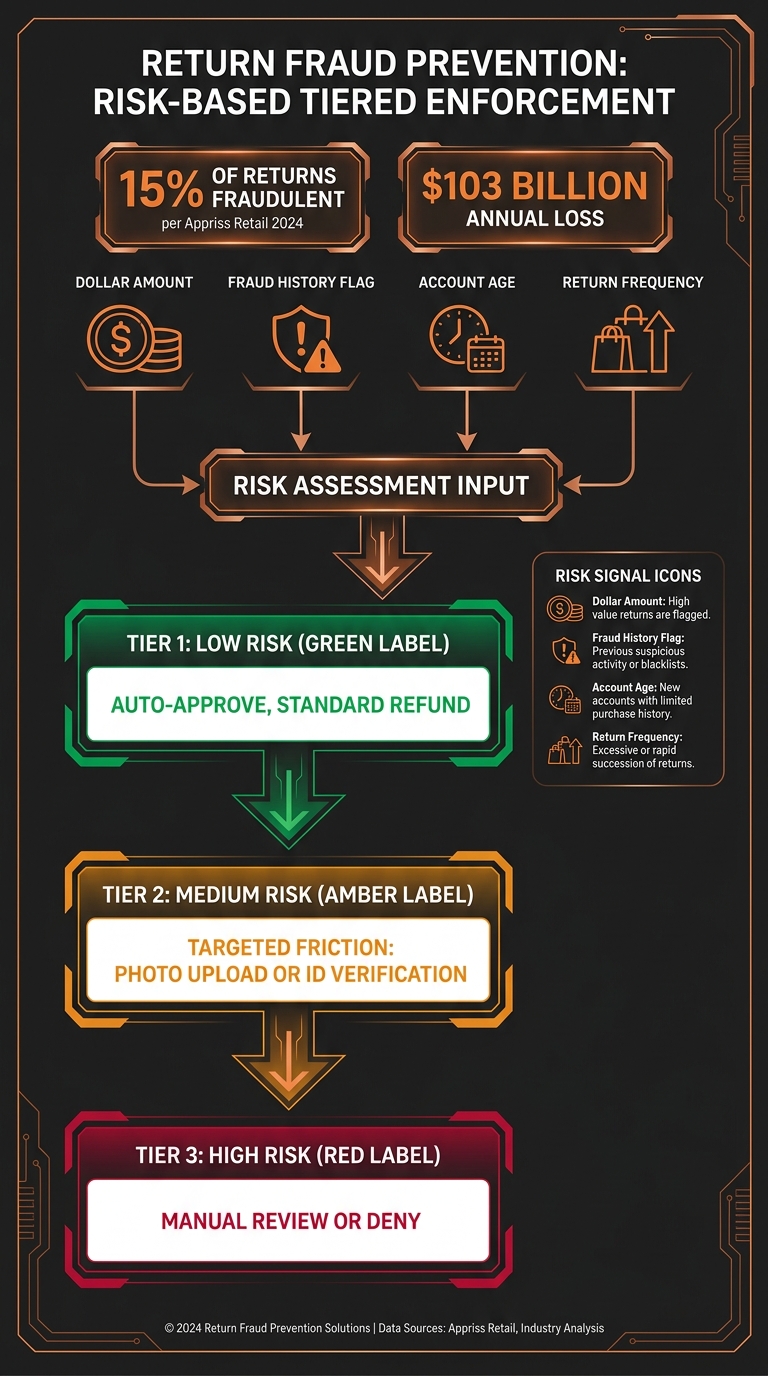
How to Prevent Return Fraud Without Punishing Good Customers
Return fraud costs U.S. retailers an estimated $103 billion a year — roughly 15% of all returns, per Appriss Retail's 2024 data. The right answer is not a blanket restrictive policy that adds friction for every customer. It is a risk-based tiered system that auto-approves the 80–85% of returns that are legitimate, and routes targeted friction only to the subset of requests that show actual fraud signals.
TL;DR: Risk-Based Return Fraud Prevention
| Tier | Risk Profile | Response | Customer Experience |
|---|---|---|---|
| Low | First return, in-window, low-value, no history | Auto-approve + API execution | Seamless — minutes, no friction |
| Medium | Repeat returner, mid-value, ambiguous signals | Request photo or one verification step | Minor friction — 1 extra step |
| High | Chronic returner, prior dispute, high-value, high-risk category | Manual review or deny | Full review — human makes call |
| Blocked | Active chargeback, confirmed fraud history | Deny automatically | No processing |
Why Is Return Fraud So Hard to Stop Without Alienating Customers?
The core tension is that your highest-value customers often look like your highest-risk ones — not because they are fraudulent, but because they buy more, return more, and have more interactions that trigger threshold alerts.
A customer who returns three times in a quarter because they are actively buying and trying different sizes is a strong retention signal, not a fraud signal. A customer who returns three times in a quarter by submitting items that never left their house is exactly the fraud you want to catch. Undifferentiated policies — "returns require photo verification after two in 90 days" — hit both groups the same way. The first customer gets annoyed and churns. The second learns to route around your rule.
The solution is not a simpler policy. It is a richer signal set evaluated at submission. Frequency alone is a weak signal. Frequency combined with account age, category, order value, return condition, and dispute history is a much stronger one. The brands that reduce fraud without hurting CSAT have moved from rule-of-thumb thresholds to multi-signal risk scoring evaluated case by case.
What Are the Most Common Types of Return Fraud?
Understanding fraud types helps you build the right signal set for detection:
Wardrobing (or "renting"). The customer purchases an item, uses it, and returns it as unworn or unused. Most common in apparel, electronics, and sporting goods. Detection signals: item returned in different condition than shipped, high-value items in categories with known wardrobing patterns, first return shortly after a major event or holiday.
Empty box or wrong item returns. The customer sends back an empty box, a rock, or a different (lower-value) item and claims a refund for the original. Detection signals: package weight mismatch at return receipt, return of item with different SKU, customer account has prior disputes.
Claim-and-keep. The customer reports an item as "not received" or "defective" and requests a replacement, then keeps the original. Detection signals: "not received" claims on orders with confirmed carrier delivery scans, same customer making multiple non-delivery claims, delivery address inconsistencies.
Friendly fraud (chargeback abuse). The customer disputes the charge directly with their bank after receiving the item, bypassing your return policy entirely. Detection signals: prior chargeback history on account, high-value order, customer contacted support shortly before dispute was filed.
Policy stacking. The customer combines extended return windows (holiday, promotional) with price adjustments or price protection to extract more value than the purchase cost. Detection signals: return submitted specifically during extended-window periods, item purchased at sale price but return credit requested at full price.
How Does a Risk-Based Tier System Work?
A tiered system applies different responses to different fraud-risk levels, evaluated at the moment of submission. The logic runs before any action is taken — before an RMA is created, before a label is generated, before any refund is initiated.
Tier 1 — Low risk: auto-approve. The customer's signals are all within normal bounds: first or second return in 90 days, order value below your threshold, no prior disputes, return window is valid, item category is not high-fraud. The agent approves the return, creates the RMA, sends the label, and queues the refund — no human involvement needed. This tier should capture 75–85% of your return volume.
Tier 2 — Medium risk: targeted friction. One or more signals fall outside normal bounds, but nothing conclusively indicates fraud. The agent pauses the auto-approval path and presents the customer with one additional step: typically a photo of the item in its current condition, or a confirmation link sent to the email on file. If the step is completed, the return proceeds. If it is not completed within 48 hours, the request escalates to Tier 3. This tier typically captures 10–20% of return volume.
Tier 3 — High risk: human review or deny. Multiple fraud signals are present — chronic return behavior, prior dispute history, high-value order in a high-risk category, or a pattern that matches known fraud vectors. The agent creates a human-review task with the full signal summary and pauses the return pending a decision. A human reviews and either approves with additional conditions, requests more documentation, or denies with the policy basis stated. Automatic denial (without human review) is appropriate only for accounts with confirmed prior fraud on file.
What Signals Indicate High Fraud Risk at Submission?
Not all fraud signals carry equal weight. A single signal is a weak predictor; a cluster of signals in the same return request is much stronger. Build your tier logic around signal combinations, not single rules.
High-weight signals: Prior chargeback or dispute on the account. Active fraud tag applied by your fraud-scoring tool. Return of a high-value item in a category with elevated wardrobing rates (apparel above $150, electronics above $200). Return submitted immediately after a major purchase spike (indicative of claim-and-keep).
Medium-weight signals: Third or subsequent return in a 90-day window. Return submitted unusually quickly after delivery (under 2 days for non-defective claims). Return value significantly exceeds purchase price (gift-card or discount stacking). Return of final-sale or promotional item where policy explicitly excludes returns.
Lower-weight signals (require combination): Second return in 90 days alone. High order value without other flags. New account (under 30 days old) on a low-value order.
The signals you have access to depend on your stack. Shopify provides order history, tags, and transaction data. Your helpdesk stores dispute flags and prior interaction history. A dedicated fraud-scoring integration (like Signifyd or NoFraud) adds machine-learning-based risk scores at the order level. Connecting all three at return submission time gives your agent the full picture.
How Do You Apply Targeted Friction Without Blocking Good Customers?
The key is that friction must be proportional and single-step. Adding multiple verification requirements — photo plus ID plus waiting period — causes even legitimate customers to abandon returns and contact support to complain. One clearly explained step, delivered with empathy, is what keeps CSAT stable.
Photo verification is the most effective single friction step for wardrobing and condition-related fraud. The request should specify exactly what photo is needed ("a photo of the item with the original tags attached" or "a photo showing the defect you mentioned") and give a clear deadline. Photo verification auto-approves the return if completed within 48 hours.
Confirmation link works for claim-and-keep fraud where the customer's stated address does not match delivery confirmation. Sending a confirmation to the email on file verifies that the request is coming from the account holder and eliminates opportunistic third-party claims.
Returnless refund with photo is appropriate for high-risk items in mid-tier returns where the cost of reverse logistics (shipping, inspection, restock) approaches the refund value. The customer sends the photo, you issue the refund and tell them to keep or donate the item. This eliminates the return-logistics cost while still requiring evidence.
Internal note on implementation: friction steps must be executed at the helpdesk layer and confirmed before any refund or RMA API call fires. Platforms like CorePiper that handle end-to-end return automation can gate the execution on the friction step completion — the refund API call only runs after the photo is received and logged, not when the return request is first submitted.
How Should You Set Up Return Fraud Detection Logic in Practice?
The implementation sequence matters. Brands that try to deploy fraud detection on top of a fully manual return process add overhead without removing it — the agent detects fraud but a human still processes every return. The right sequence:
Step 1: Automate the legitimate-return baseline first. Before adding fraud detection, make sure your auto-approval path works end-to-end for low-risk returns: the agent reads the order, checks the return window, verifies eligibility, and executes the refund via the Shopify Admin API. Reference how to automate refunds in Shopify for the API sequence and guardrail structure. If the auto-approval path is not working cleanly, adding fraud tiers on top will create confusion about whether failures are fraud-detection or automation errors.
Step 2: Connect customer history data. Extend your return agent's data access to include the customer's prior return history, dispute flags, and account age. Without this, fraud detection is limited to order-level signals (item value, category) and misses the customer-level patterns that catch chronic abusers.
Step 3: Deploy tiered routing with a conservative initial calibration. Start with high thresholds for Tier 3 escalation — only route to manual review when three or more high-weight signals are present simultaneously. This avoids false-positive overload on your human review queue during the calibration period. Tighten thresholds over the first 30 days as you validate signal accuracy.
Step 4: Build the friction step into your helpdesk flow. The photo request or confirmation link should be sent as an automated message from your helpdesk (Zendesk, Gorgias, or Freshdesk), with the original ticket held in a pending state. The agent monitors the ticket for the customer's response, and proceeds to refund execution when the step is complete or escalates at 48 hours if not.
Step 5: Review the human-escalation queue weekly. Every case that went to Tier 3 is data. Review patterns: what signals clustered on the cases you approved vs. denied? Are specific product categories generating false positives? Are new fraud vectors appearing that your current signal set is missing? Recalibrate thresholds monthly.
What Metrics Tell You If Your Fraud Prevention Is Working?
Track these five metrics from week one:
False positive rate: The percentage of Tier 2 or Tier 3 escalations that were approved on review with no fraud found. A false positive rate above 20% in Tier 2 means your thresholds are too aggressive — legitimate customers are experiencing unnecessary friction.
False negative rate: Fraudulent returns that cleared the auto-approval path. Measured by sampling approved returns for condition inconsistencies, claim-and-keep patterns, or post-refund chargebacks. You will never catch 100% — target below 5% of return volume.
Friction step completion rate: The percentage of Tier 2 customers who complete the photo or verification step. A completion rate below 60% may indicate that your friction request is unclear or too burdensome. Above 85% is healthy — it means legitimate customers are completing it and fraudsters may be abandoning.
Manual review queue resolution time: The time from Tier 3 escalation to human decision. If this exceeds 24 hours, your queue is under-resourced relative to fraud volume, and customers in legitimate Tier 3 escalations are experiencing unacceptable delays.
CSAT on returns: Tracked separately for Tier 1 (auto-approved), Tier 2 (friction required), and Tier 3 (manual review). CSAT in Tier 1 should be comparable to your non-return CSAT. Tier 2 CSAT will typically be 5–10 points lower; if it drops further, the friction step needs simplification. WISMO and returns are the two categories most likely to drive repeat contacts — a second contact on the same return is a signal that friction caused confusion rather than deterrence.
The Takeaway
Return fraud is a real and growing cost — but blanket policies that add friction for every customer trade one cost for another. The brands that solve this without CSAT damage apply risk signals at submission, auto-approve the legitimate majority, and reserve friction and manual review for the minority that actually shows fraud indicators. That distinction requires encoded SOP logic with access to customer history data at the moment of submission — not a document-based bot, and not a manual review queue applied to every return. Build the auto-approval baseline first, then layer tiered fraud detection on top. Calibrate weekly. The return queue gets faster for honest customers and harder to exploit for dishonest ones.
Mustafa Bayramoglu is a YC W19 alum and founder with experience in enterprise operations automation. CorePiper is an SOP-driven AI agent platform for cross-platform case operations across Shopify, Zendesk, Freshdesk, Salesforce, and Jira.
Stop Return Fraud at Submission — Not After the Fact
CorePiper's SOP-driven agents evaluate every return request against your fraud signals at the moment of submission: auto-approving low-risk returns in minutes and routing suspicious ones to human review. No blanket policies, no lost CSAT. Book a 30-minute walkthrough.