
Returnless Refund Decisioning: When the Math Works to Skip the Physical Return
Returnless refund decisioning is the process of issuing a refund without requiring the customer to ship the item back. When done with a rules-based decision framework, it cuts reverse logistics costs, speeds resolution, and preserves margin. Here's the complete decision framework.
 Mustafa BayramogluAugust 24, 202614 min read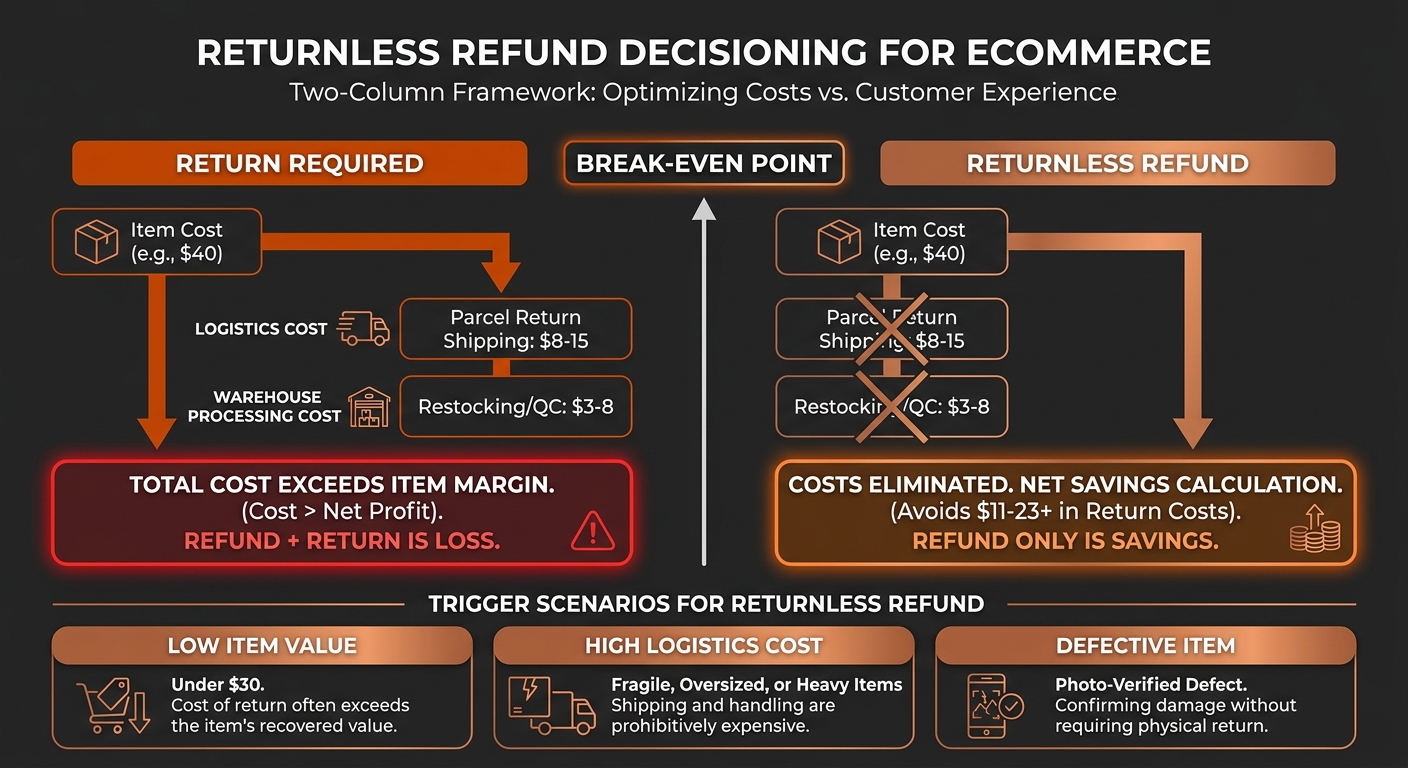
Returnless Refund Decisioning: When the Math Works to Skip the Physical Return
A returnless refund issues a refund without requiring the customer to return the item. When the cost of processing a physical return — shipping, handling, inspection, restocking — exceeds the recoverable value of the item, requiring the return costs more than skipping it. A rules-based decisioning framework identifies which tickets qualify, applies fraud guardrails, and routes eligible requests to automatic approval — cutting resolution time from days to minutes on the items where the math clearly works.
TL;DR: The Returnless Refund Decision Framework
| Factor | Standard Return Path | Returnless Refund Path |
|---|---|---|
| Trigger | Item value above threshold | Item value below threshold OR defective |
| Reverse logistics cost | $13–$29 (shipping + handling + inspection + restock) | $0 |
| Resolution time | 7–21 days (transit + processing) | Same day |
| Customer satisfaction | Neutral (process is expected) | High (no shipping hassle) |
| Fraud risk | Lower (physical item required) | Higher without risk screening |
| Break-even threshold | Varies by category | Typically $10–$30 per item |
| Decision mechanism | Standard RMA workflow | Automated policy gate + risk check |
The decision is not about customer generosity. It is about cost structure: when the total cost of the return workflow exceeds the refund amount, requiring the return generates a net loss while delaying resolution for everyone involved.
What Is Returnless Refund Decisioning?
Returnless refund decisioning is the systematic process of evaluating each return request against a predefined set of rules to determine whether issuing a refund without a physical return is economically rational and policy-appropriate.
The evaluation happens at ticket submission, before a human reviews or a return merchandise authorization (RMA) is generated. The decision logic checks:
- Item value — is the refund amount below the reverse logistics cost threshold?
- Item category — is this a category where items cannot be resold (consumables, personalized goods) or where logistics costs are disproportionately high (fragile, oversized)?
- Claim type — is this a defect or damage claim where the item cannot be resold regardless of whether it returns?
- Customer risk profile — does this account have prior fraud flags, chargeback history, or claim frequency above threshold?
Requests that pass the first three gates and clear the risk check route to returnless approval. Requests that fail any gate route to the standard return path or to human review.
This is the mechanistic difference between a returnless refund policy (a written rule about when to allow it) and returnless refund decisioning (automated evaluation of each ticket against that policy). A policy without decisioning relies on agents to remember and apply the rule consistently — which they do not. Decisioning runs the rule on every eligible ticket.
The Reverse Logistics Cost Math
The central calculation is straightforward: compare the total cost of the return workflow to the refund amount. If total workflow cost exceeds refund amount, requiring the return generates a net loss.
Standard parcel return cost breakdown:
- Return shipping label cost: $8–$15 (carrier + class-dependent; often less with volume rates)
- Warehouse receiving and sorting: $2–$4 per item
- Inspection and quality check: $1–$3 per item
- Restocking (if resalable) or disposal (if not): $1–$3 per item
- Processing and system update overhead: $0.50–$1.50 per item
Total: $12.50–$26.50 per standard parcel return
At a $20 refund on a $20 item, requiring the return costs approximately the same as the refund — and often more when you include the labor cost of processing the RMA, communicating with the customer, and handling the exception if the return arrives damaged or outside the window. The item's resale value after return processing is the critical variable: if the item cannot be resold (defective, personalized, consumable, low-quality), the return generates zero incremental value regardless of cost.
Oversized and freight categories are more extreme. LTL parcel returns run $40–$90 per shipment. For any item with a unit value below $90, requiring a freight return is economically irrational on its face. This is why furniture, large appliance, and industrial equipment brands have used returnless refund policies for decades — long before the term existed.
Setting the Returnless Refund Threshold
The break-even threshold is the maximum refund amount at which a returnless resolution costs less than a standard return. The formula:
Break-even threshold = reverse logistics cost ÷ (1 − item resale recovery rate)
For a standard parcel with $18 total reverse logistics cost and a 60% resale recovery rate on returned items:
Break-even = $18 ÷ (1 − 0.60) = $18 ÷ 0.40 = $45
Below $45, a returnless refund is cheaper. Above $45, requiring the return is more economical assuming the item is resalable.
Most brands do not calculate this precisely. They pick a round number — $20, $25, $30 — based on rough logistics cost knowledge and adjust it over time. The directional estimate is sufficient for policy purposes; exact optimization matters when return volume is high enough to make small threshold changes material.
Category-specific threshold considerations:
- Apparel (standard parcel): $20–$35 threshold is typical. Garments are frequently not resalable after return (fitting room effect, sanitation concerns) which raises the effective threshold — if the resale recovery rate is low, the break-even is higher.
- Electronics and accessories: $15–$25 threshold. Higher resale recovery rate (items are often resalable), so the break-even is lower than apparel.
- Consumables and perishables: Returnless by default. Returned consumables cannot be resold; the only question is whether to require the return for fraud-deterrence purposes (usually not worth it for low-value items).
- Oversized and freight: $50–$100+ threshold. Reverse logistics cost is the dominant factor.
- Personalized or custom goods: Returnless by default unless the customer wants to dispute — personalized items have zero resale value.
The Four Decision Gates
A working returnless refund decisioning system evaluates each return request against four sequential gates. A request fails out of the returnless path as soon as it fails any gate.
Gate 1: Item value check Is the refund amount at or below the category threshold? If yes, continue to Gate 2. If no, route to standard RMA.
This is the most straightforward gate. It runs a simple comparison against a configurable threshold by product category or SKU.
Gate 2: Claim type classification Is the claim type one where a physical return is operationally necessary? Defective item, wrong item received, and damaged-on-arrival claims all qualify for returnless consideration — the item cannot be resold regardless. "Change of mind" and "no longer needed" claims on items above the value threshold should route to standard return (the item is resalable and the customer's preference, not a defect, is the reason for return).
Photo verification applies here for damage or defect claims above a sub-threshold: require photographic evidence of the claimed defect before approving returnless on damage grounds. This gate prevents opportunistic damage claims on items that are actually in working condition.
Gate 3: Customer risk screening Does the customer account have prior fraud flags, chargebacks, or claim frequency above your threshold? High-risk accounts do not receive automatic returnless approval regardless of item value. Route them to human review.
Risk screening criteria typically include:
- More than N returnless refunds in the trailing 12 months (e.g., 2 or 3 depending on order volume)
- Any open or recent chargeback dispute
- Flagged accounts from a return fraud scoring system
- Order-to-return ratio above threshold (e.g., returning more than 40% of purchases)
Gate 4: Policy eligibility Final check: is the item in a non-returnable category that requires special handling? Gift cards, downloadable products, and health/personal care items often have blanket returnless policies that override the value threshold in the other direction (returnless by default, not by exception). Check category-level policy flags before routing.
Requests that clear all four gates route to returnless approval and refund execution. The refund processes via the standard Shopify Refunds API (or your payment gateway) without generating an RMA.
How Returnless Refund Decisions Interact with Exchange-First Routing
Returnless refund decisioning and exchange-first returns routing address different scenarios but can coexist in the same return SOP.
Exchange-first routing applies when the item is valuable enough to justify a return and the customer is likely to want an alternative (size exchange, replacement unit). Returnless refund decisioning applies when the item is not worth recovering physically.
The sequencing in a combined SOP looks like this:
- Classify intent (defective, wrong item, size issue, change of mind)
- Apply exchange-first gate — is this a size or preference issue where an exchange offer is relevant?
- If exchange is declined or not applicable, apply returnless gate — does the item value and claim type qualify?
- If returnless is approved, execute refund and close
- If returnless is not approved, generate RMA and route to standard return
This ordering means exchange-first captures the revenue retention opportunity first, and returnless captures the cost reduction opportunity second. Both run before the standard return path.
Fraud Guardrails for Returnless Refund Programs
The primary risk of returnless refund programs is abuse: customers who discover the policy and exploit it by claiming damage or defects on items they intend to keep. This risk is real but manageable with the right guardrails.
The baseline fraud rate on returnless claims is not as high as intuition suggests. Most customers who receive a returnless refund for a genuine defect do not become repeat abusers. Abuse concentrates in a small subset of accounts that can be identified and excluded through risk screening. The return fraud prevention guide covers the risk-scoring approach in detail; the same signals apply to returnless refund eligibility.
Specific guardrails for returnless programs:
- Frequency caps: Limit returnless approvals to a maximum per account per rolling period. Two returnless refunds in 12 months for a customer who places 30 orders is a normal rate. Two returnless refunds in 12 months on 5 orders is an elevated rate. Frequency is always relative to purchase rate.
- Photo verification for above-threshold damage claims: For items above a lower sub-threshold (e.g., $15 within a $30 overall threshold), require photographic evidence before approving returnless on defect/damage grounds. This step eliminates the majority of opportunistic damage claims with minimal customer friction for genuine cases.
- Category exclusions: Some high-value categories should never qualify for automatic returnless approval regardless of individual item value — electronics, jewelry, items with high secondary market value. Route these to human review regardless of the value gate outcome.
- Account flag propagation: When a customer's account is flagged for prior fraud or chargebacks, exclude them from all automatic returnless approvals for the trailing period. Do not reset flags automatically; require a manual review to reinstate eligibility.
Implementation: Manual Policy vs. Automated Decisioning
Two implementation paths exist, and they produce different outcomes.
Manual policy (agent-applied): A written policy document instructs agents to offer returnless refunds when item value is below threshold and claim type qualifies. The agent evaluates each request and applies the policy.
Outcome: inconsistent. Agents apply the policy when they remember it, when the customer does not seem confrontational, and when the ticket does not have other complicating factors. Agents trained on the policy typically apply it correctly on fewer than half of eligible tickets. The consistency problem compounds during peak periods when ticket volume is high and agent attention is stretched.
Automated decisioning (SOP-driven): Decision logic is encoded in an agent SOP. The SOP evaluates item value, claim type, customer risk profile, and category flags at ticket submission, before any human touches the ticket. Eligible requests route to returnless approval and refund execution automatically. Ineligible requests route to the appropriate path with context for the human reviewer.
Outcome: consistent. Every eligible ticket is evaluated against the same criteria. The policy runs on 100% of return requests, not the subset an agent catches. Resolution time on returnless-eligible tickets drops from days (transit + processing) to same-day.
The automation gap between these two paths is material. At 500 returnless-eligible returns per month with $18 average refund value and $18 average reverse logistics cost, manual policy that catches 40% of eligible requests saves approximately $3,600/month in avoided logistics costs. Automated decisioning that catches 95% of eligible requests saves approximately $8,550/month — a $4,950/month difference driven entirely by consistency, not policy design.
The automation also eliminates the labor cost of the return processing workflow for each approved returnless case: no RMA generation, no inbound shipping coordination, no warehouse receiving, no inspection queue.
When Returnless Refund Decisioning Is NOT the Right Answer
Returnless refund decisioning is a cost-reduction tool, not a universal return policy. Three scenarios where it produces worse outcomes:
High-value items with recoverable resale value: For items where the refund amount significantly exceeds the reverse logistics cost and the item is resalable, requiring the return is the economically correct choice. Routinely issuing returnless refunds on $200 items is not a policy efficiency — it is unrecovered inventory cost.
Return fraud hotspots: If a specific product, SKU, or customer segment is experiencing elevated fraud rates, extending returnless refund eligibility to that segment before the fraud pattern is understood and mitigated will accelerate losses. Hold the category for human review until the fraud signal is resolved.
Items with regulatory or safety implications: Defective items in regulated categories (children's products, food, medical devices) may have recall or safety reporting obligations that require the physical item to be returned for inspection regardless of value. Returnless refunds in these categories may conflict with compliance obligations.
Building the Return Decision Framework
The complete return resolution decision framework — combining exchange-first routing, returnless refund decisioning, and standard return processing — looks like a single decision tree applied at ticket submission:
Decision tree:
- Is this a defective or damaged item claim? → Go to defect sub-path
- Defect with photo verification + item below value threshold + account not flagged → Returnless refund
- Defect without photo or above threshold → Human review
- Is this a size, preference, or change-of-mind return on an in-stock item? → Exchange-first gate
- Exchange accepted → Execute exchange
- Exchange declined + item below threshold + account not flagged → Returnless refund
- Exchange declined + item above threshold → Standard RMA
- Is this a wrong-item-received claim?
- Below threshold + account not flagged → Returnless refund + correct item sent
- Above threshold → Standard RMA + correct item sent
- Is the account flagged for risk? → Human review regardless of category
This tree covers the majority of return ticket types. Edge cases (BFCM return surge, gift returns, international shipments with customs complexity) layer on top of the base tree with additional gates.
The Shopify refund automation guide covers the API-level execution for each path, including the Shopify Refunds API calls for returnless approval and the Order API calls for exchange execution. The decision framework described here determines which path each ticket takes; the automation covers the execution.
The Business Case for Returnless Refund Decisioning
Returnless refund decisioning reduces costs on a segment of return requests where the math is clear. The business case is not a complex ROI model — it is an accounting identity:
- Reverse logistics cost eliminated per returnless approval: $13–$29
- Resolution time reduced per returnless approval: 7–21 days → same day
- Customer satisfaction impact: positive (no shipping burden for items that aren't worth returning)
- Fraud exposure: manageable with risk screening
- Implementation requirement: decision rules encoded in agent SOP, risk scoring from order data
At 500 returnless-eligible returns per month (a realistic volume for brands doing 3,000–5,000 monthly orders with a 10% return rate), eliminating $18 in average reverse logistics cost across 95% of eligible cases saves approximately $8,550/month or $102,600/year. The implementation pays back within weeks at that scale.
The less obvious benefit is operational: eliminating the return processing workflow for eligible items removes a category of work from the warehouse, the returns team, and the customer service queue simultaneously. The labor hours freed from processing returns that were never worth processing can be redirected to exceptions, VIP handling, and the complex cases that actually require human judgment.
If you want to see how the decision tree maps to your specific return volume, average order value, and logistics cost structure, book a walkthrough with the CorePiper team.
Mustafa Bayramoglu is the founder of CorePiper (YC W19) and has worked on SOP-driven AI automation for enterprise operations teams since 2019.
Automate Returnless Refund Decisions at Every Eligible Ticket
CorePiper's SOP-driven agents evaluate each return request against your policy rules — item value, category, logistics cost, customer risk score — and execute the appropriate path automatically. Returnless approvals, exchange routing, and standard return RMAs all run from the same decision layer without manual review queues. Book a walkthrough to see the decision logic for your return volume.