
Siena vs. Gorgias AI vs. CorePiper: Choosing an AI Agent for Your Store
Siena, Gorgias AI, and CorePiper compared on pricing, platform coverage, and automation depth. Honest 2026 guide to choosing the right AI agent for your e-commerce support stack — from single-helpdesk resolution to cross-platform case operations.
 Mustafa BayramogluJune 30, 202614 min read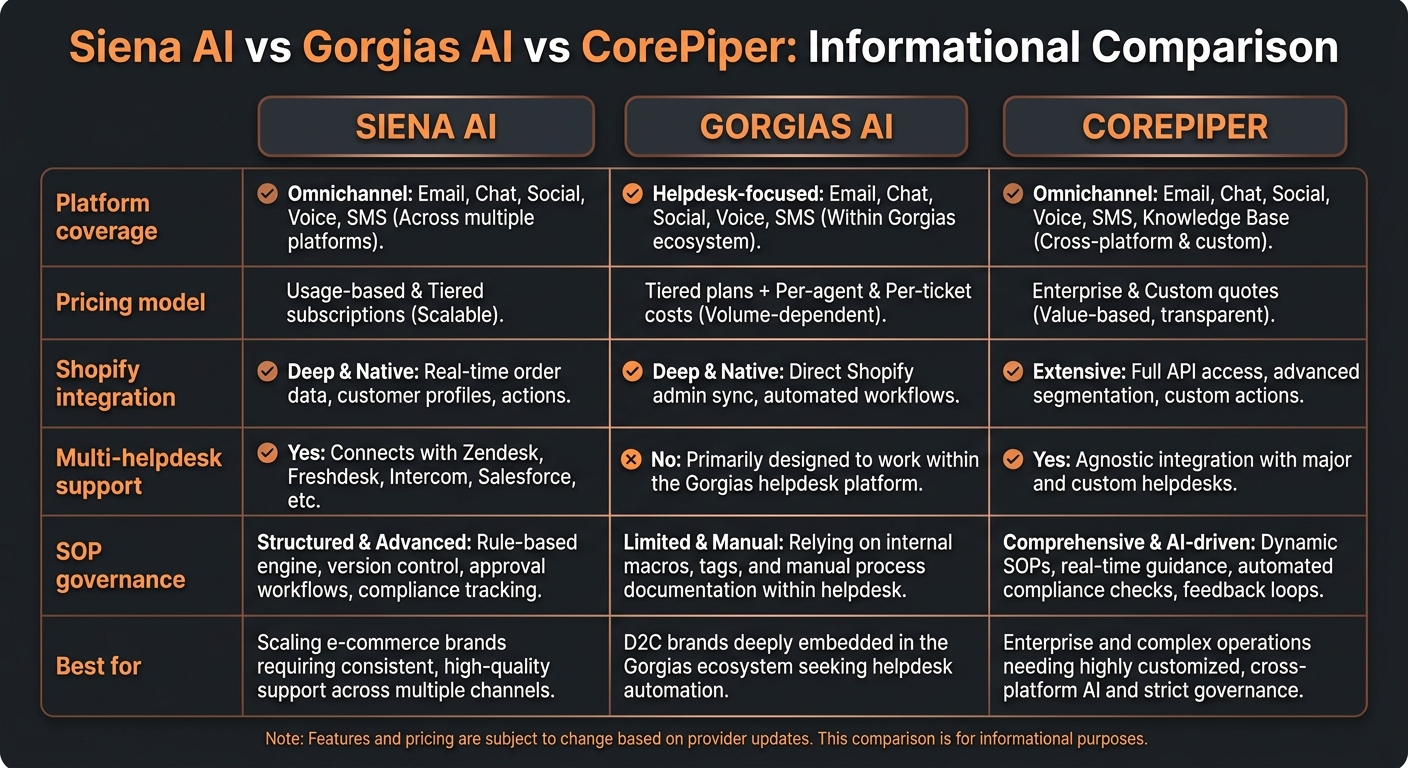
Siena vs. Gorgias AI vs. CorePiper: Choosing an AI Agent for Your Store
Gorgias AI is the fastest path to automated resolution if you're already on Gorgias; Siena is the right choice when you need empathetic, brand-voice AI across multiple e-commerce channels; CorePiper is the answer when your support operations span Shopify, a helpdesk, Salesforce, or Jira and single-platform tools can't cross those system boundaries.
TL;DR: Siena vs. Gorgias AI vs. CorePiper
| Siena AI | Gorgias AI Automate | CorePiper | |
|---|---|---|---|
| Best for | DTC brand voice across channels | Shopify brands on Gorgias | Cross-platform case operations |
| Pricing | ~$750/mo platform + ~$0.90/conversation | $0.90 to $1.00/resolved conversation | $10/mo Starter, $99/mo Pro, Enterprise custom |
| Shopify integration | Via Gorgias/connector | Native | Via API |
| Multi-helpdesk | Yes (Gorgias, Zendesk, email, SMS) | Gorgias only | Gorgias; Zendesk/Freshdesk on Enterprise |
| Salesforce / Jira | No | No | Enterprise plan |
| SOP governance | Brand voice rules | Automation rules in Gorgias | SOP-encoded workflows |
| Setup time | 1–2 weeks | Hours | 1–2 days |
| Requires Gorgias? | No | Yes | No |
What Problem Are You Actually Trying to Solve?
Before comparing products, it helps to be precise about the problem. Three distinct needs appear in e-commerce support operations, and each one maps to a different tool:
Need 1: Automate the majority of tickets inside your existing Gorgias setup, without adding new software. Gorgias AI Automate is purpose-built for this — it is an add-on inside an existing Gorgias account, priced per resolved conversation, and requires no separate product or vendor relationship.
Need 2: Bring a consistent, empathetic brand voice across every channel your customers use — Gorgias, email, SMS, social, and chat — with AI that sounds like your brand, not like a generic bot. Siena is built for exactly this use case. It is a standalone AI agent optimized for DTC brands that care as much about how the AI communicates as about what it resolves.
Need 3: Resolve tickets that span more than one system — a WISMO inquiry that requires checking Shopify, reading the helpdesk thread, querying a carrier API, and writing the result back to the customer in Zendesk or Freshdesk. Neither Siena nor Gorgias AI resolves across multiple platforms in a single automated workflow. CorePiper is designed for this case.
Getting this choice wrong is expensive. Deploying Siena when your real problem is Shopify-only automation means paying a platform fee for capability you do not need. Deploying Gorgias AI Automate when your stack includes Zendesk or Freshdesk means the AI stops at the Gorgias boundary. And choosing any single-helpdesk tool when your operations touch Salesforce or Jira means you are back to manual work for every case that crosses that line.
What Is Siena AI? (The Brand-Voice Multi-Channel Agent)
Siena is an AI customer experience platform built specifically for direct-to-consumer e-commerce brands. Its design premise is that DTC brands have distinct brand voices and emotional resonance with their customer bases — and that AI-powered support should reflect that voice rather than produce generic, transactional responses.
What Siena does well:
Siena handles customer conversations across Gorgias, email, SMS, social comments, and messaging apps in a unified way. Its AI is trained to mirror your brand's tone, escalate based on sentiment signals, and manage complex conversational threads where a customer's emotional state matters as much as the operational outcome. For fashion, beauty, wellness, and lifestyle brands where customer relationships are part of the product, Siena's design fits the use case.
Siena's pricing structure: Siena charges a platform fee of approximately $750/month plus approximately $0.90 per conversation handled. This structure makes economic sense when you need multi-channel coverage across a high conversation volume — the per-conversation cost is comparable to Gorgias AI, and the platform fee buys the brand-voice customization and multi-channel orchestration that a helpdesk add-on does not provide.
Notably, Siena has publicly argued against pure per-outcome pricing models, making the case that a subscription platform model aligns incentives better when the goal is brand experience rather than pure deflection rate. This is a legitimate philosophical position — it reflects that not all "resolved" conversations are equivalent outcomes for a brand.
Where Siena hits its ceiling: Siena's integrations concentrate on DTC commerce channels. There is no documented Salesforce Service Cloud integration, no Jira integration, and no purpose-built workflow for logistics claims or freight disputes. If your support operations extend into enterprise back-office systems, Siena operates on the front-end of customer communication but cannot close the loop with systems that sit behind your helpdesk.
What Is Gorgias AI Automate? (The Native Shopify Resolution Layer)
Gorgias AI Automate is an add-on to the Gorgias helpdesk that automates ticket resolution for Shopify brands. It is not a separate product — it runs inside an existing Gorgias account, uses the same ticket data, and executes Shopify actions via Gorgias's native Shopify connector.
What Gorgias AI does well:
For a Shopify-native DTC brand already running Gorgias, AI Automate is the lowest-friction path to automated resolution. Setup requires configuring the automation rules inside Gorgias — no separate vendor onboarding, no new authentication stack, no separate API integration. The system can handle WISMO inquiries by reading order status from Shopify, initiate refunds within Shopify, and close tickets without agent involvement. The $0.90 per resolved conversation price (annual) is among the lowest in the market for comparable functionality, and the Gorgias alternatives roundup shows how other options compare.
Gorgias AI pricing:
| Commitment | Price per resolved conversation |
|---|---|
| Annual | $0.90 |
| Monthly | $1.00 |
There is no platform fee on top of your existing Gorgias subscription. For brands processing 2,000–5,000 AI-resolved conversations per month, the cost is $1,800–$4,500/month — competitive with any outcome-based alternative.
Where Gorgias AI hits its ceiling: The automation ceiling is Shopify. Gorgias AI Automate can touch anything inside Gorgias and Shopify. It cannot read a Salesforce case, create a Jira ticket, query a carrier API, or write to a Freshdesk or Zendesk account. For the substantial portion of e-commerce companies that use Gorgias for customer communication but have Salesforce for B2B accounts or Jira for internal escalations, Gorgias AI handles the front-end ticket and then stops — the rest remains manual.
It also does not extend to companies on Zendesk or Freshdesk. If your company has migrated helpdesks or runs multiple helpdesks for different business units, Gorgias AI is bound to whichever tickets arrive in Gorgias specifically.
What Is CorePiper? (The Cross-Platform Resolution Layer)
CorePiper is a SOP-driven AI agent platform built for support operations that span more than one system. Rather than automating within a single helpdesk, CorePiper executes standard operating procedures as workflows that pull data from and write actions to multiple connected platforms — Shopify, Gorgias, Zendesk, Freshdesk, Salesforce Service Cloud, and Jira — in a single end-to-end resolution step.
The mechanics: You encode your existing SOPs into CorePiper. The platform builds agents with the right tool connections mapped to each SOP step. When a ticket arrives, the agent executes the SOP — reading order data from Shopify, checking account data in Salesforce if needed, querying a carrier portal for shipment status, updating the helpdesk ticket, and confirming with the customer — without stopping at any system boundary.
Pricing: CorePiper's plans start at $10/month (Starter, 5 resolved cases included, $3/case over) and $99/month (Pro, 75 resolved cases included, $2/case over), with Enterprise pricing custom for high-volume operations. Starter and Pro connect to Shopify; the Zendesk, Freshdesk, Salesforce, and Jira access described above is part of the Enterprise plan. A resolved case covers every system action taken across connected platforms during a single case lifecycle, not a charge per ticket update or per API call, but per full case resolved. For cases that span four or five systems over multiple steps, the economics are substantially different from per-ticket pricing that only covers one platform.
Where CorePiper fits: Operations teams that run Shopify plus Zendesk, Shopify plus Freshdesk, or Salesforce plus Jira alongside a customer-facing helpdesk. Logistics and DTC brands managing freight claims, carrier disputes, address escalations, or refund disputes that require data from multiple systems before a resolution decision can be made. Companies running more than one helpdesk for different geographies or product lines.
Where CorePiper is not the default choice: If your entire support operation runs inside Gorgias and Shopify, and you do not need Salesforce, Jira, or Freshdesk access, Gorgias AI Automate is simpler and cheaper. CorePiper's value multiplies with stack complexity — a brand on a single-helpdesk, Shopify-only stack is likely better served starting with Gorgias AI and graduating to CorePiper as the stack grows.
How Does Each Tool Handle the Most Common E-commerce Support Tickets?
Let's run the five most common ticket types through each tool:
WISMO ("Where Is My Order?")
Gorgias AI: Reads order status from Shopify and closes the ticket. Fast, accurate for Shopify-fulfilled orders. Cannot query carrier APIs directly for more detailed status (carrier delays, customs holds).
Siena: Can handle the customer conversation empathetically across whatever channel it arrives on, but depends on Gorgias or a direct Shopify connection to surface order data.
CorePiper: Reads Shopify order status, queries carrier API for shipment events, synthesizes a response with full delivery timeline, and closes the ticket — cutting WISMO resolution time without requiring agent involvement at any step.
Refund and Return Requests
Gorgias AI: Initiates refunds through Shopify within configured guardrails. Works for standard cases inside Gorgias's refund automation rules.
Siena: Handles the communication layer and can initiate Shopify actions, but the refund execution depends on the underlying helpdesk or Shopify connection, not Siena itself.
CorePiper: Applies SOP-defined guardrails (order value threshold, fraud signals, return window), executes the refund or RMA in Shopify, logs the action in the helpdesk, and confirms with the customer across the full workflow.
Address Change Requests
Gorgias AI: Can update the shipping address in Shopify if the order has not yet shipped. Does not handle carrier intercept requests for post-shipment changes.
Siena: Manages the conversation and can route to Shopify, but the carrier intercept step requires a separate process.
CorePiper: Checks fulfillment status in Shopify, updates the address if pre-shipment, initiates a carrier intercept request if already shipped, and logs the outcome — all as a single automated workflow.
Tickets Involving Salesforce Account Data
Gorgias AI: Not applicable — no Salesforce integration.
Siena: Not documented for Salesforce access.
CorePiper: Reads Salesforce account data, contract terms, and LTV context before responding to or escalating a ticket — enabling resolution decisions informed by account status.
Freight Claims and Carrier Disputes
Gorgias AI: Not designed for this use case.
Siena: Not designed for this use case.
CorePiper: Purpose-built for logistics claims workflows — damage documentation, carrier portal filing, dispute tracking, and resolution across carrier, helpdesk, and Salesforce in a single case workflow.
Which AI Pricing Model Actually Aligns Cost to Outcomes?
The AI support pricing debate between per-seat, per-conversation, and per-outcome models plays out differently across these three tools.
Gorgias AI Automate ($0.90–$1.00/resolved conversation) is outcome-priced and transparent. You pay only when the AI resolves a ticket without human involvement. Conversations that escalate to a human do not incur the AI resolution fee. This is the most buyer-friendly pricing model for simple, single-platform ticket automation.
Siena (~$750/month + ~$0.90/conversation) has a hybrid model. The platform fee is a fixed subscription that covers the brand-voice configuration and multi-channel orchestration layer; the per-conversation fee then applies. Siena has argued this structure better reflects the value of consistent brand experience beyond raw deflection rate — you are paying for the AI's quality of interaction, not only its resolution volume.
CorePiper (from $10/mo Starter or $99/mo Pro, plus $2 to $3 per case beyond the plan's included allowance) is plan-plus-case pricing. Starter includes 5 resolved cases a month and Pro includes 75; each additional case, covering every system action taken to resolve a workflow, from a Shopify API call to a helpdesk update, carrier query, Salesforce read, or Jira ticket, is billed at $3 on Starter or $2 on Pro. For simple, single-step ticket resolutions, that overage rate is higher than Gorgias's $0.90. For multi-system cases that would require four or five separate API interactions and manual coordination across platforms, the per-case economics become favorable compared to per-action or seat-based models.
The practical test: calculate your current cost per ticket including agent labor, coordination time, and system switching overhead. For simple Shopify tickets resolved in one step, Gorgias AI's $0.90 per resolution clears most cost-per-ticket benchmarks easily. For cross-system cases requiring human coordination across multiple platforms, CorePiper's per-case rate often represents a substantial reduction from the true cost of manual handling.
How Do They Compare on Setup and Time to Value?
| Siena AI | Gorgias AI Automate | CorePiper | |
|---|---|---|---|
| Prerequisites | Any helpdesk + Shopify | Existing Gorgias account | Any supported stack |
| Estimated setup time | 1–2 weeks (brand voice config) | Hours (configuration in Gorgias) | 1–2 days (SOP encoding) |
| Training data required? | Some historical data helpful | No — rule-based | No — SOP-driven |
| Engineering required? | Low | None | None |
| Goes live on day one? | With basic config, yes | Yes | Yes |
Gorgias AI Automate wins on setup speed for Gorgias users — it is a native add-on with no separate vendor onboarding. Siena requires configuration of brand voice, escalation rules, and channel connections, but its 1–2 week timeline is fast for a multi-channel AI deployment. CorePiper encodes SOPs rather than training on historical data, which means it can go live without prior ticket history — a significant advantage for teams that have not yet generated enough training data for model-based AI to perform reliably.
What Should You Choose?
Choose Gorgias AI Automate if:
- You are on Gorgias and Shopify exclusively
- Your tickets are primarily WISMO, refund, and returns requests that live entirely within Gorgias and Shopify
- You want the lowest cost per resolved conversation with the least setup friction
- You do not need Salesforce, Jira, Freshdesk, or Zendesk access from within your automation layer
Choose Siena AI if:
- Brand voice and empathetic communication quality are as important to you as resolution volume
- You need AI coverage across email, SMS, social, and helpdesk channels in a unified way
- You are a DTC brand in fashion, beauty, wellness, or lifestyle where tone consistency directly affects customer retention
- You do not need enterprise back-office system integration
Choose CorePiper if:
- Your support operations touch more than one system — Shopify + Zendesk, Shopify + Freshdesk, Salesforce + Jira + helpdesk — and you need resolution to complete across all of them
- You have freight claims, carrier disputes, or logistics exceptions that require carrier API, WMS, or TMS access
- You run multiple helpdesks for different geographies or business units
- You need every automated action traced to a specific SOP step for compliance or auditability
- You want the flexibility to work with whichever helpdesk your team prefers, not commit to one vendor's ecosystem
The One Question That Decides It
The most useful test is this: does the ticket you want to automate stay inside one system, or does it cross system boundaries?
If a customer asks about their order and the answer is entirely inside Shopify and your Gorgias account — Gorgias AI Automate handles it. If the customer experience you care about extends across channels and you want the AI to sound like your brand everywhere — Siena handles it. If resolving the ticket requires pulling from Salesforce, querying a carrier, reading Jira, or writing to Freshdesk — you need a cross-platform resolution layer.
That is not a criticism of Siena or Gorgias AI — both are well-designed for the problems they solve. It is a clarification of where each tool's design ends and what sits beyond it.
Book a 30-minute walkthrough to see how CorePiper resolves cross-platform cases across your specific stack — or explore how it layers on top of Gorgias or Zendesk without replacing what you've already built.