
The Parahelp alternative built for cross-platform case operations
Parahelp resolves tickets inside Zendesk and Intercom for AI-native SaaS startups — but it has no Salesforce integration, no Jira support, and no story for logistics or freight claims. CorePiper is the SOP-driven Parahelp alternative that orchestrates cases across Salesforce, Zendesk, and Jira from day one.
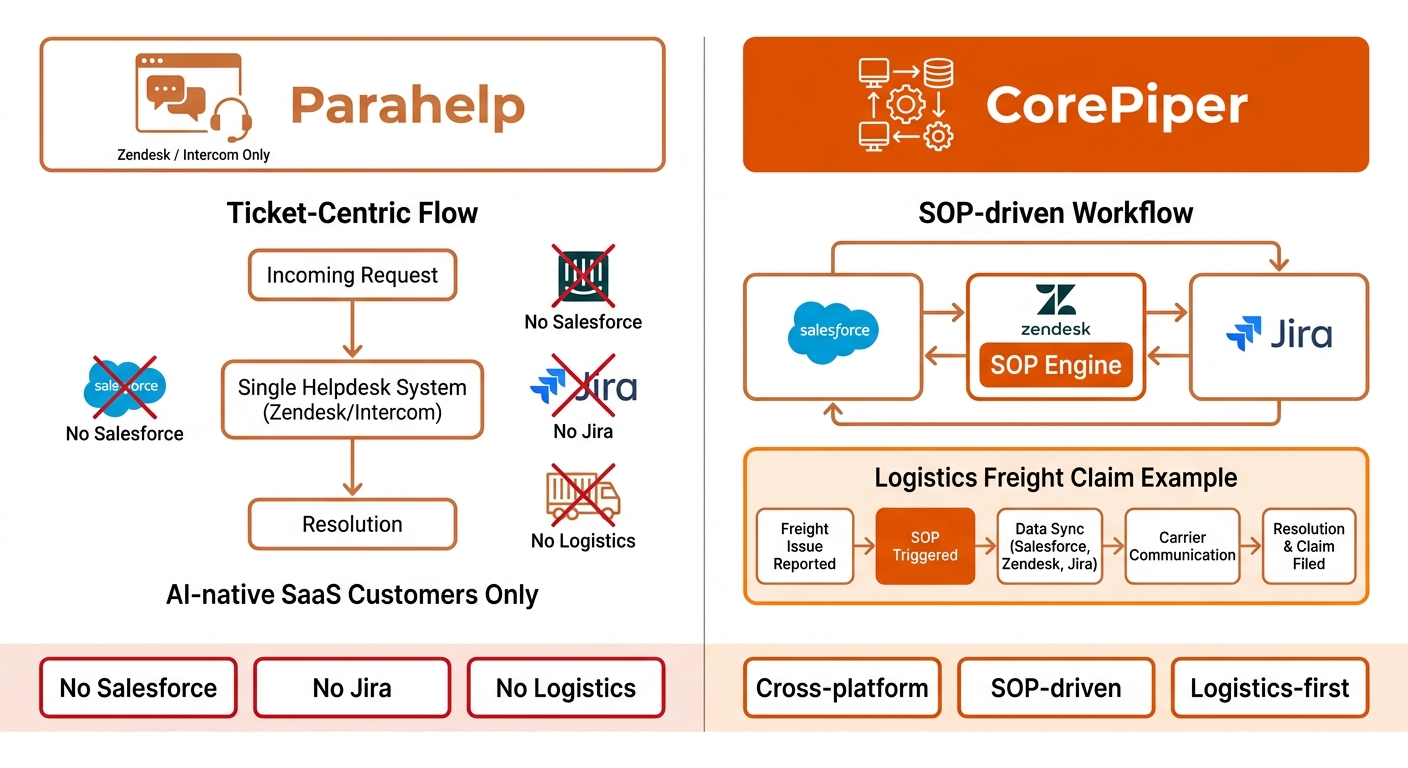
Parahelp vs CorePiper at a glance
The key differences between Parahelp and CorePiper across platform coverage, target market, pricing model, and use-case fit.
| Dimension | Parahelp | CorePiper |
|---|---|---|
| Primary use case | Ticket resolution inside Zendesk / Intercom / Front | SOP-driven multi-system case orchestration |
| Salesforce integration | Not supported | Full Service Cloud support |
| Jira integration | Not supported | Native bidirectional sync |
| Logistics / freight claims | No coverage — zero logistics customers | Core vertical |
| Pricing model | Pay-per-successful-resolution (sales-gated) | From $10/month flat; predictable per-case |
| Target market | AI-native SaaS startups (Perplexity, Replit, Cursor) | Enterprise B2B operations teams, logistics, 3PL |
| Deployment time | ~1 day (inside existing helpdesk) | ~1 day per SOP workflow |
How does CorePiper compare to Parahelp feature-by-feature?
A detailed breakdown of where Parahelp stops and where CorePiper picks up for enterprise operations teams managing cases across multiple systems.
Why does Parahelp fall short for enterprise case operations teams?
Parahelp was purpose-built for AI-native SaaS ticket resolution inside single helpdesks. That design leaves four structural gaps for enterprise B2B operations teams.
No Salesforce — Parahelp is invisible to the world's largest CRM
Salesforce Service Cloud is the primary system of record for the majority of Fortune 1000 operations teams. Parahelp has zero references to Salesforce integration on its website, in YC materials, or in any marketing content. Its published tool-call library connects Stripe, Linear, and Slack — not Salesforce Cases, Accounts, or custom objects. For B2B operations teams whose workflows are anchored in Salesforce, Parahelp simply cannot participate.
No Jira — engineering escalations and ops tickets are a dead end
Logistics, IT, and enterprise case operations routinely involve Jira for internal engineering coordination. Carrier disputes that require engineering investigation, freight damage claims that involve warehouse systems, and B2B case escalations that need dev-team involvement all route through Jira. Parahelp's integration set does not include Jira. CorePiper supports native bidirectional Jira sync — creating issues, updating status, and triggering downstream SOP steps based on Jira responses.
Zero logistics exposure — freight, 3PL, and supply chain are untouched
Every named Parahelp customer is an AI-native consumer software company: Perplexity, Replit, Cursor, Framer, Bolt.new, HeyGen, ElevenLabs. Their published tool calls cover Stripe refunds, consumer subscription lookups, and Linear bug creation — not BOL retrieval, POD verification, carrier dispute filing, or TMS integration. The entire freight, logistics, and supply chain operations category is structurally absent from Parahelp's product and customer story.
Per-resolution pricing breaks for multi-week case operations
Parahelp's pay-per-successful-resolution model maps cleanly onto a support ticket where resolution is a clear binary. For a multi-week freight claim — spanning carrier notification, documentation assembly, dispute filing, escalation, and settlement — there is no single resolution event. Billing ambiguity is not just a pricing concern; it makes budgeting, forecasting, and ROI calculation structurally difficult. CorePiper's flat per-case pricing is designed exactly for this scenario: one price per case regardless of how many workflow steps run across how many systems over how many days.
What makes CorePiper architecturally different from Parahelp?
CorePiper is built for a different job than Parahelp — not helpdesk ticket resolution for AI-native SaaS, but SOP-driven case orchestration across Salesforce, Zendesk, and Jira for enterprise operations.
Truly cross-platform: Salesforce + Zendesk + Jira
CorePiper reads and writes to all three enterprise platforms within a single orchestrated workflow. A case can originate in Zendesk, pull account and contract context from Salesforce, create a Jira sub-task for an engineering or claims team, and return an automated resolution — all without custom code or middleware. Parahelp operates inside one helpdesk at a time.
SOP-driven: your existing playbooks become the agent
CorePiper agents run from your existing Standard Operating Procedures — not from AI training on historical conversation data or prompt engineering. When your process changes, you update the SOP. No helpdesk content retraining, no conversation-flow rebuilds, no manager-agent prompt re-engineering required.
Logistics-first: freight claims, carrier disputes, OS&D
CorePiper ships with pre-built workflows for freight damage claims, OS&D processing, carrier dispute management, and shipment exception handling. Logistics and 3PL teams can deploy a claims automation workflow in a single day — a vertical Parahelp has never entered and is structurally unable to enter with its current helpdesk-centric architecture.
Predictable pricing for complex, multi-step case workflows
CorePiper's flat plans start at $10/month (Starter, 5 resolved cases) and $99/month (Pro, 75 resolved cases, $2/case overage). Enterprise pricing is per-case, all-in. There is no per-resolution ambiguity, no billable complexity cliff for multi-week workflows, and no sales-gated opacity. One number per case, no matter how many systems it touches.
What is the difference between ticket resolution and case orchestration?
The distinction explains why teams with complex multi-system operational workflows need a different category of tool than Parahelp provides.
Parahelp: single-helpdesk ticket resolution
A user submits a support ticket inside Zendesk, Intercom, or Front. Parahelp reads the ticket, determines the appropriate action using its two-layer agent architecture, executes tool calls (Stripe refund, Slack message, Linear issue), and resolves the ticket — all within a single helpdesk session.
This model works well for AI-native SaaS companies with high-volume, well-defined ticket types: billing questions, password resets, feature requests, subscription changes. The resolution event is binary and contained within one helpdesk conversation.
It does not work for cases that span systems — reading a Salesforce Account record, creating a Jira escalation, filing a carrier dispute through a TMS integration, or waiting 10–30 days for a freight claim to resolve before the workflow can close.
CorePiper: multi-system case orchestration
A freight damage notification arrives. CorePiper reads the Zendesk ticket, pulls the associated Salesforce Case and Account data, retrieves the BOL and POD from the TMS, assembles the documentation package, and creates a Jira sub-task for the claims analyst — all as a single orchestrated SOP workflow.
The SOP defines every step and every conditional branch. If the claim exceeds $10,000, a human approval gate fires before the carrier dispute is filed. If the carrier denies within 72 hours, the escalation SOP automatically triggers the next workflow stage.
The "resolution" is a structured process spanning 10–30 days, touching four systems, and involving three different teams. CorePiper was designed for exactly this workflow — and charges a flat per-case rate regardless of complexity or duration.
How does Parahelp pricing compare to CorePiper for enterprise operations teams?
Parahelp's pay-per-resolution model is sales-gated with no public rate card. Here is the honest comparison at three common scale points.
| Scale | Parahelp (estimated) | CorePiper | Notes |
|---|---|---|---|
| 75 cases/month | Sales-gated (no public rate card) | $99/month (Pro) | Parahelp targets AI-native SaaS — enterprise contracts typically start in $20K–$50K+/year range |
| 500–1,000 cases/month | Sales-gated (no public rate card) | Enterprise (custom volume) | CorePiper per-case pricing is all-in — no separate helpdesk AI subscription required |
| Multi-week freight claim | Ambiguous — no single resolution event | One flat case price, regardless of duration | Pay-per-resolution breaks for multi-week multi-system workflows; CorePiper pricing does not |
Parahelp pricing estimates based on comparable AI-native support vendor benchmarks (Decagon, Sierra, Intercom Fin) and publicly available outcome-pricing conventions. No public Parahelp rate card exists. See CorePiper pricing →
When should you choose Parahelp instead of CorePiper?
We think CorePiper is the right choice for most enterprise B2B operations teams — but Parahelp genuinely excels in specific AI-native SaaS contexts.
Parahelp is a strong choice — and the right one — in the following scenarios:
- Your company is an AI-native SaaS startup — a product-led growth company similar to Perplexity, Replit, or Cursor
- Your support tickets are primarily consumer-facing single-session interactions inside Zendesk, Intercom, or Front
- You want AI that can resolve complex tickets end-to-end without human involvement in those specific helpdesk channels
- You do not need Salesforce Service Cloud, Jira, or logistics and freight workflow automation
- Your team values Parahelp's two-layer 'manager agent' prompt engineering architecture for consumer ticket quality
If you recognize your use case in that list, Parahelp is a well-positioned product for AI-native SaaS ticket automation. If you need multi-system case orchestration, Salesforce integration, Jira escalation workflows, predictable all-in pricing, or logistics-specific SOP automation, keep reading.
Which teams get the most value from CorePiper over Parahelp?
CorePiper is a specific tool for a specific job. Here is where the ROI is clearest for teams moving beyond single-helpdesk ticket resolution.
3PLs and freight brokers
Processing OS&D claims, carrier disputes, and damage reports across Salesforce and carrier portals. CorePiper automates the full claim lifecycle that Parahelp was never built to touch.
B2B SaaS operations teams
Managing cases that span Salesforce, Zendesk, and Jira — contract changes, billing disputes, escalated engineering bugs — where Parahelp's helpdesk-only model leaves the back-office work manual.
Enterprise support operations
Teams with 5,000+ multi-step cases per year that need predictable per-case pricing and cross-platform orchestration, not a per-resolution AI priced for AI-native SaaS ticket volumes.
Logistics and supply chain ops
Shippers and carriers running exception management, WISMO responses, and chargeback defense that require integration with ERP, TMS, WMS, and Salesforce — a stack Parahelp has never documented a customer success in.
Teams on Salesforce Service Cloud
If your primary system of record is Salesforce and your helpdesk is Zendesk, you need AI that bridges both natively. Parahelp does not integrate with Salesforce at all.
Teams with documented SOPs
If your operations are already procedure-driven, CorePiper requires almost no new configuration. Point it at your SOPs, connect your integrations, and go live in a day per workflow.

Mustafa Bayramoglu
Founder, CorePiper · YC W19 alum · Previously built enterprise automation for logistics and B2B ops teams across MENA and North America
Frequently asked questions
What enterprise B2B operations teams ask when evaluating Parahelp alternatives for cross-platform case automation.
- What is the best Parahelp alternative for enterprise case operations?
- CorePiper is the purpose-built Parahelp alternative for teams that need to orchestrate cases across Salesforce, Zendesk, and Jira. Parahelp resolves support tickets inside Zendesk, Intercom, and Front for AI-native SaaS companies — it has no Salesforce integration, no Jira support, and no logistics or freight claims capability. CorePiper executes SOP-driven multi-step workflows that span all three enterprise platforms simultaneously.
- Does Parahelp integrate with Salesforce Service Cloud?
- Parahelp does not integrate with Salesforce Service Cloud. Its integrations are limited to helpdesks like Zendesk, Intercom, and Front. For enterprise operations teams whose system of record is Salesforce — where Cases, Accounts, Opportunities, and custom objects live — Parahelp cannot participate in those workflows. CorePiper was built around Salesforce as a first-class integration from day one.
- Does Parahelp integrate with Jira?
- Parahelp does not integrate with Jira. The product operates inside helpdesk channels and its published tool-call library covers Stripe refunds, Linear bug creation, and Slack approvals — not Jira issue creation, bidirectional sync, or engineering escalation workflows. CorePiper supports native bidirectional Jira integration as part of its cross-platform case orchestration.
- How does Parahelp pricing compare to CorePiper?
- Parahelp uses pay-per-successful-resolution pricing with no public rate card — a sales-gated model similar to Sierra, Decagon, and Intercom Fin. For logistics and B2B case ops, where a single multi-week freight claim may involve dozens of touchpoints before 'resolution', per-resolution pricing becomes unpredictable. CorePiper offers flat monthly plans starting at $10/month (Starter) and $99/month (Pro), with predictable per-case Enterprise pricing for high-volume operations.
- Can CorePiper handle logistics and freight claims that Parahelp cannot?
- Yes. CorePiper was built specifically for logistics operations — BOL lookups, carrier dispute filings, OS&D claim processing, and damage evidence gathering. Parahelp's named customers are exclusively AI-native SaaS companies (Perplexity, Replit, Cursor, Framer); it has no logistics customers, no logistics integrations, and no published case studies in freight, 3PL, or shipping operations.
- What is the architectural difference between Parahelp and CorePiper?
- Parahelp's fundamental unit is a support ticket resolved end-to-end within a single helpdesk session. CorePiper's fundamental unit is a case orchestrated across multiple systems over multiple days. Parahelp's Agent Operating Procedures govern individual ticket responses; CorePiper's SOPs govern multi-system business processes involving Salesforce, Zendesk, Jira, TMS, WMS, and carrier portals. These are different product categories addressing different operational problems.