
Best AI Customer Service Tools for E-commerce (2026): An Honest Comparison
The 8 best AI customer service tools for e-commerce in 2026 compared by resolution depth, platform coverage, pricing model, and setup time. Honest ratings for DTC brands and CX leaders choosing between Intercom Fin, Gorgias AI, Zendesk AI, Siena AI, Ada, Yuma AI, and CorePiper.
 Mustafa BayramogluJune 16, 202615 min read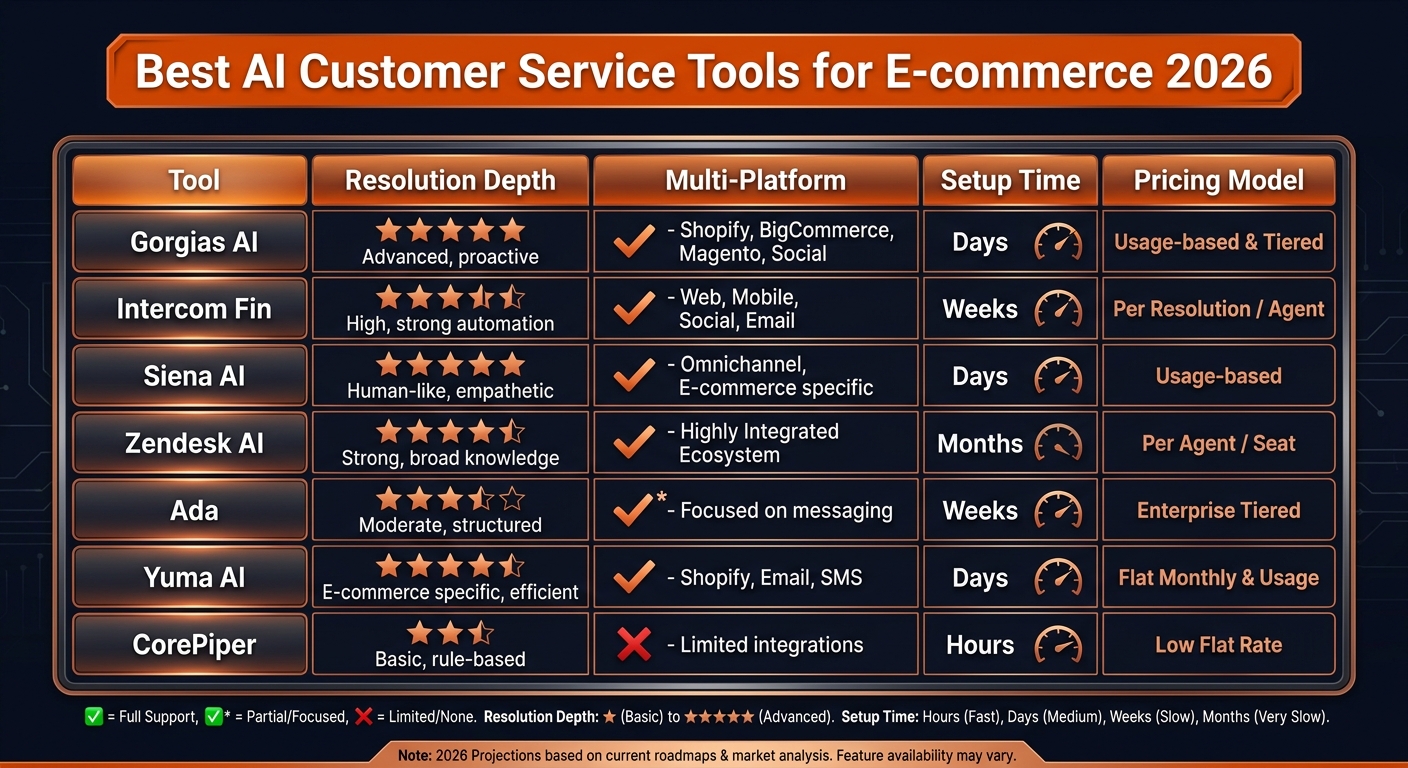
Best AI Customer Service Tools for E-commerce (2026): An Honest Comparison
The best AI customer service tools for e-commerce in 2026 split into two architectures: single-helpdesk resolution tools (Intercom Fin, Gorgias AI, Zendesk AI, Yuma AI) that automate tickets inside the platform you already use, and cross-platform resolution layers (CorePiper) that span Shopify, Zendesk, Freshdesk, Salesforce, and Jira simultaneously. Resolution depth and platform coverage matter more than any individual feature. This guide rates 8 tools honestly across the criteria that drive real support economics.
TL;DR: Best AI Customer Service Tools for E-commerce 2026
| Tool | Best For | Platform Coverage | Pricing Model | Avg. Setup Time |
|---|---|---|---|---|
| CorePiper | Cross-platform resolution, multi-stack brands | Shopify + Zendesk + Freshdesk + Salesforce + Jira | $2.50/resolved case | ~1 day |
| Intercom Fin | High-volume SaaS and e-com on Intercom | Intercom-native | $0.99–$1.49/outcome | Days |
| Gorgias AI | Shopify-native DTC brands | Gorgias + Shopify | $0.90–$1.00/resolved conversation | Hours |
| Zendesk AI | Enterprise brands already on Zendesk | Zendesk-native | $1.50–$2.00/automated resolution | Weeks |
| Siena AI | Mid-market DTC, empathy-focused | Gorgias, Shopify, email, social | Subscription + per conversation | Days |
| Ada CX | Mid-market and enterprise, multi-channel | Email, chat, voice (cross-platform) | $1.00–$3.50/resolution | Weeks |
| Yuma AI | Shopify brands, fast setup | Shopify + Gorgias | Per resolution | Hours–days |
| Richpanel | Shopify DTC, all-in-one helpdesk + AI | Shopify + email + chat | Subscription | Days |
What Criteria Should You Use to Evaluate AI Customer Service Tools for E-commerce?
Five factors separate tools that materially improve your support economics from ones that rearrange the furniture:
Resolution depth. The most important variable. A tool that can read a Shopify order, issue a refund via the Shopify Admin API, update the helpdesk ticket, and confirm the action to the customer is categorically different from one that generates a response for a human agent to approve. The former closes tickets; the latter creates a more sophisticated routing step. Ask each vendor: what actions can the agent take without human approval, in which systems?
Platform coverage. E-commerce support rarely lives in one place. Shopify handles order data; Zendesk, Gorgias, or Freshdesk handles communication; Salesforce holds account context; Jira tracks internal escalations. A tool locked to one platform cannot access the data needed to resolve tickets that span them. If your support operation involves more than one system, platform coverage is a elimination criterion, not a nice-to-have.
Pricing model alignment. Per-outcome pricing (the current market standard) aligns cost to value — you pay when a ticket is genuinely resolved. Per-seat pricing scales linearly with team size regardless of automation lift. Per-conversation pricing can create incentives toward volume rather than resolution. Evaluate the pricing model against your ticket profile: high-volume, low-complexity queues favor per-outcome; low-volume, high-complexity case operations favor per-case.
Setup time and integration complexity. Setup time claims range from "hours" to "six months," and both are sometimes true at different scales. "Hours" typically means you connect a Shopify app, point it at your Gorgias knowledge base, and enable an AI responder. "Weeks or months" usually means enterprise onboarding that requires custom API work, security reviews, training data ingestion, and SOP documentation. Match your timeline to the vendor's actual implementation process — not their marketing copy.
Auditability and guardrails. For any action the AI takes on a customer account (refund, order edit, return approval), you need a complete audit trail: what the agent decided, why, what data it used, and what it changed. Brands in regulated markets or with high-value orders also need configurable guardrails — thresholds that escalate to human review rather than auto-executing. Ask for specific examples of what happens when an AI agent hits a case it cannot confidently resolve.
CorePiper: Cross-Platform Resolution Across Your Entire Support Stack
Best for: Brands operating across Shopify and at least one enterprise platform (Zendesk, Freshdesk, Salesforce Service Cloud, Jira). Operations teams managing complex post-purchase workflows that span multiple systems.
CorePiper's architecture solves a problem the single-helpdesk tools structurally cannot: a support workflow where the resolution requires touching Shopify and a helpdesk and Salesforce — in sequence, with the right data from each. A damaged-shipment resolution, for example, might require reading the Shopify order, querying carrier tracking data, checking the Salesforce account tier, filing the claim, and updating the Zendesk ticket — all in one workflow. That is not a ticket. It is a case.
The SOP-driven model is CorePiper's mechanical differentiator. You document your standard operating procedures — the decision logic your support team already uses — and CorePiper builds agents that execute them across connected systems. There is no training data requirement and no cold-start period. The agent knows what to do because it is following your SOPs, not pattern-matching against historical tickets.
Resolution depth: High. CorePiper executes actions (Shopify refunds, order edits, return approvals, Zendesk ticket updates, Salesforce case creation) rather than drafting responses for human approval.
What it doesn't do: CorePiper is not a helpdesk replacement. It layers on top of your existing platforms. If you want an all-in-one helpdesk with AI, Gorgias or Zendesk are the relevant comparisons. CorePiper is for teams that already have a stack and want cross-platform automation without a rip-and-replace migration.
Pricing: $2.50 per resolved case. Per-case pricing covers multi-step workflows spanning multiple systems, which is structurally different from per-resolution pricing on a single platform. See how CorePiper compares to single-helpdesk AI tools for a full breakdown.
Intercom Fin: The Outcome-Priced Default for Intercom Teams
Best for: SaaS companies and e-commerce brands with a high volume of text-based tickets, already running Intercom as their primary helpdesk.
Intercom Fin is the AI resolution agent built into Intercom's helpdesk product. At $0.99 per outcome on committed pricing ($1.49 pay-as-you-go), it is the lowest entry cost per resolution among named AI agents, and Intercom's reported 67% resolution rate across more than 40 million conversations makes it a credible performer on standard e-commerce ticket types: order status, shipping questions, subscription management, and basic refund requests.
Fin's strength is seamless integration with Intercom — if your support lives entirely inside Intercom, Fin adds AI resolution without any new vendor relationship, integration project, or platform migration. For teams that match that profile, it is hard to beat on speed-to-value.
The structural limitation is the same constraint every helpdesk-native tool carries: Fin can only access what Intercom can access. It cannot natively read a Salesforce account, query a carrier portal, or cross-reference a Jira ticket. For brands whose support complexity exceeds the boundary of a single helpdesk, Fin's resolution rate falls sharply on the tickets that actually matter to the business — escalations, complex refunds, shipment exceptions.
Resolution depth: Medium-high for Intercom-native workflows; low for cross-system cases.
Platform coverage: Intercom only. Fin does not integrate natively with Salesforce, Jira, or Gorgias.
Pricing: $0.99/outcome (committed) or $1.49/outcome (pay-as-you-go), per Intercom's published pricing.
Gorgias AI: The Shopify-Native Choice for DTC Brands
Best for: Shopify-native DTC brands already using Gorgias as their helpdesk, with a ticket queue dominated by WISMO, refunds, and return requests.
Gorgias built its helpdesk specifically for e-commerce, and the AI Agent reflects that specialization. It reads Shopify order data directly, applies configurable rules, and executes resolutions — refunds, return approvals, order cancellations — without leaving the Gorgias environment. Setup time for a Shopify store already on Gorgias can be hours rather than days.
Per-conversation pricing runs $0.90 (annual plan) or $1.00 (monthly), which is competitive among e-commerce-focused tools. The pricing model also has a clear ceiling: you know your approximate cost before you scale.
The limitation is the Gorgias-Shopify boundary. Gorgias AI does not span Salesforce, Zendesk, Freshdesk, or Jira. For brands that use Gorgias for customer-facing support and Salesforce or Jira for internal operations, Gorgias AI cannot read the internal context that sometimes determines the correct resolution. It also does not cover voice tickets, which matter for high-AOV brands with phone support.
Resolution depth: High for Shopify-native workflows; limited outside the Gorgias-Shopify pair.
Platform coverage: Gorgias + Shopify. Not cross-platform.
Pricing: $0.90/resolved conversation (annual) or $1.00/resolved conversation (monthly), per Gorgias's published pricing.
Zendesk AI: Enterprise Helpdesk With AI Agents
Best for: Enterprise and mid-market brands already invested in Zendesk, with large ticket volumes and defined SLA requirements.
Zendesk AI Agents (formerly Zendesk Answer Bot, rebranded through multiple iterations) now offer genuine AI resolution rather than FAQ deflection. The $1.50 per automated resolution (committed pricing) or $2.00 per resolution (pay-as-you-go) pricing reflects enterprise positioning — Zendesk is not competing on price against Gorgias or Intercom Fin.
What Zendesk offers in exchange is depth: a mature, enterprise-grade helpdesk with extensive routing rules, SLA management, workforce tools, and a large integration marketplace. If your brand is on Zendesk and your primary pain is reducing the volume of tickets that require human agents, Zendesk AI is the obvious starting point.
The caveats are real. Zendesk's per-resolution billing model changed in January 2026 to enable automatic billing for resolutions above a committed volume — a change that surprised some customers who did not model their overage exposure correctly. The math behind Zendesk AI pricing per resolution is worth understanding before you commit to a volume tier. And like all helpdesk-native tools, Zendesk AI operates within the Zendesk environment — it does not natively reach Shopify order APIs, Salesforce account data, or Jira issue queues.
Resolution depth: High for Zendesk-native workflows; requires custom integration for cross-system resolution.
Platform coverage: Zendesk-native. App marketplace extensions available for some Shopify and Salesforce connections.
Pricing: $1.50/automated resolution (committed) or $2.00/automated resolution (PAYG), per Zendesk's published pricing.
Siena AI: The Mid-Market DTC Autonomous Agent
Best for: Mid-market DTC brands, particularly those selling across multiple channels (DTC website, social commerce, email) who want an AI with branded empathy built in.
Siena positions itself as an "empathic AI" built specifically for consumer brands — meaning it is trained to handle emotionally charged tickets (shipping delays, damaged goods, frustrating returns) in a tone that reflects the brand's voice rather than a generic support bot. This matters more than it sounds for brands where a single frustrated social media post can reach thousands of customers.
Siena's integration footprint covers Gorgias, Shopify, email, and social channels including Instagram DMs and Facebook Messenger. For omnichannel DTC brands where customer contact arrives through multiple channels simultaneously, Siena's breadth is a genuine advantage over single-channel tools.
Siena has also publicly argued against pure outcome-based pricing, on the grounds that it creates incentives to resolve tickets prematurely rather than thoroughly. Their pricing reflects this philosophy: a subscription base (starting around $750/month) plus per-conversation fees, rather than pure pay-per-resolution. For brands with predictable ticket volume, the subscription model can be more budget-forecastable than variable per-outcome pricing.
Resolution depth: Medium-high for DTC consumer ticket types; not designed for complex case operations.
Platform coverage: Gorgias, Shopify, email, Instagram DM, Facebook Messenger. Not Zendesk, Salesforce, or Jira.
Pricing: Subscription base (approximately $750/month) plus per-conversation fees; verify current pricing with Siena directly.
Ada CX: Enterprise-Grade Multi-Channel Automation
Best for: Mid-market to enterprise brands that need multi-channel coverage (email, chat, voice) and are willing to invest in a more substantial onboarding process to configure a branded AI agent.
Ada is one of the longer-tenured AI customer service platforms, and the product reflects that maturity. Its outcome-based pricing ($1.00–$3.50 per resolution depending on plan) sits in a range that encompasses both startup-friendly entry points and enterprise complexity tiers. Ada's strength is channel breadth: it covers web chat, email, voice, and in-app messaging from a single configuration, which matters for brands that do not want to stitch together separate AI tools for each channel.
Ada does not publish a rate card publicly — pricing is sales-gated and configured per-deal based on volume, channels, and integration complexity. Ada AI pricing in 2026 covers the estimated cost structure in detail, including the $70,000/year median contract value and what drives the per-resolution cost to the higher end of the range.
The onboarding process is heavier than single-helpdesk tools. Ada's more complex setups take weeks to months — this is not a same-day deployment. For brands that need a polished, branded AI presence across multiple channels and have the runway to configure it properly, Ada's maturity is a genuine asset. For brands that need to move fast or test on a single channel first, the setup investment may be misaligned with the timeline.
Resolution depth: High for configured workflows; depth depends on what systems Ada is integrated with in your specific deployment.
Platform coverage: Email, chat, voice, in-app — channel-breadth is Ada's differentiator. Requires specific integrations for Shopify and other operational systems.
Pricing: $1.00–$3.50 per resolution (estimated range); sales-gated. Verify current pricing with Ada directly.
Yuma AI: Shopify-First With Fast Deployment
Best for: Shopify brands with a Gorgias helpdesk that want quick AI deployment on their highest-volume ticket types without a lengthy onboarding process.
Yuma AI targets the Shopify + Gorgias combination directly, and its setup is genuinely fast — the tool connects to Shopify order data and Gorgias ticket history, then deploys AI responses and actions on the ticket types you configure. For a brand whose ticket queue is 60% to 70% WISMO and standard refund requests, Yuma can be running a meaningful resolution share within days.
Per-resolution pricing (specific rate card varies by plan — verify with Yuma) keeps cost aligned to outcomes, and Yuma's narrow focus means the integration footprint is small and the configuration surface is manageable for a lean team.
The scope is the constraint. Yuma is a Shopify-Gorgias tool. It does not support Zendesk, Freshdesk, Salesforce, or Jira. It is not designed for multi-system case operations or enterprise complexity. Brands that have outgrown the Shopify-Gorgias pairing — either because they have added enterprise platforms or because their support cases are growing in complexity — will hit Yuma's ceiling.
Resolution depth: Medium-high for Shopify + Gorgias workflows; limited to that pairing.
Platform coverage: Shopify + Gorgias.
Pricing: Per-resolution; verify current tiers with Yuma directly.
How Do You Choose Between AI Customer Service Tools for E-commerce?
The decision comes down to two questions your stack answers for you:
Question 1: How many systems does resolving a ticket actually require?
If a WISMO response requires only Shopify order data and a Gorgias ticket — one system, one helpdesk — Gorgias AI or Yuma AI resolve this faster and cheaper than a cross-platform tool. If resolving a damaged-shipment ticket requires Shopify order data, a Zendesk ticket, a carrier portal lookup, and a Salesforce account tier check, no single-helpdesk tool can complete that resolution without a human stitching systems together. CorePiper was built for that second scenario.
Question 2: What is your primary performance constraint?
If the constraint is ticket response time — you want the AI to handle WISMO faster — any of the single-helpdesk tools solve this well. If the constraint is true cost per ticket — you are paying humans to work across systems on cases that should be automated — the platform coverage matters more than the per-resolution price. A $0.99 tool that resolves 40% of tickets is more expensive per fully-resolved case than a $2.50 tool that resolves 80%, because the unresolved 60% still routes to a human at $8–$13 per escalated contact.
The quick decision framework
- Single Shopify store + Gorgias only: Gorgias AI or Yuma AI.
- Single Shopify store + Intercom only: Intercom Fin.
- Enterprise brand on Zendesk: Zendesk AI as the default; evaluate CorePiper if resolution requires systems outside Zendesk.
- DTC brand, omnichannel, empathy-critical: Siena AI.
- Mid-market/enterprise, multi-channel from day one: Ada CX.
- Two or more platforms that must exchange data to resolve tickets: CorePiper.
The common mistake is buying on per-outcome price and discovering six months in that the tool only resolves the easy 40% of your queue — which your team was already handling quickly — while the complex tickets that actually drive support cost continue to require human agents across multiple systems. Resolution rate on your full ticket queue, not the subset the tool can handle, is the metric that determines ROI.
About the author: Mustafa Bayramoglu is the founder of CorePiper (YC W19 alum) with experience building cross-platform automation for logistics and enterprise operations teams. CorePiper is one of the tools compared in this post.
CorePiper resolves tickets end-to-end across Shopify, Zendesk, Freshdesk, Salesforce, and Jira — using your existing SOPs as the agent's decision logic, not a replacement platform that requires migrating your stack. For brands where resolving a ticket requires touching more than one system, cross-platform resolution is the lever that single-helpdesk AI tools cannot pull. Book a 30-minute walkthrough to map your support stack to a resolution model and see how the cost-per-ticket math changes when the agent can reach every system the ticket touches.
One AI Agent Across All Your Support Platforms — Without Ripping Any of Them Out
CorePiper resolves tickets end-to-end across Shopify, Zendesk, Freshdesk, Salesforce, and Jira — using your existing SOPs, not a replacement platform. Book a 30-minute walkthrough to see how cross-platform resolution changes your cost-per-ticket math.