
Cost Per Resolution: AI Agent vs Human Agent Economics at Every Ticket Volume (2026)
AI agents resolve ecommerce support tickets at $1.50–$3.50 each versus $8–$17.50 for human agents — but the gap widens at scale. This teardown shows the full per-resolution math at 500, 2,000, and 5,000 tickets per month.
 Mustafa BayramogluAugust 28, 202615 min read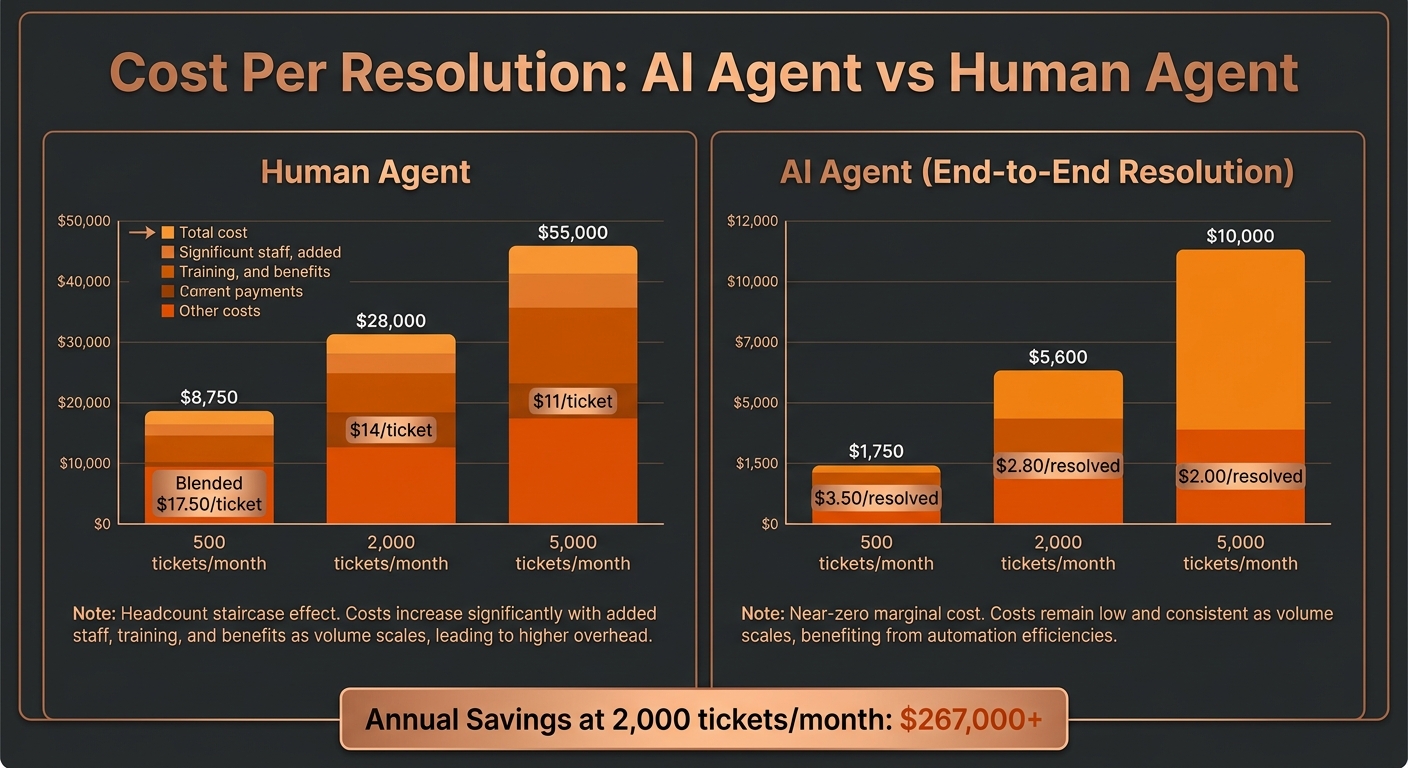
Cost Per Resolution: AI Agent vs Human Agent Economics at Every Ticket Volume (2026)
AI agents resolve ecommerce support tickets at $1.50–$3.50 each. Human agents resolve the same tickets at $8–$17.50 each. The gap is real at every ticket volume — not just at enterprise scale — but it widens significantly as volume grows, because human costs follow a headcount staircase while AI costs follow a near-zero marginal-cost curve. This teardown shows the full per-resolution math for ecommerce brands at 500, 2,000, and 5,000 tickets per month.
TL;DR: Cost Per Resolution Comparison
| Ticket Volume | Human Agent (fully loaded) | AI Agent (end-to-end resolution) | Annual Savings |
|---|---|---|---|
| 500/month | $14–$17.50/ticket | $3.00–$3.50/ticket | $66,000–$84,000 |
| 2,000/month | $12–$14/ticket | $2.50–$3.00/ticket | $213,000–$264,000 |
| 5,000/month | $9–$11/ticket | $1.50–$2.00/ticket | $450,000–$540,000 |
The savings figures above assume 70% AI resolution rate on a typical ecommerce ticket mix (WISMO, standard returns, refunds, address changes). The remaining 30% escalates to human agents and is excluded from the AI savings calculation. Real brands with 75–85% AI resolution rates on structured ticket types see proportionally higher savings.
What Is Cost Per Resolution and Why Does It Matter?
Cost per resolution is the fully loaded expense of solving one customer problem end-to-end. It is the metric that connects support operations to P&L — more directly than CSAT, faster-moving than NPS, and more actionable than headcount ratios.
Brands that optimize for CSAT alone routinely over-staff. Brands that optimize for deflection rate push customers to self-service that doesn't resolve their issue, which generates repeat contacts that double or triple the effective cost per problem solved. Cost per resolution captures the outcome: was the issue actually fixed, and what did that fix cost?
The metric has three components:
- Labor cost — agent salary, benefits, and seat license, divided by monthly resolved tickets
- Platform overhead — helpdesk software, QA tools, WFM software, and management time allocated per ticket
- Repeat contact load — tickets that require a second or third contact to resolve increase effective cost per resolution by 1.5–2.3x, per industry benchmarks
When all three are included, the "fully loaded" cost per human-handled ticket is consistently higher than most support leaders report from labor cost alone.
How Much Does Human Agent Support Cost Per Resolution?
What Are the Fully Loaded Labor Costs?
A full-time ecommerce support agent in a US-based or near-shore operation costs:
- Salary: $38,000–$52,000 annually ($3,167–$4,333/month)
- Benefits and payroll taxes: 20–25% on top of salary ($633–$1,083/month)
- Helpdesk seat license: $50–$120/month per agent (Zendesk, Freshdesk, Gorgias plans)
- QA and management overhead: 15–20% of direct labor costs, annualized per agent
Fully loaded monthly cost per agent: $4,350–$6,500/month for a US-based or near-shore model. Offshore models (Philippines, Eastern Europe) run $1,500–$3,000/month fully loaded.
The cost per ticket is the monthly cost divided by monthly resolved tickets. An efficient agent handles 400–600 tickets per month (roughly 20–30 per day); a mid-tier agent handles 250–350 per month when ticket complexity is moderate.
How Does Ticket Volume Change the Per-Ticket Cost?
The headcount staircase is the defining characteristic of human support economics: cost per ticket is not continuous — it jumps every time a new hire is required, then falls as that agent's capacity fills in.
500 tickets per month:
At 500 tickets/month, one full-time agent with moderate efficiency handles the volume (assuming 500–600 tickets/month capacity). Fully loaded cost at $5,500/month for one agent: $11/ticket. Add platform overhead and QA (20%): $13–$14/ticket. Add a 15–20% repeat-contact load (some tickets require follow-up): effective cost per resolved issue climbs to $14–$17.50.
This is the bracket where human support is most expensive relative to ticket volume, because the fixed cost of one full agent spreads across limited ticket count.
2,000 tickets per month:
At 2,000 tickets/month, a team of 4–5 agents handles the volume. Management overhead spreads across more tickets, but each agent's salary cost is unchanged. Fully loaded cost for 4 agents at $5,500/month = $22,000/month for 2,000 tickets: $11/ticket. Add platform overhead at team scale (volume discounts, shared tooling): $12–$14/ticket blended. Repeat contacts at 15% add cost back in: effective fully loaded cost per resolution: $13–$17/ticket depending on ticket mix complexity.
At this scale, a brand at the low end (WISMO-heavy, low-complexity mix) achieves closer to $12; a brand with complex return-fraud, carrier disputes, and subscription management issues trends toward $15–$17.
5,000 tickets per month:
At 5,000 tickets/month, a team of 10–13 agents is typical. Scale efficiencies begin to appear: team leads specialize, tier-1 agents handle structured tickets faster, and helpdesk seat costs fall on volume plans. Fully loaded cost at 11 agents at $5,000/month average (mix of senior and junior): $55,000/month for 5,000 tickets: $11/ticket base. Add platform overhead at scale ($1.50–$2/ticket): $12.50–$13/ticket. With 12% repeat-contact load (better QA at this scale): effective cost per resolution $9–$11/ticket.
This is the floor of human-agent cost per resolution: at peak efficiency with a low-complexity ticket mix and high agent utilization, brands reach $9–$10. Few brands sustain below $9 at human-only operations.
How Much Does an AI Agent Cost Per Resolution?
What Is the All-In Cost of AI-Resolved Tickets?
AI agent platforms for ecommerce support are typically priced in one of three models:
- Per-resolution pricing — you pay only for tickets the AI resolves end-to-end (e.g., $2–$3 per resolved ticket). Escalations to human agents are not charged.
- Monthly subscription with resolution caps — flat fee with a ceiling on AI-resolved tickets; overages billed per-resolution.
- Percentage of human cost savings — some platforms take a revenue-share on documented savings.
For this teardown, we use per-resolution pricing as the comparison model because it most directly maps to cost-per-resolution analysis.
Platform cost at per-resolution pricing:
- Typical range for ecommerce SOP-driven AI agents: $1.50–$3.50 per resolved ticket
- Lower end ($1.50–$2.00): high-volume accounts (5,000+ resolutions/month), structured WISMO and refund flows, minimal human-in-the-loop review
- Upper end ($2.50–$3.50): lower volume (under 500 resolutions/month), more complex ticket types requiring more tool calls, or platforms with white-glove onboarding bundled
Implementation and onboarding cost (annualized):
First-year implementation typically adds $5,000–$15,000 in onboarding, SOP documentation, and integration costs. Annualized across monthly resolution counts, this adds $0.10–$0.50/ticket in year one, declining to near-zero in year two and beyond. We include a $0.25/ticket year-one overhead in the calculations below.
What Is the Per-Resolution Math at Each Volume?
500 AI-resolved tickets per month (70% of 714 total tickets):
- Platform cost at $3.00/resolution: $1,500/month
- Year-one onboarding overhead at $0.25: $125/month
- Human agent handling remaining 30% (214 tickets at $15/ticket): $3,210/month
- Total monthly cost at 714 tickets: $4,835 — blended $6.77/ticket
- Compare to fully human at $15/ticket × 714 tickets = $10,710/month
- Monthly savings: $5,875 | Annual: $70,500
At this scale, AI per-resolution cost is $3.00–$3.50; human per-resolution cost for escalated tickets is $15. The blended cost across the full queue drops significantly even with 30% human handling.
2,000 AI-resolved tickets per month (70% of 2,857 total tickets):
- Platform cost at $2.80/resolution: $5,600/month
- Year-one overhead: $500/month
- Human agent handling 857 tickets at $13/ticket: $11,141/month
- Total monthly cost at 2,857 tickets: $17,241 — blended $6.03/ticket
- Compare to fully human at $13.50/ticket × 2,857 = $38,570/month
- Monthly savings: $21,329 | Annual: $255,948
At 2,000 AI-resolved tickets/month, the savings are large enough to fund 4–5 additional headcount hires or redirect to growth-side investment. This is the volume bracket where AI ROI is clearest for mid-market ecommerce brands. Support cost as a percentage of revenue drops dramatically once this many tickets move off the human cost curve.
5,000 AI-resolved tickets per month (70% of 7,143 total tickets):
- Platform cost at $2.00/resolution: $10,000/month
- Year-one overhead: $1,000/month
- Human agent handling 2,143 tickets at $10/ticket: $21,430/month
- Total monthly cost at 7,143 tickets: $32,430 — blended $4.54/ticket
- Compare to fully human at $11/ticket × 7,143 = $78,573/month
- Monthly savings: $46,143 | Annual: $553,716
At enterprise-adjacent ticket volumes, AI resolving 70% of tickets saves over half a million dollars annually while improving resolution speed on the handled tickets (AI operates 24/7 with sub-30-second response time versus 4–12 hour SLA for human agent queues).
What Makes the AI Cost Curve Different?
Why Does AI Cost Per Resolution Fall With Scale?
Human support economics are driven by headcount: adding tickets requires adding agents, adding agents adds cost in near-linear proportion. The headcount staircase — cost steps up each time a new hire is required — means cost per ticket never falls smoothly; it jumps down when a new agent reaches full utilization, then climbs again until the next hire threshold.
AI support economics are driven by platform licensing: the marginal cost of one additional AI-resolved ticket is near zero once the platform and integrations are in place. The per-resolution price falls with volume (platform providers offer lower per-resolution rates at higher volume tiers) because their infrastructure cost is also largely fixed — the model is already trained, the integrations are already built.
The result: AI cost per resolution falls with scale in the way human cost never can. At 500 resolutions/month, AI costs $3.00–$3.50. At 5,000/month, the same AI costs $1.50–$2.00. Human costs, by contrast, compress only modestly — from $17.50 at 500 tickets/month to $9–$11 at 5,000/month — because labor costs have a floor that does not fall with volume.
What Ticket Types Are Included in AI Resolution Rates?
The 70% AI resolution rate used in this teardown assumes a typical ecommerce ticket mix weighted toward structured queries:
| Ticket Type | Typical % of Queue | AI Resolution Rate | Notes |
|---|---|---|---|
| WISMO (order status, tracking) | 30–40% | 90–95% | Fully automatable with carrier API + order data |
| Standard returns and RMAs | 15–25% | 75–85% | Policy-governed; AI applies rules without judgment |
| Refund processing | 10–15% | 70–80% | Automatable when refund policy is codified as SOP |
| Address corrections | 5–8% | 65–75% | Window-dependent; AI checks order status before acting |
| Product questions | 8–12% | 50–65% | RAG-powered knowledge base retrieval |
| Subscription management | 5–8% | 60–70% | Pause, cancel, upgrade — policy-governed |
| Complex disputes and fraud | 5–10% | 20–35% | Escalation-heavy; AI triage then human resolution |
| Freight and carrier claims | 3–8% | 55–70% | SOP-driven but multi-step; see LTL claims automation |
Brands with a ticket mix concentrated in WISMO and standard returns (common for apparel, CPG, and electronics DTC brands) consistently see AI resolution rates of 75–85%. Brands with high dispute and fraud volumes (subscription boxes, luxury goods, high-value electronics) see rates closer to 55–65%.
How Does the True Cost of Ecommerce Support Factor In?
The true cost of ecommerce support includes components beyond labor: repeat-contact load, management overhead, agent turnover, and training costs. These components add 25–40% to raw agent salary cost but do not affect AI cost per resolution proportionally — AI agents do not turn over, do not require retraining, and generate fewer repeat contacts because they close tickets with greater consistency than human agents (who may apply policy unevenly across agents or shifts).
When repeat-contact rate is included in the comparison, the human cost per truly resolved issue is higher than the per-ticket cost implies. A brand with a 20% repeat-contact rate is effectively paying 1.2x the per-ticket cost for each final resolution. AI-resolved tickets have repeat-contact rates of 5–10% because automated resolution either fully closes the issue (order status confirmed, refund processed to card) or escalates to a human when it cannot — avoiding the partial-resolution pattern that drives repeat contacts in human queues.
How to Calculate Your Own Cost-Per-Resolution Gap
What Data Do You Need?
To calculate your current cost per resolution and the AI comparison:
Step 1 — Calculate fully loaded human cost per month: (Agent count × monthly salary) + (agent count × benefits at 22%) + (helpdesk seats × monthly cost) + (management and QA overhead at 18% of labor)
Step 2 — Divide by monthly resolved tickets: Fully loaded cost / monthly tickets closed = current cost per resolution
Step 3 — Estimate AI-resolvable ticket count: Total monthly tickets × estimated AI resolution rate for your mix (use 65% as a conservative starting point; 75% if WISMO-heavy)
Step 4 — Apply AI platform cost: AI-resolvable tickets × $2.00–$3.50 per resolution (depending on volume and platform; get a quote for your volume tier)
Step 5 — Calculate savings: (Human cost per resolution − AI cost per resolution) × AI-resolved tickets per month × 12 = annual savings
Step 6 — Subtract platform cost and year-one implementation: Annual savings − annual platform cost − implementation = year-one net ROI
At 2,000 tickets/month with a $13/ticket human cost and $2.80 AI cost, the annual gross savings on 70% of tickets run approximately $255,000 against a $25,000–$40,000 annual platform investment — a 6–10x ROI in year one before counting repeat-contact reduction or CSAT improvements from faster resolution.
What the Headcount Staircase Actually Costs You
How Do Hiring Cycles Inflate Cost Per Resolution?
The headcount staircase creates cost spikes that do not appear in per-ticket averages but are visible in monthly P&L reports. When ticket volume crosses the threshold that requires a new hire — typically every 400–600 tickets/month added — cost per resolution jumps immediately:
- Before new hire: 4 agents handling 1,800 tickets/month at $5,500 each = $22,000 total = $12.22/ticket
- After hiring a 5th agent for 2,200 tickets/month: $27,500 total = $12.50/ticket initially, falling to $11.00 as the new agent reaches full capacity
The staircase means cost per resolution is highest exactly when growth is strongest — the opposite of what a growth-stage brand needs. AI platforms do not have a hiring cycle: capacity scales instantly with ticket volume at near-constant per-resolution pricing.
Brands using SOP-driven AI automation for tier-1 tickets effectively decouple ticket volume from headcount growth. The support team grows in complexity-handling capacity (hiring for harder tickets, escalation review, policy governance) rather than in raw ticket throughput.
Internal Link: How This Fits the Broader Support Economics Picture
Cost per resolution is the central metric in a three-part support economics framework:
- Support cost as % of revenue — the macro P&L benchmark showing where your total support spend sits relative to GMV
- Cost per resolution (this post) — the unit economics teardown showing what each resolved ticket actually costs, and where AI changes the math
- True cost of ecommerce returns — the specific unit economics of the return-and-refund ticket category, which typically represents 25–40% of support volume and 40–60% of support cost
Together these three metrics give ecommerce CFOs and ops leaders the full cost picture: the macro ratio, the per-unit cost driver, and the largest single cost category within the ticket queue.
Frequently Asked Questions
Is cost per resolution the right metric to optimize in ecommerce support?
Cost per resolution is the right primary metric for support economics, but it should be paired with resolution rate to avoid false efficiency. A team that resolves 90% of tickets for $5 each is more efficient than a team that resolves 70% of tickets for $4 each — because the 20% gap in resolution rate generates repeat contacts at $15–$17 each, erasing the per-ticket savings. Optimize cost per resolution and resolution rate together.
Does AI cost per resolution include the cost of escalations to human agents?
In a per-resolution pricing model, you pay only for tickets the AI resolves end-to-end. Tickets escalated to human agents are handled at human cost. The blended cost per ticket across your full queue is lower than human-only cost, but the AI platform cost applies only to the resolved slice. In our teardown above, we calculated total queue cost (AI-resolved + human-handled escalations) to give an honest blended picture.
How long does it take to reach AI cost per resolution savings?
Most ecommerce brands reach full AI resolution rate (70–85% of tier-1 tickets) within 4–8 weeks of go-live, after initial SOP configuration and integration testing. Year-one savings are typically realized from month 2 onward; month 1 absorbs implementation and tuning costs. Brands with clean Shopify + helpdesk data and well-documented return/refund policies reach resolution rate targets faster than brands with fragmented data or undocumented edge cases.
Mustafa Bayramoglu is co-founder of CorePiper (YC W19) and has led AI automation deployments for logistics, 3PL, and ecommerce operations teams. Cost figures in this post reflect 2026 market ranges; per-resolution pricing varies by platform and volume tier — validate against vendor quotes for your specific ticket mix.
Replace the Headcount Staircase With Per-Resolution Pricing
CorePiper's SOP-driven agents resolve WISMO, returns, refunds, and shipping exceptions end-to-end across Shopify on Starter and Pro, and Zendesk, Freshdesk, Salesforce, and Jira on Enterprise, without the staircase. See the math for your ticket volume.