
The DTC Founder's Guide to Customer Support Economics
Support costs eat 5–30% of revenue for DTC brands depending on scale. This guide breaks down the real math behind the headcount trap — and how outcome-based AI automation breaks the cost-scales-with-growth curve.
 Mustafa BayramogluJune 28, 202614 min read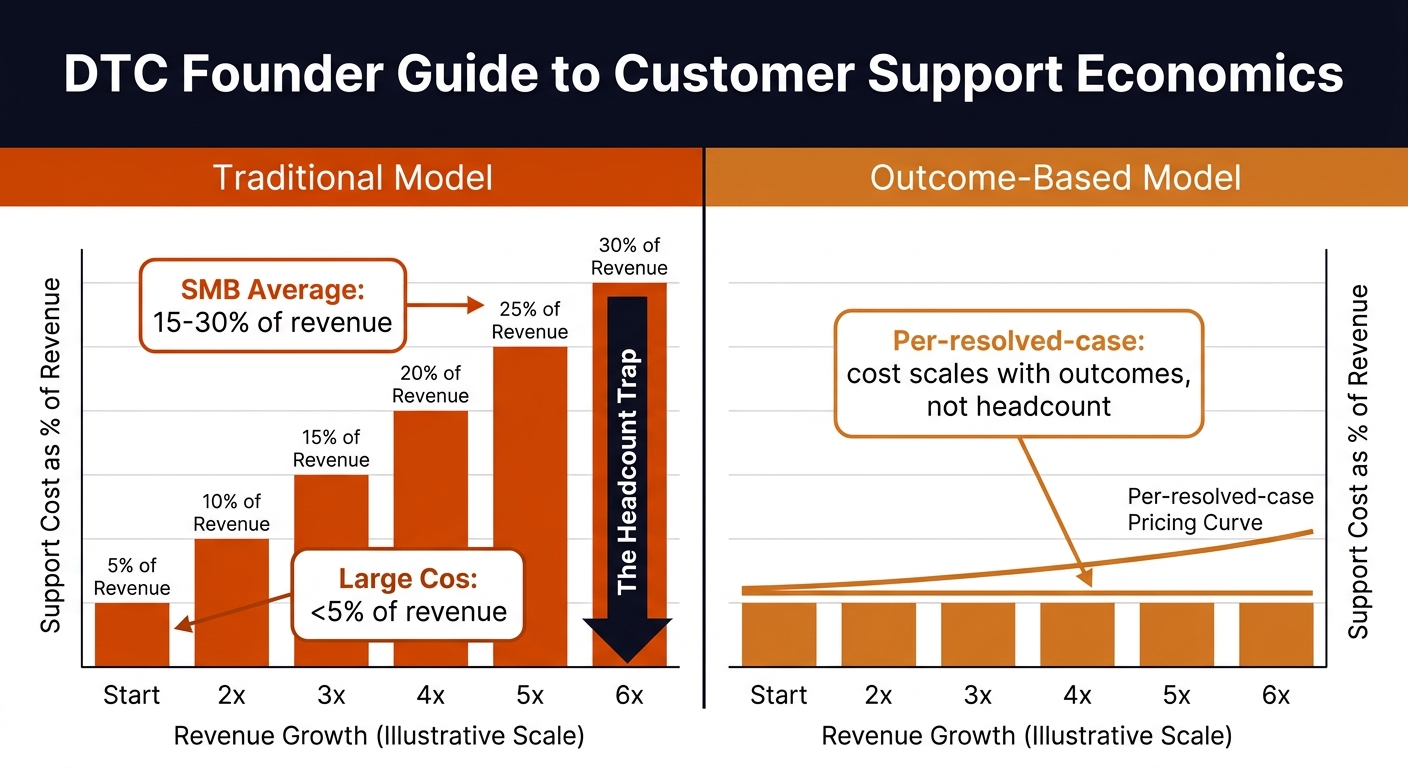
The DTC Founder's Guide to Customer Support Economics
Customer support costs DTC brands between 5% and 30% of revenue depending on scale — and most founders discover this too late, after they've hired a team that's structurally too expensive to maintain. Large e-commerce companies spend under 5% of revenue on support. The gap is almost entirely explained by automation coverage and the cost per resolved case. This guide breaks down the real math and why outcome-based AI changes the curve permanently.
TL;DR: DTC Support Cost at a Glance
| Company Stage / Size | Support Cost as % of Revenue | Primary Driver |
|---|---|---|
| Enterprise (1M+ orders/year) | Under 5% | High automation coverage; cost spread across volume |
| Mid-market DTC ($5M–$50M ARR) | 5–15% | Partial automation; human agents at core |
| Early-stage / growing DTC | 15–30% | Manual-heavy; high repeat-contact rates |
| Post-AI automation (SOP-driven) | 3–8% regardless of stage | Per-resolved-case cost is fixed; scales with outcomes |
Why Do Support Costs Eat More Revenue at Small DTC Brands?
The cost-to-revenue gap between a large e-commerce operator and an early-stage DTC brand is not explained by brand reputation, customer demographics, or return rates. It is almost entirely explained by cost per resolved ticket and automation coverage.
A large retailer processing 500,000 orders per month has built (or bought) automation for the 60–70% of tickets that follow repeatable patterns: order status checks, standard return requests, address changes, shipping exception notifications. The automation cost per resolution is low — often under $2. Human agents handle the remaining 30–40%, but they are working on genuinely complex tickets, not answering "where is my order" 200 times a day. The blended cost per resolution averages well under $5.
An early-stage DTC brand processing 3,000 orders per month typically cannot justify enterprise tooling investment. Its support stack is a Gorgias or Freshdesk seat with a few macros, and those macros require a human to trigger. Every WISMO ticket — which makes up 30–50% of all e-commerce support volume — gets handled manually. The cost per ticket is not $2. It is $8–$15 once you count the agent's fully loaded hourly rate at a realistic tickets-per-hour throughput. At 1,500 WISMO tickets per month and a $10 average cost per ticket, that single ticket type costs $15,000 per month — for a brand that might be doing $100,000 in monthly revenue. That is 15% of revenue on one ticket category.
This is the dynamic founders underestimate: the percentage of revenue spent on support is not a fixed overhead line. It is a variable that tracks ticket-volume-to-automation-coverage ratio. Every point of automation coverage that moves tickets from human resolution to automated resolution shifts cost from the 8–15% zone toward the 3–5% zone.
What Does Customer Support Actually Cost?
The direct cost: per-ticket benchmarks
Published benchmarks put simple e-commerce ticket costs at $2.70–$5.60 per contact for well-run operations. This captures direct agent labor time at standard hourly rates.
Gartner's benchmark is the most cited primary source: the median cost per contact is $1.84 for self-service and $13.50 for assisted channels (phone, chat, and email to a human agent). The 7.3x gap between self-service and assisted channels is not a rounding error — it is the fundamental cost dynamic in support economics.
Where your cost falls within the $2.70–$13.50 range depends on two variables:
- What share of tickets are handled by a human — every point of escalation rate shifts cost toward the $13.50 side
- How long each human-handled ticket takes — complex tickets (carrier disputes, fraud claims, subscription issues) run 3–5x longer than WISMO queries
The hidden costs: the three multipliers
The $2.70–$5.60 headline figure excludes three cost categories that compound across every ticket, every month, invisibly to most founders:
Multiplier 1: Agent turnover and training. Retail and e-commerce support has some of the highest turnover rates in any industry — 30–45% annual churn is common. Replacing one support agent costs $5,000–$20,000 when you account for recruiting time, onboarding overhead, and the 6–8 week productivity ramp before a new hire is handling full ticket volume. At 30% annual churn on a 5-person team, that's 1.5 replacement cycles per year — $7,500–$30,000 in hidden overhead before you count training time.
Multiplier 2: Repeat contacts. When a ticket is not fully resolved on first contact, the customer contacts again. Per SQM Group's contact center benchmarks, the industry First Contact Resolution average is 70% — meaning 30% of issues generate at least one re-contact. Industry analysis puts the effective repeat-contact multiplier at 2.3x: the true per-resolution cost is 2.3x the per-ticket cost because you're paying to handle the same issue twice. At a $5 per-ticket cost, the actual cost per resolved issue is $11.50.
Multiplier 3: Peak-season capacity mismatch. E-commerce support volumes spike 4–6x during peak season (BFCM, December, post-Christmas returns). Brands that handle 500 tickets per day in September face 2,000–3,000 per day in December. The options are: (a) over-hire before peak and carry excess capacity into January, or (b) under-staff and pay for degraded response times with CSAT drops and churn. Neither option is cheap. The over-hire path adds 2–4 temporary agents for 8–10 weeks — $16,000–$40,000 in seasonal labor cost even on minimum-wage shifts.
When you stack these three multipliers — turnover, repeat contacts, peak-season over-hiring — against a true cost-per-ticket framework, the effective cost per resolved customer issue at an early-stage DTC brand is commonly $8–$18 regardless of what the per-ticket benchmark says.
The Headcount Trap: Why Support Costs Scale Linearly With Growth
The fundamental problem with headcount-based support is not that agents are expensive. It is that headcount scales linearly with ticket volume, and ticket volume scales with order volume. As a DTC brand grows — adding customers, increasing AOV, launching new SKUs — the support ticket volume grows in lockstep. More orders mean more WISMO tickets. More SKUs mean more product questions. Faster growth means more new customers who do not yet know the return policy.
The result: support cost as a percentage of revenue is effectively fixed at the per-ticket cost times the tickets-per-order ratio, divided by AOV. A brand generating a WISMO ticket for 20% of orders at $10 per ticket and a $75 AOV is spending 2.7% of revenue on WISMO alone — and that percentage does not naturally improve as the brand scales, unless automation coverage increases in parallel.
The headcount trap is what makes this a founder-scale problem rather than an operations problem. Every dollar of new revenue adds a proportional support load. The business cannot outgrow the cost curve — it has to change the slope.
How Does Outcome-Based Automation Change the Curve?
The pricing model matters as much as the automation itself
The standard AI support pricing models — per seat, per conversation, per API call — do not break the headcount trap. They replace one form of linear scaling with another. Per-seat pricing scales with agent count. Per-conversation pricing scales with ticket volume. You trade one linear cost function for another.
Outcome-based pricing (per-resolved-case) breaks the linearity because the unit of cost is resolution, not volume. You pay only when the AI agent fully resolves a ticket, not when it processes it, deflects it, or starts a conversation that a human must finish. The per-resolution rate is fixed at the margin (CorePiper's Pro plan is $99/month billed annually with 75 cases included, then $2 per resolved case beyond that). As volume grows, total cost grows, but cost per order shrinks as resolution rates improve, because the AI handles more of the volume within each cost tier without requiring proportional investment.
The economic model looks like this at different scales:
| Monthly Order Volume | Support Tickets (20% rate) | AI Resolution Rate | AI Cost (Pro: $99/mo + $2/case over 75) | Human Escalations | Blended Cost/Order |
|---|---|---|---|---|---|
| 1,000 orders | 200 tickets | 65% = 130 resolved | $209 | 70 tickets to humans | ~$0.21 AI + human escalation cost |
| 5,000 orders | 1,000 tickets | 75% = 750 resolved | $1,449 | 250 tickets to humans | ~$0.29 AI + lower human escalation cost |
| 20,000 orders | 4,000 tickets | 80% = 3,200 resolved | $6,349 | 800 tickets to humans | ~$0.32 AI + further lower human cost |
As volume grows, the resolution rate typically improves as the AI agent learns the ticket patterns — and the cost per order trends flat or slightly lower rather than scaling linearly. The human team shrinks proportionally to ticket volume handled, not grows.
What drives resolution rate improvement?
Resolution rate is the lever that makes per-resolved-case economics work at scale. The rate at which an AI agent fully resolves tickets (without human handoff) depends on three factors:
SOP coverage. An AI agent can only resolve tickets that fall within a defined SOP — a documented decision workflow covering the ticket type, the data sources to check, the conditions for each outcome, and the action to take. Every new SOP added to the system increases resolution rate. For a DTC brand, the first five SOPs (WISMO, standard refund, address change, order cancellation, return request) typically cover 60–70% of all inbound tickets and can be built in 1–2 days.
System access. The agent can only take action in systems it is connected to. An AI agent with read-only access to Shopify can answer "where is my order" but cannot trigger a refund or modify a delivery address. An agent with cross-platform access across Shopify, the helpdesk, carrier APIs, and payment systems can complete the full resolution loop in one interaction — and that completion is what drives FCR, which drives resolution rate.
Edge case refinement. After go-live, the tickets that fail to resolve (escalations) reveal gaps in SOPs — edge cases the policy didn't cover, data conditions the agent didn't handle, or action limits that need adjustment. Weekly SOP refinement based on escalation patterns typically moves resolution rate 5–10 percentage points in the first 60 days.
What Does the Math Look Like for a Real DTC Brand?
To make this concrete: a DTC brand doing $3M in annual revenue with a 20% ticket-per-order rate and an average order value of $75:
- Annual orders: ~40,000
- Support tickets: ~8,000/year (667/month)
- Current cost at $10/ticket (blended, including turnover/repeat-contact overhead): $80,000/year (~2.7% of revenue)
- But actual cost with turnover and peak hiring: ~$100,000–$120,000/year (3.3–4% of revenue)
After implementing SOP-driven AI automation at 70% resolution rate, on CorePiper's Pro plan ($99/month billed annually, 900 cases included per year, $2/case beyond that):
- AI-resolved tickets: 5,600/year, 900 included in the annual plan fee ($1,188) plus 4,700 at $2 = $10,588
- Human-handled tickets: 2,400/year at $10 = $24,000
- Total support cost: $34,588/year (~1.2% of revenue)
- Headcount: 1–2 specialists handling complex escalations instead of 3–4 full-time agents
The support-as-percent-of-revenue drops from 3.3–4% to 1.2%, not because of a one-time efficiency gain, but because the cost model changed from linear headcount scaling to per-outcome scaling.
When Should a DTC Founder Automate Support?
The inflection point varies by business, but the clearest signals that the headcount model has become uneconomical:
1. You are hiring your third support agent. Three agents means you have a team, which means you have management overhead, scheduling complexity, and turnover risk multiplied across all three. The economics of AI automation typically turn favorable before agent three in most DTC ticket-volume profiles.
2. Your support cost per order is above $1. At $75 AOV, a $1 per-order support cost is 1.3% of revenue. If your actual cost is $2–$3 per order, you are 2–4% of revenue in support alone — compressing margin that should fund growth.
3. Your resolution rate on WISMO is below 80%. WISMO is the most automatable ticket class in e-commerce. If you are resolving fewer than 80% of WISMO tickets without a follow-up contact, the automation on your highest-volume ticket type is either absent or not working. That is both a cost problem and a CSAT problem.
4. You are over-hiring before BFCM. If your peak-season preparation involves hiring temporary agents who will be let go in January, you are paying for elastic capacity in a way that outcome-based automation handles at a fraction of the cost. Pay per resolution during peak, and cost scales with volume automatically.
The Founder-to-Founder Perspective
I built CorePiper after watching the headcount trap play out across B2B operations — not just DTC, but logistics, insurance, and enterprise case management. The pattern is the same in every vertical: the team resolves the short-term capacity problem by hiring, the hiring embeds a cost floor that compounds with growth, and the business eventually faces a support-cost-as-percent-of-revenue number that is structurally incompatible with sustainable margins.
The insight that drove CorePiper's design is that the cost model matters more than the automation itself. Automation that replaces human time at per-seat pricing still scales linearly. Automation priced per outcome aligns the cost to the value delivered — and gives the business a support cost that trends toward a fixed percentage of volume rather than a fixed percentage of headcount.
For DTC founders, the practical takeaway is not "automate everything immediately." It is: calculate your true per-resolution cost today (including turnover, repeat contacts, and peak-season over-hiring), identify the three to five ticket types that make up 60–70% of your volume, and determine whether the economics of per-resolved-case automation are favorable at your current scale. For most brands above 500 tickets per month, they are — and every month you delay is another month paying for the headcount trap at the expense of growth margin.
Frequently Asked Questions
What percentage of revenue do DTC brands spend on customer support?
Large e-commerce companies typically spend under 5% of revenue on customer support. Mid-market and SMB DTC brands commonly run 5–15%, and early-stage brands with high ticket volumes and small teams can reach 20–30% of revenue. The gap between large and small is almost entirely explained by automation coverage and the support cost per order.
Why do support costs scale with headcount instead of revenue?
Support costs scale with headcount because each new order, return, or shipping exception generates a ticket that requires human time to process. Without automation, the only way to handle more volume is to hire more agents. Because agent capacity grows in steps (you hire one person at a time), support cost tracks order volume linearly — and grows disproportionately during peak seasons when you over-hire and then carry excess capacity.
What is outcome-based AI pricing and how does it change support economics?
Outcome-based pricing (also called per-resolved-case pricing) means you pay only when a ticket is fully resolved by the AI agent — not per ticket processed, per agent seat, or per conversation. Because the cost is proportional to successful resolutions rather than headcount, support cost scales with outcomes rather than with order volume. As resolution rates improve, cost per resolved case falls without any headcount change.
What is the true cost per support ticket for DTC brands?
Published benchmarks put simple e-commerce ticket costs at $2.70–$5.60. The true cost — including agent turnover ($5K–$20K per replacement), onboarding ramp, and repeat contacts (a 2.3x multiplier on unresolved tickets) — routinely exceeds $8 per resolved case. Gartner benchmarks the median assisted-channel contact at $13.50, versus $1.84 for self-service.
When does hiring more support agents stop being the right answer?
Hiring becomes uneconomical when ticket volume exceeds a level where per-agent cost plus management overhead is higher than the per-resolved-case cost of AI automation. For most DTC brands, that inflection point arrives somewhere between 2,000 and 5,000 monthly tickets — well before the typical "we need a team" threshold, because the hidden costs of turnover and training compound faster than founders expect.
CorePiper's plans mean your support cost scales with outcomes, not headcount: Starter ($10/month, 5 cases included) and Pro ($99/month billed annually, 75 cases included) cover Shopify, with Zendesk, Freshdesk, Salesforce, and Jira on Enterprise, custom priced. Book a 30-minute walkthrough to see the math for your ticket volume.