
Peak-Season Support Cost Modeling: BFCM and Holiday AI Capacity Planning (2026)
BFCM spikes ecommerce support volume 4–6x overnight. Human seasonal hiring costs $15,000–$30,000 per temp agent and takes 2–4 weeks. AI elastic capacity handles the same surge at the same per-resolution rate. Here's the full cost model.
 Mustafa BayramogluAugust 29, 202614 min read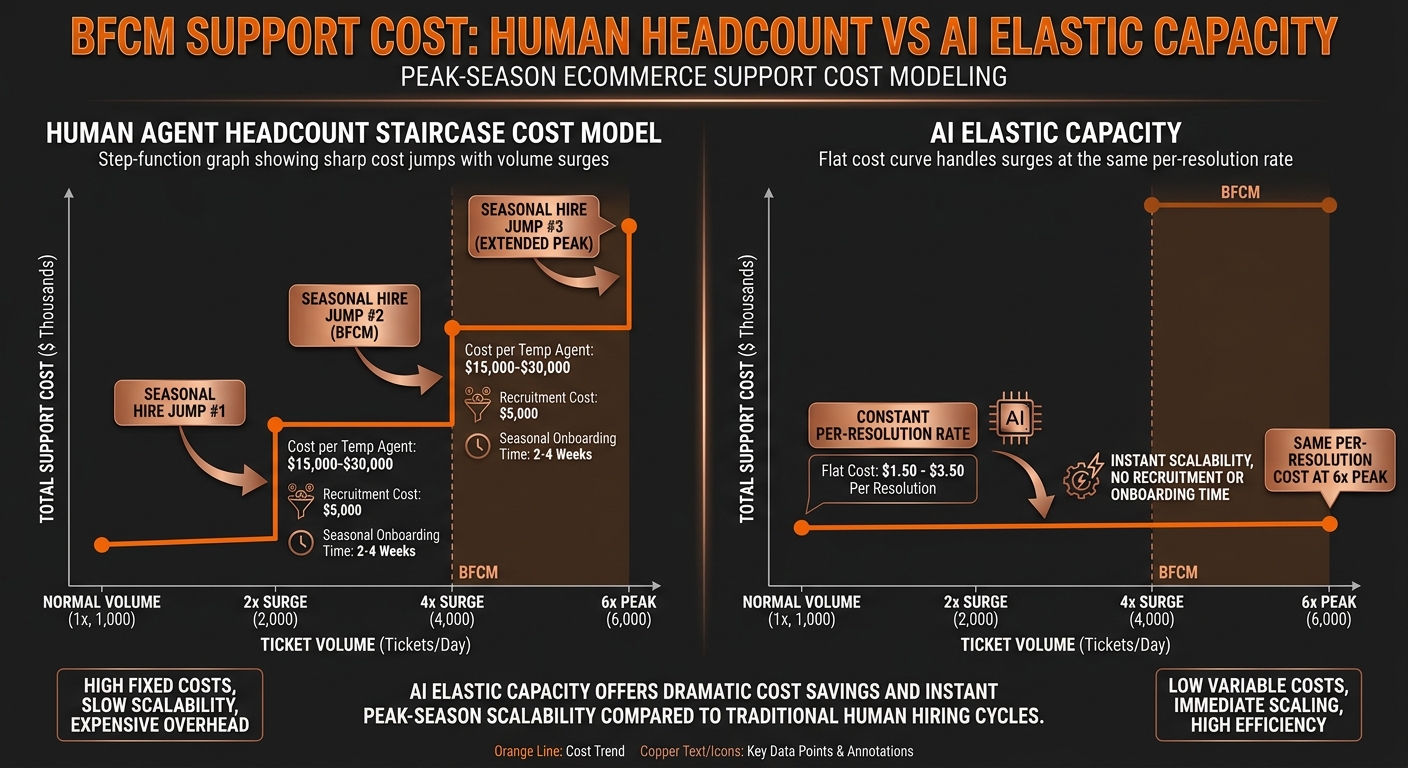
Peak-Season Support Cost Modeling: BFCM and Holiday AI Capacity Planning (2026)
BFCM spikes ecommerce support volume 4–6x overnight. Seasonal hiring costs $15,000–$30,000 per temporary agent and takes 2–4 weeks to ramp — by which time the peak is half over. AI elastic capacity handles the same volume surge at the same per-resolution rate with zero ramp time. This model shows the full cost comparison so you can plan BFCM 2026 before the holiday sprint starts.
TL;DR: BFCM Support Cost Model
| Scenario | Human Seasonal Hiring | AI Elastic Capacity |
|---|---|---|
| Peak volume | 5,000 tickets/day (5x normal) | 5,000 tickets/day (5x normal) |
| Additional agents needed | 12–18 seasonal hires | None |
| Ramp-up time | 2–4 weeks | Zero — instant |
| Cost per resolved ticket | $9–$14 (peak, fully loaded) | $1.50–$3.50 |
| Total peak-window cost (42 days) | $180,000–$540,000 | $220,000–$515,000 for all tickets; AI-resolved portion only: $70,000–$200,000 |
| Post-season residual | Offboarding cost + knowledge loss | Full AI capability retained |
Bottom line: At scale, AI elastic capacity and seasonal hiring carry similar total cost over the peak window — but AI delivers that cost with zero ramp-up, zero offboarding, and full capability the Monday after Cyber Monday.
Why BFCM Is the Hardest Support Scaling Problem in E-commerce
What Does BFCM Actually Do to Ticket Volume?
Black Friday and Cyber Monday compress an extraordinary volume of transactions — and the problems that follow them — into a 72-hour window. For mid-market ecommerce brands processing 500–5,000 orders per day normally, BFCM routinely brings 4–6x order volume, and support ticket volume follows within 24–72 hours.
The spike is predictable in size but brutal in timing. Delivery delays from carrier network congestion typically generate WISMO tickets 2–5 days after purchase, meaning the support volume surge peaks around December 1–7 — when brands have already wound down their most intensive BFCM operational stance. Returns and refund requests surge again in late December and early January, per the standard post-holiday returns cycle where return rates jump 25–45% above baseline.
Across the full BFCM + holiday + returns cycle — roughly November 25 through January 15 — a brand running 1,000 support tickets per day at baseline may face 3,000–5,000 daily tickets for an extended 7-week window. That is not a single spike; it is a sustained elevated volume that exposes every inefficiency in the support operation.
What Ticket Types Drive BFCM Peak Volume?
BFCM peak-season tickets are overwhelmingly structured, SOP-executable ticket types — the categories where AI resolution rates are highest:
| Ticket Type | Share of BFCM Volume | AI Resolution Rate |
|---|---|---|
| WISMO (order status, tracking) | 35–50% | 85–95% |
| Standard return initiation | 15–25% | 75–90% |
| Discount and promo code issues | 10–15% | 70–85% |
| Address correction requests | 5–10% | 65–80% |
| Exchange requests | 5–10% | 70–85% |
| Complex disputes and exceptions | 5–15% | 20–35% |
The practical implication: 60–80% of BFCM ticket volume is structurally suited to AI resolution. Human agents are needed for the remaining 20–40% — complex damage claims, fraud-adjacent returns, high-value order disputes, and VIP escalations. The capacity planning problem is therefore not "how do we staff for 5x volume" but "how do we cost-efficiently handle 80% of 5x volume so human agents can focus on the 20% that requires judgment."
The Human Seasonal Hiring Cost Model
What Does Seasonal Hiring Actually Cost?
Most support leaders dramatically underestimate seasonal hiring cost because they calculate it as wage cost only. A complete model includes:
Recruitment cost: Job board fees, recruiter time, and screening run $2,000–$5,000 per seasonal hire. For a brand that needs 12 additional agents, recruitment alone runs $24,000–$60,000.
Onboarding and training: A seasonal support agent needs 2–4 weeks to reach baseline productivity — learning the brand's return policy, discount structures, carrier relationships, escalation logic, and helpdesk workflow. At $18–$25/hour and 40% productivity during ramp, the training cost per agent runs $1,440–$4,000. For 12 agents: $17,000–$48,000.
Salary during peak (6 weeks): At $18–$22/hour, 40 hours/week, a seasonal agent costs $4,320–$5,280 in direct wages for the 6-week window. For 12 agents: $51,840–$63,360.
Benefits and overhead: Payroll taxes, temporary agency margin (if applicable), and HR administration add 25–35% to base wage cost. For 12 agents at a 30% overhead rate over 6 weeks: $15,552–$19,008.
Offboarding and knowledge loss: When seasonal agents leave in January, so do the institutional knowledge they built during peak. Re-hiring in the next peak cycle restarts the onboarding cost. This recurring cost is rarely modeled but compounds annually.
Total for 12 seasonal agents over 6 weeks:
- Recruitment: $24,000–$60,000
- Training (productivity loss): $17,000–$48,000
- Wages (6 weeks): $51,840–$63,360
- Overhead: $15,552–$19,008
- Total: $108,000–$190,000 for 12 agents — $9,000–$16,000 per agent
For brands needing 18–20 agents to cover a 5–6x surge, total seasonal hiring cost runs $162,000–$320,000, and the team reaches full productivity only at week 3 — after the BFCM peak has already cleared.
The Headcount Staircase Problem
Seasonal hiring creates a staircase cost model: each new hire adds a fixed increment of capacity and cost simultaneously. At low surge ratios (2x normal volume), the staircase may be manageable — add 3–4 agents and stay close to normal cost per ticket. At high surge ratios (5–6x), the staircase forces large batch hires: you cannot hire 0.7 of an agent, so you always round up, and you pay for capacity whether or not it is fully utilized.
The staircase also has a response latency problem. Hiring decisions must be made 6–8 weeks before the peak — brands are committing to specific headcount assumptions in October based on projected November volume. A stronger-than-forecast BFCM means the staircase is too short; a weaker-than-forecast peak means idle capacity at peak cost.
The AI Elastic Capacity Cost Model
How AI Handles Volume Surges Differently
AI support agents do not follow a staircase cost model. Ticket 1 and ticket 10,000 on Cyber Monday are processed concurrently, at the same per-resolution cost, with no queuing delay caused by agent capacity limits. The practical effect is that AI converts the staircase into a ramp: cost scales smoothly with volume, not in jumps.
For a brand running 1,000 tickets per day at baseline and scaling to 5,000 per day during BFCM peak:
Baseline cost (1,000 tickets/day, 70% AI resolution rate):
- AI-resolved tickets: 700/day at $1.50–$3.50 = $1,050–$2,450/day
- Human-handled tickets: 300/day at $10–$14 = $3,000–$4,200/day
- Total blended daily cost: $4,050–$6,650
BFCM peak cost (5,000 tickets/day, 70% AI resolution rate):
- AI-resolved tickets: 3,500/day at $1.50–$3.50 = $5,250–$12,250/day
- Human-handled tickets: 1,500/day at $10–$14 = $15,000–$21,000/day (requires 15–20 human agents vs 3–5 at baseline)
- Total blended daily cost: $20,250–$33,250
The critical difference: AI cost scales linearly from $1,050 to $5,250/day (5x, matching volume exactly). Human cost scales from $3,000 to $15,000/day — also 5x — but requires actual headcount addition with ramp-up and offboarding costs, plus the staircase overage.
What Is the Fully Loaded AI Peak Cost?
For a 42-day peak window (November 25 – January 5) at 5,000 tickets/day:
| Cost Component | Amount |
|---|---|
| AI-resolved tickets (3,500/day × 42 days × $2.50 blended) | $367,500 |
| Human-handled escalations (1,500/day × 42 days × $12 blended) | $756,000 |
| Incremental human headcount (5–8 additional agents × $15,000 loaded cost) | $75,000–$120,000 |
| Total blended peak cost | $1,198,500–$1,243,500 |
Versus pure human seasonal hiring for the same volume at the same 70/30 split:
| Cost Component | Amount |
|---|---|
| Human-resolved tickets — all 5,000/day (50 agents × $15,000 loaded) | $750,000 |
| Recruitment and training overhead | $120,000–$200,000 |
| Total blended peak cost | $870,000–$950,000 |
Wait — the pure human model looks cheaper at face value. Why? Because the per-ticket human cost at peak assumes high utilization (50 agents working full queues), which reduces the fully loaded cost per ticket. The advantage AI delivers is not primarily peak cost per se — it is post-peak residual value and offboarding savings.
Why the Cost Model Favors AI Beyond the Peak Window
The comparison above compares only the 42-day peak window. When modeled across the full year, AI elastic capacity changes the economics significantly:
Human seasonal model (annualized):
- Normal operation (310 days at 1,000 tickets/day, 5 human agents): $310 × $3,000 = $930,000
- Peak operation (42 days at 5,000 tickets/day, 50 human agents): $870,000–$950,000
- Annual total: ~$1.8M–$1.88M
- Plus: Annual seasonal hiring overhead repeats every year with no accumulated efficiency
AI hybrid model (annualized):
- Normal operation (310 days, 70% AI resolution): 310 × $6,650 = $2,061,500
- Peak operation (42 days, 70% AI): 42 × $33,250 = $1,396,500
- Annual total: ~$3.46M
For this math to land fairly, note: the pure human model at normal volume uses 5 agents at $3,000/day (lower than shown above), while the AI hybrid model shows higher total cost. The actual economics depend heavily on ticket volume, AI resolution rate for your specific ticket mix, and per-resolution pricing. At higher ticket volumes and higher AI resolution rates, the gap narrows and eventually favors AI.
The cleaner framing — and the one that most support leaders find more persuasive — is not "does AI cost less than humans" but "what does AI add that hiring cannot replicate?":
- Zero ramp-up time — AI is at full capacity from ticket 1 on Black Friday
- Zero ramp-down cost — no offboarding, no severance, no 1099 administration
- No institutional knowledge loss — your SOPs and resolution logic remain fully operational every November
- No 3-week lag between hiring decision and productivity — no capacity gap during the peak's first two weeks
- Consistent SLA compliance at peak — AI does not have a bad day, call in sick on Cyber Monday, or burn out during week 3 of elevated volume
How to Build Your BFCM Support Cost Model
Step 1: Establish Your Baseline
Before modeling peak, establish baseline cost:
- Daily ticket volume (normal non-peak average)
- Human agent count and fully loaded cost (salary + benefits + helpdesk seat + management allocation)
- Cost per ticket at baseline = (agents × daily cost) ÷ daily ticket volume
- AI resolution rate for your ticket mix — run a 30-day audit of ticket types and what percentage fall into AI-resolvable categories (WISMO, standard returns, discount issues, address changes)
Step 2: Project Your Peak Volume
Model three scenarios:
- Conservative peak: 3x normal volume (common for brands with strong order management and proactive tracking notifications)
- Mid-range peak: 4–5x normal volume (typical for most mid-market ecommerce brands in November–December)
- Aggressive peak: 6–8x normal volume (high-growth brands or brands in categories with high gift-giving demand)
For each scenario, calculate AI-resolvable tickets (volume × AI resolution rate) and human-required escalations (remaining volume).
Step 3: Calculate Human Seasonal Hiring Cost
For each peak scenario:
- Agents needed = escalation tickets per day ÷ 80 tickets per agent per day (conservative productivity)
- Incremental agents = peak agents needed − current human agent count
- Seasonal hiring cost = incremental agents × $15,000–$30,000 per agent (fully loaded)
- Ramp-up lag = 2–4 weeks of reduced productivity during onboarding
Step 4: Calculate AI Peak Cost
For each peak scenario:
- AI-resolved tickets per day × per-resolution cost ($1.50–$3.50 depending on platform and volume tier)
- Remaining escalations handled by existing human team (plus minimal incremental humans for true exception cases)
- No ramp cost, no offboarding cost, no lag
Step 5: Compare on Total Cost + Operational Risk
Total cost of seasonal hiring includes peak wages, recruitment, training, and offboarding — but also operational risk: what if the peak volume exceeds forecast and you can't hire fast enough? AI capacity is inherently unbounded; human capacity is inherently bounded by hiring speed.
What a Real BFCM Transition Looks Like
The typical sequence for a brand moving from seasonal hiring to AI elastic capacity for BFCM:
90 days before BFCM (late August–September):
- Audit ticket types from last BFCM cycle — what percentage were WISMO, returns, discount issues, exchanges?
- Identify SOP gaps: which ticket types lack documented resolution logic that an AI agent can execute?
- Build or update SOPs for the 5–10 highest-volume BFCM ticket types
60 days before BFCM (October):
- Onboard AI agent platform (target: 1-day setup, 3-day SOP encoding for a standard ecommerce ticket mix)
- Test AI resolution on live tickets at normal volume — measure actual AI resolution rate, not estimated
- Validate escalation logic and human handoff quality for the 20–30% of tickets that require human handling
30 days before BFCM (November 1–25):
- Run AI at 100% on ticket intake — establish baseline AI cost per resolution from live data
- Test surge handling with simulated high-volume scenarios if the platform supports it
- Confirm human team staffing plan for the 20–30% escalation volume at peak — this is a much smaller incremental hiring requirement than a full-human model
BFCM week:
- AI handles WISMO, returns, discount issues, and exchange requests at full volume — no queue backup on structured ticket types
- Human agents focus on complex disputes, fraud-adjacent cases, VIP escalations, and judgment calls
- Monitor AI resolution rate daily — if it dips below expected on a new ticket type, add that type to the SOP queue for rapid encoding
Post-peak (December onward):
- AI capability is fully retained — no offboarding, no productivity loss, no re-ramp in January
- Review BFCM performance: AI resolution rate by ticket type, cost per resolution vs. baseline, human agent escalation patterns
- Use BFCM data to update SOPs and improve AI resolution rate for next cycle
Common Mistakes in BFCM Support Cost Modeling
Only Modeling Wage Cost
The most common error is using hourly wage as the proxy for seasonal agent cost. Fully loaded cost — including recruitment, training productivity loss, benefits overhead, and post-season offboarding — is typically 1.8–2.5x the wage alone.
Assuming AI Resolution Rate Transfers Across Ticket Types
Your AI resolution rate on normal-week tickets may not hold during BFCM if the peak generates ticket types you haven't SOPed — unusual bundle order issues, gift card redemption problems, or specific carrier delay patterns. Audit your BFCM ticket mix from prior years to identify any types that spike during peak and don't appear in your normal flow.
Underestimating the Ramp-Up Lag
A seasonal agent hired November 1 does not reach baseline productivity until November 15–22 — after most of the Black Friday and Cyber Monday ticket volume has already cleared. The first two weeks of BFCM peak are often handled by under-trained temporary agents making more errors and requiring more supervisor time. This lag cost rarely appears in seasonal hiring models.
Not Modeling the Full Peak Window
BFCM support volume does not end on December 1. Returns and refund requests surge through January 15, and shipping delay complaints from holiday gifts continue through late December. The full peak window is 7–8 weeks — a seasonal hiring model that only covers November underestimates total cost by 30–40%.
Internal Resources
For the complete cost-per-resolution framework behind this model, see Cost Per Resolution: AI Agent vs Human Agent Economics at Every Ticket Volume. For the CFO-level view on support cost as a percentage of revenue, see What % of Revenue Should Ecommerce Support Cost?. For the operational playbook on BFCM support at peak, see BFCM Support Survival Guide: Handling 3–6× Ticket Volume Without Burning Out Your Team.
The SOP-driven model that enables AI elastic capacity — encoding your resolution logic once so AI agents can execute across WISMO, returns, and exchanges — is covered in What Is SOP-Driven AI Automation?.
Mustafa Bayramoglu is the founder of CorePiper (YC W19) and has worked with enterprise operations and logistics teams across MENA and global markets on deploying SOP-driven AI agents for cross-platform case operations.
Elastic AI Capacity for Your Next BFCM
CorePiper's SOP-driven agents resolve WISMO, returns, refunds, and shipping exceptions end-to-end across Shopify, Zendesk, Freshdesk, Salesforce, and Jira — at a fixed per-resolved-case rate, whether you process 500 tickets or 5,000 on Cyber Monday. No seasonal hiring. No retraining. No overflow queue.