
Agentic AI for Customer Support: What It Is and Why 2026 Is the Inflection Point
Agentic AI for customer support goes beyond chatbots — it takes autonomous actions across your systems to resolve tickets end-to-end. Learn what it is, how it differs from chatbots, what the Gartner data says, and what CX leaders should expect in 2026.
 Mustafa BayramogluJune 17, 202614 min read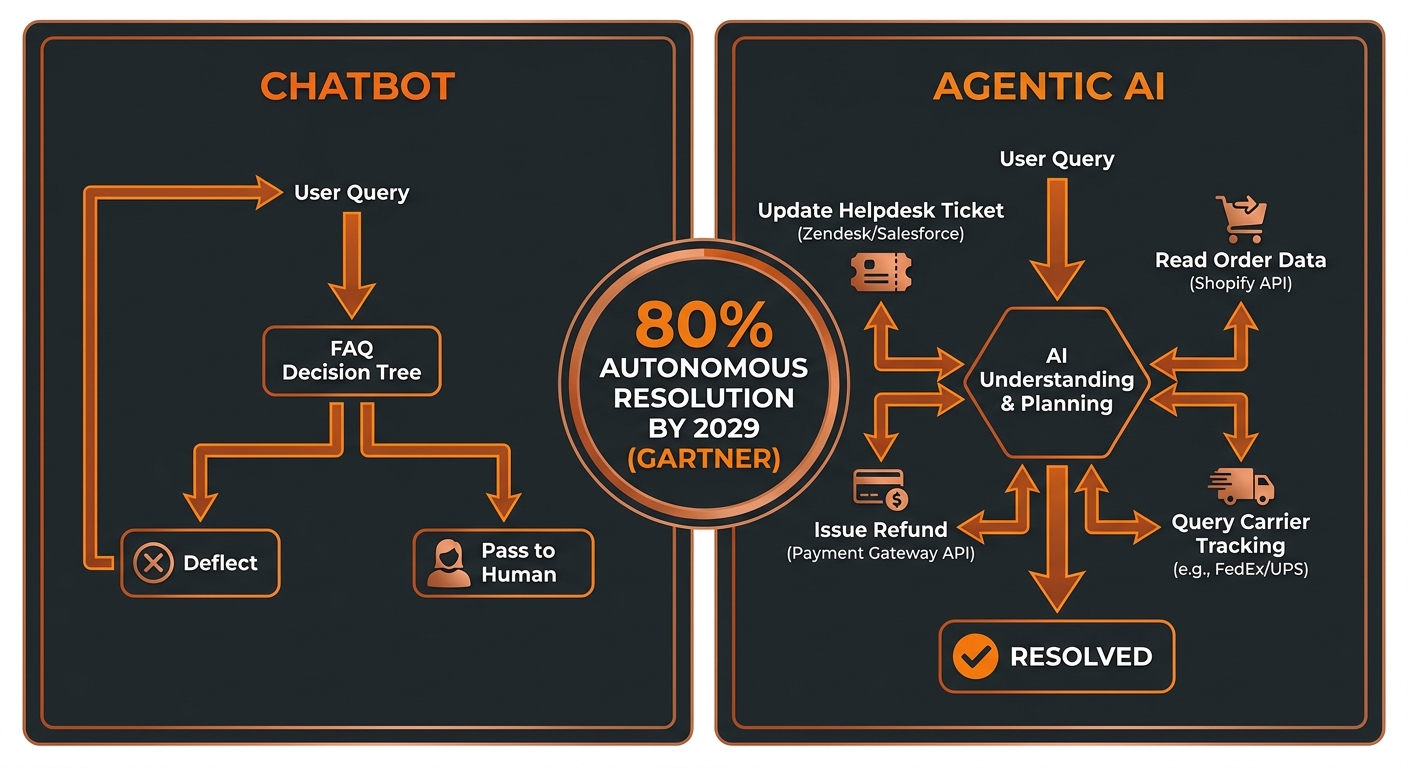
Agentic AI for Customer Support: What It Is and Why 2026 Is the Inflection Point
Agentic AI for customer support is an AI system that resolves tickets autonomously by taking actions across your connected systems — reading order data, querying carrier APIs, issuing refunds, updating helpdesk records, and confirming resolution — without a human approving each step. It is categorically different from chatbots that generate responses for agents to send. Per Gartner (March 2025), agentic AI will autonomously resolve 80% of common customer service issues by 2029.
TL;DR: Agentic AI for Customer Support
| Chatbot / Virtual Assistant | Agentic AI | |
|---|---|---|
| What it does | Generates responses, suggests FAQs, routes tickets | Takes actions, executes resolutions, closes tickets |
| System access | Reads limited data (knowledge base, FAQs) | Reads and writes across order management, helpdesk, CRM |
| Human required | Yes — for every resolution action | No — for defined tier-1 ticket types |
| Resolution rate | 30–40% (deflection-based) | 65–85% (action-based) |
| Audit trail | Response logs only | Full action audit: what decided, what executed, what changed |
| 2026 benchmark | Plateauing | Gartner projects 80% autonomous resolution by 2029 |
What Is Agentic AI for Customer Support?
Agentic AI for customer support is an AI system designed to autonomously complete resolution tasks — not just respond to them. The word "agentic" means the system acts as an agent: it perceives a situation, decides on a course of action, executes that action in an external system, observes the result, and proceeds to the next step until the task is done.
In a customer support context, that looks like this: a customer emails your Zendesk saying their order arrived damaged. An agentic AI reads the ticket, queries Shopify to confirm the order details and delivery date, checks your carrier's tracking portal for the exception record, evaluates the claim against your SOP (order value, damage severity, account tier), issues a replacement shipment or refund via the Shopify Admin API, updates the Zendesk ticket to "Resolved," and sends a confirmation email — all without a human touching the case.
This is what distinguishes agentic AI from the category that preceded it. A chatbot reads the same damage ticket and generates a response: "We're sorry to hear about your order. Please reply with your order number and photos of the damage." A human agent then picks up the ticket, does the same Shopify lookup, makes the refund decision, and closes it manually. The chatbot added language; the agent did the work. Agentic AI does the work.
How Is Agentic AI Different from a Chatbot or Virtual Assistant?
The architectural difference is system integration and action authority.
Chatbots and virtual assistants are text-in, text-out systems. They read a message and produce a response. Sophisticated ones classify intent, look up knowledge base articles, and route tickets. The most advanced draft context-aware responses that still need human review. At no point does the system touch your Shopify backend, call your carrier's API, or issue a refund. The human agent is still the executor.
Agentic AI has read-write access to your operational systems. It does not draft — it executes. The difference is permission plus integration: the agent has been granted access to specific APIs (Shopify Admin API for refunds and order edits, Zendesk API for ticket updates and comments, Salesforce API for case creation and account lookup, carrier portals for tracking and claims submission) and has been instructed on when and how to use each one.
The resolution rate gap reflects this difference. Systems that draft responses for human approval resolve 30–40% of tickets autonomously — "autonomous" in the narrow sense that the response is generated without human input, not that the resolution is completed without human action. Systems that execute resolutions directly resolve 65–85% of tier-1 tickets without any human involvement from triage to close.
Understanding this distinction is foundational to evaluating any AI customer support tool in 2026. "AI-powered" has become a marketing descriptor that applies equally to a simple FAQ bot and a fully autonomous resolution agent. The question to ask any vendor is not "does it use AI?" but "what actions does it take, in which systems, without human approval?"
What Can Agentic AI Actually Do in a Customer Support Context?
The practical scope of agentic AI depends on what systems it is connected to and what action permissions it has been granted. A well-integrated agentic system for e-commerce customer support can handle:
Order status and WISMO. The agent reads the order from Shopify or your OMS, queries the carrier for real-time tracking status, and provides a specific, factual response. It can also proactively detect exceptions (delayed shipments, carrier holds) and reach out to customers before they contact support. WISMO tickets alone represent 30–50% of e-commerce support volume — automating them end-to-end is the single highest-leverage starting point for most brands.
Refunds and returns. The agent evaluates the request against your return policy (order date, product type, account tier, fraud flags), initiates the Shopify refund or return merchandise authorization, updates the helpdesk record, and confirms to the customer. Configurable guardrails (order value thresholds, high-risk flags) route edge cases to human review rather than auto-approving them.
Address changes and order edits. Within the Shopify editing window, the agent can modify shipping addresses, update line items, or cancel orders. Outside the editing window, it routes the request to fulfillment with the context already assembled.
Shipment exception claims. For logistics operations specifically, agentic AI can read delivery exceptions, check carrier liability thresholds, collect evidence (photos, delivery records), and submit claims through carrier portals — the same workflow that takes a human claims agent 15–40 minutes per case.
Cross-system escalation. When a ticket exceeds the agent's resolution authority — a high-value dispute, a legally sensitive complaint, a customer threatening churn — the agent creates a Salesforce case with full context, assigns it to the right human queue, and updates the helpdesk ticket, so no information is lost in the handoff.
The ceiling is defined by your system access and your SOP documentation. Actions the agent is not authorized to take, or workflows it has not been given decision logic for, escalate to human agents. Agentic AI is not general-purpose problem solving — it is SOP execution at machine speed.
Why Is 2026 the Inflection Point for Agentic AI in Customer Support?
Three converging forces made 2026 the year agentic AI moved from early adopter to mainstream in customer support operations.
The model capability threshold crossed. Large language models reached the reliability threshold where autonomous action — taking an irreversible step like issuing a refund without human confirmation — became acceptable for defined ticket types. Earlier models hallucinated too often, misread context, and made decisions that required systematic human review. Current models make errors at a rate comparable to human agents on structured, process-driven tasks, which is the threshold required for autonomous deployment.
The integration infrastructure matured. Shopify's Admin API, Zendesk's APIs, Salesforce's REST API, and Jira's REST API have all reached production-grade stability. Connecting an AI agent to all four, with the right authentication and permission scoping, became a configuration task rather than a custom engineering project. The infrastructure that agentic AI depends on became accessible to more teams.
The economics made it unavoidable. Gartner's benchmark puts human-assisted support at $13.50 per contact versus $1.84 per self-service interaction. For e-commerce brands with 5,000–50,000 monthly tickets, the cost delta between a human-executed workflow and an AI-executed one is material at the operating-income level. The same Gartner analysis (March 2025, Daniel O'Sullivan) projects a 30% reduction in operational costs alongside the 80% autonomous resolution figure.
For CX leaders, 2026 is the inflection point because the early-adopter risk has passed. The resolution-rate benchmarks are published, the integration patterns are documented, and the pricing models (per-resolved-case, per-outcome) align vendor incentives to actual outcomes rather than activity. The question has shifted from "should we evaluate agentic AI?" to "which architecture and vendor configuration fits our support operation?"
What Does the Research Say About Agentic AI Resolution Rates?
The most-cited projection is Gartner's March 2025 statement from Senior Director Analyst Daniel O'Sullivan: "By 2029, agentic AI will autonomously resolve 80% of common customer service issues without human intervention, leading to a 30% reduction in operational costs." This is a forward projection, not a measured current state — it should be read as the trajectory of the category, not a current baseline.
Current published resolution rates from deployed systems:
- Intercom Fin reports 67% resolution rate across 40M+ conversations (as cited in their public marketing materials)
- Captions (Parahelp customer) reported 46% of tickets resolved end-to-end within 7 days post-implementation
- General agentic AI range: 65–85% for tier-1 e-commerce tickets where the system has full API access
The SQM Group benchmark for human agents on First Contact Resolution is 70% industry average, with world-class at 80%+ (achieved by only approximately 5% of contact centers). Well-configured agentic AI is now within or above the human FCR range for the specific ticket types it handles.
The key variable is ticket eligibility — the share of your queue that falls within the agent's resolution scope. A brand where 70% of tickets are WISMO, standard returns, and address changes will see much higher overall automation rates than one where 40% of tickets are complex disputes or multi-channel escalations.
Evaluating which tools achieve these rates in practice requires looking at resolution depth, not just marketed percentages. A tool that "resolves" tickets by closing them without customer confirmation inflates its rate. Ask for the methodology: what counts as resolved, and what is the post-resolution escalation rate?
How Does Agentic AI Handle Escalation and Guardrails?
Guardrails are the operational foundation of responsible agentic deployment. Without them, an autonomous system can make errors that are more damaging than the inefficiency it replaced — an incorrectly issued refund at high volume, an order modification that violates fulfillment constraints, a claim filed with incorrect documentation.
Effective guardrail design for agentic customer support AI includes:
Action thresholds. Refund amounts above a configured ceiling (e.g., orders over $500) route to human review rather than auto-executing. Return requests for products on a no-return list escalate immediately. High-risk account flags (chargeback history, fraud signals) block autonomous action.
Confidence scoring. The agent assigns a confidence score to its resolution decision. Below the threshold, it escalates with the full context assembled — the human agent receives a pre-populated case, not a raw ticket. Above the threshold, it executes.
Audit trails. Every autonomous action generates an immutable log: what the agent read, what it decided, what it changed, when. For compliance, regulatory review, and quality improvement, this trail is non-negotiable. A system that cannot produce a per-action audit trail is not enterprise-ready.
Human-in-the-loop hooks. For certain ticket types (high-value accounts, VIP customers, legal or regulatory topics), the system can be configured to always route to human review after the AI has assembled context — the human confirms the recommendation rather than doing the legwork. This hybrid model achieves most of the efficiency gain while keeping human judgment on sensitive cases.
The right guardrail configuration is SOP documentation. Your support team already has implicit decision rules — order value limits for no-questions-asked refunds, product categories that require manager approval, account tiers that get different service levels. Encoding those into the agent's guardrail logic is what separates a deployed agentic system from a liability.
What Does SOP-Driven Agentic AI Look Like in Practice?
The SOP-driven model — where the AI agent's behavior is defined by your standard operating procedures rather than a training dataset — is the architecture that makes agentic AI deployable without a machine learning team.
In a traditional ML-based support automation project, you need labeled training data (thousands of resolved tickets with correct actions tagged), model fine-tuning, and ongoing retraining as policies change. This puts the project out of reach for most support operations.
In the SOP-driven model, you document the decision logic your team already uses — if the order is within 30 days and under $200, process the refund automatically; if over $200, route to Level 2; if the product is on the non-return list, escalate with the reason — and the agent executes that logic through connected APIs. When your policy changes, you update the SOP. The agent updates accordingly, with no retraining.
This is the architecture CorePiper uses. You encode your SOPs — the same decision trees your support leads have documented for onboarding — and CorePiper builds agents that execute them across whichever systems your support operation spans: Shopify, Zendesk, Freshdesk, Salesforce, Jira. The setup timeline is measured in days, not months, because there is no training data collection phase.
How Do I Evaluate Whether an AI Customer Support Tool Is Truly Agentic?
Six questions that separate genuinely agentic tools from AI-branded routing systems:
-
What actions does the AI take without human approval? Name specific API calls: issue Shopify refund, update Zendesk ticket status, create Salesforce case, submit carrier claim. If the vendor describes "drafting responses" or "suggesting actions," the system is not agentic — it is assisted drafting.
-
Which systems does it read from and write to? A system with read-only access to your order data can tell customers their order status. A system with write access can issue the refund. The distinction is whether the agent completes the resolution or prepares it for a human to complete.
-
What is the audit trail for autonomous actions? Ask for a sample audit log from a resolved ticket. It should show: ticket received, data queried, decision made, action taken, confirmation sent, ticket closed. If the vendor cannot produce this, escalation accountability is undefined.
-
What percentage of your ticket volume falls within the agent's resolution scope? A vendor claiming 85% resolution rate on a curated set of simple tickets may achieve 30% against your full queue. Ask for the eligibility methodology.
-
How do guardrails and escalation work? What triggers a route-to-human? At what thresholds? What does the human agent receive — raw ticket or pre-assembled context?
-
How does the system handle policy changes? If your return policy changes, how long does it take for the agent to reflect the new policy? SOP-driven systems update immediately; training-data systems require a retraining cycle.
What Should E-commerce Brands Expect from Agentic AI in 2026?
For e-commerce brands implementing agentic AI in 2026, realistic expectations look like this:
Resolution rates of 60–80% on eligible ticket types — WISMO, standard returns, address changes, subscription updates. The specific rate depends on the share of your queue that falls within these categories and the quality of your SOP documentation.
First-value in days, not months. Agentic systems built on SOP documentation rather than training data can reach production on defined ticket types in one to five business days. Enterprise deployments with complex integration requirements take longer, but the configuration phase is not a training phase.
Cost-per-resolution reduction of 40–70% on automated ticket types, benchmarked against current human handling cost. The Gartner $1.84 vs $13.50 benchmark represents the ceiling — most brands will see the delta on the automated subset, not the full queue.
Audit and compliance readiness from day one. Unlike early chatbot deployments that operated as black boxes, agentic systems with proper guardrail and audit-trail design satisfy the documentation requirements most enterprise compliance teams need.
Continuous policy alignment, not periodic retraining. When your refund window changes from 30 to 45 days, or you add a new product category to your no-return list, the SOP-driven agent reflects the change immediately. The system does not degrade as your business evolves.
The category is real, the benchmarks are published, and the infrastructure is production-grade. 2026 is not a year to pilot agentic AI — it is a year to deploy it.
See Agentic AI Resolution in Action
If you're evaluating whether agentic AI is ready for your support operation, the most direct test is seeing it work against your actual ticket types: your Shopify stack, your helpdesk, your SOPs, your escalation rules. CorePiper resolves tickets end-to-end across Shopify, Zendesk, Freshdesk, Salesforce, and Jira — using your existing SOPs, not a replacement platform.
Read the full guide to the best AI agents for customer support in 2026 to see how agentic systems compare across resolution depth, platform coverage, and pricing models.
Or book a 30-minute walkthrough to see cross-platform agentic resolution working against a real support scenario.
See Agentic AI Resolution in Action
CorePiper's agentic AI resolves tickets end-to-end across Shopify, Zendesk, Freshdesk, Salesforce, and Jira — using your SOPs, not a replacement platform. Book a 30-minute walkthrough to see what autonomous resolution actually looks like across a real multi-system support stack.