
Store Credit vs. Cash Refund: The Decision Framework That Protects Margin
Store credit vs. cash refund is a returns decision that directly affects revenue retention, margin, and repeat purchase rate. This decision framework shows you when each option wins and how to automate the choice at the ticket level.
 Mustafa BayramogluAugust 25, 202612 min read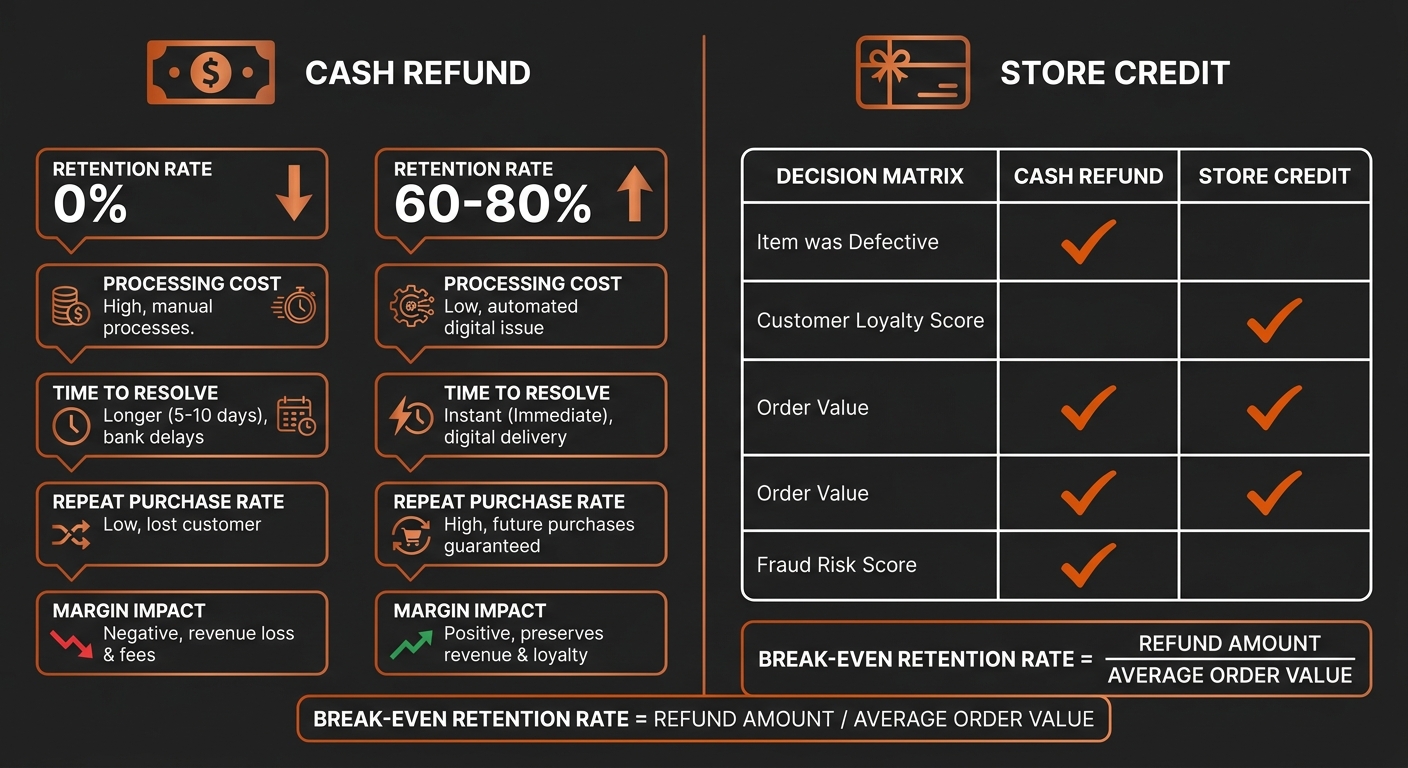
Store Credit vs. Cash Refund: The Decision Framework That Protects Margin
When a customer submits a return, the resolution path — store credit or cash refund — is one of the highest-leverage decisions in your returns operation. A cash refund returns money to the customer permanently; store credit keeps that revenue inside your business and creates a second purchase opportunity. At scale, systematically routing eligible returns to store credit over cash refund retains 20–35% of return revenue that would otherwise leave your P&L. The decision, however, is not binary: applying store credit indiscriminately damages customer trust, while offering cash refund by default leaves recoverable margin on the table.
TL;DR: Store Credit vs. Cash Refund at a Glance
| Factor | Cash Refund | Store Credit |
|---|---|---|
| Revenue retained | 0% (exits business) | 60–75% (on repeat purchase) |
| Customer acceptance rate | 100% (no friction) | 40–70% (incentive-dependent) |
| Processing cost | Same-day settlement | Same-day issuance |
| Repeat purchase trigger | No | Yes — average redemption within 30–60 days |
| Legal exposure | None | Jurisdiction-dependent for defective items |
| Fraud risk | Low (money returns) | Moderate (credit resale on secondary markets) |
| Best for | Defective items, first-time buyers | Preference returns, loyalty cohort |
The framework below defines when each path wins, how to calculate the break-even on store credit incentives, and how to automate the decision at the ticket level using SOPs.
Why the Choice Matters More Than Most Brands Realize
What Is the Actual Cost of a Cash Refund?
A cash refund is often modeled as cost-neutral — the brand gets the item back (if required) and refunds the purchase price. The real cost is more complex:
- Revenue permanently exits the business. A $60 cash refund on a $60 order is $60 of lifetime value lost. If that customer never returns, the cost includes the original customer acquisition cost (CAC) paid to acquire that order.
- Payment processing fees are not refunded on most platforms. Stripe, Square, and most processors return the interchange portion of the processing fee but retain the fixed component ($0.30 per transaction). On low-average-order-value (AOV) businesses, this erodes margin on refunded orders.
- Chargeback risk remains. Customers who receive a cash refund can still initiate a chargeback, particularly if the refund timeline is unclear. Chargebacks add $15–$100 in penalty fees per transaction depending on your processor and chargeback rate history.
What Is the Actual Value of Store Credit?
Store credit keeps refund revenue inside the business, converts the return into a second purchase opportunity, and — when paired with an incentive — delivers a higher resolution satisfaction score than cash refunds for customers who accept it.
The value equation:
- Revenue retention. A $60 store credit that is redeemed turns a $60 loss into a $60 future purchase (minus your cost of goods, which you would have incurred on any new order anyway). On a 60% gross margin business, $60 of retained revenue through store credit generates approximately $36 of gross profit on redemption versus $0 on cash refund.
- Repeat purchase signal. Customers who redeem store credit within 60 days show significantly higher 12-month LTV than customers who received cash refunds on equivalent return reasons. The store credit acts as a committed next-purchase trigger.
- Incentive cost is typically 5–10% of face value. A $6 bonus on a $60 store credit — bringing it to $66 — increases acceptance rates by 15–25 percentage points and costs $6. If the credit is redeemed at a product margin of 60%, the net cost of the $6 bonus is approximately $2.40 in gross profit foregone on the redemption.
When Cash Refund Wins
Are There Cases Where Cash Refund Is the Right Default?
Yes. Store credit is not the right resolution for every return type or customer profile. The following scenarios should default to cash refund:
The item was defective or misrepresented. When CorePiper delivered a product that does not match what was described, or arrived damaged through no fault of the customer, a cash refund is the ethically correct resolution and is often legally required. Offering store credit on a defective item signals that the brand values revenue retention over accountability — a trust-destroying message that drives chargebacks and social complaints.
The customer is a first-time buyer with no loyalty history. A first-time buyer has no established relationship with the brand and no demonstrated intent to repurchase. Offering store credit as the default — particularly without clear explanation of redemption terms — creates friction at exactly the moment when the customer's trust is lowest. For first-purchase returns, cash refund with a clean experience converts better into future purchases than store credit with a retention play.
The return is driven by a sizing or fit system failure. When a brand's sizing guide, product imagery, or description contributed to the purchase decision, the brand bears partial responsibility for the return. Routing these to store credit can feel punitive to the customer and increases the likelihood of a negative review.
Legal or payment method requirements. Several jurisdictions — including EU member states under EU consumer rights regulations, and California under the Song-Beverly Act — require that cash refunds be available for defective goods or where the product was not as described. PayPal and buy-now-pay-later products (Klarna, Afterpay) have specific refund-to-original-payment requirements that override store credit policies. Consult your legal team before defaulting to store credit on these transaction types.
High-risk accounts with chargeback or fraud history. Customers with prior chargeback activity, multiple claims per year, or flagged fraud patterns represent elevated risk on store credit too — store credit can be resold on secondary markets or used in fraudulent repurchase schemes. These accounts should route to human review rather than automatic store credit issuance.
When Store Credit Wins
Which Returns Should Default to Store Credit?
Store credit captures the most value in the following scenarios:
Preference-based returns from repeat customers. A customer returning a shirt because it doesn't fit — not because it was defective — who has ordered from the brand three times in the past 12 months is your highest-value store credit candidate. They've demonstrated willingness to buy again. An incentivized store credit offer here has the highest acceptance rate and the highest redemption probability.
Returns from loyalty program members. Loyalty program members have explicitly signaled ongoing brand relationship. Store credit aligns with their expected benefit structure — many loyalty programs already use point-credit systems — and the incentivized credit adds perceived value on top of their existing relationship.
Seasonal returns with a natural next-purchase window. A post-holiday return in January has a natural next-purchase window in February (Valentine's Day, new arrivals). Store credit issued in January with a 60-day expiry creates urgency that maps directly to this window.
Cross-category merchants where exchange is not feasible. When the right exchange variant isn't in stock, store credit preserves the revenue that exchange-first routing cannot — and avoids the customer leaving empty-handed. This is the natural fallback after exchange-first routing fails due to stockout.
The Store Credit Incentive Math
How Do You Calculate Whether a Store Credit Incentive Is Worth It?
The break-even calculation requires three inputs: incentive cost, acceptance rate lift, and repeat purchase rate.
Base case (no incentive):
- $60 average refund amount
- 35% base store credit acceptance rate
- 60% repeat purchase rate on accepted credits
- Revenue retained per 100 returns: 100 × 0.35 × 0.60 × $60 = $1,260
With 10% bonus incentive ($6 on $60):
- Acceptance rate lifts to 55% (a 20-point lift is typical for a 10% bonus on this AOV)
- Incentive cost: 55 returns × $6 = $330
- Revenue retained: 100 × 0.55 × 0.60 × $60 = $1,980
- Net gain from incentive: $1,980 − $1,260 − $330 = $390 per 100 returns
The incentive pays for itself when acceptance rate lift × repeat purchase rate × refund amount exceeds the incentive cost. At an AOV of $60 and a 10% bonus, this break-even acceptance lift is approximately 9 percentage points — well below the typical 15–25 point lift a bonus generates.
For lower-AOV categories (orders below $30), the absolute incentive cost is smaller but so is the retained revenue per redemption. Validate the model with your actual AOV, acceptance rate, and repeat purchase data before setting the incentive level.
Building the Decision Framework as a SOP
How Do You Automate the Store Credit vs. Cash Refund Decision?
The decision has enough structure to run as a rules-based SOP at ticket submission, before any agent reviews the queue. A four-gate decision sequence handles the majority of cases without human intervention:
Gate 1: Item type and return reason
- Defective or damaged → cash refund (no store credit offer)
- Misrepresented (description or imagery error) → cash refund
- Preference return (size, color, changed mind) → proceed to Gate 2
Gate 2: Customer cohort
- First-time buyer (one prior order) → cash refund
- Repeat customer (two or more prior orders) → proceed to Gate 3
- Loyalty program member → proceed to Gate 3
Gate 3: Fraud risk score
- High fraud risk (prior chargebacks, multiple claims above threshold) → human review queue
- Standard risk → proceed to Gate 4
Gate 4: Offer store credit with configured incentive
- Issue store credit offer with incentive (e.g., 10% bonus)
- Customer accepts → issue store credit, close ticket
- Customer declines → issue cash refund, close ticket
- No response within 48 hours → issue cash refund (avoids limbo state)
This SOP integrates with the broader returnless refund decisioning flow: tickets that qualify for returnless first run the returnless gate; those that require a physical return then run the store credit vs. cash refund gate. The two decisions are sequential, not parallel.
The same SOP layer that handles exchange-first routing feeds into this framework. Exchange offer → exchange accepted ends the flow. Exchange offer → exchange declined or item out of stock → store credit offer → credit accepted or cash refund. The three decisions form a single returns resolution waterfall:
- Can this be resolved without a return? (returnless refund gate)
- Can this be resolved with a same-brand exchange? (exchange-first gate)
- Should the refund stay in the business? (store credit vs. cash refund gate)
Each gate is a policy check with defined inputs and outputs. An AI agent running SOP-driven case operations executes the waterfall at ticket submission, applies the appropriate resolution, and closes the ticket without manual handling for cases that pass all gates cleanly.
Measuring Store Credit Program Performance
What Metrics Indicate a Healthy Store Credit Program?
Track four metrics monthly to validate and tune your store credit framework:
Store credit acceptance rate — the percentage of customers offered store credit who accept it. Baseline: 35–45% without incentive; 50–65% with a 10% bonus. A sudden drop signals incentive fatigue, friction in the credit issuance flow, or a shift in return reason mix (more defective returns, which you should be routing away from the offer).
Store credit redemption rate — the percentage of issued credits that are redeemed within your expiry window. Healthy range: 60–75%. Redemption rates below 50% indicate that your expiry window is too short, the customer has low intent to repurchase, or the credit issuance experience was confusing. Unredeemed credits are accounting liabilities and SEO-reputation risks when customers complain about expiring credits they never used.
Incremental AOV on credit redemption orders — the average order value of orders placed using store credit versus standard orders. A healthy incremental AOV is 15–30% above the credit amount, indicating customers are buying more than the credit covers. This is the upsell signal that makes store credit structurally more valuable than cash refund at scale.
Chargeback rate on store credit recipients — the percentage of customers who accepted store credit but still filed a chargeback. A rate above 2% suggests either a quality problem driving dissatisfaction after resolution, or store credit issuance to high-risk accounts that the fraud gate should have caught. Audit the chargeback cohort monthly.
Connecting Store Credit to Your Broader Returns Automation Stack
The store credit vs. cash refund decision is one component of a broader returns automation layer. Brands that see the highest margin recovery from their returns operation combine:
- Returnless refund decisioning for low-value or defective items that cost more to process than they recover (full framework)
- Exchange-first routing for preference-based returns where an exchange is available (economics here)
- Store credit vs. cash refund decisioning for returns that require a full refund resolution
- Return fraud prevention controls across all three paths (prevention guide)
Each layer reduces cash refund volume. Combined, they convert returns from a pure cost center into a structured margin-recovery operation.
Platforms running SOP-driven AI agents across their support operations execute this waterfall automatically: the agent receives the return ticket, evaluates each gate against policy, issues the resolution, and closes the ticket — with human review queued only for the cases the automation cannot classify with confidence.
The goal is not to prevent customers from getting cash refunds. It is to make sure that every customer who is eligible for a store credit offer receives one, every exchange candidate is offered an exchange before a refund, and every returnless-eligible ticket resolves without a return workflow. The margin recovery compounds across each layer.
Mustafa Bayramoglu is a YC W19 alum and founder with experience building AI-driven operations systems. CorePiper automates case operations across Salesforce, Zendesk, and Jira for ecommerce and logistics teams.
Automate the Store Credit vs. Cash Refund Decision at Every Return Ticket
CorePiper's SOP-driven agents evaluate each return request against your policy rules — customer cohort, order value, item type, fraud risk — and route the appropriate resolution path automatically. Store credit incentives, exchange routing, and cash refunds all run from the same decision layer without manual review queues. Book a walkthrough to see the decision logic for your return volume.