
AI Agent Total Cost of Ownership: The 2026 Buyer's Guide for Ecommerce Support Teams
Per-resolution pricing looks cheap until you add integration setup, SOP maintenance, and hidden escalation costs. This guide breaks down the full TCO of AI support agents across every major pricing model so you can compare apples to apples.
 Mustafa BayramogluAugust 30, 202616 min read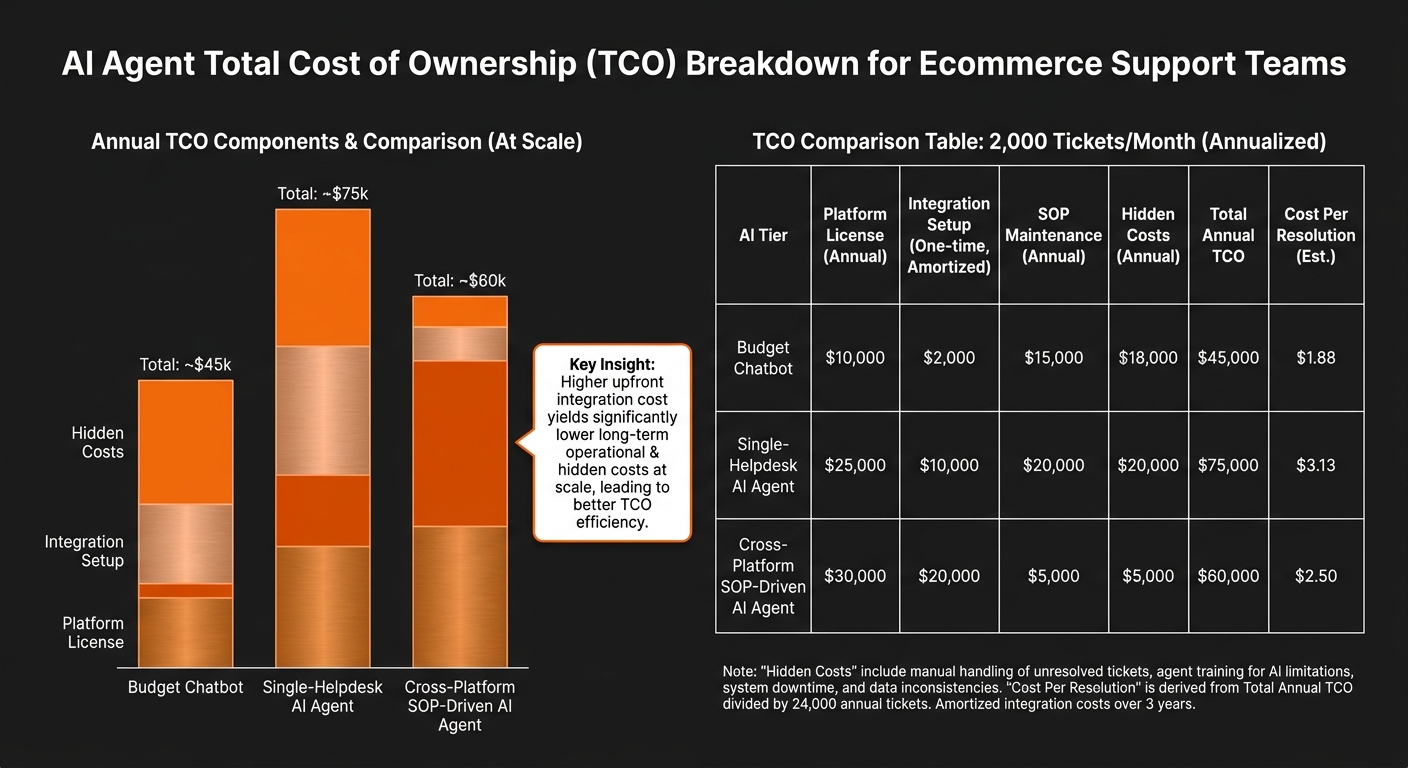
AI Agent Total Cost of Ownership: The 2026 Buyer's Guide for Ecommerce Support Teams
Per-resolution pricing at $0.99 looks cheap until you add $15,000 in integration engineering, 8 hours/month of SOP maintenance, and a human escalation team for the 30% of tickets the AI can't touch. This guide breaks down the full four-component TCO of every major AI support pricing model — so you can compare total cost, not just the sticker price — and shows where each model wins and loses at different ticket volumes.
TL;DR: AI Agent TCO at 2,000 Tickets/Month (Annual)
| Cost Component | Budget Chatbot | Single-Helpdesk AI | Cross-Platform AI |
|---|---|---|---|
| Platform license / resolution fees | $3,600–$8,400 | $10,800–$21,600 | $14,400–$25,200 |
| Integration setup (amortized 3yr) | $1,667–$5,000 | $5,000–$8,333 | $6,667–$16,667 |
| SOP maintenance (monthly × 12) | $1,200–$2,400 | $4,800–$9,600 | $3,600–$7,200 |
| Hidden costs (escalation, monitoring) | $8,400–$14,400 | $3,600–$7,200 | $2,400–$4,800 |
| Total annual TCO | $14,867–$30,200 | $24,200–$46,733 | $27,067–$53,867 |
| Net saving vs. full human team | $14,000–$30,000 | $38,000–$60,000 | $54,000–$80,000 |
Bottom line: Budget chatbots have the lowest gross cost but the lowest resolution rate — you still pay for a large human team. Cross-platform AI has the highest gross cost but the highest resolution rate and zero re-integration risk, producing the best net TCO when your ticket mix includes cross-system workflows.
Why "Price Per Resolution" Is Not the Same as TCO
What Does AI Support Agent Pricing Actually Cover?
Most AI support agent pricing pages show one number: $0.99 per resolution (Intercom Fin), $1.50 per automated resolution (Zendesk), $0.90–$1.00 per resolved conversation (Gorgias AI Agent), or $750/month platform fee plus ~$0.90 per conversation (Siena). These numbers are real — they represent what the platform charges for each AI-handled outcome.
What they do not cover is the other 60–70% of your total cost of running an AI support operation: the engineering time to build and maintain integrations, the ongoing SOP-update work as your policies change, and the human workforce you still need for the tickets the AI doesn't resolve.
A complete TCO analysis adds four components:
- Platform licensing or resolution fees — the sticker price
- Integration setup cost — the engineering investment to connect the AI to your systems
- Ongoing SOP maintenance — the operational cost of keeping agent workflows current
- Hidden costs — escalation staffing, monitoring, and re-integration risk
Every major pricing model performs differently across these four components. Understanding the trade-offs is what separates a TCO-optimized AI purchase from a sticker-price purchase that balloons in year two.
Component 1: Platform Licensing and Resolution Fees
How Do the Major Pricing Models Work?
Per-resolution pricing (Intercom Fin, Zendesk, Gorgias AI Agent) charges only when the AI fully resolves a ticket — no human intervention required. Resolution is typically defined as the AI responding with an answer or action and the ticket closing within 24–48 hours without escalation. Published rates:
- Intercom Fin: $0.99 per resolution (per Intercom's pricing page)
- Zendesk AI: $1.50 per automated resolution (committed volume) / $2.00 pay-as-you-go
- Gorgias AI Agent: $0.90/resolution (annual) / $1.00/resolution (monthly)
At 2,000 tickets/month with 70% AI resolution rate (1,400 AI-resolved tickets), annual cost:
- Intercom Fin: $16,632/year
- Zendesk: $25,200/year (committed) to $33,600/year (PAYG)
- Gorgias AI Agent: $15,120/year (annual) to $16,800/year (monthly)
Per-seat pricing charges a fixed monthly fee per user regardless of resolution volume. Traditional helpdesk vendors (Zendesk Suite, Freshdesk) have historically used this model; it is less common for AI-native agents but appears in enterprise contracts. At $150–$300/seat/month for a 5-agent equivalent AI tier, annual cost is $9,000–$18,000 — cheaper than per-resolution at low volume, more expensive at high volume.
Platform fee plus per-conversation (Siena: $750/month + ~$0.90/conversation; some Lorikeet configurations) charges for every AI-touched conversation, resolved or not. At 2,000 tickets/month, annual platform cost: $9,000 platform + $21,600 per-conversation = $30,600 — effectively a combined model that carries more risk for brands with low AI resolution rates.
Usage-based with enterprise minimum (Decagon, Sierra, Ada) typically requires a minimum annual commitment of $50,000–$150,000+ for enterprise-grade resolution capability, with per-resolution rates that fall substantially at volume. These models are not designed for sub-5,000-ticket/month ecommerce brands.
Which Pricing Model Wins at Your Volume?
| Monthly Ticket Volume | AI Resolution Rate | Lowest License Cost Model |
|---|---|---|
| Under 500 | Under 50% | Per-seat (chatbot tier) |
| 500–2,000 | 50–70% | Per-resolution (Gorgias AI, Intercom Fin annual) |
| 2,000–5,000 | 70–85% | Per-resolution (Zendesk committed or Gorgias annual) |
| Over 5,000 | 80%+ | Enterprise platform fee (volume discounts justify commitment) |
Component 2: Integration Setup Cost
Why Integration Engineering Is the Biggest Hidden Ticket in AI Support
Every AI support agent needs to connect to at least three systems to be useful: your helpdesk (where tickets live), your ecommerce platform (where order data lives), and your backend (where refund and fulfillment execution happens). The cost of building, testing, and maintaining those connections is almost never on the pricing page.
Budget chatbots typically use pre-built connectors for Shopify and one helpdesk (Gorgias, Zendesk, or Freshdesk). Setup is primarily configuration — 20–40 hours of internal ops work at $50–$75/hour = $1,000–$3,000 upfront. The limitation is that these connectors cover lookups and templated responses, not action execution. Adding a second helpdesk or connecting to Salesforce typically requires custom engineering.
Single-helpdesk AI agents (Intercom Fin for Intercom, Zendesk AI for Zendesk, Gorgias AI for Gorgias) are deeply integrated with their own helpdesk but require significant engineering to connect to other systems. A typical mid-market integration — Shopify data read + refund execution + helpdesk ticket management — runs 60–120 engineering hours at $100–$150/hour = $6,000–$18,000. If your stack includes Salesforce or Jira for internal case management, expect 40–80 additional hours per system.
Cross-platform AI agents (CorePiper, Lorikeet with multi-helpdesk configurations) are designed to connect multiple systems out of the box. Initial integration is more comprehensive — 80–160 hours to connect Shopify + two helpdesks + Salesforce/Jira — but subsequent system additions are incremental rather than re-implementations. At $100–$150/hour, upfront setup runs $8,000–$24,000 but covers multi-system resolution from day one.
Amortized over three years, integration setup cost per year:
| Agent Type | Upfront Setup | 3-Year Amortized Annual |
|---|---|---|
| Budget chatbot | $1,000–$3,000 | $333–$1,000 |
| Single-helpdesk AI | $6,000–$18,000 | $2,000–$6,000 |
| Cross-platform AI | $8,000–$24,000 | $2,667–$8,000 |
The amortized cost gap narrows considerably — but the risk profile differs. Single-helpdesk agents carry re-integration risk: if you change your helpdesk (common during scaling), you rebuild the entire integration. Cross-platform agents are built around the data model, not the helpdesk, so helpdesk migration is an incremental update rather than a full rebuild.
Component 3: Ongoing SOP Maintenance
What Does It Cost to Keep an AI Agent Current?
An AI support agent is only as good as the operating procedures it runs on. Every time your return policy changes, a new SKU category launches, your carrier roster expands, or an escalation threshold shifts, someone must update the agent's decision logic. This is SOP maintenance — and it is the most frequently underestimated ongoing cost in AI support operations.
For ecommerce brands with normal seasonal and policy change cadence, SOP maintenance runs:
Budget chatbots (rule-based): 2–4 hours/month to update response templates and decision trees. At $50/hour fully loaded, $100–$200/month = $1,200–$2,400/year. Low cost, but also low resolution rate — the limited rule set is precisely why maintenance is cheap.
Single-helpdesk AI agents: 8–16 hours/month for a mid-market brand with 4–6 major policy areas. AI agents trained on SOPs require prompt and knowledge-base updates for each policy change, plus regression testing to confirm adjacent workflows were not broken. At $50/hour, $400–$800/month = $4,800–$9,600/year.
Cross-platform SOP-driven agents: 6–12 hours/month when SOPs are maintained in a structured format that directly maps to agent behavior. The key variable is whether the SOP system is structured enough to translate policy changes into agent updates without full re-prompting. Platforms that use explicit SOP libraries (rather than free-form prompt injection) typically require less maintenance time per policy change because the change is localized to one SOP rather than requiring a full prompt rebuild. At $50/hour, $300–$600/month = $3,600–$7,200/year.
The SOP Maintenance Multiplier for Multi-Helpdesk Stacks
Brands using two helpdesks (Zendesk for customer-facing + Jira Service Management for internal) with separate AI agents on each must maintain SOPs in two separate systems. Policy changes require double updates, double regression testing, and double audit trails. Cross-platform agents that maintain a single SOP library shared across helpdesks eliminate this multiplier — one policy change propagates to all helpdesks simultaneously.
For a brand with a two-helpdesk stack, single-helpdesk SOP maintenance effectively doubles: $9,600–$19,200/year vs. $3,600–$7,200/year for a cross-platform agent. This is a frequently overlooked TCO driver for brands that have grown beyond a single-helpdesk stack.
Component 4: Hidden Costs
What AI Agents Don't Resolve Still Costs Money
Even the best AI support agents resolve 70–85% of tickets — meaning 15–30% require human handling. The cost of the human team that handles AI escalations is a real TCO component that belongs in the comparison. It is often treated as a constant (your current support headcount), but it is not — it changes with AI resolution rate and escalation routing quality.
Escalation staffing cost by AI resolution rate:
| AI Resolution Rate | Human-Handled % | Tickets/Month Requiring Human (at 2,000 total) | Estimated Annual Escalation Staff Cost |
|---|---|---|---|
| 50% (budget chatbot) | 50% | 1,000 | $72,000–$120,000 |
| 70% (mid-tier AI agent) | 30% | 600 | $43,200–$72,000 |
| 80% (high-performing AI) | 20% | 400 | $28,800–$48,000 |
| 90% (cross-platform + SOPs) | 10% | 200 | $14,400–$24,000 |
At 2,000 tickets/month and $6–$10 per human-handled ticket (agent labor only, not fully loaded), the annual escalation cost ranges from $72,000 for a 50% AI resolution rate to $14,400 for a 90% resolution rate. A 20-percentage-point improvement in AI resolution rate saves $29,000–$48,000/year in escalation staffing — often more than the entire platform licensing cost.
Monitoring and quality assurance typically runs 2–4 hours/week of ops time for a mid-market brand: reviewing AI decision logs, checking escalation patterns, auditing edge-case resolutions. At $50/hour, $5,200–$10,400/year. This cost is similar across agent types but slightly higher for AI agents with less explainable decision logic (black-box models vs. SOP-based systems with readable audit trails).
Re-integration risk cost is a probabilistic cost: the probability your helpdesk changes in the next three years multiplied by the cost to rebuild the AI integration. For brands growing rapidly (common in ecommerce), helpdesk migrations are common — Gorgias to Zendesk as ticket volume scales, Zendesk to Salesforce as enterprise contracts require it. At 30% three-year probability of one helpdesk migration and $6,000–$18,000 re-integration cost, the expected annual risk cost of single-helpdesk AI is $600–$1,800/year. Cross-platform agents, which are built around data models rather than helpdesk-specific APIs, carry $0–$600/year expected re-integration cost.
Full TCO Comparison: Three Scenarios
Scenario A: 500 Tickets/Month, One Helpdesk (Early-Stage DTC Brand)
| Budget Chatbot | Single-Helpdesk AI | Cross-Platform AI | |
|---|---|---|---|
| Resolution fees (annual) | $1,080 (50% resolve, $0.90/ea) | $3,780 (70% resolve, $0.90/ea) | $4,410 (70% resolve, $1.05/ea est.) |
| Integration (amortized) | $333 | $2,000 | $2,667 |
| SOP maintenance | $1,800 | $7,200 | $4,800 |
| Escalation staffing | $18,000 | $10,800 | $7,200 |
| Monitoring | $5,200 | $5,200 | $5,200 |
| Total TCO | $26,413 | $28,980 | $24,277 |
At 500 tickets/month, the cross-platform advantage is already visible — higher resolution rate drives escalation staffing down below the single-helpdesk option's savings on resolution fees.
Scenario B: 2,000 Tickets/Month, Two Helpdesks (Scaling Mid-Market Brand)
| Budget Chatbot | Single-Helpdesk AI (×2) | Cross-Platform AI | |
|---|---|---|---|
| Resolution fees (annual) | $5,400 | $21,600 | $21,600 |
| Integration (amortized) | $1,000 | $10,000 | $8,333 |
| SOP maintenance | $2,400 | $14,400 | $7,200 |
| Escalation staffing | $60,000 | $28,800 | $14,400 |
| Monitoring | $7,800 | $10,400 | $7,800 |
| Re-integration risk | $600 | $3,600 | $600 |
| Total TCO | $77,200 | $88,800 | $59,933 |
At 2,000 tickets/month with a two-helpdesk stack, the cross-platform AI delivers the lowest TCO — roughly $29,000/year less than two single-helpdesk agents despite higher per-resolution fees, driven by SOP maintenance consolidation and escalation staffing savings.
Scenario C: 5,000 Tickets/Month, Enterprise Stack (Salesforce + Zendesk + Jira)
At this scale, the two single-helpdesk agents option breaks: most single-helpdesk agents do not connect to Salesforce for case management and Jira for internal escalations simultaneously. Tickets that cross these systems — a B2B customer dispute that requires Zendesk customer-facing resolution, Salesforce opportunity update, and Jira internal investigation — require human handling regardless of AI resolution rate, adding a structural floor to escalation cost.
Cross-platform AI that spans Salesforce, Zendesk, and Jira eliminates this structural floor. At 5,000 tickets/month with 20% cross-system tickets (1,000/month), avoiding human handling of those 1,000 tickets saves $72,000–$120,000/year in escalation costs that a single-helpdesk agent cannot avoid.
The enterprise argument for cross-platform AI is not about per-unit pricing — it is about resolution coverage across the full ticket surface area your stack generates.
How to Build Your Own TCO Model
Step-by-Step TCO Calculation
-
Determine your monthly ticket volume and seasonal peak multiplier (typically 4–6x at BFCM).
-
Estimate AI resolution rate by vendor for your ticket mix. Use vendor-published benchmarks as a starting point — Intercom reports 67% across 40M+ Fin conversations — but apply a 10–20% discount for your first year as the agent learns your specific policies.
-
Calculate annual resolution fees: (tickets/month × 12 × AI resolution rate × per-resolution cost).
-
Estimate integration setup hours for your specific stack (helpdesk + ecommerce platform + any backend systems), multiply by your blended engineering rate, and amortize over three years.
-
Estimate monthly SOP maintenance hours based on your policy change frequency — a brand that updates return policies quarterly needs fewer maintenance hours than one with weekly SKU launches.
-
Calculate escalation staffing cost: (tickets/month × 12 × [1 − AI resolution rate] × per-ticket human cost). Use $6–$10 for Tier 1 tickets, $12–$20 for complex cases.
-
Add monitoring overhead: 2–4 hours/week at your ops rate.
-
Sum all components and compare against your current fully loaded human agent cost: (agents × fully loaded annual cost). The difference is your net annual savings.
What the TCO Model Tells You About Vendor Selection
Where Each Model Wins
Budget chatbots win at sub-200-ticket/month volume where resolution depth is not the primary constraint and integration engineering budget is limited. They are a starting point, not a scaling strategy.
Single-helpdesk AI wins when your entire support operation runs through one platform and your ticket mix does not cross system boundaries. Gorgias AI for a Gorgias-first Shopify brand, Intercom Fin for an Intercom-first SaaS company, and Zendesk AI for a Zendesk-committed enterprise are all defensible single-helpdesk choices within those constraints.
Cross-platform AI wins when any of the following are true: you run more than one helpdesk, your tickets cross system boundaries (Shopify + helpdesk + Salesforce + Jira), your helpdesk is likely to change as you scale, or your SOP maintenance burden across multiple systems is significant. The higher upfront integration cost pays back within 12–24 months through escalation staffing savings and SOP consolidation.
The One Question That Simplifies the Decision
What percentage of your tickets require actions in more than one system to fully resolve?
If the answer is under 10%, a single-helpdesk AI agent is a reasonable choice. If the answer is over 15%, cross-platform AI is likely the lower-TCO option within 18 months — because those cross-system tickets will always require human handling with a single-helpdesk agent, regardless of how good its resolution rate is on simpler tickets.
For most scaling ecommerce brands — running Shopify, a helpdesk, and some combination of Salesforce for B2B customers or Jira for internal operations — that cross-system percentage is typically 15–25% of total ticket volume. The SOP-driven, cross-platform case operations model CorePiper is built on addresses exactly this structural gap that single-helpdesk agents leave behind.
The TCO Argument for SOP-Driven AI
Why SOPs Change the Maintenance Economics
The highest ongoing cost in AI support operations is not platform fees — it is the labor of keeping agent behavior current as your business changes. Every policy update, carrier addition, SKU expansion, or escalation-rule change requires updating the AI's behavior. How that update is made determines whether maintenance runs 4 hours/month or 16 hours/month.
AI agents built on prompt injection — where policy is embedded in a single large system prompt — require the entire prompt to be rebuilt, tested, and re-deployed for each policy change. AI agents built on structured SOP libraries — where each policy is a discrete, named workflow with explicit conditions and actions — allow targeted updates. Change the return policy SOP; the refund and exchange SOPs are untouched and require no regression testing.
The SOP-driven AI automation model reduces maintenance overhead by 30–50% compared to prompt-injection architectures, because policy changes are scoped to individual SOPs rather than requiring full prompt reconstruction. At 10 hours/month of maintenance at $50/hour, that is $3,000–$6,000/year in ops savings — on top of the platform and escalation savings documented above.
Internal Links for Further Reading
- Cost Per Resolution: AI Agent vs Human Agent Economics — the per-unit cost math that feeds into TCO Component 1
- What % of Revenue Should Ecommerce Support Cost? — the CFO benchmark that contextualizes total TCO as a revenue ratio
- Peak-Season Support Cost Modeling — how TCO changes at BFCM 4–6x volume spikes
- What Is SOP-Driven AI Automation? — the architecture that drives Component 3 (SOP maintenance) savings
Summary
The four-component TCO framework — platform fees, integration setup, SOP maintenance, and hidden escalation costs — reveals a different ranking than sticker-price comparison alone. Budget chatbots look cheap until you account for the large human team required to handle the 50% of tickets they can't resolve. Single-helpdesk AI looks efficient until you count the SOP maintenance multiplier on a two-helpdesk stack and the re-integration cost when your helpdesk changes. Cross-platform AI looks expensive until you run the full model and find that escalation staffing savings and SOP consolidation produce the lowest net TCO for brands with multi-system stacks and 2,000+ tickets/month.
The decision simplifies to one question: how many of your tickets cross system boundaries? If more than 15% require actions in more than one platform to fully resolve, a cross-platform, SOP-driven agent is the TCO-optimized choice within 18 months of deployment.
See CorePiper's Full TCO in Your Environment
CorePiper's SOP-driven agents resolve WISMO, returns, refunds, and shipping exceptions end-to-end across Shopify, Zendesk, Freshdesk, Salesforce, and Jira — at a transparent per-resolved-case rate with no hidden platform fees, no per-seat license, and no surprise re-integration costs when you add a new helpdesk.