
What Is AI Resolution Rate? Definition, Benchmarks, and How to Improve It (2026)
AI resolution rate is the percentage of customer interactions where an AI agent fully solves the customer's problem. Here's the 2026 definition, industry benchmarks by query type, and what actually moves the number.
 Mustafa BayramogluAugust 14, 202614 min read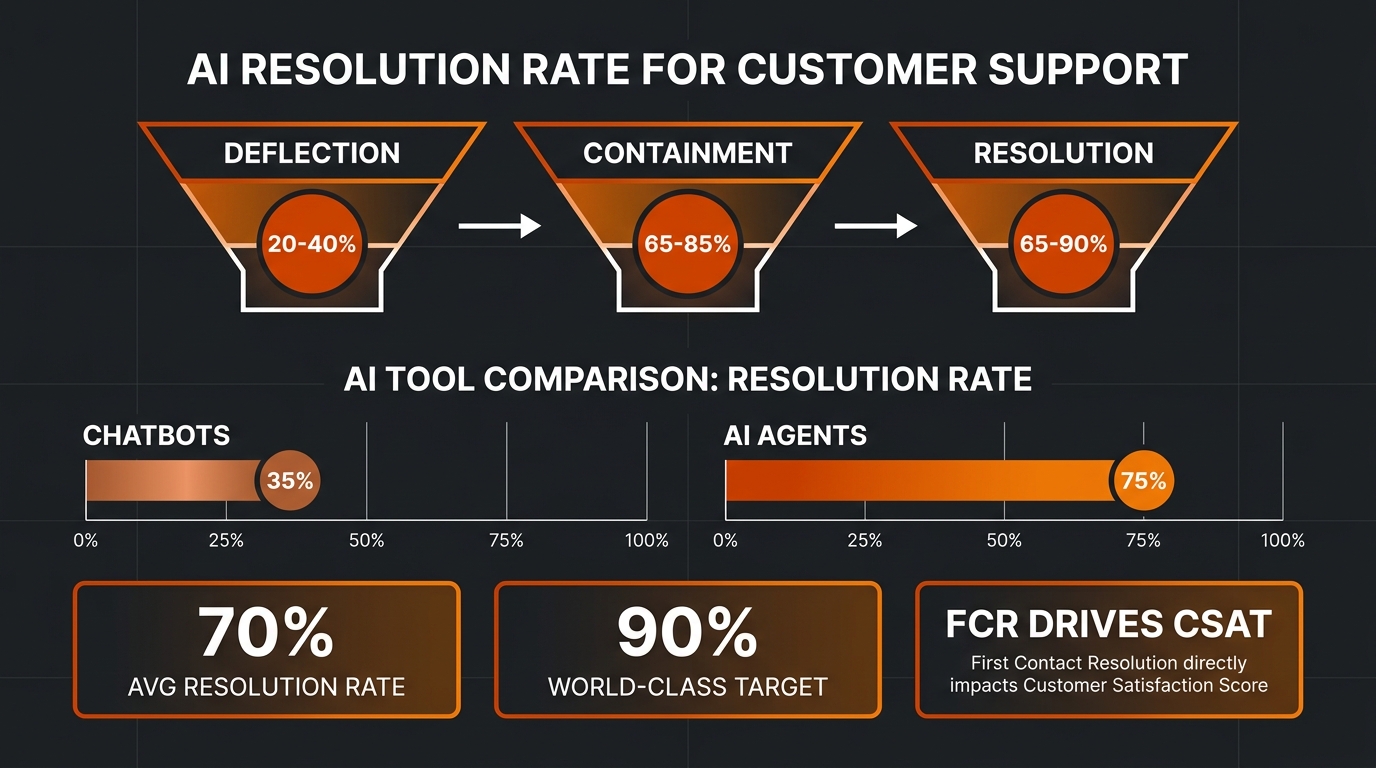
What Is AI Resolution Rate? Definition, Benchmarks, and How to Improve It (2026)
AI resolution rate is the percentage of customer interactions in which the AI agent fully solves the customer's problem — no follow-up needed, no issue left open, no human required to finish the job. In 2026, well-configured agentic AI systems handling structured e-commerce and logistics workflows achieve resolution rates of 65–90% on their core query types, compared with 30–45% for rule-based chatbots that can respond but cannot act.
TL;DR: AI Resolution Rate at a Glance
| Metric | What it measures | Typical range | What moves it |
|---|---|---|---|
| Resolution rate | Issues actually solved by AI | 65–90% (agentic AI), 30–45% (chatbots) | System integrations + SOP quality |
| Containment rate | Conversations handled without human escalation | 60–85% (agentic AI) | Escalation thresholds + scope |
| First contact resolution (FCR) | Issues resolved without repeat contact | 70% all-industry avg (SQM Group) | Resolution quality + follow-up rate |
| Deflection rate | Contacts that never start (self-service) | 20–40% (e-commerce) | Knowledge base + proactive notifications |
| False resolution | Closed tickets where issue recurs within 72h | Should be near zero | Audit sample + repeat-contact tracking |
Resolution rate is the outcome metric. Containment and deflection reduce cost; resolution rate confirms value was delivered to the customer.
Why Resolution Rate Is the Metric That Actually Matters
Resolution rate sits at the top of the AI support metrics hierarchy because it is the only metric that directly measures whether customers are getting what they need. Every other AI support metric is a proxy or a cost signal:
- Deflection rate tells you how many contacts you avoided — not whether the customers who deflected had their questions answered.
- Containment rate tells you how many conversations stayed with the AI — not whether the AI actually helped the customer.
- Handle time tells you how fast the interaction was — not what it accomplished.
Resolution rate cuts through the noise. If a customer's shipping exception was resolved, the refund was processed, or the order was updated correctly, the interaction succeeded. If not, every other metric is measuring an activity, not an outcome.
The business case is direct: each unresolved contact typically generates 1.5–2.3 repeat contacts (per the repeat-contact multiplier widely cited across contact center research), multiplying cost without multiplying customer satisfaction. A team that moves from 55% to 75% resolution rate on 10,000 monthly contacts eliminates approximately 3,500–4,000 repeat contacts per month — easily $25,000–50,000 in avoided cost before counting the compounding CSAT benefit.
How Is AI Resolution Rate Calculated?
The formula is:
Resolution rate = (interactions where customer's issue was fully solved ÷ total interactions handled by AI) × 100
The harder question is what "fully solved" means operationally. Three definitions are in common use:
Transactional resolution: The AI executed a specific action — processed a refund, updated an address, filed a claim, generated a return label — and the action succeeded. This is the strictest and most reliable definition for e-commerce and logistics use cases because the resolution is a discrete system event, not a customer judgment.
Conversational resolution: The customer's stated question was answered to their satisfaction, as measured by a post-interaction CSAT score above a threshold (typically 4+/5) or the absence of a repeat contact within 72 hours. This definition works for informational queries but is harder to measure in real time.
First-contact resolution (FCR): The issue was resolved in a single interaction, without the customer contacting support again for the same issue within a measurement window (typically 7 days). FCR is a stricter variant of resolution rate that penalizes resolution-through-repeated-contact. Per SQM Group, the all-industry FCR average is 70%, with world-class operations achieving 80%+.
Most operations teams track transactional resolution for AI-handled contacts (because it's objective and measurable in the system of record) and use FCR as the quality overlay (because it catches cases where the AI "resolved" an issue incompletely, prompting the customer to contact again).
What Is a Good AI Resolution Rate?
Benchmarks vary significantly by query type and AI architecture:
By deployment type
- Rule-based chatbots: 25–45% resolution. Can answer scripted queries but cannot take actions in connected systems, so any issue requiring an actual action (refund, tracking update, claim filing) results in deflection or escalation rather than resolution.
- LLM-powered helpdesk assistants: 45–65% resolution. Better at understanding intent and generating contextual responses, but limited by inability to execute actions across integrated systems without an agentic layer.
- SOP-driven agentic AI (multi-system): 65–90% resolution. The agent reads live data from Shopify, carrier APIs, Salesforce, or Zendesk and executes resolution actions — not just replies — following documented procedures.
By query type
The resolution rate distribution by ticket type is the most actionable benchmark for planning your AI deployment scope:
- WISMO / order tracking: 80–95% resolution. High-volume, high-structure, data-accessible. If the shipment data is available via carrier API and the answer can be given definitively, the AI resolves it nearly every time.
- Standard refunds and returns: 70–85% resolution. Requires policy judgment and Shopify write-access for execution, but the procedure is well-defined and the data dependencies are limited.
- Address changes (within fulfillment window): 65–80% resolution. Gate on order fulfillment status; if the window is open and the change is within policy, the AI can execute via Shopify API.
- Shipping damage or loss claims: 60–80% resolution. Requires reading carrier claim status, applying claim SOP, and often executing a partial refund or replacement order. Manageable for agentic AI; structurally impossible for chatbots.
- Subscription changes or billing adjustments: 55–70% resolution. Policy judgment required; often depends on subscription platform API access.
- Complex disputes or exception cases: 30–50% resolution. Higher variance in customer situations, more reliance on CRM context and account history. These should escalate to humans; the goal is identifying them quickly and routing efficiently.
A realistic target for a first AI deployment across a mixed e-commerce ticket queue: 65–75% overall resolution rate, improving to 75–85% after the first 90 days as SOP gaps are identified and integrations are validated.
What Is the Difference Between Resolution Rate and Containment Rate?
This is the most important distinction in AI support metrics, and getting it wrong produces the most dangerous outcome: high containment with low resolution, which means customers are being deflected rather than helped.
Containment rate answers: did the conversation stay with the AI?
Resolution rate answers: did the customer's problem get solved?
A conversation can fall into four quadrants:
| Resolved | Unresolved | |
|---|---|---|
| Contained (AI-handled) | ✓ Goal state | ⚠ False containment — deflection |
| Escalated (human-handled) | ✓ Appropriate for complex cases | ✗ Worst outcome |
The false containment quadrant is the critical failure mode. When an AI agent is measured primarily on containment rate, the easiest way to improve the number is to close conversations faster — including conversations where the customer's issue wasn't resolved. The AI sends a generic "your issue has been logged" message and closes the ticket. Containment rate rises; resolution rate falls; repeat contacts increase; CSAT drops.
The containment rate benchmark post covers this in detail: any AI deployment showing containment rate rising while CSAT or repeat-contact rate is worsening is almost certainly gaming containment at the expense of resolution. The fix is to track resolution rate independently and require both metrics to improve together.
What Is the Difference Between AI Resolution Rate and First Contact Resolution?
First contact resolution (FCR) is a stricter variant of resolution rate that adds a time constraint: the issue must be resolved in the first interaction, without the customer needing to contact support again for the same issue.
Key differences:
Scope: Resolution rate measures the AI's performance within an interaction. FCR measures the customer's outcome across interactions — a customer who contacts twice and gets resolved on the second attempt has a 0% FCR but a 100% resolution rate on that second contact.
Timing: FCR typically uses a 7-day or 30-day non-repeat window. Resolution rate is assessed at the point of interaction close.
Use cases: Resolution rate is the right metric for evaluating AI agent performance, optimizing SOP design, and comparing query types. FCR is the right metric for understanding customer experience impact and measuring whether the support operation as a whole is reducing repeat contacts.
In practice: a well-configured AI agent should achieve FCR rates of 70–80% on structured query types (WISMO, standard returns, address changes) and 50–65% on complex or exception cases. Per SQM Group's all-industry benchmarks, FCR is the single strongest predictor of CSAT — each percentage point of FCR improvement correlates with approximately 1.0–1.2 CSAT points gained.
Why Do AI Agents Achieve Higher Resolution Rates Than Chatbots?
The resolution rate gap between chatbots (30–45%) and agentic AI (65–90%) comes down to a fundamental architectural difference: chatbots respond, AI agents act.
A chatbot that receives a "my package is damaged" message can:
- Send a scripted reply with damage claim instructions
- Link to a knowledge base article
- Escalate to a human agent
None of those actions resolve the customer's issue. The customer still needs to navigate the claim process, fill out forms, and wait for a human review. The chatbot's interaction is contained but not resolved.
An AI agent configured with the right system access and SOPs can:
- Pull the order and carrier data to confirm delivery and note the exception
- Cross-reference against your claim eligibility policy (within 30 days, over threshold amount)
- File the initial claim via carrier API or your TMS
- Issue a proactive replacement order or partial refund per your resolution SOP
- Update the helpdesk ticket with action taken and set a follow-up trigger
- Notify the customer of resolution within the same interaction
The customer's issue is resolved in the first contact. This is what the SOP-driven AI architecture enables at scale: documented procedures that the agent follows consistently, accessing connected systems to execute — not just respond — on every interaction.
The resolution gap also explains why cross-platform integrations are the highest-leverage investment for operations teams: resolution requires data access and action execution across multiple systems, and any gap in that integration stack becomes a ceiling on resolution rate.
What Drives Low AI Resolution Rates?
If your AI agent's resolution rate is underperforming, four root causes account for the majority of cases:
1. Missing system integrations
If the AI cannot read live order data, it cannot give a definitive answer. If it cannot write to Shopify, it cannot process a refund. If it cannot file a claim via carrier API, it cannot resolve a damage complaint. Each missing integration creates a class of tickets the AI can only partially handle, depressing overall resolution rate. The highest-leverage integrations for e-commerce: Shopify Admin API (read and write), primary carrier APIs (UPS, FedEx, USPS), and your helpdesk ticketing system. For logistics: carrier and TMS read/write access, Salesforce case management, and Jira for internal escalation routing.
2. SOP gaps or ambiguity
AI agents resolve conversations by following documented procedures. When the agent encounters a case type with no SOP — or an SOP with ambiguous branching logic — it either escalates or gives an incomplete response. Both outcomes register as non-resolution. Weekly escalation audits that map root causes back to SOP gaps are the fastest way to identify and close these holes.
3. Threshold misconfiguration
Most deployments include escalation thresholds — cases above a dollar value, VIP customer orders, or policy exceptions always route to humans. When these thresholds are set too conservatively, the AI escalates cases it could have resolved, artificially depressing resolution rate and adding unnecessary human volume. Review escalation threshold settings after the first 60–90 days as confidence in AI performance develops.
4. Scope overreach
Deploying the AI across query types it isn't configured for — complex contract disputes, nuanced return fraud cases, or enterprise account management questions — pulls down the overall resolution rate with cases that should go directly to humans. Start with the three to five highest-volume, highest-structure query types. Build resolution rate on those to 80%+ before expanding scope.
How Do You Improve AI Resolution Rate?
In order of impact:
1. Audit every non-resolved interaction for root cause. Pull a weekly sample of 20–30 interactions with low resolution scores or repeat contacts within 72 hours. Classify root cause: integration gap, SOP gap, threshold misconfiguration, scope mismatch, or genuine complexity requiring human judgment. The distribution tells you where to invest next.
2. Expand system integrations before optimizing prompts. Resolution rate is primarily a data and action access problem, not a language model quality problem. An agent with full Shopify, carrier, and helpdesk access running on a mid-tier language model will outresolve a best-in-class language model without system access on every operational query type.
3. Map SOPs to resolution rate by ticket type. A ticket-type breakdown showing resolution rate per category (WISMO: 82%, standard return: 74%, address change: 68%, damage claim: 55%, complex dispute: 38%) tells you exactly which SOPs need development or refinement. Closing the gap on damage claims from 55% to 75% is a specific project; "improve resolution rate" is not.
4. Track false resolution separately. Run a monthly audit of contained, "resolved" interactions: pull a sample and check whether the customer had a repeat contact within 7 days for the same issue. False resolution above 5% indicates the agent is gaming the metric by closing tickets prematurely. This requires conversation-level review, not just aggregate metrics.
5. Set up escalation reason tracking. Every human handoff should log a reason: SOP gap, integration failure, policy exception, customer insistence, or genuine complexity. The SOP-gap and integration-failure categories are directly actionable; the others are expected escalation types the AI shouldn't be trying to contain.
Resolution Rate in the Full Metrics Stack
No metric tells the full story in isolation. Resolution rate is most valuable tracked alongside:
- Containment rate: Should track within 10 percentage points of resolution rate. If containment significantly exceeds resolution rate, false containment is occurring.
- FCR (first contact resolution): Confirms that resolution is genuine and durable — not partial or temporary. Target 70%+ on structured query types, per SQM Group benchmarks.
- Repeat contact rate: Within 72 hours and 7 days. The most reliable lagging indicator of false resolution. A rising repeat contact rate in the same period as rising containment rate is a definitive signal of deflection.
- CSAT on AI-handled interactions: Per SQM Group, every 1 percentage point of FCR improvement correlates with 1.0–1.2 CSAT points. Resolution rate → FCR → CSAT is the causal chain; measure all three.
- Escalation reason distribution: Tells you which resolution failures are fixable (SOP gaps, integration holes) versus expected (genuine complexity, high-stakes exceptions).
The deflection rate, containment rate, and resolution rate form a three-layer funnel: deflection reduces total contact volume; containment ensures AI handles the contacts that do arrive; resolution confirms those contacts deliver value to the customer. A mature AI support operation optimizes all three — but resolution rate is the one that validates the others.
AI resolution rate is the accountability metric for AI support deployments: it measures whether the investment in AI is actually making customers' problems go away, not just moving them around the support funnel. For e-commerce and logistics operations, a 70%+ overall resolution rate with 80%+ on core structured ticket types is achievable in the first 90 days of a well-configured agentic deployment — and is the threshold at which AI support shifts from a cost experiment to a reliable operational capability.
Mustafa Bayramoglu is the founder of CorePiper (YC W19). He writes about AI agents, enterprise case operations, and the logistics technology stack.