
What Is AI Containment Rate? Definition, Benchmarks, and How to Improve It (2026)
AI containment rate is the percentage of customer conversations an AI agent handles to resolution without escalating to a human. Here's the 2026 definition, industry benchmarks, and what actually moves the number.
 Mustafa BayramogluAugust 12, 202612 min read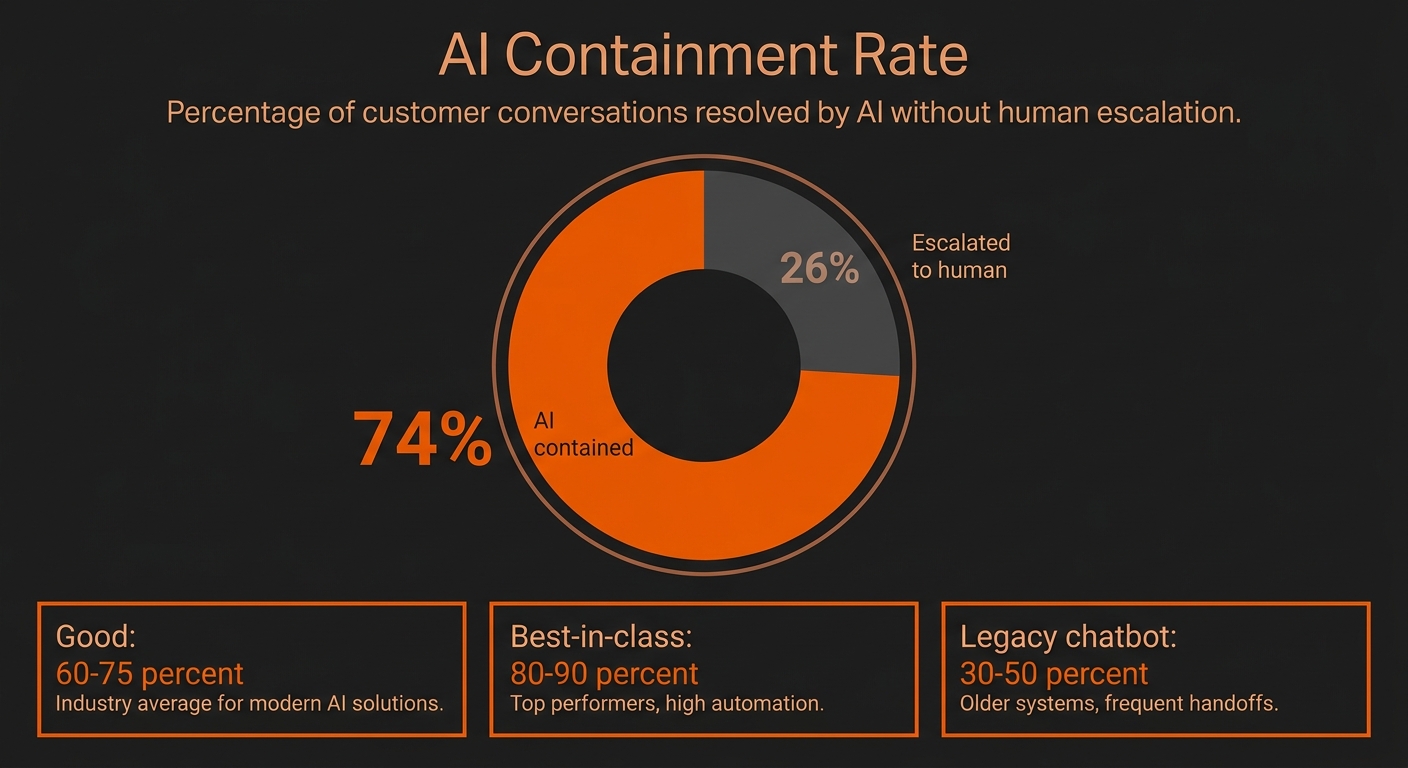
What Is AI Containment Rate? Definition, Benchmarks, and How to Improve It (2026)
AI containment rate is the percentage of customer conversations that an AI agent handles from start to finish without handing off to a human. A conversation is "contained" when the AI resolves the customer's issue — or formally closes the interaction — without a human agent intervening. In 2026, well-configured AI agents for e-commerce and logistics operations achieve containment rates of 60–85%, while legacy rule-based chatbots typically top out at 30–50%.
TL;DR: AI Containment Rate at a Glance
| Metric | What it measures | Typical range | Goal |
|---|---|---|---|
| Containment rate | Conversations handled end-to-end by AI (no human escalation) | 60–85% (AI agents), 30–50% (chatbots) | Maximize without sacrificing resolution quality |
| Resolution rate | Conversations where the customer's issue was actually solved | 65–90% | Should track closely with containment rate |
| Deflection rate | Contacts that never reach a support agent at all | Varies widely | Reduce unnecessary inbound volume |
| Escalation rate | Conversations that require human handoff (inverse of containment) | 15–40% | Minimize for standard, structured queries |
| False containment | Conversations "contained" but customer issue unresolved | Should be near zero | Red flag if containment rises but CSAT falls |
Why Does Containment Rate Matter?
Containment rate is the primary operational metric for measuring whether an AI support deployment is working. Every conversation that escalates to a human costs your team time, adds to queue depth, and degrades response times for everyone waiting. Every conversation an AI contains — genuinely resolves — removes that cost from the system.
The business case is direct: at $8–12 per human-handled contact (the typical blended cost for e-commerce support teams including agent salary, overhead, and tooling), moving from a 50% to a 75% containment rate on 10,000 monthly contacts eliminates roughly 2,500 human-handled conversations — $20,000–30,000 per month in direct cost avoidance, before counting the speed improvement for customers who remain in queue.
Beyond cost, containment rate affects customer experience. Customers who get a resolution from an AI in under two minutes consistently rate that interaction higher than waiting four to six minutes for a human agent to handle a routine query. The first contact resolution benchmark data shows FCR rates for AI-handled conversations can exceed human-handled ones for structured, data-accessible query types — because the AI always has the right data and follows the same procedure every time.
How Is AI Containment Rate Calculated?
The formula is straightforward:
Containment rate = (conversations handled entirely by AI ÷ total conversations handled by AI + escalated to human) × 100
Or equivalently: 1 − (escalations ÷ total conversations)
The operationalization question is what counts as "handled by AI." Three conventions exist:
Strict containment: The conversation closes without any human involvement, ever. If a human responds at any point — even to confirm the AI's action — the conversation is classified as escalated.
Functional containment: The AI resolves the customer's request. If the customer replies again after the AI's resolution (a follow-up, a thank-you, or a separate issue), that follow-up starts a new conversation rather than retroactively reclassifying the original.
Assisted containment: The AI handles the customer-facing interaction, but a human may have reviewed and approved the action in the background (for example, approving a refund above a threshold before the AI executes it). This is common in high-value or high-risk workflows.
Most operations teams track functional containment because it most accurately reflects customer experience — a conversation where the AI fully resolved the customer's issue and the customer replied "thanks" is contained, regardless of the follow-up.
What Is a Good Containment Rate?
Benchmarks vary by industry, query type, and AI architecture:
By deployment type
- Rule-based chatbots: 25–50% containment. Decision trees handle only the specific paths programmed; anything outside the script escalates.
- LLM-powered helpdesk bots: 45–65% containment. Better at understanding intent but limited by inability to take actions in connected systems.
- Agentic AI (SOP-driven, multi-system): 65–85% containment. The agent reads live data from Shopify, carrier APIs, or Salesforce and executes resolution actions — not just replies.
By query type
- WISMO / order tracking: 85–95% containment. High-volume, structured, data-accessible. If the shipment data is available via API, the AI can answer definitively every time.
- Standard return and refund requests: 70–85% containment. Requires policy judgment and Shopify write-access but is well-defined and high-volume.
- Shipping damage claims: 60–80% containment. Requires reading carrier claim data and applying claim SOP — manageable for agentic AI, impossible for chatbots.
- Complex billing or contract disputes: 40–60% containment. Higher variance in customer situations; more reliance on account context from Salesforce.
- Novel or exception-based issues: 20–40% containment. The "long tail" of support, where containment should be lower and human judgment is genuinely necessary.
A 75–80% overall containment rate across all query types is achievable for a well-configured AI agent handling e-commerce or logistics support. Rates consistently above 90% warrant scrutiny: the agent may be force-closing conversations rather than resolving them.
What Is the Difference Between Containment Rate and Resolution Rate?
This distinction is operationally critical and frequently confused.
Containment rate measures whether a conversation stayed with the AI. Resolution rate measures whether the customer's problem was actually solved.
A conversation can be:
- Contained and resolved: The AI handled the conversation and the customer's issue is fixed. This is the goal.
- Contained but not resolved: The AI handled the conversation — no human picked it up — but the customer's issue remains open. The AI may have given an incomplete answer, sent a placeholder response, or timed out without action. This is false containment and is the primary way containment rate can be gamed.
- Escalated and resolved: The human agent picked up the conversation and resolved it. Appropriate for complex issues.
- Escalated and not resolved: The handoff failed, the human couldn't resolve it either, or the customer abandoned. The worst outcome.
The combination to watch: containment rate rising while CSAT or resolution rate falls. This pattern almost always indicates the AI is deflecting rather than resolving — technically containing conversations by ending them, not by solving problems.
Track both metrics on the same dashboard. A healthy AI deployment shows high containment rate and high resolution rate moving together as the AI matures on your specific query types.
What Is the Difference Between Containment Rate and Deflection Rate?
Deflection rate and containment rate measure different parts of the support funnel:
Deflection rate captures contacts that never start a conversation with a support agent at all. A customer searches your help center, finds the answer, and doesn't contact support — that's a deflection. A bot presents an FAQ answer before a chat session opens and the customer closes the window — deflection. Deflection reduces total contact volume.
Containment rate applies only to conversations that did start — a ticket opened, a chat initiated, an email received. Of those conversations, containment measures how many the AI resolved without human escalation.
In a typical e-commerce support operation:
- 20–40% of potential contacts are deflected by self-service and proactive notifications before they reach the support system
- Of the remaining contacts, 60–80% are contained by AI agents
- 20–40% are escalated to human agents
Deflection is primarily a volume metric managed through knowledge base quality, proactive post-purchase communications, and self-service design. Containment is a quality metric managed through AI agent capability, SOP quality, and system integrations. Both levers contribute to reducing total human-handled volume, but they operate at different points in the funnel.
Why Do AI Agents Achieve Higher Containment Rates Than Chatbots?
The gap between chatbot containment (30–50%) and agentic AI containment (65–85%) comes down to what the AI can actually do when a customer contacts it.
Chatbots respond. AI agents act.
A chatbot matched to a "where is my order" query can look up a shipment status in a knowledge base or send a pre-written tracking link — but it cannot query the live carrier API, read the current exception status, check whether a claim was already filed, and send an updated ETA with a resolution option. If the tracking shows an exception, the chatbot escalates because it cannot take action.
An AI agent — one with API access to carrier tracking systems, Shopify order data, and your resolution SOPs — can read the live exception, classify it against your policy (delay vs. lost vs. damage), execute the appropriate response (proactive refund, rebook shipment, file claim), and close the ticket. The customer's problem is resolved. The conversation is contained.
The SOP-driven AI agent architecture is what makes this containment possible at scale: the agent follows documented resolution procedures rather than pattern-matching keywords, so it handles edge cases consistently rather than escalating when the customer's phrasing doesn't match a scripted path.
What Drives Low Containment Rates?
If your AI agent containment rate is underperforming, the root cause is almost always one of four factors:
1. Insufficient system integrations
If the AI cannot read live order data, it cannot answer definitively. An agent that responds "I'm unable to check your order status right now" on every non-trivial WISMO query is functionally a chatbot with worse UX. The highest-leverage integration for e-commerce is Shopify order data; for logistics it is carrier API access.
2. SOP gaps
AI agents contain conversations when they have a clear procedure to follow. When the agent encounters a case type with no SOP — or an SOP with ambiguous branching logic — it escalates rather than guess. Incomplete SOPs are the most common cause of containment rate underperformance in otherwise well-integrated deployments.
3. Threshold misconfiguration
Most AI deployments include escalation thresholds — cases above a dollar value, cases from VIP customers, or cases involving policy exceptions always go to a human. If these thresholds are set too conservatively, the agent escalates cases it could handle, artificially depressing containment rate. Review your escalation threshold settings quarterly as you gain confidence in AI performance.
4. Scope misalignment
If the AI is deployed on a mix of queries — some well-structured (WISMO, returns) and some genuinely complex (custom enterprise disputes) — the overall containment rate averages across very different baseline rates. Segment containment by query type. A 50% overall rate might reflect 85% on WISMO and 20% on complex billing — two very different improvement paths.
How Do You Improve AI Containment Rate?
In order of impact:
1. Expand system integrations first. If your agent cannot access live order data, carrier status, or account records, containment is structurally limited regardless of how good the AI is. Cross-platform integrations — connecting the AI to Shopify, carrier APIs, Salesforce, and Zendesk in a unified workflow — are the single highest-leverage containment lever.
2. Document and refine SOPs. For every query type the agent currently escalates, ask why. Is there an SOP gap? A data access problem? A threshold misconfiguration? Each escalation reason mapped back to a root cause is an improvement opportunity. Teams that do weekly escalation reviews — examining 20 escalated conversations per week to identify patterns — improve containment rate two to three percentage points per month in the first quarter of deployment.
3. Expand the handled query scope gradually. Start with your highest-volume, most structured query types (WISMO, standard returns). Once containment rate on those types exceeds 80%, add the next tier. Expanding scope too quickly before SOPs are mature reduces overall containment rate and makes it harder to diagnose root causes.
4. Track and eliminate false containment. Run a monthly audit: pull a sample of contained conversations and verify the customer's issue was actually resolved (CSAT score, no repeat contact within 72 hours, ticket marked resolved, not just closed). False containment above 5% indicates the agent is deflecting rather than resolving — a quality problem that metrics alone won't surface.
5. A/B test SOP variants on escalation-prone query types. For query types with containment rates below 50%, test two SOP variants simultaneously on subsets of incoming traffic. The variant with higher containment and stable resolution rate wins. This is faster than sequential testing and surfaced by most AI agent platforms that expose per-query containment analytics.
Containment Rate in Context: The Metrics That Matter Together
No single metric tells the full story of AI support performance. Containment rate should be monitored alongside:
- Resolution rate: Did the AI actually solve the problem? (Target: should track within 10 points of containment rate)
- First contact resolution (FCR): Was the issue resolved in the first interaction, without the customer needing to contact support again? (Target: 70%+ for structured query types)
- Customer satisfaction (CSAT): Do customers rate the AI interaction positively? (Target: 4.0+ out of 5 for contained conversations)
- Average handle time (AHT): How long did the AI take per conversation? (AI-handled conversations should be faster than human-handled — if not, the agent is looping or timing out)
- Escalation reason distribution: What percentage of escalations are due to SOP gaps vs. data access issues vs. threshold triggers vs. genuine complexity? (This tells you where to invest next)
The ecommerce customer service benchmarks show that best-in-class operations teams review all five metrics weekly on a shared dashboard, with containment rate and resolution rate as the primary lead indicators and CSAT as the lagging validation signal.
AI containment rate is the compass metric for AI support deployments: it tells you whether your investment is working, where the leverage is, and whether the AI is actually helping customers or just keeping them away from humans. A 75%+ containment rate achieved without sacrificing resolution quality is the operational signal that an AI agent is genuinely replacing human labor cost, not just displacing it into a worse experience.
Mustafa Bayramoglu is the founder of CorePiper (YC W19). He writes about AI agents, enterprise case operations, and the logistics technology stack.