
What Is a Good CSAT Score for E-commerce? 2026 Benchmarks by Channel
A good CSAT score for e-commerce is 75%–84%. World-class is 85%+, reached by only ~5% of contact centers. Here are 2026 benchmarks by channel, ticket type, and automation path — with what actually moves the number.
 Mustafa BayramogluJuly 15, 202614 min read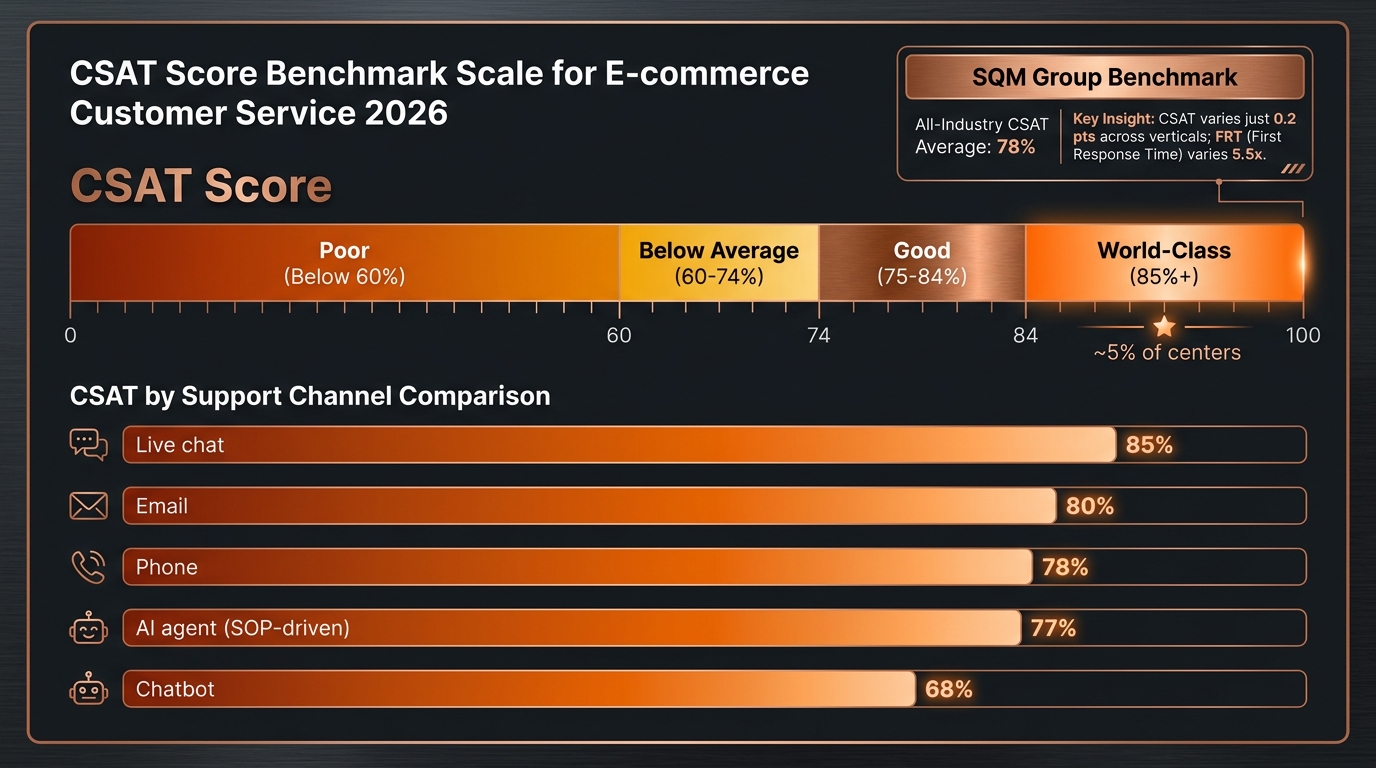
What Is a Good CSAT Score for E-commerce? 2026 Benchmarks by Channel
A good CSAT score for e-commerce is 75%–84%. World-class — 85% or higher — is reached by approximately 5% of contact centers per SQM Group's benchmarks. The all-industry average sits at 76%–78%. For e-commerce operations, 80%+ is the meaningful target; 85%+ is the benchmark for best-in-class.
TL;DR: CSAT Benchmarks at a Glance
| CSAT Performance Tier | Score | What It Signals |
|---|---|---|
| World-class | 85%+ | Top ~5% of operations; strong FCR, fast resolution, low effort |
| Good | 75%–84% | Above-average; solid resolution practices in place |
| Average | 70%–74% | Room to improve; FCR or effort gaps likely |
| Below average | 60%–69% | Structural issues in resolution or channel design |
| Chatbot / deflection baseline | 55%–65% | Typical when AI deflects rather than resolves |
| AI agent (SOP-driven, with system access) | 75%–80% | When AI closes tickets end-to-end across systems |
What Is CSAT and How Is It Calculated?
CSAT (Customer Satisfaction Score) measures customer satisfaction with a specific support interaction. It is collected via a post-contact survey — typically one question asking customers to rate their experience on a 1–5 or 1–10 scale.
The calculation:
CSAT = (Top-Box Ratings / Total Survey Responses) × 100
"Top-box" means the highest rating options: 4–5 on a 5-point scale, or 9–10 on a 10-point scale. A customer who rates the interaction a 3 out of 5 is not counted as satisfied even if they are neutral. This top-box definition is why CSAT can look lower than it "feels" — the middle of the scale is excluded.
Two common variants:
- Per-interaction CSAT (the standard): survey sent after each support contact. Best for identifying channel- and ticket-type-level patterns.
- Periodic CSAT (relationship-level): surveyed at intervals regardless of recent contact. Measures cumulative brand sentiment, not support quality. This is a different signal and should not be averaged with per-interaction CSAT.
For e-commerce support benchmarking, per-interaction CSAT is the relevant metric — it tracks the quality of specific support experiences and gives actionable signal by ticket type and channel.
One important caveat on survey response rates: CSAT benchmarks are computed from customers who respond to surveys. Response rates in e-commerce support typically run 10%–25%, with response skew toward customers who had either very positive or very negative experiences. This non-response bias means aggregate CSAT can lag or lead actual satisfaction depending on the direction of the skew. Track both your CSAT score and your response rate — a stable CSAT with a falling response rate may indicate the middle-tier customers (who drive volume) are disengaging.
What Is a Good CSAT Score? 2026 Benchmarks by Performance Tier
Per SQM Group's multi-industry benchmarks — the most widely cited longitudinal dataset in contact center research — the CSAT distribution looks like this:
| Performance Tier | CSAT Score | % of Contact Centers |
|---|---|---|
| World-class | 85%+ | ~5% |
| Above average | 80%–84% | ~20% |
| Average | 75%–79% | ~40% |
| Below average | 65%–74% | ~25% |
| Poor | Below 65% | ~10% |
The all-industry average of 76%–78% means that if your CSAT is above 80%, you are already ahead of approximately 65% of comparable operations. If it is below 75%, you are in the bottom half, and the structural driver is almost always First Contact Resolution (FCR) — the metric that predicts CSAT more reliably than any other single variable.
One finding from SQM Group's research that consistently surprises e-commerce operators: CSAT varies just 0.2 percentage points across industries. Retail, financial services, healthcare, telecommunications — the average CSAT is nearly identical across verticals. By contrast, First Response Time (FRT) varies 5.5× across the same comparison. The implication is that cross-industry CSAT benchmarks are reliable targets — you are not operating in a unique vertical where "our 72% is really a 85% in disguise." CSAT is driven by resolution quality and customer effort, not by industry-specific factors that would shift the baseline.
CSAT Benchmarks by Support Channel
CSAT varies significantly by channel — more than it varies by industry — because each channel imposes a different effort level on the customer:
| Channel | Typical CSAT Range | Key Driver |
|---|---|---|
| Live chat | 82%–87% | Speed + synchronous resolution; issue closed in session |
| Phone | 78%–84% | High empathy; penalized by hold times and transfers |
| 74%–80% | No wait time; penalized by multi-day resolution cycles | |
| AI agent (SOP-driven, with system access) | 75%–80% | Resolves end-to-end; CSAT matches email; below chat due to no empathy layer |
| Traditional chatbot (no system access) | 60%–68% | Deflects rather than resolves; customers know they weren't helped |
| SMS / messaging | 76%–82% | Speed + asynchronous convenience; growing in e-commerce |
Two patterns in this table matter for operations:
Live chat leads because it resolves synchronously. The driver is not that live chat agents are more skilled — it is that synchronous channels close the loop in a single session, which improves FCR and reduces the effort of re-contacting. When you replicate this synchronous closure with an AI agent that takes action in the first interaction (triggering the refund, updating the order, sending the carrier query), AI agent CSAT approaches live chat CSAT.
Traditional chatbot CSAT is low because deflection is not resolution. A customer who gets "I'm transferring you to a human" or "here is our returns policy page" after waiting 2 minutes in a chat queue rates that interaction low — not because the answer was wrong, but because the issue was not resolved. The 60%–68% CSAT range for chatbots reflects customers who attempted self-service and were handed off. That handoff experience is the failure point, not the AI's knowledge.
CSAT Benchmarks by Ticket Type
For e-commerce operations, CSAT is most useful when segmented by ticket type, because the achievable CSAT ceiling varies by issue complexity:
| Ticket Type | Human Agent CSAT | Automated AI CSAT | Gap / Notes |
|---|---|---|---|
| Order status / WISMO | 78%–86% | 76%–83% | AI slightly below human; closes fast, no empathy offset |
| Address change or order edit | 80%–88% | 78%–85% | High CSAT when action taken immediately |
| Standard refund | 77%–85% | 75%–82% | AI matches human when refund executes in session |
| Damaged item / carrier claim | 72%–80% | 70%–78% | CSAT drops if claim resolution takes days; FCR lower |
| Return initiation | 75%–83% | 73%–80% | Exchange-first offers boost CSAT by reducing friction |
| Fraud / chargeback dispute | 65%–75% | 55%–65% | Complexity and stakes reduce CSAT; AI ceiling lower |
| Account / subscription issue | 72%–80% | 70%–78% | Varies by account system access |
The most important pattern: AI agent CSAT is 2–4 percentage points below human agent CSAT on most ticket types, not 10–15 points. The gap is attributable to the absence of empathy expression, not to resolution quality. When resolution quality is equal — the action gets taken, the issue closes — the CSAT gap narrows to the width of the empathy deficit.
This means the path to closing the AI-vs-human CSAT gap is not "make the AI more empathetic" — it is "make the AI resolve more tickets end-to-end so the action-taking quality equals the human baseline." Resolution rate drives CSAT more than tone does.
Why FCR Is the Strongest Driver of CSAT
The single metric most predictive of CSAT in e-commerce is First Contact Resolution (FCR). Per SQM Group's longitudinal research:
- Every 1% improvement in FCR produces approximately 1.0–1.2 percentage points of CSAT improvement
- Moving FCR from 65% to 75% — a 10-point improvement — drives roughly 10–12 points of CSAT improvement with no other change
The mechanism is customer effort. Gartner's Customer Effort Score research found that high-effort interactions are 4× more likely to create a disloyal customer than low-effort ones. Every re-contact a customer makes about the same issue represents additional effort. Customers who resolve in one contact experienced low effort; customers who contact three times experienced high effort, even if the outcome was the same.
The practical implication for e-commerce operations: if your CSAT is below 78% and your FCR is below 70%, fixing FCR is a higher-leverage intervention than CSAT coaching, survey redesign, or empathy training. A 10-point FCR improvement produces more CSAT movement than any scripting or tone change.
The channels and ticket types with the lowest FCR in e-commerce are where the CSAT gap concentrates:
| FCR Driver | FCR Impact | CSAT Impact |
|---|---|---|
| Carrier claim filed but not resolved in-session | −15 to −25 FCR pts | −10 to −15 CSAT pts |
| No cross-system access (can't see Shopify from Zendesk) | −10 to −20 FCR pts | −8 to −12 CSAT pts |
| SOP edge cases unhandled (stalls at $50.01 threshold) | −5 to −15 FCR pts | −5 to −10 CSAT pts |
| Wrong routing (complex WISMO in standard queue) | −5 to −12 FCR pts | −4 to −8 CSAT pts |
How to Improve CSAT in E-commerce: Where the Leverage Is
Based on where the FCR-to-CSAT chain breaks most often in e-commerce:
1. Segment CSAT by ticket type and channel before optimizing. A blended 73% CSAT tells you you're below average; a breakdown showing 84% CSAT on automated WISMO, 76% on AI-assisted refunds, and 62% on human-handled carrier claims tells you exactly where to invest. Do not optimize a number — optimize the segments.
2. Fix FCR on your highest-volume, lowest-CSAT ticket types first. WISMO is the highest-volume category (30–50% of all inbound for most e-commerce brands) and also the most automatable. Improving WISMO FCR from 78% to 90% across 1,000 monthly tickets eliminates 120 re-contacts per month — each of which was dragging CSAT down. Start there before touching anything else.
3. Ensure AI automation resolves, not deflects. Chatbot CSAT is 60%–68% precisely because customers can tell the difference between a resolution and a handoff. If your current AI tool is generating "I'm connecting you with a human" responses for a significant share of its volume, that share is suppressing your CSAT. SOP-driven AI agents that take action — refund triggered, order updated, carrier queried — produce CSAT in the 75%–80% range because the issue is actually closed.
4. Give automation cross-system access. Most e-commerce tickets touch more than one system: a WISMO ticket requires the Shopify order + the carrier API. A return request requires Shopify order history + the helpdesk + sometimes a Salesforce account record. AI tools bounded to a single helpdesk (Zendesk AI, Gorgias AI) cannot take the full action sequence for multi-system tickets — they have to hand off. That handoff is the moment CSAT drops. Cross-platform resolution that stays in one session removes the handoff and improves FCR.
5. Measure and act on CSAT by automation path. If you cannot see CSAT for "AI-resolved tickets" versus "AI-attempted then escalated tickets" versus "human-only tickets," you cannot improve each path independently. Tag resolution path in your ticketing system and segment your CSAT survey results accordingly. The signal in "AI-escalated" CSAT is almost always more important than "AI-resolved" CSAT — it is where your automation is failing and the customer experience is worst.
What CSAT Doesn't Capture
CSAT is a post-interaction measure of satisfaction with a specific contact. It does not capture:
- Customers who gave up without contacting — the largest untracked population in e-commerce support. Per the calendar brief, proactive notifications prevent 30–50% of WISMO volume; those prevented tickets are not in CSAT denominator, but they represent resolved experiences.
- Long-term loyalty impact — a single high CSAT interaction does not guarantee retention. CSAT is correlated with loyalty but the relationship is mediated by FCR, product experience, and brand factors beyond support.
- Non-respondents — with 10–25% survey response rates typical, the 75–90% of customers who don't respond have an unknown CSAT.
The most important complement to CSAT for e-commerce operations is re-contact rate — the percentage of closed tickets that are re-opened or followed up within 7–30 days. Re-contact rate captures what CSAT misses: customers who said they were satisfied in the post-contact survey but came back because the issue wasn't actually resolved. Together, CSAT and re-contact rate give a more complete picture of support quality than either metric alone.
How AI Agents Affect CSAT: What the Data Shows
The shift from chatbots to SOP-driven AI agents produces a measurable CSAT lift, but the lift is more modest than many vendors claim:
| Tool Type | Typical CSAT Range | Why |
|---|---|---|
| Rule-based chatbot | 55%–65% | Deflects; customers know they weren't helped |
| LLM chatbot (no system access) | 62%–70% | Better answers; still cannot act; partial resolution |
| SOP-driven AI agent (with system access) | 75%–80% | Closes tickets end-to-end; CSAT approaches email-channel baseline |
| Human agent (trained, with full system access) | 78%–85% | Resolution + empathy; highest CSAT ceiling |
The realistic expectation for a well-configured AI agent in e-commerce support is CSAT in the 75%–80% range — above the chatbot baseline, below the human-with-empathy ceiling. The 5–10 point gap to human agent CSAT is attributable to empathy expression, not to resolution quality. Framing AI deployment as a way to reach the human-agent CSAT ceiling is typically an overpromise; framing it as a way to exit the chatbot CSAT floor while reducing cost per resolution is accurate.
The CSAT lift from AI agent versus chatbot deployment is most visible on:
- WISMO tickets (where action-taking closes the loop that chatbots leave open)
- Standard refund requests (where immediate execution beats "your request is being processed")
- Order edits and address changes (where synchronous completion beats multi-day email chains)
It is least visible on complex carrier claims, fraud disputes, and VIP escalations — ticket types where human judgment and empathy have a larger effect on outcome and CSAT.
Frequently Asked Questions
What is a good CSAT score for e-commerce in 2026?
A good CSAT score for e-commerce is 75%–84%. World-class — 85% or higher — is reached by approximately 5% of contact centers per SQM Group's benchmarks. The all-industry average sits around 76%–78%. E-commerce brands should target 80%+ as a meaningful operational threshold, with 85%+ as the standard to benchmark against best-in-class operations.
What is CSAT and how is it calculated?
CSAT (Customer Satisfaction Score) measures how satisfied customers are with a specific support interaction. It is typically collected via a post-contact survey asking customers to rate their experience on a 1–5 or 1–10 scale. CSAT is calculated as the percentage of respondents who give the top-box rating (4–5 on a 5-point scale, or 9–10 on a 10-point scale) divided by total survey responses.
Which support channel has the highest CSAT?
Live chat consistently produces the highest CSAT scores in e-commerce support, typically 82%–87%, due to speed and synchronous resolution. Phone support follows at 78%–84%, email at 74%–80%. AI agents with full system access (SOP-driven) average 75%–80% — above traditional chatbots (60%–68%) because they resolve issues rather than deflect them.
Does CSAT vary across e-commerce verticals?
Very little. Per SQM Group's research, CSAT varies just 0.2 percentage points across industries — a statistically negligible difference. By contrast, First Response Time (FRT) varies 5.5× across the same comparison. This means cross-vertical CSAT benchmarks are reliable targets, and CSAT is primarily driven by resolution quality and effort, not by industry-specific factors.
What is the single strongest driver of CSAT in e-commerce?
First Contact Resolution (FCR) is the single strongest driver of CSAT in e-commerce, per SQM Group's longitudinal research. Every 1% improvement in FCR produces approximately 1.0–1.2 percentage points of CSAT improvement. The mechanism is customer effort: customers who contact support more than once experience significantly higher effort, and high-effort interactions create disloyal customers at 4× the rate of low-effort ones per Gartner.
Mustafa Bayramoglu is the founder of CorePiper (YC W19). CorePiper's SOP-driven AI agents resolve customer support tickets end-to-end across Shopify, Zendesk, Freshdesk, Salesforce, and Jira — the cross-platform resolution infrastructure that moves FCR and, through it, CSAT. Book a demo to see how it works on your actual ticket types.
Move Your CSAT by Fixing What Actually Drives It
CSAT follows First Contact Resolution — and FCR follows whether your AI can actually close tickets, not just respond to them. CorePiper's SOP-driven agents are built for end-to-end resolution across Shopify, Zendesk, and Salesforce. See the difference on your real ticket types.