
Customer Service Cost Reduction: 7 Levers That Don't Hurt CSAT
Gartner benchmarks assisted-channel support at $13.50 vs $1.84 for self-service. These 7 levers cut customer service costs 25–53% without sacrificing satisfaction scores.
 Mustafa BayramogluJuly 13, 202616 min read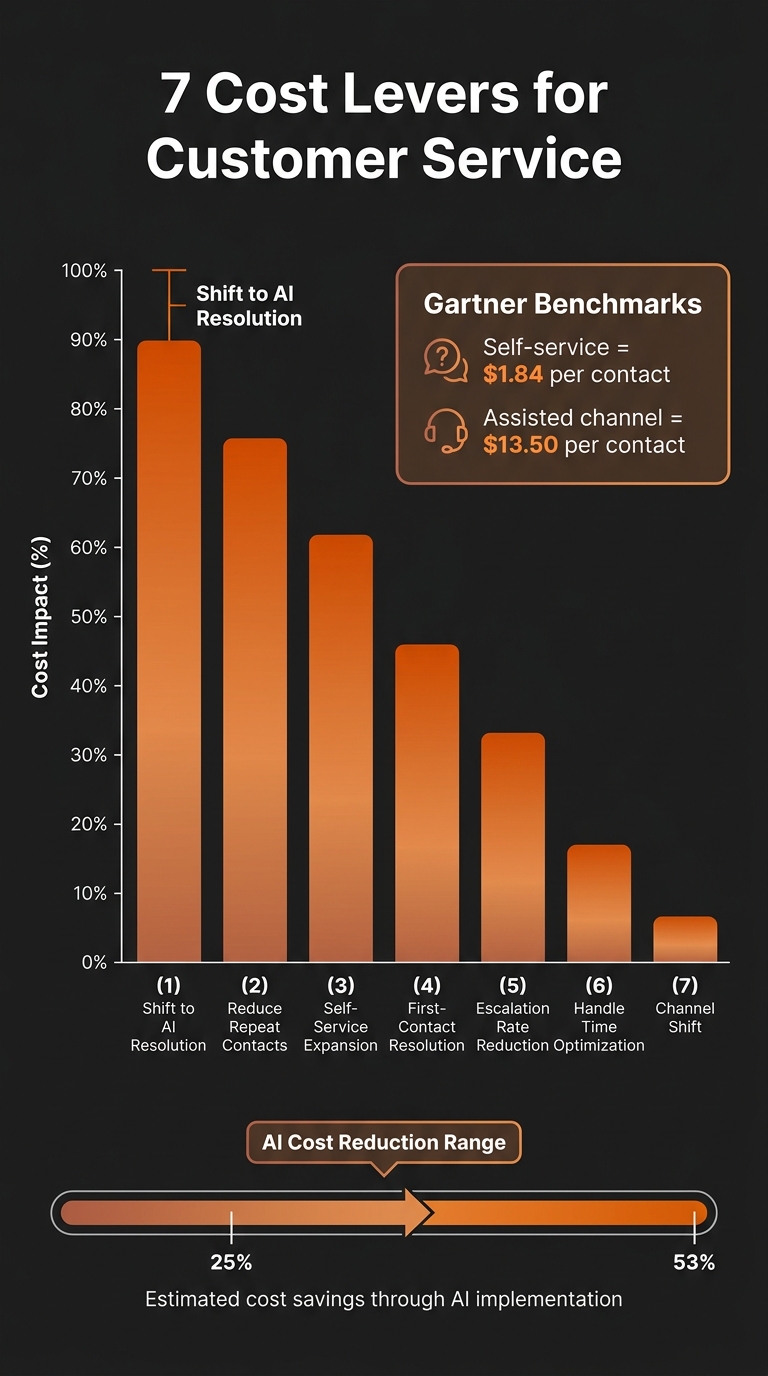
Customer Service Cost Reduction: 7 Levers That Don't Hurt CSAT
The seven most effective levers for reducing customer service costs are: AI end-to-end resolution, repeat-contact elimination, self-service expansion, first-contact resolution improvement, escalation rate reduction, outcome-based pricing, and proactive outreach. Applied together, they reduce per-ticket cost 25–53% while improving CSAT — because speed of resolution is the primary CSAT driver.
TL;DR: 7 Cost Reduction Levers and Their Impact
| Lever | Cost Impact | CSAT Effect | Complexity |
|---|---|---|---|
| 1. AI end-to-end resolution | 25–53% cost reduction | Positive (faster resolution) | Medium |
| 2. Repeat-contact elimination | 2.3x cost multiplier removed | Positive (fewer frustrated callbacks) | Medium |
| 3. Self-service expansion | $1.84 vs $13.50 per contact | Neutral (if self-service actually solves the issue) | Low |
| 4. First-contact resolution improvement | Avoids double-handling cost | Positive (issue closed on first contact) | Low–Medium |
| 5. Escalation rate reduction | Eliminates most expensive channel | Positive (human bandwidth freed for VIP work) | Medium |
| 6. Outcome-based pricing | Aligns vendor cost to resolved cases | Neutral | Low |
| 7. Proactive outreach | Prevents 30–50% of inbound volume | Positive (no wait, no friction) | Low–Medium |
Why do most cost-cutting attempts damage CSAT?
The usual playbook — slower response SLAs, lower headcount, more aggressive deflection to FAQ pages — cuts costs by degrading service. Customers wait longer, hit dead ends, and contact again. Each of those failure modes increases total cost (repeat contacts at 2.3x multiplier) while damaging the satisfaction score that determines retention.
The true cost of a support ticket in e-commerce is not the direct labor cost per contact. It includes repeat contacts, escalation costs, and agent turnover driven by high-frustration ticket queues. Per Gartner's benchmarks, the median cost per contact is $1.84 for self-service and $13.50 for assisted channels — phone, chat, and email to a human agent. That 7.3x gap is not a cost-accounting artifact. It reflects real labor, real time, and real overhead that compounds with every ticket that doesn't resolve on first contact.
The seven levers below all share one property: they reduce cost by improving resolution quality, not by reducing service. That is what keeps CSAT intact — or improves it.
Lever 1: Is AI end-to-end resolution the highest-impact cost lever?
Yes — and it is the only lever that simultaneously cuts costs and improves resolution rates. AI end-to-end resolution means the AI agent completes the ticket: pulls live carrier data, processes the refund via API, confirms the address change, and closes the ticket without a human touch. This is categorically different from AI deflection, where the agent offers knowledge-base articles and escalates when they don't work.
The cost math is straightforward. Human-handled tickets in e-commerce run $2.70–$5.60 per contact in direct labor benchmarks. AI-resolved tickets cost a fraction of that — typically $0.90–$2.50 per resolved case depending on the tool and ticket complexity. Industry analyses cite 25–53% cost reduction from AI automation, with the upper end achievable on high-volume, routine ticket types.
CSAT improves because resolution speed is the dominant CSAT driver at the ticket level. A customer whose refund is processed in 45 seconds rates the interaction higher than one who waits 6 hours for a human response that does the same thing. Most AI resolution failures trace to the same three root causes: no system access (the AI can't reach the data it needs), no SOP (the AI improvises instead of following a procedure), and single-platform ceiling (the ticket requires action across more than one system). Tools that clear all three obstacles achieve high resolution rates and corresponding CSAT.
Implementation note: AI resolution only improves CSAT when the resolution is genuine — when the underlying issue is actually closed. Deflection masquerading as resolution (the AI says "your refund should arrive in 3–5 days" without actually processing it) produces an initial positive response and a repeat contact 3 days later. Track resolution rate, not deflection rate, to distinguish the two.
Lever 2: How do repeat contacts inflate the true cost of support?
Repeat contacts are the most underestimated cost driver in e-commerce support. Industry analysis puts e-commerce repeat-contact rates at 20–30% — meaning one in four to five customers contacts support again about the same issue. That repeat contact carries a 2.3x cost multiplier: you pay once for the original contact and again for the follow-up, and the follow-up typically involves a frustrated customer whose second interaction takes longer than the first.
At 10,000 tickets per month with a 25% repeat-contact rate, you are paying for roughly 12,500 effective contacts while logging 10,000. At $3–$5 per ticket, the repeat-contact overhead is $7,500–$12,500 per month that does not appear on the per-ticket cost line.
Eliminating repeat contacts requires understanding why they happen. The three most common causes:
Incomplete first resolution. The agent addressed the customer's stated question but not the underlying issue. A customer asking "where is my order" who is told "it shipped last Tuesday" will contact again when it doesn't arrive. The right resolution closes the loop: check carrier status, flag the delay, escalate to the carrier if needed, and tell the customer when to expect resolution.
Process failure. The refund was promised but not processed, or the address change was confirmed but not updated before shipment. These are execution failures, not communication failures. SOP-driven agents that execute the action in the same interaction eliminate this class of repeat contact.
No follow-up confirmation. Some tickets require a second touchpoint — "your refund was processed; here is your confirmation number." Proactive confirmation reduces inbound follow-up from customers checking whether action was taken.
Lever 3: Does expanding self-service always reduce costs?
Self-service reduces costs only when it actually solves the problem. Gartner's benchmark puts self-service at $1.84 per contact versus $13.50 for assisted channels — a 7.3x difference. But that $1.84 only materializes if the customer finds the answer and doesn't contact again. A self-service interaction that deflects without resolving still generates the $13.50 assisted-channel cost; it just adds the $1.84 self-service overhead on top.
The highest-ROI self-service expansions target queries where the answer is factual and unambiguous: order status, refund status, return policy, store hours. For these queries, well-structured FAQ pages, order-tracking portals, and AI-powered search over a knowledge base deliver genuine resolution at near-zero marginal cost.
The categories where self-service fails: queries requiring a decision (should I process this return?), queries requiring system action (process the refund), or queries requiring contextual judgment (this order is flagged for fraud, should I approve it anyway?). Sending these to a FAQ page creates repeat contacts. Proactive WISMO automation that resolves the "where is my order" query with live carrier data delivers genuine self-service resolution rather than deflection.
Lever 4: What is the cost impact of improving first-contact resolution?
First-contact resolution (FCR) is the share of customer contacts that are fully resolved on the first interaction without a callback or follow-up. Per SQM Group, the all-industry FCR average is 70%; world-class is 80%+, achieved by only about 5% of contact centers. Each percentage point of FCR improvement reduces support volume by approximately one point — a 5-point FCR improvement on 10,000 monthly contacts eliminates 500 repeat contacts.
The direct cost impact depends on your cost per ticket. At $5 per ticket average, a 5-point FCR improvement eliminates $2,500 per month in repeat-contact costs. The secondary impact on CSAT is equally significant: FCR is the single strongest predictor of customer satisfaction at the contact level. Customers who reach resolution on the first contact rate that interaction significantly higher than customers who require a follow-up, even when the follow-up resolves the issue.
Improving FCR requires diagnosing why contacts fail to resolve. The three dominant categories: agent capability gaps (the agent lacks knowledge or authority), system access gaps (the agent can't retrieve the data needed to resolve), and policy ambiguity (the agent is uncertain what they're authorized to do). SOP-driven AI addresses all three by encoding the resolution procedure, giving agents (human or AI) both the knowledge and the authority to close tickets in the first interaction.
Lever 5: What is the cost impact of reducing escalation rate?
Escalation rate — the share of contacts that transfer from a lower-cost channel (self-service, AI) to a higher-cost one (human agent) — is the direct cost multiplier on your support budget. Every escalation turns a $1.84 self-service contact into a $13.50 assisted-channel contact. At 10,000 monthly contacts, a 10-point escalation rate reduction (from 40% to 30% escalation) eliminates 1,000 human-assisted contacts per month — $11,660 in monthly cost savings at Gartner's benchmark rates.
The highest-leverage escalation reduction comes from expanding the set of queries AI can resolve without human handoff. This requires both capability (the AI can retrieve the data and take the action) and confidence calibration (the AI knows when to escalate rather than improvising on edge cases). A well-tuned SOP-driven agent escalates the right tickets — genuine exceptions, fraud patterns, high-value customer issues — and resolves the rest autonomously.
Human bandwidth freed from routine tickets concentrates on the escalations that actually require judgment: complex complaints, high-LTV customer retention situations, and edge cases outside SOP coverage. That reallocation typically improves human-handled CSAT because agents work fewer low-complexity, high-frustration tickets and more situations where their judgment adds genuine value.
Lever 6: Does pricing model affect total support cost?
Yes — significantly. Per-seat pricing creates a fixed cost floor regardless of ticket volume. Per-contact or per-conversation pricing scales linearly with volume. Per-resolution pricing — the model used by CorePiper, Intercom Fin, Zendesk AI, and Gorgias Automate — aligns cost directly to outcomes: you pay only for tickets that are actually resolved by the AI.
The distinction matters for cost reduction because per-resolution pricing contains an automatic efficiency incentive. If the AI fails to resolve a ticket and escalates to a human, you pay for the human handling but not for the AI attempt — the AI cost is only incurred on successful resolutions. Per-contact pricing (charging per conversation regardless of outcome) eliminates that incentive and can produce situations where you pay for AI interactions that generate escalations rather than resolutions.
As we detailed in our comparison of AI support pricing models, the current market rates are: Intercom Fin at $0.99 per outcome, Zendesk AI at $1.50 per automated resolution, Gorgias Automate at $0.90 to $1.00 per resolved conversation, and CorePiper at $2.00 to $3.00 per resolved case beyond its plan allowance for cross-platform multi-system cases. The higher per-case rate on complex cross-platform tickets still delivers net cost reduction because those tickets would cost $13.50+ handled by a human.
Lever 7: Can proactive outreach reduce inbound contact volume?
Proactive outreach — notifying customers before they need to ask — directly reduces inbound ticket volume by eliminating the trigger that generates the contact. WISMO ("where is my order") tickets account for 30–50% of total e-commerce support volume. A proactive shipping notification sent at each status change (shipped, in transit, out for delivery, delivered) eliminates most of that inbound volume without requiring any customer action.
The cost math is compelling. At 40% WISMO volume, 10,000 monthly tickets include 4,000 WISMO contacts. A well-executed proactive notification program reduces WISMO volume 60–80%. That is 2,400–3,200 fewer tickets per month — $7,200–$16,000 per month in eliminated cost at $3–$5 per ticket. The notification itself costs fractions of a cent per send via email or SMS.
Proactive outreach works for more than shipping: return status updates, refund confirmations, subscription renewal reminders, and order cancellation acknowledgments all prevent inbound contacts that would otherwise generate cost. Each category requires integration with the relevant data source (carrier API, Shopify order data, payment processor) and a delivery mechanism (email, SMS, or app push). Automating order cancellations and address changes covers how to extend this proactive model to the second-most common trigger: customers trying to modify an order before it ships.
How do you prioritize these levers for maximum ROI?
The sequencing depends on your current cost breakdown and ticket mix. A practical diagnostic process:
Step 1: Measure your escalation rate. If more than 30% of contacts reach a human agent, reducing escalation rate is the highest-ROI first move. The Gartner delta ($13.50 vs $1.84) makes each escalated ticket far more expensive than the benchmark suggests.
Step 2: Audit repeat-contact causes. Pull tickets that generated a follow-up contact within 7 days. The category breakdown (incomplete resolution vs. process failure vs. no confirmation) tells you where to focus.
Step 3: Evaluate WISMO share. If WISMO exceeds 25% of your volume, proactive shipping notifications combined with AI resolution of residual WISMO tickets deliver the fastest volume reduction. Most e-commerce platforms support automated carrier status webhooks that enable this without custom engineering.
Step 4: Assess AI resolution capability. The difference between an AI chatbot that deflects and an AI agent that resolves is system access and SOP governance. If your current AI tool cannot execute actions (process refunds, update addresses, submit carrier claims), upgrading resolution capability is the prerequisite to capturing Levers 1, 2, and 5.
Step 5: Review pricing model. If you are on per-seat pricing for an AI tool, calculate whether switching to per-resolution pricing reduces total cost at your ticket volume and resolution rate.
What benchmarks indicate healthy customer service economics?
Several published benchmarks let you compare your operation against the market:
Cost per contact: Self-service $1.84, assisted channel $13.50 (Gartner). A blended average below $5 indicates strong containment; above $8 suggests escalation rate or repeat-contact issues.
First-contact resolution rate: 70% all-industry average (SQM Group); world-class 80%+. Below 65% indicates either capability gaps or policy ambiguity driving unnecessary escalation.
CSAT score: Per SQM Group, a good CSAT is 75%–84%; world-class is 85%+. CSAT variation across channels (self-service vs. AI vs. human) identifies where resolution quality is weakest.
WISMO share: Industry benchmarks range from 18% (Gorgias data for Shopify brands) to 30–50% (broader e-commerce). Higher WISMO shares indicate proactive notification gaps.
Resolution rate: For AI tools, resolution rate — the share of contacts the AI fully resolves without escalation — is the primary quality metric. Modern AI agents achieve 67–85% on appropriate ticket types (Intercom: 67% across 40M+ conversations; high-resolution tools on well-structured SOP coverage: 80–90% on routine ticket types).
How do you calculate cost per resolved ticket?
Cost per resolved ticket is the total operating cost of the support team divided by the number of tickets resolved in the same period. Build the numerator from every cost line: payroll, the software stack and overhead. Build the denominator from unique issues, not touchpoints, so a customer who contacts you twice about the same order counts as one resolved ticket and two contacts.
The two figures diverge when repeat contacts are high. As an illustration, take $60,000 of monthly support spend, 10,000 contacts and 8,000 unique issues resolved. Cost per contact is $6.00; cost per resolved ticket is $7.50. The gap is the price of the 2,000 contacts that resolved nothing new.
That difference decides which levers matter. Levers that remove repeat contacts (levers 2, 4 and 7) shrink the numerator without reducing the number of issues solved, so they lower cost per resolved ticket directly. Deflection that does not close the issue can lower cost per contact while leaving cost per resolved ticket flat or higher, because the customer comes back.
The difference between durable and fragile savings
The most important distinction in customer service cost reduction is between durable savings and fragile savings.
Fragile savings come from degrading service: slower SLAs, fewer agents, harder-to-reach escalation paths. These reduce cost in the near term and reliably increase it over the medium term as repeat contacts rise, CSAT falls, and churn accelerates. A 1% increase in customer churn costs far more than any near-term support savings.
Durable savings come from resolution quality improvements: tickets resolved faster, on first contact, without repeat follow-up. These reduce cost and improve CSAT simultaneously because customers value speed and closure over channel preference. Customers do not prefer talking to a human — they prefer having their problem solved. When AI resolution matches or exceeds human resolution quality on routine tickets, the cost savings are permanent and compound with volume growth.
The economics of DTC customer support trace this curve in detail: as ticket volume scales, per-seat headcount models create linear cost growth, while per-resolved-case AI models create sub-linear cost growth. The gap widens with every order of magnitude of ticket volume increase.
Getting started: the 30-day cost audit
A practical 30-day cost audit for e-commerce customer service:
Week 1: Baseline your cost structure. Total support spend (fully loaded: salaries, benefits, tooling, training, management overhead) divided by total tickets resolved = true cost per resolution. This number should include repeat contacts in the denominator only once per unique issue, not per contact.
Week 2: Segment by ticket type. Sort your ticket volume by root cause: WISMO, refunds, returns, address changes, product questions, order changes, fraud disputes, carrier claims. The top 3–4 categories typically represent 60–70% of volume — AI resolution of those categories produces the majority of savings.
Week 3: Measure FCR and repeat-contact rates. Tag tickets in your helpdesk to identify contacts from the same customer about the same order within a 7-day window. The share of those is your repeat-contact rate. Dig into the root cause (incomplete resolution vs. process failure vs. no confirmation).
Week 4: Model the AI scenario. For your top ticket types, model the cost impact of 70–80% AI resolution: replace those tickets at $1.50–$2.50 per resolution, retain human handling for the residual 20–30%, and calculate the net cost per resolution at your volume. The difference from your Week 1 baseline is the achievable savings — without degrading CSAT, because resolution speed improves.
Mustafa Bayramoglu is the founder of CorePiper (YC W19) and writes about the economics of AI-driven customer operations. CorePiper resolves customer support tickets end-to-end across Shopify, Zendesk, Freshdesk, Salesforce, and Jira using SOP-driven AI agents priced per resolved case.