
The 2026 E-commerce CX Operating Model: From Reactive Tickets to Autonomous Resolution
The 2026 e-commerce CX operating model replaces reactive ticket queues with a two-tier system: AI agents resolve 70-85% of Tier-1 requests autonomously, while humans focus on high-judgment Tier-2 exceptions and VIP work.
 Mustafa BayramogluJuly 17, 202615 min read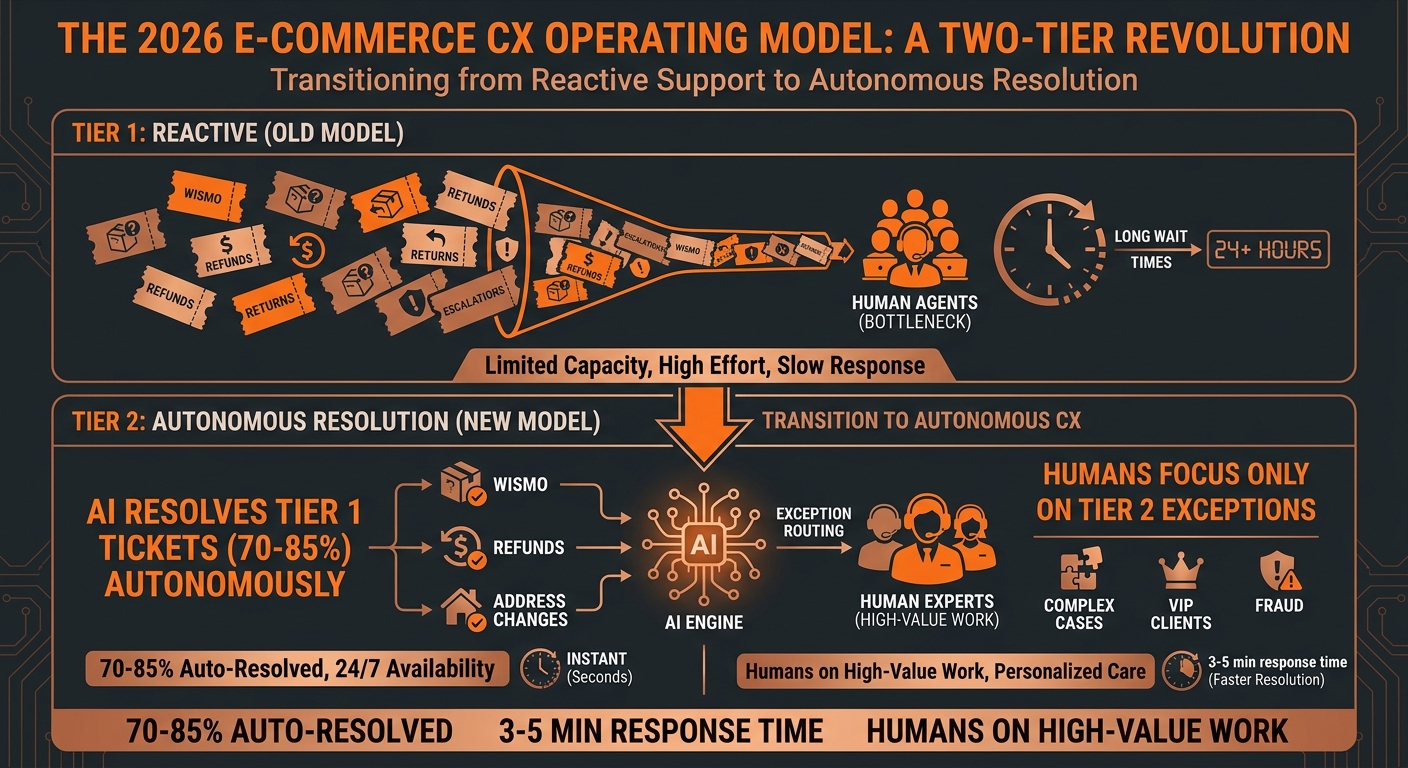
The 2026 E-commerce CX Operating Model: From Reactive Tickets to Autonomous Resolution
The 2026 e-commerce CX operating model is a two-tier architecture: AI agents handle 70-85% of Tier-1 tickets autonomously — WISMO, standard refunds, address changes, and FAQ — while human agents own the Tier-2 exceptions that require judgment, relationship management, or cross-system investigation. The primary outcome metric shifts from response time to resolution rate.
TL;DR
| Dimension | Old Model (Reactive) | New Model (Autonomous Resolution) |
|---|---|---|
| Ticket routing | All tickets enter a shared human queue | AI resolves Tier-1 autonomously; Tier-2 escalates to humans |
| Primary metric | Response time / SLA compliance | End-to-end resolution rate |
| Human role | Front-line ticket handler | Tier-2 specialist + escalation owner |
| Cost driver | Headcount scales with volume | AI capacity scales elastically; humans absorb complexity |
| Peak-season approach | Emergency staffing and overtime | AI absorbs surge; humans handle edge cases |
| Pricing model | Per-seat or per-conversation | Per-resolved-case (outcomes-aligned) |
What Does the 2026 E-commerce CX Operating Model Actually Look Like?
Think of e-commerce customer support as a two-layer stack.
Tier 1 — Autonomous resolution (AI handles, no human involved): The 70-85% of tickets that are data-lookup-plus-decision. A customer asks where their package is; the AI reads the carrier API, maps the status to the right message, sends the reply, and closes the ticket. A customer requests a refund; the AI checks order value against the refund SOP, executes the Shopify refund, generates a confirmation email, and closes the case. No human touched it. No queue delay.
Tier 2 — Human specialists (AI escalates with context): The remaining 15-30% requiring judgment. A carrier has lost a shipment and the customer wants compensation beyond policy. A suspected fraud case needs a human to weigh risk against customer LTV. A VIP brand ambassador has a complaint that's as much a relationship issue as a logistics problem. The AI recognizes it can't resolve these under existing SOPs, surfaces them with full context pre-filled — order history, carrier timeline, prior contacts — and routes to the right human.
The operating model insight is that these two tiers require fundamentally different tooling and staffing logic. Conflating them — routing everything to a shared human queue, then layering AI drafting on top — solves the wrong problem. The real leverage comes from separating them architecturally.
Why Did the Old Reactive Model Break?
The reactive model — every ticket enters a human queue, agents respond in order — worked when ticket volumes were predictable and margins were high enough to absorb the labor cost. Three things broke it.
Volume growth outpaced hiring. Successful DTC brands double ticket volume every 12-18 months during early growth. Hiring scales in discrete headcount increments with a 60-90 day ramp; ticket volume scales daily. The gap accumulates until peak season collapses SLAs.
Most tickets don't require humans. Per Gartner's benchmark data, the median cost per contact is $1.84 for self-service and $13.50 for agent-assisted — a 7x gap driven largely by the fact that the majority of contacts are data lookups, not judgment calls. Routing lookup tickets to $13.50 agents is a structural overspend.
WISMO tickets alone consume 30-50% of queue capacity. At 5-8 minutes of handle time each, WISMO at scale consumes more agent-hours than any other ticket class — for questions the AI can answer in under 10 seconds by reading carrier data. The reactive model treats WISMO the same as a fraud dispute, which is operationally incoherent.
What Is Tier-1 vs. Tier-2 in Practice?
The right way to define the tiers is by decision type, not topic. A ticket is Tier-1 if it can be resolved by applying a documented rule to live data. It's Tier-2 if it requires judgment that can't be encoded in a rule.
Tier-1 (AI resolves):
- Order status inquiries (WISMO): read carrier tracking, map to policy response, send, close
- Standard refund requests: check order value and recency against refund SOP, execute, confirm
- Address changes before fulfillment: check fulfillment window, update if open, notify if closed
- Return label requests: verify return eligibility against policy, generate label via returns integration
- Subscription pause or cancel: apply SOP with retention offer trigger, execute per customer choice
- Account FAQ (password reset, payment update, loyalty points): read account state, take documented action
Tier-2 (human owns):
- Carrier disputes and damage claims requiring multi-system investigation
- Suspected fraud cases where order history and behavioral signals need human interpretation
- VIP or high-LTV accounts with relational stakes above the SOP threshold
- Complaints involving product defects, safety concerns, or reputational risk
- Out-of-policy exceptions where the SOP doesn't cover the scenario and a judgment call is needed
The ratio in a typical DTC Shopify brand: approximately 70-80% Tier-1, 20-30% Tier-2. Brands with unusually high fraud exposure or complex product lines may run 60-70% Tier-1. The exact split is measurable — look at ticket tagging data for your three most common ticket types; if they account for over 50% of volume, Tier-1 automation is the highest-leverage starting point.
What Separates AI Resolution From AI Deflection?
The 2026 operating model depends on a critical distinction that most teams miss when they first evaluate AI agents vs. chatbots: resolution requires system access, deflection doesn't.
Deflection is redirecting a customer to information without solving the problem. A chatbot that links to the tracking page, suggests the FAQ, or sends a template reply is deflecting. The customer still has their problem; they just know it exists. Deflection metrics look good (fewer human contacts) but CSAT typically declines because the underlying issue rate stays flat while the resolution rate falls.
Resolution means the AI takes an action that closes the problem. The order is refunded. The replacement is shipped. The tracking link is retrieved and surfaced with a correct status message. The return label lands in the customer's inbox. Each of these requires the AI to have write access to at least one external system — not just retrieval, but action.
The architecture difference:
- Deflection AI: LLM reads ticket, generates draft, human approves
- Resolution AI: LLM reads ticket, classifies intent, reads live data from connected systems, applies SOP decision logic, executes action, writes back to helpdesk, closes ticket
The resolution architecture requires three things a deflection tool doesn't: live system connections (Shopify, carrier, helpdesk), write permissions (not just read), and a documented SOP that specifies what decision to make in each state. That's the SOP-driven AI agent model — encode the rules, connect the systems, the AI executes under policy.
How Does the New Operating Model Change Human Roles?
The most common concern when teams evaluate Tier-1 automation is headcount. The actual operational outcome is consistently redeployment, not reduction.
When AI absorbs 70%+ of Tier-1 tickets, the humans who were handling WISMO and standard refunds become available for work that was previously deferred or rushed: in-depth fraud investigation, proactive VIP outreach, improving SOP documentation, analyzing escalation patterns to catch emerging product issues, and building the institutional knowledge that makes the AI better over time.
The practical sequence most DTC brands follow:
Month 1: AI handles WISMO and standard refunds. Human team notices the queue pressure drop and starts catching up on backlog. Ticket volume handled per human agent doubles.
Month 2: AI coverage expands to address changes, returns, and subscription management. Human agents shift to an explicit Tier-2 role — they are no longer picking from a mixed queue but working a curated escalation list where every ticket needs real judgment.
Month 3+: Humans begin tracking escalation patterns, improving SOP coverage, and handling VIP proactive outreach that the reactive model never had bandwidth for. The team dynamic shifts from reactive responders to case specialists.
The question changes from "will we need fewer agents?" to "what do our best agents spend their time on once they're not answering the same nine questions all day?"
What Does the Implementation Path Look Like?
The 2026 CX operating model doesn't require a helpdesk replacement or a multi-month integration project. The implementation sequence that works in practice:
Step 1 — Ticket audit (1 week): Pull 90 days of ticket data, tag the three to five most common types, and calculate what percentage of volume they represent. This tells you your Tier-1 ceiling — the maximum automation you can reach if you automate those types perfectly.
Step 2 — SOP documentation (1-2 weeks): Write the decision rules for the top ticket types. Not prompts — actual documented logic: "If order was fulfilled more than 7 days ago AND customer is requesting a full refund AND order value is under $150, issue refund. If order value exceeds $150 or order was placed over 30 days ago, escalate." These become the SOPs the AI executes.
Step 3 — System connection (1-3 days per integration): Connect the AI platform to Shopify, your helpdesk, and the carrier APIs or tracking aggregator. The AI needs read/write access; read-only access enables drafting, not resolution.
Step 4 — Pilot on one ticket type (week 1 of live): Start with WISMO — the highest-volume, lowest-complexity type. Watch the automation rate, spot any edge cases the SOP didn't cover, refine. Don't launch all ticket types simultaneously.
Step 5 — Expand and measure (ongoing): Add ticket types in order of volume. Track First Contact Resolution rate (the leading CSAT predictor), automation rate, and escalation rate. The KPI stack for the 2026 model looks different from the reactive model: response time matters less; resolution rate and FCR matter more.
What Metrics Define the New Operating Model?
The shift from reactive to autonomous changes the metric hierarchy. The reactive model optimizes for response time (fast queue drain) because that's what the staffing model can control. The autonomous resolution model can actually optimize for what customers care about: did their problem get solved?
Metrics that rise in importance:
- End-to-end resolution rate: What percentage of tickets were resolved without a human touch or a repeat contact? This is the North Star for Tier-1 AI performance.
- First Contact Resolution (FCR): Per SQM Group, the all-industry FCR average is 70%; world-class is 80%+. Each 1% improvement in FCR correlates with a 1% improvement in CSAT. FCR is a better CSAT predictor than response time.
- Escalation quality rate: Of the tickets AI escalated to Tier-2, what percentage genuinely needed human judgment? Low escalation quality means the SOP coverage is under-defined; AI is escalating things it should be resolving.
- Automation rate by ticket type: Tracks whether the AI is actually capturing the tickets it should, broken out by type rather than blended.
Metrics that fall in importance:
- First Response Time (FRT): At Tier-1 volume, the AI responds in seconds. FRT is solved by default; optimizing it further adds no customer value.
- Agent handle time: Matters only for Tier-2 tickets now. AHT across all tickets is a misleading metric when 75% of tickets are closed by AI without a human.
- Queue size: The reactive model tracked this as a proxy for SLA stress. In the autonomous model, the AI queue is infinite in capacity; the relevant bottleneck is Tier-2 queue depth.
Where Does the 2026 Model Break Down?
The autonomous resolution model is not universal. Three scenarios where it underperforms:
Unusual ticket mixes. Brands where the majority of tickets are complex — bespoke product customization, high-value B2B orders with contractual nuances, regulated categories — may have a smaller Tier-1 automatable pool. Run the ticket audit before committing to an automation rate target.
Poorly documented SOPs. The AI executes what the SOP specifies. If the refund policy has unstated exceptions ("unless the customer is a VIP," "unless the item was on final sale") that live in agents' heads rather than in documentation, the AI will get those edge cases wrong. The documentation process surfaces these gaps, which is itself valuable, but it requires investment upfront.
Single-helpdesk architecture with no cross-system access. AI that can only read and write within the helpdesk is limited to deflection and drafting. True Tier-1 resolution requires Shopify access for order data and carrier API access for tracking. Brands that have locked down API permissions for security or vendor reasons need to evaluate whether cross-platform write access is achievable before setting automation rate expectations.
The Competitive Context: Why This Model Shifts Vendor Selection
Understanding the 2026 operating model changes which vendors make sense. The evaluation criteria for "AI for customer support" in 2024 was largely about quality of AI responses — how natural, how accurate. The evaluation criteria in 2026 is about resolution architecture: can the AI actually execute across the systems my Tier-1 tickets require?
That's why the comparison between AI agents and traditional chatbots has become the foundational purchase question. Chatbots optimize for deflection. Agentic AI platforms optimize for resolution. The operating models are different, the vendor stacks are different, and the ROI math is different.
Gartner's March 2025 projection (Senior Director Analyst Daniel O'Sullivan) that agentic AI will autonomously resolve 80% of common customer service issues by 2029 — reducing operational costs by 30% — reflects this architectural shift. The gains aren't from better chatbot responses; they're from AI that can actually take action.
Conclusion: The Operating Model IS the Strategy
The 2026 e-commerce CX operating model is not a technology purchase decision — it's a structural decision about how customer operations should work. The technology follows from the model, not the other way around.
The core choices:
- Define your Tier-1 and Tier-2 split by ticket type, not volume
- Document the SOPs that govern Tier-1 resolution before deploying AI
- Connect the AI to the systems it needs — not just the helpdesk, but the e-commerce platform and carrier integrations
- Measure resolution rate and FCR rather than response time
- Redefine the human role as Tier-2 specialist, not queue handler
Brands that make this shift early build a scalable support architecture that absorbs 4-6x peak-season volume without emergency staffing, maintains CSAT by resolving rather than deflecting, and frees human agents for the work that actually builds customer loyalty.
The brands that delay are trading compound efficiency gains for short-term status quo comfort — and the compounding works both ways.
Mustafa Bayramoglu is the founder of CorePiper (YC W19). CorePiper's SOP-driven AI agents resolve customer support tickets end-to-end across Shopify, Zendesk, Freshdesk, Salesforce, and Jira.