
Freshdesk AI Agent: Autonomous Ticket Resolution Without Replacing Your Helpdesk (2026 Guide)
A Freshdesk AI agent adds autonomous resolution across Shopify, carrier APIs, and back-office systems without replacing Freshdesk. Here's how it works, what Freddy AI can and can't do, and when you need a third-party AI agent.
 Mustafa BayramogluAugust 11, 202613 min read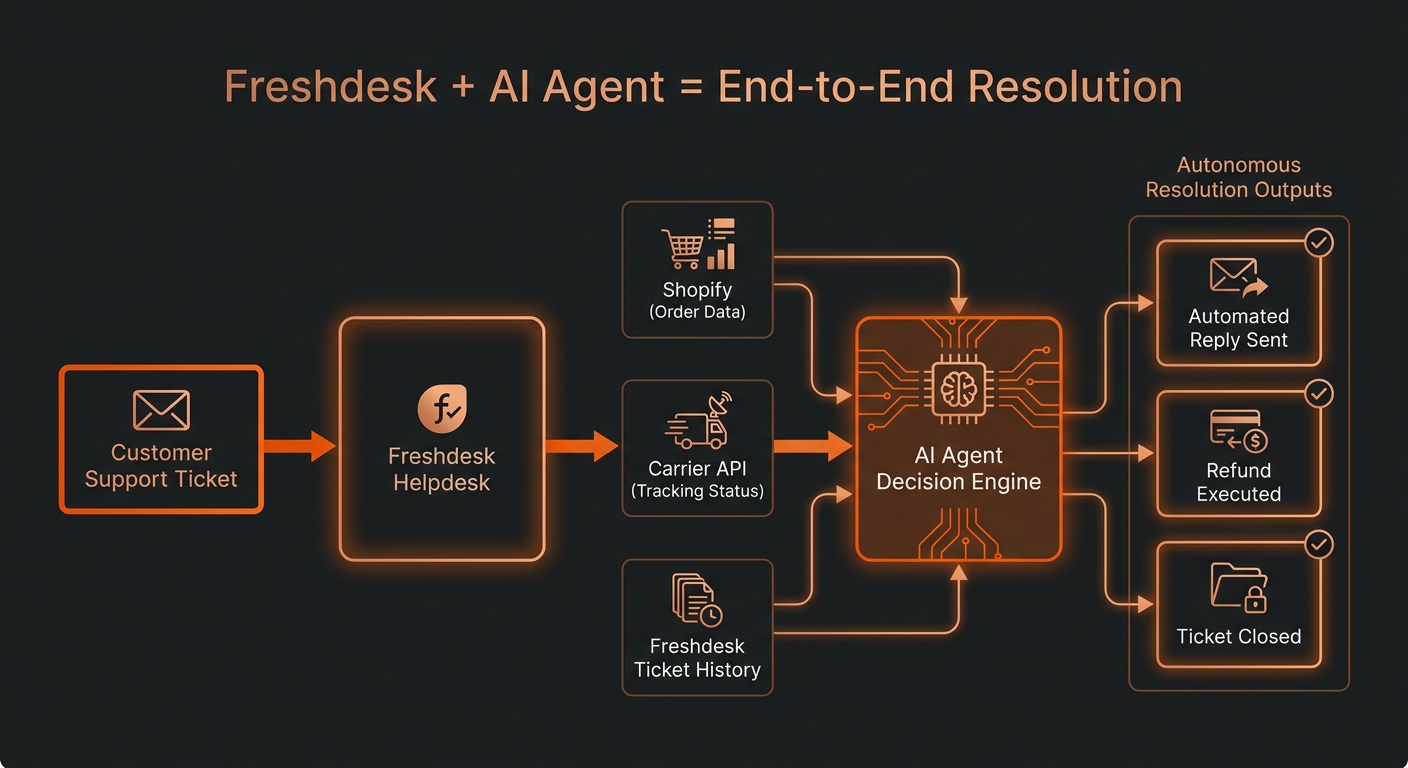
Freshdesk AI Agent: Autonomous Ticket Resolution Without Replacing Your Helpdesk (2026 Guide)
A Freshdesk AI agent is a third-party autonomous resolution layer that connects to Freshdesk via API alongside Shopify, carrier tracking systems, and back-office platforms — resolving support tickets end-to-end without human input. Unlike Freshdesk's native Freddy AI, which drafts replies and deflects FAQ queries, a true AI agent reads live data, executes actions in connected systems, and closes tickets autonomously.
TL;DR: Freshdesk AI Options Compared
| Approach | What it does | System access | Autonomous resolution? | Best for |
|---|---|---|---|---|
| Freddy AI Copilot | Drafts replies, summarizes tickets, adjusts tone | Freshdesk-internal | No — human confirms every action | Teams that need faster agent throughput |
| Freddy Self Service | Deflects FAQ tickets via bot | Knowledge base only | Deflection only, no cross-system action | Reducing inbound on policy / FAQ queries |
| Third-party AI agent (e.g. CorePiper) | Resolves tickets end-to-end across connected systems | Freshdesk + Salesforce/Jira (Enterprise) + Shopify + carrier | Yes, closes tickets without human intervention | Brands targeting 65–85% automation rate |
What Is a Freshdesk AI Agent?
The phrase "Freshdesk AI agent" covers two different things depending on who is using it, and the distinction matters operationally.
The Freshdesk definition: Freshdesk's own Freddy AI platform includes Freddy AI Copilot — which helps support agents work faster by drafting replies, suggesting responses, and summarizing threads — and Freddy Self Service, a bot that deflects incoming queries using your knowledge base. Freshdesk markets both as AI. Neither resolves tickets autonomously in the sense of reading live order data, executing a Shopify refund, and closing the case without a human confirming the action.
The operations definition: An AI agent — in the agentic AI sense — is software that perceives a situation (the ticket), reasons about it against a policy (your SOP), accesses external tools (Shopify API, carrier API, Freshdesk write access), and takes action to completion without waiting for human approval at each step. The outcome is a closed ticket with the customer's issue resolved, not a drafted reply queued for review.
The gap between these two definitions explains why most Freshdesk teams that add Freddy AI still see significant human-handled ticket volume. Freddy makes agents faster inside Freshdesk; it does not replace the need for a human to make the call, confirm the action, and close the case.
A third-party AI agent connects to Freshdesk as an external system — reading incoming tickets via the Freshdesk API, querying connected data sources, executing the resolution action (refund, reply, label generation, escalation), and writing the outcome back to Freshdesk — all without a human in the loop for each ticket.
How Does Freshdesk's Native Freddy AI Compare to Third-Party AI Agents?
Freddy AI is a strong agent-assist tool. For teams where the bottleneck is agent speed — handling more tickets per hour, drafting replies faster, summarizing long threads — Freddy Copilot delivers measurable throughput gains within Freshdesk. That is a legitimate use case that many Freshdesk teams find valuable.
The comparison changes when the question is resolution rate: the percentage of tickets that are fully resolved — customer's issue closed, action executed — without human involvement.
Freddy Self Service handles FAQ deflection: your return policy, your hours, your shipping timeframe. These are knowledge-retrieval questions where the customer needs information, not an action. Deflection rate can be meaningful here, but it addresses a narrower subset of your ticket distribution than most teams expect.
Freddy Copilot addresses the agent's time, not the ticket's resolution path. A human still reviews, decides, and executes every action Freddy suggests. Response time goes down; resolution autonomy stays at zero.
Third-party AI agents address resolution: the AI is the decision-maker and action-taker for defined ticket categories. It reads the ticket, calls the carrier API to get the actual shipment status, applies your refund SOP, executes the Shopify refund, and sends the customer a confirmation — all without a human confirming each step.
This is not a subtle product difference. It is an architectural one. As we explored in detail in what end-to-end resolution really means, the distinction between drafting and resolving determines whether your automation compounds over time or plateaus at agent throughput. Drafting tools raise the ceiling on human productivity. Resolving tools reduce the number of tickets that need humans at all.
The practical implication: if your automation goal is handling 65–85% of ticket volume without human agents, Freddy Copilot is not the path — it addresses agent productivity, not ticket throughput. A third-party AI agent that takes autonomous action is what crosses that threshold.
What Tickets Can a Freshdesk AI Agent Actually Resolve?
The answer depends on which systems the AI agent connects to. An AI agent's resolution capability equals its system access. Freshdesk is the ticket interface; the resolution capability comes from what the agent can read and write in connected platforms.
WISMO (Where Is My Order?) tickets: If the AI agent has a live carrier API connection — FedEx, UPS, USPS, DHL, Aftership, or similar — it can read the real tracking status, map it to the right customer message, send the reply, and close the Freshdesk ticket autonomously. No human involved. WISMO makes up 30–50% of e-commerce support volume for most brands, so resolving it automatically moves the overall automation rate significantly.
Return and refund requests: If the AI agent has Shopify write access, it can evaluate the order against your refund SOP (order value thresholds, return window, item condition rules, exchange-first logic), execute the Shopify refund or generate a return label, and confirm with the customer — all through Freshdesk. For brands handling hundreds of returns per week, this compounds quickly into measurable labor reduction.
Order modifications: Address changes, cancellation requests, and quantity changes within defined policy windows can be executed autonomously if the agent has Shopify API write access and the modification falls within the window before fulfillment. Brands running the automate order changes playbook see this ticket class almost disappear from the human queue.
Cross-system escalations: Tickets that involve both a Freshdesk conversation and a Salesforce account record, a Jira service request, or a third-party claims system can be routed and updated in both places simultaneously — something Freddy AI has no path to do. This matters particularly for brands that run B2B account support in Salesforce alongside DTC in Freshdesk; the AI maintains state across both systems without requiring agents to context-switch.
FAQ and policy questions: Handled by standard knowledge-base retrieval, comparable to Freddy Self Service, but typically covered within the same agent configuration rather than requiring a separate tool deployment.
Tickets that remain human-handled: Fraud investigations requiring judgment calls, VIP account management, complex damage claims under dispute, and policy exceptions requiring managerial approval. A well-configured AI agent recognizes these limits and escalates them to human agents in Freshdesk with full context pre-filled — order history, prior contacts, relevant policy sections — so the human agent picks up with everything they need, not a blank slate.
How Do You Set Up an AI Agent for Freshdesk?
The setup sequence for a third-party AI agent on Freshdesk follows a consistent pattern that requires no changes to Freshdesk itself.
Step 1 — Connect via the Freshdesk API. Third-party agents connect to Freshdesk through its REST API using an API key from your Freshdesk admin settings. This gives the agent read access to incoming tickets and write access to post replies, update ticket status, and close or escalate cases. Freshdesk's API is well-documented and supports this pattern natively.
Step 2 — Connect your resolution data sources. This is where the agent gains the ability to actually resolve rather than draft. For e-commerce, the minimum connections are:
- Shopify API — read order data, execute refunds and cancellations
- Carrier or tracking API — Aftership, EasyPost, or direct carrier APIs for live shipment status
Optional connections for operational depth:
- Salesforce — for B2B account data and case management
- Jira — for internal escalation and cross-team ticket management
- ERP or WMS — if your fulfillment is managed separately from Shopify
Step 3 — Upload your SOPs as decision rules. The AI agent applies your policies — refund thresholds, return window, exchange-first rules, escalation triggers — as structured decision logic. This is what SOP-driven AI agents mean in practice: the resolution path is governed by your actual policies, not the model's general inference about what you probably want. Encoding policies explicitly dramatically reduces edge-case errors compared to purely prompt-based approaches.
Step 4 — Run a supervised pilot. Before going fully autonomous, route a ticket subset through the agent in review mode where human agents can see and approve each resolution before it executes. This surface-tests the decision logic against real ticket distributions and catches edge cases in your SOP configuration. Most teams spend three to five business days in supervised mode before switching to fully autonomous operation.
Step 5 — Go live autonomously. Once the pilot resolution accuracy meets your threshold, the agent runs without per-ticket human approval. Human agents continue handling escalated tickets in Freshdesk exactly as before — but the proportion requiring human handling drops to 15–30% of total volume for a typical e-commerce support mix.
The entire process from API connection to autonomous operation typically takes one to two business days for initial setup and five to ten business days through supervised pilot to full live operation. No changes to Freshdesk configuration, no migration of tickets or data, and no retraining of your support team on a new helpdesk interface.
How Much Does Adding AI to Freshdesk Cost?
Understanding the cost structure requires separating three layers.
Freshdesk platform cost: Freshdesk charges per agent seat per month across Growth, Pro, and Enterprise plans. This is your helpdesk foundation and does not change whether you add native Freddy AI or a third-party agent. Verify current per-seat pricing at freshworks.com — Freshdesk revises pricing periodically.
Freddy AI pricing (native Freshdesk AI): Freddy Self Service bot sessions and Freddy Copilot credits are available as add-ons or included in higher plan tiers. These cost additional fees on top of base seat costs and are scoped to within-Freshdesk capabilities. If your automation goal is faster human agents and FAQ deflection, this is a reasonable cost. If your goal is autonomous resolution across Shopify and carrier data, it does not address the problem.
Third-party AI agent pricing: Per-resolved-case models charge only when a ticket is closed without human involvement. CorePiper's Freshdesk integration is priced on Enterprise, with a custom per-case rate and no per-seat fee; Starter and Pro (Shopify only) price cases at $3 and $2 each beyond the included allowance. At any of these rates, per-case pricing compares favorably against the true cost of human-handled tickets, typically $5 to $15 per ticket once labor, management overhead, repeat contacts, and error rates are factored in. For a more detailed breakdown of the pricing model comparison, AI support pricing models walks through per-seat versus per-resolution versus subscription cost structures at scale.
Build vs. buy: Some teams evaluate building AI resolution logic in-house. Connecting Freshdesk to Shopify and carrier APIs, building a decision engine, and maintaining it against API version changes typically runs $100K or more in Year 1 engineering cost for a scope comparable to a pre-built agent — before accounting for ongoing maintenance. For most mid-market brands, a pre-built agent reaches break-even in weeks, not years.
When Does a Third-Party AI Agent Outperform Native Freshdesk AI?
Native Freddy AI wins when the problem is agent speed within Freshdesk and resolution genuinely requires human judgment on most tickets. If your team handles complex cases where policy exceptions, relationship context, or safety decisions are frequent, Freddy Copilot helps agents work through that volume faster.
A third-party AI agent wins in four distinct scenarios:
Your tickets require data from outside Freshdesk to resolve. A WISMO ticket requires carrier API data. A return requires Shopify order state. A B2B account escalation requires Salesforce account history. If the resolution depends on information that is not in Freshdesk, Freddy cannot close the ticket autonomously — the data simply is not there.
Your automation rate target exceeds 40–50%. Freddy Self Service deflects FAQ questions — typically 20–30% of volume for e-commerce brands. A third-party AI agent that resolves WISMO, returns, and order modifications autonomously pushes the automation rate to 65–85% of total ticket volume. That is the tier where support economics change materially: teams handling 3,000 tickets per month at 80% automation rate assign roughly 600 tickets to humans instead of 3,000.
You run multiple platforms simultaneously. Brands that use Freshdesk for DTC consumer support alongside Salesforce for enterprise accounts, or Freshdesk plus Jira for engineering escalations, need an AI layer that maintains context across both. Freddy is native to Freshdesk; it has no path into Salesforce or Jira. A third-party agent connects to the full stack and can update records in all connected systems as part of a single resolution flow. We covered the architectural case for this in cross-platform support automation.
You want cost aligned to resolution outcomes. Per-seat AI tools and per-session bot pricing charge regardless of how many tickets get fully resolved. A per-resolved-case model aligns cost to actual business value — you pay when a customer's issue closes without human involvement, not when an AI drafted a reply the agent then had to revise.
The Bottom Line
Freshdesk is a strong helpdesk. Freddy AI makes the humans working inside it faster and makes FAQ deflection configurable without engineering. But the 2026 standard for AI in customer support has moved from "faster human agent" to "autonomous resolution" — and crossing that line requires a third-party AI agent with connections to Shopify, carrier systems, and any other platforms where resolution actually happens.
The practical advantage: you do not have to replace Freshdesk to get there. A well-integrated AI agent connects through the Freshdesk API, resolves tickets in the background, writes outcomes back to Freshdesk, and leaves your human agents handling only the cases that require them. Your Freshdesk interface, SLA rules, reporting, and ticket history remain unchanged.
What changes is the proportion of tickets your team touches — and the cost structure that follows from it.
Add Autonomous Resolution to Freshdesk — Without Replacing It
CorePiper connects to Freshdesk, Salesforce, and Jira on Enterprise, alongside Shopify and carrier APIs on every plan, so AI agents resolve tickets end-to-end using your existing SOPs. No rip-and-replace required. Book a 30-minute walkthrough.