
The Best Gorgias Alternatives for Brands That Want Real Automation
Looking for a Gorgias alternative that goes beyond helpdesk deflection? Six tools compared on automation depth, cross-platform reach, pricing, and which fits your stack.
 Mustafa BayramogluJuly 12, 202614 min read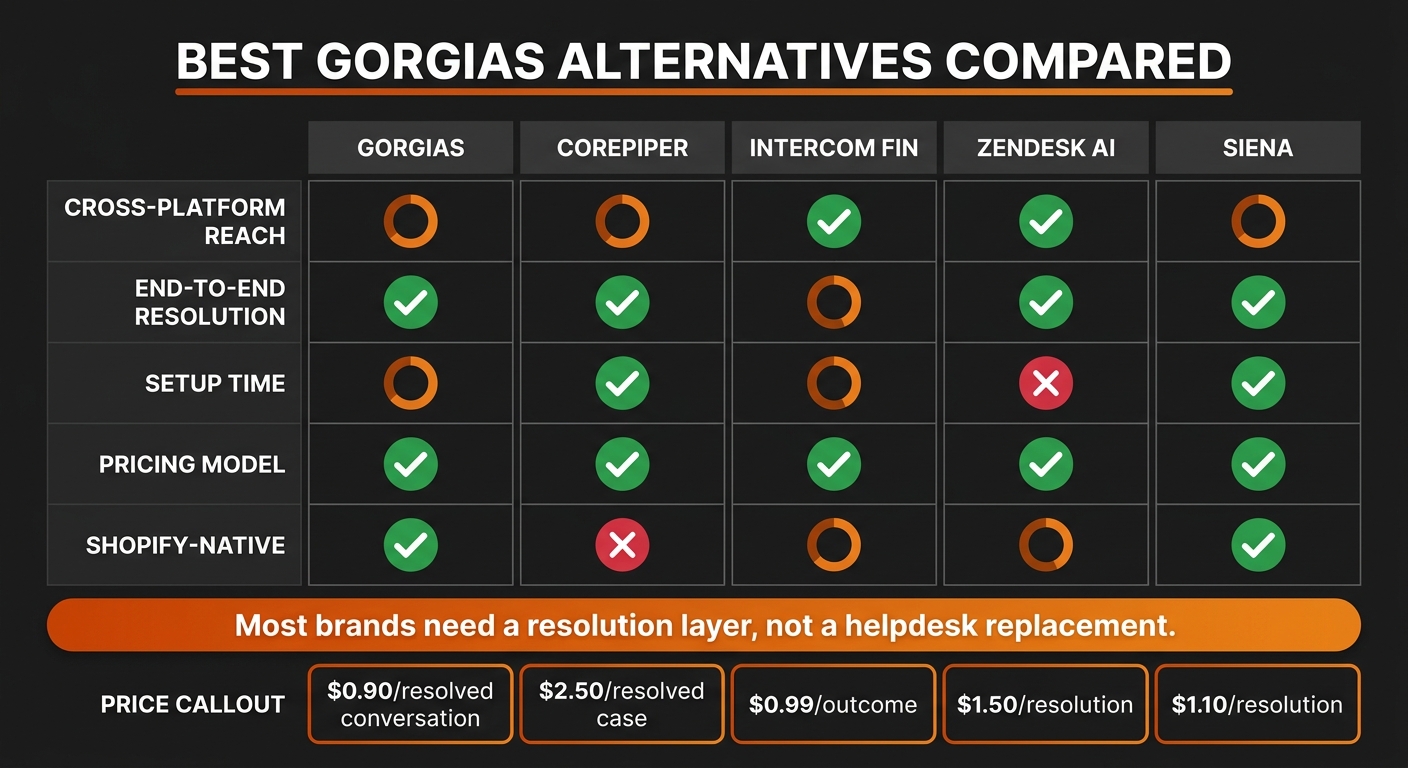
The Best Gorgias Alternatives for Brands That Want Real Automation
The best Gorgias alternative depends on what's limiting you: CorePiper if you need cross-platform case resolution spanning Shopify, carrier APIs, and back-office systems; Intercom Fin if you want per-outcome pricing in a messaging-first platform; Zendesk or Freshdesk if you need a full enterprise helpdesk migration and Gorgias's DTC focus has become the constraint.
TL;DR: Gorgias Alternatives Compared
| Tool | Best for | Pricing model | Shopify-native | Cross-platform | Setup time |
|---|---|---|---|---|---|
| CorePiper | Cross-platform SOP-driven automation | $2 to $3/case (Starter/Pro); Enterprise custom | Via API | Gorgias + Zendesk + Salesforce + Jira (Enterprise) | 1–2 days |
| Intercom Fin | Messaging-first per-outcome resolution | $0.99/outcome | No | Intercom only | Days–weeks |
| Zendesk AI | Enterprise helpdesk with built-in AI | $1.50/automated resolution | Integration | Zendesk + Salesforce | Weeks |
| Siena AI | DTC brand voice across channels | ~$750/mo + ~$0.90/conversation | Via connector | Gorgias, Zendesk, email, SMS | 1–2 weeks |
| Richpanel | Shopify self-service portal | Per-seat + add-ons | Yes | Shopify-centric | Days |
| Yuma AI | Shopify-only ticket automation | Per-automated-reply | Yes | Shopify-only | Hours |
Why Are Brands Looking for Gorgias Alternatives?
Gorgias earned its position as the most popular helpdesk for Shopify brands. Deep native Shopify data access, a purpose-built e-commerce interface, and a product built for DTC workflows made it the obvious choice through the last several years of DTC growth.
The alternatives conversation is accelerating for three distinct reasons.
The automation ceiling. Gorgias's AI Automate add-on resolves routine tickets inside the Gorgias environment — but it cannot reach outside it. A WISMO ticket that requires a live carrier API call, a refund request tied to a Salesforce account, or a damage claim that requires filing directly with FedEx: none of these can be resolved inside Gorgias AI Automate because the tool has no path to those external systems. Brands that want genuine end-to-end resolution — not faster deflection — eventually need something that spans more than one platform. As we covered in detail in what end-to-end AI resolution actually means, the difference is architectural: tools confined to a single helpdesk escalate cross-system tickets to humans not because the issue is complex but because their reach stops at the helpdesk boundary.
Multi-system and multi-helpdesk operations. A growing segment of brands runs Gorgias for their DTC consumer operation alongside Zendesk or Salesforce Service Cloud for B2B accounts or enterprise customers. Gorgias AI Automate doesn't extend to either, leaving two separate support stacks with no shared automation layer.
Pricing model at scale. Gorgias's base platform fee scales with usage at higher tiers, and AI Automate is an additional per-resolution cost layered on top. As ticket volumes push past 10,000 per month, some teams find the combined platform-plus-Automate cost exceeds what they'd pay for a dedicated cross-platform AI layer priced per resolved case rather than per ticket.
What Makes a Strong Gorgias Alternative?
Before reaching for a replacement, it helps to identify whether you're solving an automation problem or a helpdesk problem. These lead to entirely different evaluations.
If you want better automation inside or alongside Gorgias: The right question is what system access the alternative actually has — not just what data it can read, but what actions it can take in connected systems. Resolve means the customer's issue is closed, the action was executed, and no human intervened. Deflection at higher velocity is not resolution.
If you want to migrate off Gorgias entirely: The right questions are helpdesk feature parity (ticket management, SLA rules, Shopify integration quality), migration cost, and whether the destination platform's AI layer covers your ticket mix. Switching helpdesks is an operational commitment; migration costs and agent retraining are real and often underestimated.
Key criteria across both paths:
- Resolution rate (not deflection rate) at your actual ticket distribution
- System access: which external APIs does the tool connect to and what can it write
- Cross-platform coverage: if you run Zendesk or Salesforce alongside Gorgias, does the alternative span those systems
- Pricing alignment: does cost scale with resolved value or ticket volume
- Implementation time and migration risk
The single most common mistake in this evaluation is measuring the wrong metric. Deflection rate goes up when customers give up. Resolution rate only goes up when issues are actually solved. These are different things that happen to affect ticket count in the same direction. See our breakdown of AI chatbot resolution rate failures for a closer look at why this distinction matters in practice.
The 6 Best Gorgias Alternatives in 2026
1. CorePiper — Best for Cross-Platform Automation
What it is: SOP-driven AI agent platform that connects to Shopify on Starter and Pro, and Zendesk, Freshdesk, Salesforce, and Jira on Enterprise, and resolves tickets end-to-end using structured Standard Operating Procedures.
Why it's a strong Gorgias alternative: CorePiper doesn't replace Gorgias, it extends it. Your support team keeps Gorgias as the helpdesk; CorePiper adds a resolution layer that handles the tickets Gorgias AI Automate can't: WISMO requests with live carrier tracking data, refunds that require Shopify Admin API write access, damage claims that need carrier portal filing, and (on Enterprise) B2B operations that pull from Salesforce accounts.
For brands that want to stay on Gorgias but push automation coverage above what Automate can deliver, particularly on tickets that cross system boundaries, this is the most direct path. For brands already considering Zendesk or Freshdesk, CorePiper's Enterprise plan spans all three, which means no new tool when the helpdesk changes.
The SOP-driven model also solves the institutional knowledge problem most automation tools ignore: instead of training on historical ticket patterns (which reflect past procedures, not current ones), CorePiper executes the procedure your team actually uses today. When the return window changes, you update the SOP — the agent's behavior updates immediately.
Pricing: Starter ($10/month, 5 cases included, $3/case after) and Pro ($99/month billed annually, 75 cases included, $2/case after) cover Shopify. Cross-platform resolution across Zendesk, Freshdesk, Salesforce, or Jira is priced on Enterprise, which is custom.
What you give up: CorePiper is a resolution layer, not a helpdesk interface. If the primary need is a richer agent workspace — better macros, ticket merge tools, a redesigned UI — CorePiper doesn't address those.
Best for: DTC brands on Gorgias or Zendesk that need to automate complex, multi-system ticket types. Brands running Gorgias for DTC alongside Zendesk or Salesforce for enterprise. Operations teams whose cases span Shopify, carrier portals, and back-office systems.
See the full CorePiper vs. Gorgias breakdown →
2. Intercom Fin — Best for Messaging-First Resolution
What it is: AI agent built natively into the Intercom customer messaging platform. Resolves customer questions within Intercom's chat, email, and support workflows at $0.99 per outcome. Intercom reports Fin resolves 67% of conversations across 40M+ interactions.
Why it's a Gorgias alternative: Fin works for brands willing to move their customer-facing support channel to Intercom's platform. The per-outcome pricing is the lowest headline cost in the AI agent category, and Intercom's knowledge-base integration and AI retrieval are mature. For brands that run a chat-first customer support model and are open to migrating their support messaging, Fin is compelling on both cost and capability.
What you give up: Intercom is not Shopify-native. You can integrate it via API, but the depth of Shopify data access native to Gorgias — order history in the ticket sidebar, one-click refunds from the agent view — requires custom build in Intercom. Fin also operates within the Intercom environment; it does not span Salesforce, Jira, or carrier APIs without additional engineering work.
Pricing: $0.99 per outcome. Requires Intercom's base platform subscription (priced separately by seat or usage tier).
Best for: Brands willing to migrate to Intercom's messaging product and for whom chat-channel resolution at low per-outcome cost is the primary goal. Not suited for Shopify-native operations or cross-system case workflows.
3. Zendesk AI — Best for Enterprise Teams Ready to Migrate
What it is: AI automation built into Zendesk's enterprise helpdesk platform, including intelligent triage, automated resolution agents, and Copilot features for human agents. Priced at $1.50 per automated resolution (committed) or $2.00 (pay-as-you-go). For a detailed breakdown of how Zendesk AI pricing actually works, see our Zendesk AI agent pricing analysis.
Why it's a Gorgias alternative: Zendesk is the most common migration destination for Gorgias brands that have outgrown DTC-first design and need enterprise ticket management, SLA workflows, and native integrations with Salesforce and Jira. Zendesk AI inherits that infrastructure — automated resolution agents can act on tickets within the Zendesk environment with access to connected systems.
For brands that need audit trails, multi-tier SLA management, and compliance-grade reporting — functions Gorgias was not designed for — Zendesk is the natural upgrade path.
What you give up: Migrating from Gorgias to Zendesk is a significant operation. Ticket history migration, agent retraining, Shopify re-integration. Zendesk's Shopify connector is functional but not as deeply native as Gorgias's sidebar integration. The AI automation layer is still maturing for DTC-specific workflows.
Pricing: $1.50–$2.00 per automated resolution. Zendesk platform seats priced separately by tier.
Best for: Brands at 10,000+ monthly tickets that need enterprise-grade helpdesk management, SLA enforcement, compliance-level audit logs, or native Salesforce/Jira integration — and are ready for the migration investment.
4. Siena AI — Best for DTC Brand Voice Across Channels
What it is: Standalone AI agent built for DTC brands that want empathetic, brand-voice AI across email, chat, SMS, and social — operating on top of Gorgias, Zendesk, or both. Siena works alongside your existing helpdesk rather than replacing it.
Why it's a Gorgias alternative: For brands that want consistent AI brand voice across every customer-facing channel — not just inside the helpdesk ticket inbox — Siena's multi-channel design is a genuine differentiator versus Gorgias AI Automate, which is confined to the Gorgias environment. Siena can also span multiple helpdesks, which Automate cannot.
Siena has publicly argued against pure outcome-based pricing, noting that "resolution" is inconsistently defined across vendors and that outcome-only models create definitional disputes. Their pricing (~$750/month platform fee plus ~$0.90 per conversation) reflects that philosophy.
For a side-by-side view of how Siena, Gorgias AI, and CorePiper compare on specific ticket types and pricing, see our three-way comparison.
What you give up: Siena focuses on DTC consumer channels and does not extend into enterprise back-office integrations like Salesforce or Jira. It is not designed for cross-system case operations or B2B support workflows.
Pricing: Approximately $750/month platform fee plus approximately $0.90 per conversation handled by the AI.
Best for: DTC brands that want consistent brand-voice AI across email, chat, SMS, and social alongside their helpdesk; brands running both Gorgias and Zendesk that want one AI layer across both.
5. Richpanel — Best for Self-Service Portal Volume Reduction
What it is: Shopify-native customer service platform with a customer-facing self-service portal, agent helpdesk, and AI automation layer. Designed as a Gorgias alternative or complement for Shopify brands.
Why it's a Gorgias alternative: Richpanel's self-service portal is its distinctive feature — customers can look up order status, initiate returns, and manage exchanges before ever submitting a support ticket. For brands where a significant share of inbound contacts are information requests customers could self-serve (order tracking, return windows, policy questions), the portal can reduce ticket volume at the source.
What you give up: Richpanel's AI resolution depth outside the portal is less developed than CorePiper or Intercom Fin. It does not span non-Shopify systems. Migrating from Gorgias is a full helpdesk switch, not an automation layer added to your existing stack.
Best for: Shopify brands that want to reduce ticket volume through self-service as a primary lever, alongside a helpdesk migration from Gorgias. Less suited for brands with complex multi-system workflows.
6. Yuma AI — Best for Shopify-Only Full Automation
What it is: AI agent built specifically for Shopify brands to automate order-related support tickets — WISMO, refunds, cancellations, exchanges — using Shopify data as the primary source, priced per automated reply.
Why it's a Gorgias alternative: Yuma AI's Shopify specialization gives it deep automation coverage for Shopify-native ticket types. It can write to Shopify — issue refunds, process cancellations — without significant configuration overhead.
What you give up: Yuma AI is a Shopify-only tool. If your support operations extend to carrier APIs, B2B accounts in Salesforce, or internal escalation workflows in Jira, Yuma has no path to those systems. It also does not span multiple helpdesks; it is an extension of a single-platform stack.
Best for: Pure-play DTC Shopify brands with a clean single-platform stack that want maximum automation depth on Shopify-native ticket types without a full helpdesk migration.
How Do These Tools Handle the Hardest Ticket Types?
The real test of any automation platform is not how it handles simple WISMO requests — it is what happens when a ticket requires more than one system to close.
| Ticket type | What resolution requires | CorePiper | Gorgias AI Automate | Intercom Fin | Zendesk AI |
|---|---|---|---|---|---|
| WISMO with live carrier data | Carrier API + Shopify order lookup | Yes | No (Gorgias data only) | No (no carrier API) | No without custom build |
| Refund with Shopify write access | Shopify Admin API write | Yes | Yes (within Gorgias) | No | No without connector |
| Carrier damage claim filing | Carrier portal API | Yes | No | No | No |
| Cross-helpdesk ticket (Gorgias + Zendesk) | Context across both systems | Yes (Enterprise) | No | No | No |
| B2B Salesforce account lookup | Salesforce API | Yes (Enterprise) | No | No | Via native connector |
The pattern is consistent: tools built inside a single helpdesk resolve well within that helpdesk's reach and fail at the system boundary. Brands discover this gap most acutely when they run an audit and find that the AI handles WISMO and simple refunds well but escalates every carrier exception, every cross-platform lookup, and every ticket that requires a Salesforce account check. Those escalations represent both the highest human labor cost and the highest customer frustration per ticket.
Which Gorgias Alternative Is Right for Your Store?
Stay on Gorgias, need deeper automation: CorePiper as a resolution layer. Keep your helpdesk, extend automation to tickets that require Shopify API writes on Starter or Pro, or Salesforce or Jira on Enterprise.
Full helpdesk migration, enterprise requirements: Zendesk. SLA management, compliance-grade audit logs, and native Salesforce and Jira integrations are its differentiation. Migration is significant but the enterprise infrastructure is real.
Full helpdesk migration, budget-constrained: Freshdesk. Per-agent pricing is lower than Zendesk at most tiers; Freddy AI provides a built-in automation layer. Shopify integration is functional, not native-deep. Suitable for brands that do not need Zendesk's enterprise compliance footprint.
Multi-channel DTC brand voice, current helpdesk is fine: Siena AI. Runs alongside Gorgias or Zendesk; adds consistent AI handling across email, SMS, and social.
Pure Shopify stack, single-helpdesk operation: Gorgias AI Automate is the path of least resistance if it covers your ticket types. Yuma AI if you want a standalone Shopify automation tool outside Gorgias.
Chat-first strategy, willing to migrate to Intercom: Intercom Fin at $0.99 per outcome is compelling if your channel strategy is messaging-first and you are open to moving support into Intercom's platform.
For most Gorgias brands, the most important first question is not "which product do we switch to?" but "what can our current stack not resolve, and what is the most targeted fix?" For tickets that require crossing system boundaries — carrier APIs, Salesforce, multi-helpdesk coverage — a resolution layer on top of an existing stack is operationally lower-risk than a full helpdesk migration. For brands whose primary constraint is helpdesk design and feature depth rather than automation coverage, a migration makes more sense.
See also: our comparison of AI support pricing models for a structured breakdown of per-resolution, per-seat, and per-conversation pricing and when each one works in your favor.
Mustafa Bayramoglu is the founder of CorePiper (YC W19). CorePiper builds SOP-driven AI agents for cross-platform case operations across Shopify, Zendesk, Gorgias, Freshdesk, Salesforce, and Jira.