
What Is Human-in-the-Loop AI? Definition, When It Applies, and 2026 Benchmarks
Human-in-the-loop AI (HITL AI) routes decisions to a human reviewer at defined confidence or policy thresholds. Here's the 2026 definition, the four HITL patterns, intervention-rate benchmarks, and when to use HITL vs. fully autonomous AI.
 Mustafa BayramogluAugust 15, 202612 min read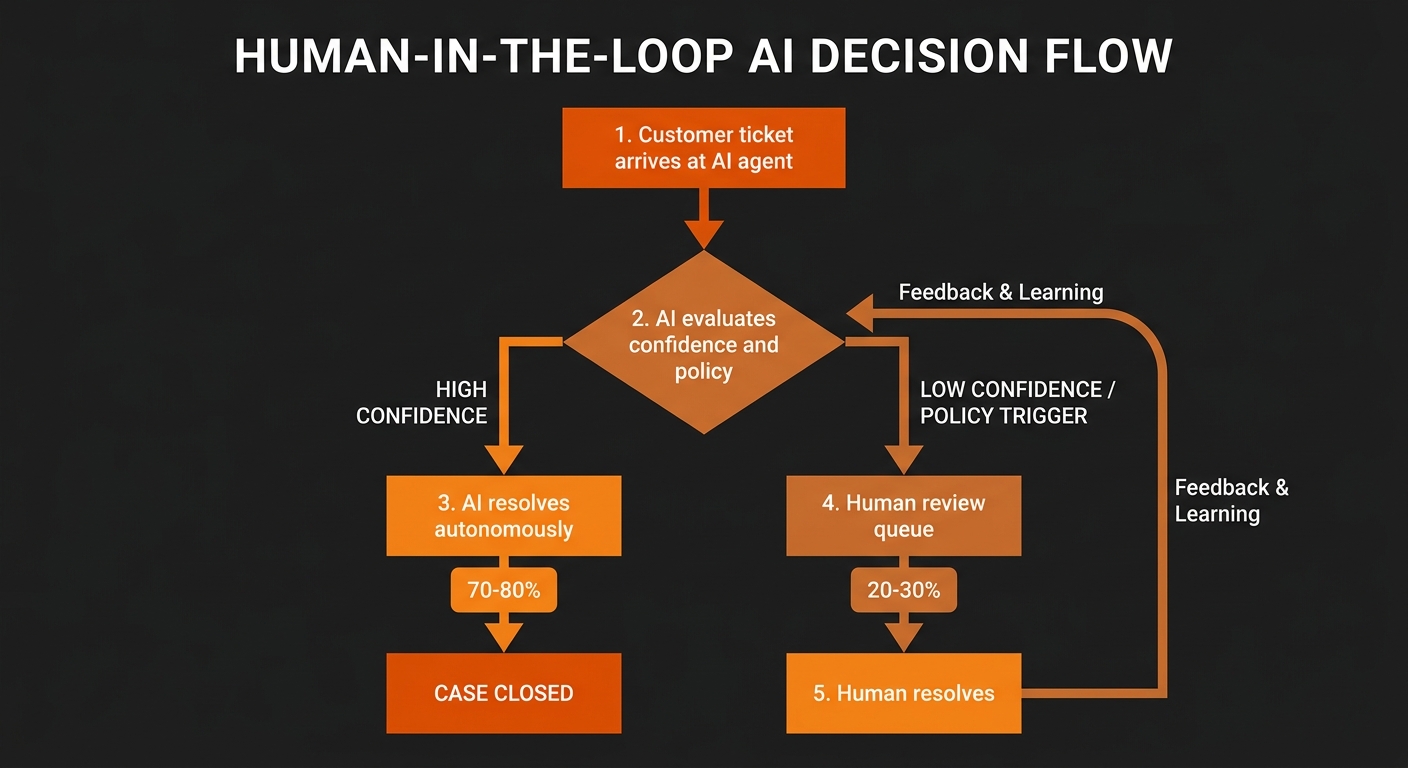
What Is Human-in-the-Loop AI?
Human-in-the-loop AI (HITL AI) is an architecture where a human reviews, approves, or corrects AI decisions at defined checkpoints before — or immediately after — the AI acts. In customer support deployments, HITL typically triggers on low-confidence predictions, high-stakes actions (large refunds, contract changes), or queries outside the AI agent's authorized scope.
TL;DR: Human-in-the-Loop AI at a Glance
| Term | What it means | Typical trigger | When to use |
|---|---|---|---|
| Human-in-the-loop (HITL) | AI waits for human approval before acting | Low confidence, policy limit, irreversible action | High-stakes or out-of-scope decisions |
| Human-on-the-loop (HOTL) | AI acts; human can override within a window | All autonomous actions | Routine, reversible, high-confidence queries |
| Human-out-of-the-loop | Fully autonomous; no human review | N/A (AI handles everything) | Narrow, well-defined, low-risk workflows only |
| Escalation rate | Conversations that require any human handoff | Any HITL trigger | Inverse of AI containment rate |
| Intervention rate | Subset of escalations requiring human action vs. AI restart | Post-audit | Quality signal for HITL threshold calibration |
The goal is not to minimize human involvement — it is to route the right decisions to the right decision-maker: humans for judgment-intensive or high-stakes cases, AI for the structured 70–80% majority.
Why Does Human-in-the-Loop AI Matter in Customer Support?
Fully autonomous AI sounds appealing, but every support operation has decisions where the cost of an AI error exceeds the cost of a one-minute human review. A $15 WISMO resolution answered incorrectly is a minor inconvenience. A $2,000 freight claim approved on a fraudulent BOL is a recoverable error only if a human catches it before payout.
HITL AI exists to keep the AI operating in the space where it genuinely outperforms humans — speed, consistency, availability, data access — while giving humans a defined role in decisions where judgment, relationship context, or policy authority matters.
In practice, this produces a division that aligns with the economics: AI handles the high-volume, high-confidence, low-stakes queries autonomously. Humans handle the low-volume, low-confidence, or high-stakes exceptions. The AI resolution rate for the autonomous tier should be 75–90% on those query types. The human tier resolves the remaining cases at 95%+ because they are receiving routed, context-enriched escalations — not cold tickets from a disorganized queue.
The alternative — fully autonomous AI on all ticket types — collapses when the AI encounters an edge case it handles incorrectly. Without a human gate, the error ships. With HOTL or HITL, the error is caught before or shortly after it ships, and the AI learns from the correction.
What Are the Four Patterns of Human-in-the-Loop AI?
HITL is not a single design. Four distinct patterns appear in production support deployments:
1. Pre-action approval (synchronous HITL) The AI drafts the action — a refund, a case update, a carrier dispute submission — and waits for human approval before executing. The customer waits, but the action is guaranteed correct. Used for irreversible or high-value actions: account deletions, refunds above a threshold, dispute escalations to external parties.
2. Post-action review (asynchronous HOTL) The AI executes the action immediately and places it in a review queue. A human reviews within a defined window (commonly 15–60 minutes). If the review finds an error, the action is reversed. Used for fast-moving, reversible actions where latency matters more than perfect accuracy before execution.
3. Confidence-threshold routing The AI scores every conversation with a confidence estimate. Queries above the threshold (say, 85%) proceed autonomously. Queries below route to a human queue with the AI's draft response pre-populated for one-click approval. This is the most common pattern in e-commerce and logistics support.
4. Policy-boundary escalation The AI is explicitly prohibited from acting on certain query types (legal threats, chargebacks above $X, multi-party disputes). These escalate immediately regardless of the AI's confidence score. The policy list is maintained separately from the confidence model and updated by the operations team as edge cases emerge.
Most production deployments combine patterns 3 and 4 as the primary architecture, with pattern 1 reserved for a narrow set of high-stakes actions and pattern 2 for the audit layer.
What Is the Difference Between Human-in-the-Loop and Human-on-the-Loop?
The distinction is about when in the decision cycle the human is required:
- HITL: The human is a synchronous gate. The AI cannot act on the flagged decision until a human approves. Latency increases, but error rate before action is minimized.
- HOTL: The human is an asynchronous monitor. The AI acts immediately; the human can override within a window. Speed is preserved; errors can reach the customer before correction.
The right choice depends on reversibility and stakes:
| Action type | Reversibility | Recommended pattern |
|---|---|---|
| WISMO ticket close | High | HOTL or fully autonomous |
| Standard refund (<$50) | High | HOTL with batch audit |
| Large refund ($200+) | Low | HITL (pre-action approval) |
| Carrier dispute submission | Low | HITL |
| Account closure | Very low | HITL + dual-approval |
| Shipping label reissue | High | Fully autonomous |
| Contract modification | Very low | Human only |
Neither pattern is universally better. The goal is matching the oversight level to the decision stakes — not imposing maximum control everywhere (which defeats the economics of AI) or minimum control everywhere (which eliminates quality assurance).
How Does HITL AI Affect Containment and Resolution Rates?
Human-in-the-loop AI introduces a deliberate ceiling on the AI containment rate. Every query that routes to a human for approval or review is, by definition, not contained. This is not a failure — it is the design.
The relationship between HITL thresholds and containment rate is direct: a higher confidence threshold (say, 90%) routes more queries to humans, lowering containment rate but raising the resolution quality of autonomously handled queries. A lower threshold (say, 75%) allows the AI to handle more queries but increases the false-resolution rate — conversations the AI "contained" without genuinely solving.
The practical calibration target is:
Maximize containment rate subject to the constraint that AI resolution rate stays above 70% on autonomously handled queries.
If resolution rate falls below 70% as you raise the containment rate ceiling, the confidence threshold is set too low. Walk it back until resolution rate stabilizes, then expand the AI's scope incrementally.
The AI deflection rate is upstream of both: contacts that deflect via self-service or proactive notification never reach the AI, so they do not affect containment or HITL calculation. Track all three metrics together to understand the full funnel from contact volume to human effort.
When Should Your AI Agent Escalate to a Human?
Five conditions should trigger escalation in a well-configured HITL deployment:
1. Confidence below threshold The AI's confidence score on the recommended action falls below the operational threshold. The query routes to the human queue with the AI's best-guess draft pre-populated.
2. Policy boundary The query type or requested action is explicitly outside the AI's authorized scope (large refunds, legal threats, chargebacks, regulatory inquiries). These escalate immediately regardless of confidence.
3. Sentiment or intent signals The AI detects explicit frustration markers, legal language ("I'll sue," "attorney," "BBB"), or distress signals. Routing angry or distressed customers to a human immediately — not after one more AI turn — prevents escalation damage.
4. Data unavailability A required connected system (carrier API, TMS, ERP) returns an error or unavailable status. The AI cannot resolve a shipment exception without tracking data; routing to a human ensures the customer is not stuck in a data-gap loop.
5. Repeat contact on the same issue If a customer has contacted support for the same issue more than once and the AI previously handled it, the next contact escalates automatically. Repeat contact is the strongest signal that the prior resolution failed; re-routing to the AI on the third contact repeats the failure.
What Are the Benchmarks for HITL Intervention Rates?
Based on observed patterns across e-commerce and logistics support deployments:
| Deployment maturity | Query type | Typical intervention rate | Notes |
|---|---|---|---|
| First 30 days (new deployment) | Mixed | 40–50% | High while thresholds are being calibrated |
| 90-day steady state | Mixed | 20–30% | Normal operating range |
| Optimized deployment | Mixed | 15–20% | Achievable with good SOP documentation and system integrations |
| Optimized deployment | WISMO only | 8–15% | Lowest rates on highest-volume, most structured query type |
| Optimized deployment | Freight claims | 25–40% | Higher intervention rate reflects claims complexity and policy limits |
| Optimized deployment | Chargebacks | 60–80% | Policy or legal mandate; most escalate by design |
A 90-day intervention rate above 35% on a mixed queue suggests one of three problems: confidence thresholds are set too conservatively, SOPs are underdocumented, or system integrations are missing required data. A rate below 10% on a mixed queue — with no uptick in repeat contacts or CSAT decline — suggests the thresholds may actually be well-calibrated; but audit a sample to confirm the AI is genuinely resolving, not just containing.
Human-in-the-Loop AI vs. Fully Autonomous AI: Which Should You Deploy?
The decision is not binary. The practical answer is: deploy fully autonomous AI for structured, high-confidence, reversible queries; deploy HITL AI for low-confidence, high-stakes, or irreversible actions; and maintain a human tier for the residual judgment-intensive minority.
The correct architecture for most e-commerce and logistics operations in 2026 is a tiered system:
- Tier 1 (fully autonomous): WISMO, standard returns within policy, address changes within fulfillment window, FAQ resolution. 60–75% of total volume. AI handles end-to-end.
- Tier 2 (HOTL or HITL): Large refunds, damaged-goods claims, carrier disputes, out-of-policy edge cases. 15–25% of volume. AI drafts; human approves or reviews.
- Tier 3 (human-only): Legal disputes, VIP customer escalations, regulatory inquiries, complex multi-party claims. 5–15% of volume. Human owns from intake to close.
This three-tier design is the architecture SOP-driven AI agents operationalize. The SOP specifies not just what the AI does but where the HITL gates live — which query types require pre-action approval, which confidence scores trigger routing, and which escalation paths go to which human skills.
Critically, fully autonomous AI across all tiers is not a target state. The 5–15% of genuinely complex queries will always require human judgment. The goal is to remove humans from Tier-1 queries entirely — where they are slower and more expensive than AI — and preserve them for the Tier-3 decisions where their judgment is irreplaceable.
How to Implement Human-in-the-Loop AI for Customer Support
Five steps to a working HITL deployment:
Step 1: Classify your ticket types by stakes and confidence Audit 500–1,000 recent tickets. For each type, estimate: (a) what happens if the AI gets it wrong, and (b) how often the AI is likely to get it right at deployment. High-stakes + uncertain = HITL. Low-stakes + confident = autonomous.
Step 2: Document SOPs with explicit HITL gates Each SOP should specify the confidence threshold, the policy boundaries, and the escalation path. "Refund > $150 → pre-action approval from billing queue" is a HITL gate. "Refund ≤ $50 → execute autonomously" is the autonomous counterpart.
Step 3: Connect the systems the AI needs to act Most HITL escalations happen because the AI lacks the data to be confident. If your AI cannot read live carrier tracking, it will route every shipment question to humans regardless of confidence scoring. Cross-platform integrations — Shopify, Salesforce, Zendesk, Jira, carrier APIs — are a prerequisite for achieving the autonomous tier, not an optional add-on.
Step 4: Pilot with conservative thresholds, then calibrate Start with a high confidence threshold (90%) and a narrow autonomous scope. Measure intervention rate, resolution rate, and repeat-contact rate for 30 days. If resolution quality holds at the autonomously handled tier, lower the threshold by 5 points and expand scope to one new query type. Repeat until the intervention rate stabilizes in the 15–25% range.
Step 5: Feed corrections back to the AI Every human override is a labeled data point. The human approved a refund the AI flagged for rejection, or rejected a resolution the AI was confident about. Build a feedback loop from the review queue back to the AI's confidence model. Over 60–90 days, intervention rates typically fall 30–40% from day-1 levels as the model learns from human corrections.
Human-in-the-loop AI is not a compromise position between full automation and full human staffing — it is the design that makes AI automation sustainable at scale. The goal is an operation where the AI handles the structured majority autonomously, humans add judgment where it matters, and the boundary between the two is actively managed through confidence scoring, SOP documentation, and feedback loops.
Book a demo to see how CorePiper's SOP-driven AI agents implement configurable HITL gates across Shopify, Salesforce, Zendesk, and Jira — and how the three-tier architecture performs against a live ticket queue.