
What Is RAG for Customer Support? (Retrieval-Augmented Generation, Explained)
RAG (Retrieval-Augmented Generation) grounds AI responses in your actual knowledge base instead of relying on training data alone. Here's the 2026 definition, how it works in customer support, benchmarks, and when RAG is and isn't enough.
 Mustafa BayramogluAugust 16, 202613 min read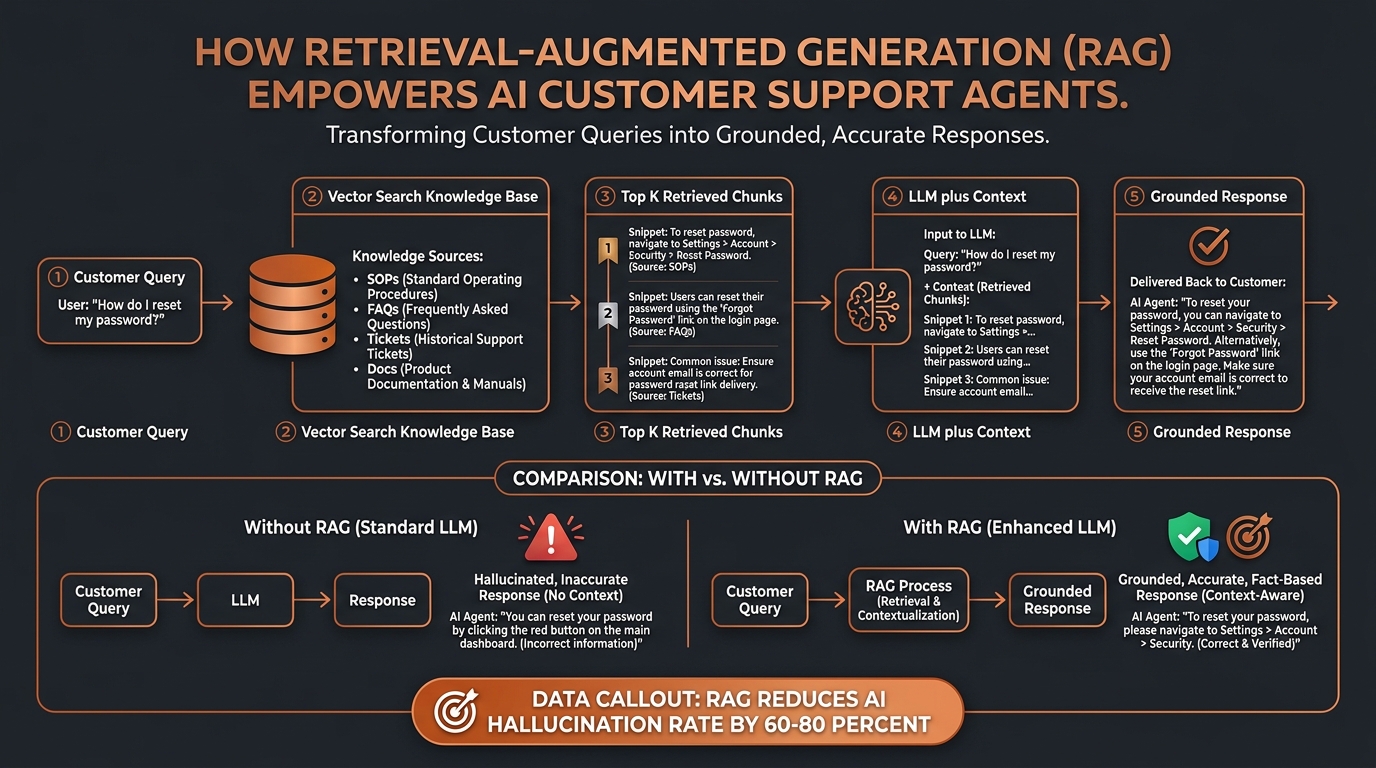
What Is RAG for Customer Support?
Retrieval-Augmented Generation (RAG) is an AI architecture that grounds model responses in retrieved documents — your SOPs, FAQs, product policies, and case history — rather than generating answers from training data alone. In customer support, RAG-enabled agents look up the relevant policy or procedure before responding, dramatically reducing hallucination and keeping answers accurate to current operations.
TL;DR: RAG for Customer Support at a Glance
| Concept | What it means | Why it matters |
|---|---|---|
| RAG (Retrieval-Augmented Generation) | AI retrieves relevant docs before generating a response | Answers are grounded in your actual policies, not generic training data |
| Vector search | Converts queries and documents to numeric embeddings; finds semantically similar chunks | Retrieves the right policy even when the customer doesn't use exact keywords |
| Knowledge base | Indexed collection of SOPs, FAQs, product docs, past tickets | The source of truth the AI retrieves from |
| Grounded response | Answer built from retrieved context, not model memory | Reduces hallucination; citations point back to the source document |
| RAG vs fine-tuning | RAG retrieves at inference time; fine-tuning bakes knowledge into model weights | RAG updates instantly when policies change; fine-tuning requires retraining |
| RAG vs full agent | RAG handles "knowing"; system integrations handle "doing" | Full resolution requires both: grounded knowledge plus write access to connected systems |
Why Does RAG Matter for Customer Support AI?
Standard large language models (LLMs) answer from their training data — which closes at a fixed date, reflects the public internet, and contains nothing specific to your company's policies, your pricing, or your carrier contracts. Ask an un-grounded AI agent about your refund window and it may give a confident, wrong answer based on what a competitor's policy looked like two years ago.
RAG fixes the root cause. Before generating a response, the agent:
- Converts the customer's query into a vector embedding
- Searches the indexed knowledge base for the most semantically similar chunks
- Prepends those chunks to the model's context window
- Generates a response constrained to what was retrieved
The result is an AI that answers from your policy document — dated to when you last updated it — not from a statistical average of the internet.
For customer support operations, this matters in three ways:
Accuracy on policy-specific questions. "What is your freight damage claim window?" "Do you accept concealed damage claims after 15 days?" "Can I change a Shopify order after fulfillment?" These questions have precise, company-specific answers. RAG delivers the exact policy chunk; an un-grounded model guesses.
Auditability. Because RAG agents retrieve and cite source chunks, you can inspect exactly why the agent gave a particular answer. This is critical for regulated industries (freight, insurance, financial services) and for HITL review workflows where a human needs to understand the AI's reasoning before approving a high-value action.
Policy freshness. When your refund threshold changes from $150 to $200, you update the document in the knowledge base. RAG agents pick up the change immediately — no retraining, no deployment. Fine-tuned models require a new training run, which can take days to weeks.
How Does RAG Work? (The Technical Architecture, Simplified)
A production RAG pipeline for customer support has five components:
1. Knowledge base ingestion
Source documents — SOPs, help articles, product specs, carrier terms, internal wikis, historical resolved tickets — are chunked into retrievable segments (typically 300–800 tokens per chunk), converted to vector embeddings, and stored in a vector database (Pinecone, Weaviate, pgvector, or similar). Chunking strategy matters: too short and retrieved chunks lack context; too long and retrieval precision degrades.
2. Query encoding
When a customer sends a message, the AI encodes the query into the same embedding space as the knowledge base. This is what enables semantic search: "my package was damaged when it arrived" retrieves the freight damage claim SOP even though the SOP says "physical damage at delivery" — the embeddings are close in vector space even though the words differ.
3. Top-K retrieval
The system retrieves the K most semantically similar chunks (typically K = 3–10 for support use cases). Most deployments also apply metadata filters — retrieve from product-category-specific SOPs if the ticket is tagged to a product line, or from carrier-specific procedures if the customer named the carrier.
4. Context augmentation
Retrieved chunks are injected into the model's context window alongside the customer query and the conversation history. A well-engineered RAG prompt instructs the model to: answer from the retrieved context, cite the source if the response is policy-dependent, and escalate rather than guess if the retrieved context does not cover the question.
5. Response generation and grounding check
The model generates a response. In production deployments with strict accuracy requirements, a second pass checks whether the response is factually grounded in the retrieved chunks — a technique called "faithfulness scoring." Responses that score below a threshold route to human review rather than being sent to the customer.
What Is the Difference Between RAG and Fine-Tuning?
Both approaches solve the same problem — making the AI more accurate on domain-specific content — but they solve it differently and at very different operational costs.
| Dimension | RAG | Fine-Tuning |
|---|---|---|
| How knowledge is stored | External database, retrieved at runtime | Embedded in model weights at training time |
| Update frequency | Instant — edit the document, change takes effect | Requires a new training run (hours to days) |
| Cost to update | Near-zero (document edit) | Significant (GPU compute, engineering time) |
| Hallucination risk | Reduced (grounded in retrieved context) | Can introduce new confabulations if training data is noisy |
| Interpretability | High — you can see which chunks were retrieved | Low — knowledge is distributed across billions of weights |
| Works on closed-source LLMs | Yes — retrieval is model-agnostic | Usually no — requires access to model internals |
| Best for | Frequently updated policies, proprietary procedures, company-specific data | Highly specialized vocabulary, consistent output format, domain-specific tone |
For customer support, RAG wins on almost every dimension. The exception is specialized language — if your operation uses proprietary terminology that the base LLM systematically misinterprets, a targeted fine-tune can help. But even then, RAG over a well-structured knowledge base is the first fix to try.
What Goes in a Customer Support RAG Knowledge Base?
The quality of a RAG system is bounded by the quality of its knowledge base. High-retrieval-precision knowledge bases share three characteristics: they are chunked at the right granularity, they are free of contradictions, and they are updated when policies change.
Best sources to index:
- SOPs and resolution workflows. Step-by-step procedures for each ticket type: WISMO, refund, exchange, freight damage claim, carrier dispute, address change. These are the highest-value documents in the knowledge base because they tell the agent what to do, not just what to say.
- Product and policy FAQs. Return windows, shipping SLAs, warranty terms, subscription policies. Short, Q&A-formatted documents retrieve cleanly.
- Historical resolved tickets. Accepted resolutions on edge cases the SOPs don't explicitly cover. A vector search over past tickets surfaces the closest analogous case — a form of few-shot reasoning grounded in real outcomes.
- Carrier and vendor terms. Claim filing windows, liability caps, required documentation. Critical for logistics and freight support operations where the agent needs to know what a specific carrier accepts.
- Compliance and contractual constraints. Anything the agent is explicitly prohibited from doing — large refunds without manager approval, chargebacks above a threshold, out-of-warranty replacements. These belong in the knowledge base and as hard policy constraints in the agent's system prompt.
What not to index:
- Marketing copy (optimized for persuasion, not accuracy)
- Unreviewed internal Slack threads or email chains
- Outdated policy versions (tag documents with effective dates and expire old versions)
- Duplicate or near-duplicate documents (confuses retrieval)
Does RAG Eliminate AI Hallucination in Customer Support?
RAG substantially reduces hallucination by constraining the model to retrieved context. Vendor benchmarks and academic evaluations consistently report hallucination rate reductions of 60–80% on RAG systems versus un-grounded LLMs on domain-specific question-answering tasks. But "reduces" is not "eliminates."
Residual hallucination occurs in three scenarios:
Incomplete knowledge base. The customer asks about an edge case not covered by any indexed document. The model has retrieved context, but none of it is directly applicable. A poorly configured agent will synthesize an answer anyway — plausibly but incorrectly. A well-configured agent will escalate: "I don't have a policy for this situation — routing to a human."
Conflicting documents. Two documents in the knowledge base give different answers to the same question (e.g., one SOP says the refund window is 30 days, another says 45). The model may blend them or pick one arbitrarily. Solution: knowledge base audits and version control on policy documents.
Long-distance synthesis. The model retrieves three chunks that each contain part of the answer but must synthesize across all three. Synthesis errors are the most common remaining failure mode in RAG systems. Mitigation: structured SOPs with explicit decision logic reduce the need for cross-document synthesis.
Best-practice RAG deployments layer three safeguards over the retrieval: citation requirements (the model must reference the source chunk), confidence scoring (low-confidence answers go to human-in-the-loop review), and regular knowledge base audits to catch stale or contradictory content before it surfaces in customer responses.
How Does RAG Interact with the AI Agent's Containment and Resolution Rates?
RAG directly lifts two of the three core AI support metrics:
AI containment rate. An agent that cannot answer accurately escalates to a human — every unclear or uncertain response becomes an escalation. RAG reduces the knowledge gap, so the agent correctly handles more queries within the AI tier without routing to a human. Well-deployed RAG typically improves AI containment rate by 10–20 percentage points compared to an un-grounded baseline.
AI resolution rate. Containment only counts if the customer's issue is actually resolved. RAG improves resolution rate by ensuring the action the agent takes — the refund amount, the replacement decision, the claim filing — matches the correct policy rather than a hallucinated one. An agent that confidently executes the wrong refund threshold is contained but not resolved.
The third metric, AI deflection rate, is less directly affected by RAG since deflection happens before the agent engages. But RAG-grounded proactive responses (policy information sent before the customer contacts support) can deflect contact volume by ensuring customers find accurate answers in self-service channels.
Is RAG Enough to Build a Full Customer Support AI Agent?
RAG handles the knowing part of customer support. It answers the question: "what does our policy say about this situation?"
But resolution also requires doing: looking up the order in Shopify, checking the carrier status via API, issuing the refund in the payment system, updating the Salesforce case, or submitting the dispute to the carrier portal. These actions require system integrations — authenticated API connections to the platforms where the data lives and the actions execute.
A RAG-only agent is essentially a sophisticated, low-hallucination FAQ bot. It will tell the customer what the refund policy is. It cannot issue the refund.
Full customer support resolution requires:
- RAG — grounded knowledge retrieval to know the right policy and procedure
- System integrations — API connections to Shopify, Salesforce, Zendesk, Jira, carrier portals, and payment systems to take action on retrieved data
- SOP-driven execution — structured decision logic that maps retrieved policy to the specific action sequence in the connected systems
- HITL escalation — a defined path for cases where the retrieved context is ambiguous or the action is high-stakes
This is the architecture behind CorePiper's cross-platform case operations approach: SOP-driven agents that combine RAG-grounded knowledge retrieval with authenticated write access across Salesforce, Zendesk, Shopify, and Jira. RAG ensures the agent knows the correct policy. System integrations ensure it can execute on that policy. The SOP layer bridges the two — translating retrieved policy into the specific API calls and state transitions that produce a resolved case.
How Do You Evaluate a RAG System for Customer Support?
Four metrics characterize RAG quality in production:
Retrieval recall. On a test set of known questions with known correct source documents, what fraction of the time does the top-K retrieval include the correct document? Aim for 90%+ at K=5 before deploying to production. Low retrieval recall means the agent will confidently answer from the wrong policy.
Answer faithfulness. Given the retrieved context, does the model's generated answer stay within what the retrieved chunks say? Faithfulness is measured by whether every claim in the answer can be traced to a specific retrieved chunk. Faithfulness below 80% indicates the model is generating beyond its retrieved context — the hallucination problem RAG is supposed to solve.
Answer relevance. Does the answer actually address what the customer asked? A faithfully grounded but off-topic answer is still a failure. Evaluated by human raters or a second LLM judge.
End-to-end resolution rate. The downstream outcome metric: of conversations the RAG agent handles fully, what fraction result in the customer's issue being resolved (not just answered)? This is the metric that connects RAG quality to business outcomes. Track it by ticket type — WISMO RAG resolution rate, refund RAG resolution rate, freight claim RAG resolution rate — since resolution rates vary significantly by query complexity.
What's Next After Implementing RAG?
A deployed RAG system is the foundation, not the ceiling. Operations teams that have grounded their AI agents with RAG typically pursue three next steps:
Expand the knowledge base systematically. Start with the 5–10 highest-volume ticket types, validate retrieval recall, then add coverage for edge cases and specialized workflows. Quarterly knowledge base audits should catch stale policies and gaps in coverage.
Add agentic action execution. Move from "the agent answers from policy" to "the agent executes per policy." This requires system integrations but delivers the jump from AI deflection rate metrics to true AI resolution rate metrics — from deflecting contacts to resolving cases.
Layer human-in-the-loop review on low-confidence retrievals. Not every retrieved chunk is equally reliable. Build escalation logic for queries where retrieval confidence is low, where the answer requires cross-document synthesis, or where the action is irreversible. This keeps the RAG system operating at high accuracy even as it encounters novel queries.
Mustafa Bayramoglu is the founder of CorePiper (YC W19) and has spent six years building cross-platform AI automation for enterprise operations teams across logistics, freight, and B2B case ops.
AI That Knows Your Policies — Not Just the Internet
CorePiper's SOP-driven AI agents combine RAG-grounded knowledge retrieval with system-connected action execution across Salesforce, Zendesk, Shopify, and Jira — so agents answer from your policies and act on your data, not on training data from two years ago.