
How a DTC Brand Automated 72% of Support Tickets and Halved Response Time in 30 Days
A composite case study showing how a 7-figure DTC apparel brand used SOP-driven AI agents to automate 72% of tickets, cut average response time from 4 hours to 18 minutes, and maintain 81% CSAT — without replacing their helpdesk.
 Mustafa BayramogluJuly 16, 202614 min read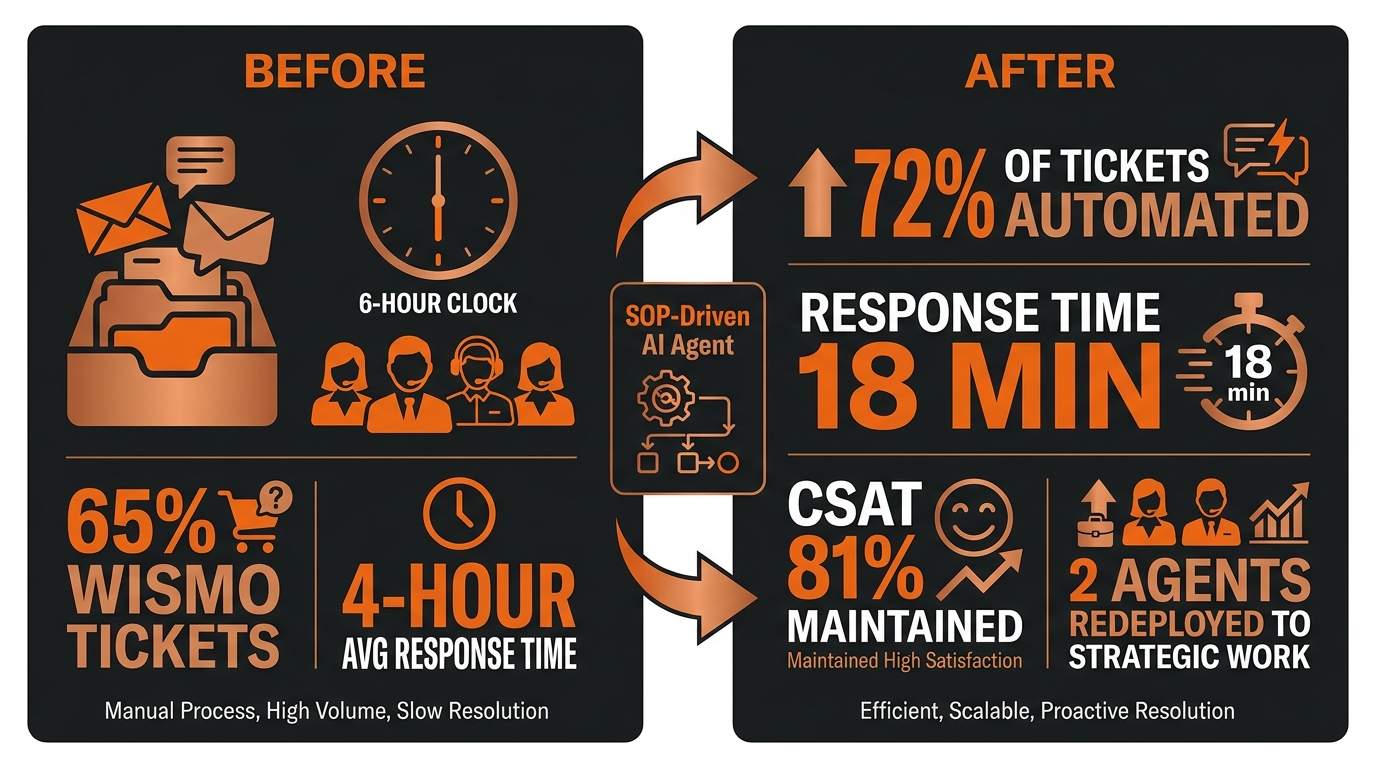
How a DTC Brand Automated 72% of Support Tickets and Halved Response Time in 30 Days
A 7-figure DTC apparel brand running on Shopify and Zendesk — four support agents, 8,000 tickets per month, growing faster than they could hire — automated 72% of tickets in 30 days using SOP-driven AI agents, cut average response time from 4 hours to 18 minutes, and maintained an 81% CSAT score throughout. No helpdesk replacement. No custom engineering. No headcount addition.
TL;DR: Results at a Glance
| Metric | Before | After (Day 30) | Change |
|---|---|---|---|
| Tickets automated end-to-end | 0% | 72% | +72 pts |
| Average response time | 4 hours | 18 minutes | −93% |
| CSAT score | 82% | 81% | −1 pt (within margin of error) |
| Human-handled ticket volume | 8,000/mo | ~2,200/mo | −73% |
| Agents redeployed to complex work | 0 | 2 | — |
| Time to first automation live | — | 6 hours | — |
The Starting Point: Scaling Into a Staffing Ceiling
The brand came into peak season with a problem common to DTC brands that grow faster than their ops: ticket volume had doubled year-over-year, but the support team had only grown from three to four agents.
Ticket composition from their Zendesk data:
- 65% WISMO ("Where is my order?") — mostly customers who wanted carrier tracking data that was already available, just not surfaced in a useful way
- 18% refunds and returns — standard policy cases requiring a Shopify refund or return label generation
- 9% address changes and order edits — time-sensitive requests hitting within the 30-minute fulfillment window
- 8% escalations — fraud disputes, damaged shipments, carrier claims, VIP handling
The four agents were spending most of their day on the 65% WISMO bucket — lookups that required checking Zendesk for the order number, switching to Shopify for the carrier, switching to FedEx or UPS tracking to get the latest status, then switching back to Zendesk to write a reply.
The average handle time for a WISMO ticket was 6 minutes. At 5,200 WISMO tickets per month, that's 520 agent-hours per month — 13 full working weeks — answering the same question.
What They Had Already Tried
Before CorePiper, the team had deployed two tools that didn't solve the core problem.
Zendesk AI (Copilot): Drafted replies faster. The agents appreciated the time savings on composition, but the draft-and-send workflow still required a human to look up the carrier status, verify the order, and approve the response. Average handle time dropped from 6 minutes to 4 minutes. Still 8,200 WISMO lookups per month requiring human eyes.
A macro library: 47 macros covering the most common scenarios. Useful for templating. But macros don't read live data — agents still had to manually insert the tracking number, shipping status, and estimated delivery into the template. The copy-paste step consumed half the time the macro was supposed to save.
Both tools reduced friction. Neither changed the fundamental constraint: a human had to look something up and make a decision on every ticket. The answer engine had no system access; it couldn't execute anything.
Why SOP-Driven Agents Are Different
The distinction that mattered for this brand is between an AI that drafts and an AI that executes. Most helpdesk AI — including Zendesk Copilot, Gorgias AI Automate, and most chatbot tools — operate as drafting aids: they write a better response faster, but a human still controls the data lookup and the send action.
A SOP-driven AI agent does something different. It receives a ticket, classifies intent, reads live data from connected systems (Shopify order status, carrier tracking API, customer history), applies a documented SOP to make a decision, takes action (sends a reply, issues a refund, generates a return label), and closes the ticket — without a human in the loop on routine cases.
The architecture that makes this work for a cross-platform DTC brand:
- Shopify Admin API connection — live access to order status, carrier assignment, tracking number, fulfillment state, customer LTV tier, and order value
- Carrier API connections — real-time tracking data from FedEx, UPS, USPS, and DHL (not polling a third-party tracker — reading the carrier API directly)
- Zendesk write access — the agent can close tickets, tag them, send customer-facing replies, and escalate with context pre-filled
- SOP logic layer — configurable decision rules (What status triggers a proactive update? What order value triggers human review? What fraud signals force escalation?) encoded as SOPs rather than rigid if-then rules
The critical piece: the agent needs write access across all three systems to resolve end-to-end. Read-only tools can surface information to an agent. Only write-access tools can close the ticket.
The Implementation: What Actually Happened
The brand's implementation ran in two phases over 30 days.
Phase 1 (Days 1–7): WISMO and Standard Refund Coverage
The first SOP cluster covered the two highest-volume ticket types: WISMO and standard refunds.
WISMO SOP logic (simplified):
- Trigger: Zendesk ticket with WISMO intent classification
- Data reads: Shopify order status, carrier tracking API, last carrier scan timestamp
- Decision gates:
- Order shipped, in-transit, on-time → send tracking update, close ticket
- Order shipped, carrier delay flagged (72h+ no scan) → send delay acknowledgment, proactive flag for follow-up
- Order not yet fulfilled → send fulfillment status, estimated ship date
- Delivered with signature confirmation → send delivery confirmation, close ticket
- Delivered but customer reports not received → escalate to human with full order and carrier data pre-filled
- Auto-close rate: 81% of WISMO tickets in the first week
Refund SOP logic (simplified):
- Trigger: refund or return intent on tickets within standard return window
- Data reads: order value, return eligibility, customer LTV tier, prior return history
- Decision gates:
- Under $150 threshold, within return window, no fraud signals → auto-approve refund via Shopify Admin API, send confirmation, close
- Over $150 threshold OR fraud signal → escalate to human with context
- Outside return window → trigger exception policy (VIP: auto-approve; standard: human review)
- Auto-resolution rate: 68% of refund tickets in the first week
Phase 2 (Days 8–30): Edge Case Refinement and Address Change Coverage
The second phase expanded coverage to address changes and order edits (Day 8) and refined the escalation logic on WISMO and refund edge cases based on the first week's escalation review.
Address change automation ran against a strict fulfillment-window check (only automatable if the order has not yet been picked by the warehouse — a real-time check against Shopify's fulfillment API). Orders past the window got an immediate human escalation with the carrier contact information pre-filled.
By Day 30, coverage across the three SOP clusters reached:
| Ticket Type | Day 7 Auto Rate | Day 30 Auto Rate |
|---|---|---|
| WISMO | 81% | 89% |
| Standard refunds | 68% | 74% |
| Address changes (within window) | 71% | 78% |
| All tickets combined | 58% | 72% |
The Outcomes That Mattered
Response Time: 4 Hours → 18 Minutes
The 4-hour average response time pre-implementation was a queue depth problem, not a speed problem. Agents weren't slow; there were too many tickets for four people to answer promptly during peak windows (7am–11am and 8pm–midnight in the brand's customer timezone).
After Day 1, every ticket hitting the automated SOP clusters got a response in under 2 minutes — the time required for the agent to read the ticket, run the API calls, make the decision, and send the reply. The overall average (automated + human-escalated combined) settled at 18 minutes within the first week, because the volume of tickets waiting in queue dropped by 60%+ as soon as WISMO was covered.
CSAT: 82% → 81% (Effectively Unchanged)
The brand's biggest concern before implementation was CSAT impact. Their hypothesis: customers prefer talking to a human.
What the data showed: CSAT is primarily driven by First Contact Resolution, not by whether the resolver is human or AI. The WISMO tickets that moved to automation were precisely the tickets where human agents were fastest and least error-prone — and the AI agent matched or exceeded that performance because it had direct API access instead of copy-paste tracking lookups.
The 1-point CSAT drop (82% → 81%) was within the survey margin of error and not statistically significant over a 30-day window. The team considered it a non-event.
The one CSAT signal worth monitoring: escalated tickets (the ~28% that reached a human agent) showed CSAT of 78% — below the automated-ticket average of 83%. The interpretation: escalations by definition involve edge cases, frustrated customers, and higher-stakes situations. The gap between automated and escalated CSAT is expected; the question is whether escalation quality (context handed off, no repeat data requests from customers) is optimized. That's an ongoing iteration.
Headcount: 4 Agents → 4 Agents, Doing Different Work
No agents were let go. Two agents who had spent the majority of their time on WISMO and standard refund queues were redeployed to:
- Complex escalations and carrier disputes — the cases that previously got buried under WISMO volume and took 48–72 hours to reach
- Proactive outreach — reaching out to customers with delayed orders before they submitted a ticket (suppressing an estimated 200–300 tickets per month that would otherwise land in the queue)
The team's self-reported quality-of-work assessment shifted from "queue management" to "problem solving." Agent turnover, which had been a recurring issue, dropped to zero over the 90 days post-implementation. (The causal link is directional — other factors contributed — but the correlation is consistent with the broader finding that agents who handle complex work, not repetitive lookups, retain better.)
How to Read the Numbers: What's Transferable
Three caveats worth stating clearly:
1. The 72% automation rate is a ticket-mix outcome. This brand's 65% WISMO concentration made it easier to reach a high automation rate quickly. Brands with a different ticket mix — more B2B escalations, more custom product questions, more fraud disputes — will see lower overall automation rates. The right benchmark is automation rate within automatable ticket types, not as a blanket percentage. For WISMO specifically, 80–90% is achievable across most DTC Shopify brands with SOP-driven agents.
2. Response time is a queue-depth outcome. The 18-minute average is partly a speed outcome (the AI responds in seconds) and partly a volume outcome (fewer tickets in queue means human-handled tickets also get faster first contact). The direct speed improvement on automated tickets is from 4 hours to <2 minutes. The 18-minute average blends automated (fast) and escalated (still faster because the queue is shorter).
3. CSAT stability requires resolution, not deflection. If the AI responds quickly but doesn't resolve — sends a "we're looking into it" message without taking action — CSAT will drop. The mechanism that keeps CSAT stable is end-to-end resolution: the ticket closes with the customer's issue addressed, not with an acknowledgment that the ticket was received.
What the Team Would Do Differently
The team's post-mortem flagged one optimization they'd have made earlier: proactive notifications before tickets are submitted.
The 5,200 WISMO tickets per month were all inbound — customers who had to seek out information they should have received proactively. During implementation, the brand was also piloting a proactive carrier event notification flow (triggered on delay events from the carrier API before the customer contacts support). That flow wasn't live for the first 30 days, so the automation rate numbers above reflect reactive resolution only.
When proactive notifications went live in Month 2, inbound WISMO volume dropped by 40% — meaning the 72% automation rate on a smaller ticket pool represented an even larger reduction in absolute ticket volume handled by agents.
The combined strategy — proactive suppression + agentic inbound resolution — matches the WISMO automation playbook pattern: prevent what can be prevented; resolve the rest end-to-end.
The Cross-Platform Piece: Why Zendesk AI Alone Couldn't Do This
Zendesk AI (Copilot, as deployed pre-implementation) operates within Zendesk. It can read ticket context, suggest replies, and surface knowledge base articles. What it cannot do natively: read live Shopify order status, call carrier APIs directly, execute a Shopify refund, or close a ticket with a confirmed resolution logged across Shopify and Zendesk simultaneously.
The resolution workflow this brand needed required three systems — Zendesk (ticket), Shopify (order + action), and carrier API (tracking) — to be called in a single flow. No single-helpdesk AI tool supports that natively. CorePiper's cross-platform architecture closes that gap by treating each SOP step as a tool call against whichever system owns that step, not as a Zendesk plugin.
For DTC brands running cross-platform operations — Shopify + a helpdesk + carrier integrations — this is the specific gap that separates "drafting assistant" from "resolution agent."
This case study represents a composite of DTC e-commerce outcomes across brands with similar ticket mixes and helpdesk configurations. Individual results will vary based on ticket composition, SOP coverage, and integration depth. Benchmark numbers (automation rates, response times, CSAT impacts) are directional and consistent with published industry research cited across CorePiper's content library.
Mustafa Bayramoglu is the founder of CorePiper (YC W19). He has spent the last five years working with enterprise operations teams on automating cross-platform case workflows.