
What Are Guardrails for AI Agents? (2026 Definition, Types, and Implementation)
Guardrails for AI agents are policy constraints, confidence thresholds, and escalation rules that prevent an AI agent from taking unauthorized, harmful, or incorrect actions. Here's the 2026 definition, how they work in customer support, and how to implement them.
 Mustafa BayramogluAugust 17, 202616 min read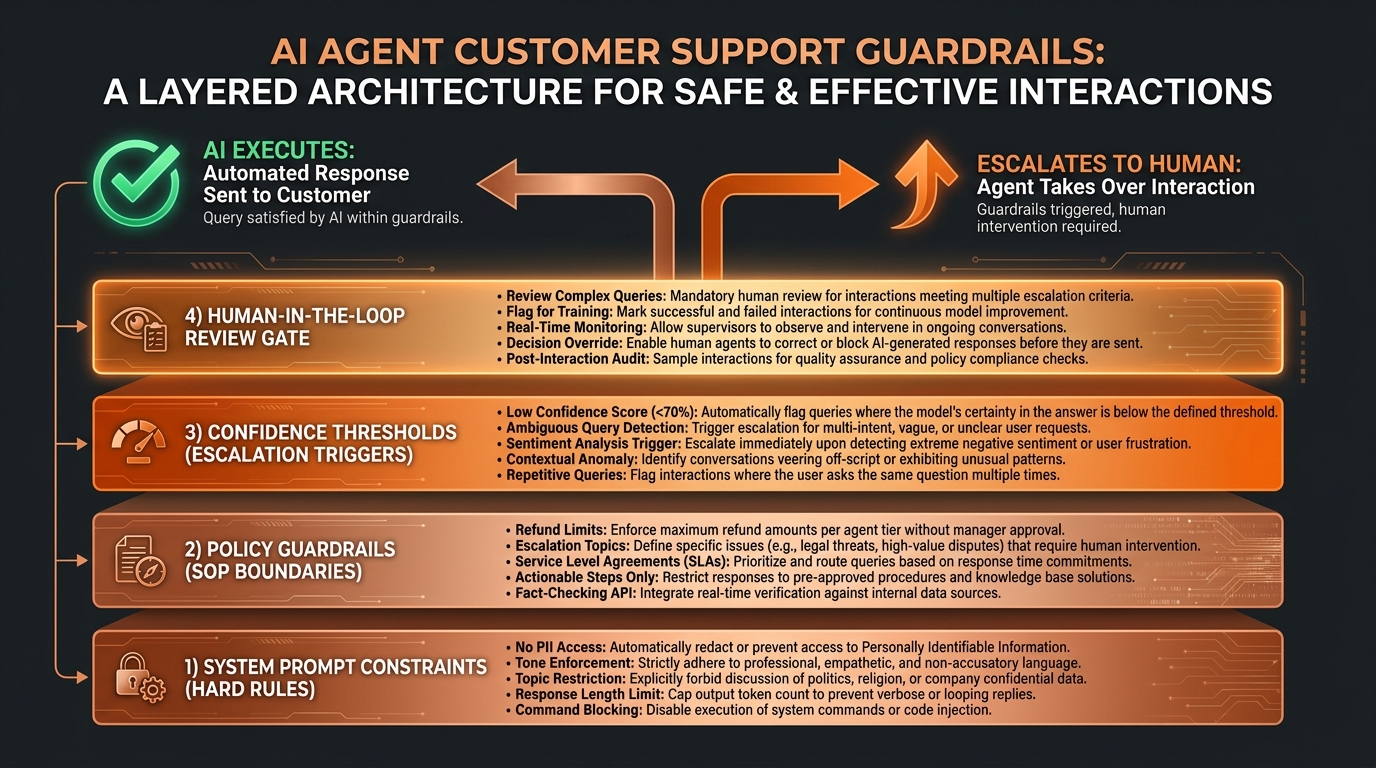
What Are Guardrails for AI Agents?
Guardrails for AI agents are policy constraints, confidence thresholds, and escalation rules that prevent an AI agent from taking unauthorized, harmful, or incorrect actions. In customer support, guardrails define the outer boundary of what the agent is allowed to do autonomously — everything outside that boundary routes to a human, is blocked entirely, or triggers a clarifying step. Without guardrails, a confident but wrong AI agent executes errors at scale.
TL;DR: Guardrails for AI Agents at a Glance
| Concept | What it means | Why it matters |
|---|---|---|
| Hard guardrail | An absolute constraint the agent cannot override (refund cap, action blocklist, permission scope) | Prevents compliance violations and irreversible errors regardless of confidence |
| Soft guardrail | A probabilistic trigger (confidence threshold, sentiment flag, policy boundary) | Routes ambiguous cases to human review without blocking normal operations |
| Escalation rule | A defined condition that hands the case to a human | Keeps AI accuracy high by reserving edge cases for human judgment |
| Action blocklist | Explicit actions the agent is never permitted to take | Limits blast radius if the agent misreads a case |
| Confidence threshold | Minimum confidence score required to act autonomously | Quantifies uncertainty and routes low-confidence cases before they become errors |
| Policy guardrail | SOP-derived rules mapped to action constraints | Connects business policy directly to agent behavior, not just general AI safety |
Why Do AI Agents Need Guardrails?
A capable AI agent that can look up orders, issue refunds, update Salesforce records, file carrier disputes, and close Zendesk tickets is extraordinarily useful. It is also, without guardrails, extraordinarily dangerous. The same capability that lets it issue a $50 refund autonomously also lets it issue a $5,000 refund if it misreads a case. The same write access that closes a resolved ticket can close an open fraud investigation if the agent misclassifies it.
The core problem is that LLMs are probabilistic systems optimized to produce plausible outputs. In most cases, the plausible output is the correct one. In a small fraction of cases — ambiguous queries, edge cases, adversarial inputs, novel situations outside the training distribution — the plausible output is confidently wrong. At human agent throughput (50–80 cases per day), a 2% error rate produces one or two mistakes per day, easily caught in review. At AI agent throughput (500–2,000 cases per day), the same 2% error rate produces 10–40 mistakes per day — a scale that can generate significant financial exposure, compliance violations, and customer harm before a human spots the pattern.
Guardrails solve this by shifting the failure mode. Instead of the agent taking a wrong action, the agent pauses and escalates. The error is caught before execution, not after. The human-in-the-loop reviewer corrects the edge case, and the agent continues autonomously on the 95–98% of cases it handles correctly. This is why human-in-the-loop AI is not a concession to AI weakness — it is a design feature of any production-grade agentic system.
What Are the Main Types of Guardrails for AI Agents?
Hard Guardrails: Absolute Constraints
Hard guardrails are non-negotiable rules enforced at the system level — not by the LLM, but by the surrounding architecture. They fire regardless of the agent's confidence or reasoning.
Action blocklists. A list of actions the agent is never permitted to take autonomously: canceling subscriptions above a certain tenure, deleting records, modifying payment methods, issuing credits above a dollar threshold, escalating a case to legal without human initiation. These are enforced by the tool layer — the API calls simply aren't available to the agent, regardless of what it decides.
Spend and liability caps. The agent's refund tool has a maximum dollar value. Anything above that value is a hard stop — the agent returns "this refund requires manager approval" and routes to a human queue. This is the most common hard guardrail in e-commerce and logistics support. For freight claims, the cap aligns with the carrier's liability limit: the agent can approve claims up to the documented liability threshold; anything above requires human underwriter review.
Permission scope. The agent's authenticated API connections are provisioned with minimum necessary permissions: read-only access to order history, write access to the refund endpoint but not the subscription cancellation endpoint, create access to Zendesk tickets but not delete access. Permission scope is the most robust guardrail because it is enforced at the infrastructure level — the agent literally cannot take an action it doesn't have credentials for.
Data handling constraints. The agent is prohibited from surfacing certain data types to the customer (full payment card numbers, other customers' orders, internal pricing tiers, case notes not meant for customer view). These constraints are enforced by field-level filtering before data enters the agent's context window.
Soft Guardrails: Probabilistic Triggers
Soft guardrails activate under specific conditions rather than universally. They handle the gray zone between "clearly within scope" and "clearly prohibited."
Confidence thresholds. The agent scores its own confidence on each decision — typically as a function of retrieval quality (how well the RAG knowledge base matched the query), action precedent (has this type of action been taken before in similar cases), and ambiguity signals (does the customer's message contain conflicting information). When confidence falls below a configured threshold, the agent escalates rather than acts. The threshold is tunable: stricter early in deployment when the agent is less calibrated, more permissive as the agent accumulates validated case history.
Sentiment and tone triggers. If the customer's message indicates distress, legal threat, or high escalation risk ("I'm going to dispute this charge," "my lawyer will be contacting you," "this is unacceptable — I've been a customer for 10 years"), the agent routes to a human before taking any action. Sentiment analysis on the input text is a standard pre-action guardrail in customer support deployments. It prevents the agent from autonomously resolving a case that should have had human-led relationship recovery.
Repeat contact detection. If the customer has contacted support more than N times on the same issue in the last 30 days, the case is flagged for human review. Repeat contacts on the same issue often signal that earlier agent resolutions were wrong or insufficient — another automated response compounds the problem. A human should review the case history before acting.
Policy boundary detection. The agent's RAG knowledge base retrieval returns a relevance score alongside the retrieved chunks. If the highest-scoring document is below a minimum relevance threshold — meaning the query doesn't match any policy document well — the agent triggers an escalation rather than synthesizing an answer from loosely related content. "I don't have a policy that covers this situation — routing to a specialist" is the correct output, not a confident but unsourced response.
Escalation Rules: Structured Handoffs
Escalation rules are the operational expression of soft guardrails — they specify not just when to escalate but where the case goes, what context travels with it, and what the human reviewer is expected to do.
A well-designed escalation rule includes:
- Trigger condition (what fired the guardrail)
- Case context packet (customer history, conversation transcript, the action the agent was about to take, the guardrail that stopped it)
- Routing destination (tier 1 support queue, specialist queue, fraud team, manager queue)
- Suggested resolution (the agent's recommendation for what the human should do, for context)
- SLA on human review (how long before the case is auto-re-routed if the human doesn't act)
This structured handoff is what distinguishes a professional HITL deployment from a naive "escalate if unsure" pattern. Without the context packet, the human reviewer starts from scratch — negating much of the efficiency gain from automation. With the context packet, the reviewer can confirm or override the agent's recommendation in under 60 seconds.
How Are Guardrails Different From SOPs?
SOPs (Standard Operating Procedures) and guardrails are complementary layers of the same policy framework, but they govern different things.
| Dimension | SOPs | Guardrails |
|---|---|---|
| Governs | What the agent does (step-by-step resolution logic) | What the agent cannot do (limits and escalation triggers) |
| Nature | Prescriptive (follow these steps) | Restrictive (don't cross these lines) |
| Authorship | Operations team (domain experts) | Operations + compliance + legal |
| Update frequency | When processes change | When risk profile changes or new failure modes discovered |
| Failure mode if missing | Agent improvises outside process | Agent takes unconstrained, potentially harmful actions |
The relationship is hierarchical: the SOP tells the agent how to resolve a freight damage claim; the guardrail prevents it from approving a claim above the liability cap without human sign-off. Both are required. An agent with SOPs but no guardrails will follow the right process up to the point where it hits an edge case — then it improvises, potentially in a harmful direction. An agent with guardrails but no SOPs will stop correctly at the boundaries but won't know how to navigate the space within them.
CorePiper's architecture combines SOP-driven execution with embedded guardrails: the SOP defines the decision tree, the guardrail defines where the tree terminates in an escalation rather than an action. This is the pattern described in what is SOP-driven AI automation — policy expressed as executable logic, not LLM judgment.
How Do You Implement Guardrails for AI Agents in Customer Support?
Step 1: Map the action inventory
List every action the agent can take: read order status, issue refund, update case status, close ticket, file carrier dispute, send customer email, update shipping address, cancel subscription. For each action, classify it by reversibility (is it undoable?), financial impact (what's the maximum dollar exposure?), and compliance sensitivity (does this action touch regulated data or contractual obligations?).
High reversibility + low financial impact + no compliance sensitivity → candidate for autonomous action without guardrails beyond soft confidence threshold.
Low reversibility + high financial impact + compliance sensitivity → candidate for hard guardrail with required human sign-off.
Step 2: Define hard guardrails first
Set the non-negotiables. For most customer support deployments, these include:
- Maximum autonomous refund value (e.g., $200 without approval)
- Subscription and account action restrictions (no autonomous cancellations above X months tenure)
- Data exposure prohibitions (no surfacing of internal pricing, payment data, other customer records)
- Record deletion prohibition (agent cannot delete records, only update or create)
These are enforced at the API and permission layer, not in the agent's prompt. They do not rely on the LLM honoring an instruction — they are architectural constraints.
Step 3: Configure soft guardrails and thresholds
Set initial confidence thresholds conservatively (80–85% minimum to act autonomously) for the first 30–60 days. Track the AI resolution rate and escalation rate by case type. As the agent validates its accuracy on specific case types (WISMO, standard returns), you can relax thresholds on those types while maintaining stricter thresholds on complex cases (freight damage claims, chargeback disputes).
Configure sentiment triggers by reviewing your human agents' escalation patterns. What keywords and phrases have historically required manager-level handling? These become the initial trigger vocabulary for the sentiment guardrail.
Step 4: Design the escalation routing
Map each guardrail trigger to a specific human queue. Confidence-threshold escalations → tier 2 support. Sentiment triggers → senior support + flagged for CSAT follow-up. Spend-cap violations → manager approval queue with 2-hour SLA. Fraud indicators → fraud team with immediate priority.
Build the context packet format: every escalation should arrive with a standardized summary of (a) what the customer asked, (b) what the agent was about to do, (c) why it stopped, and (d) the agent's recommended action. This packet design is where most implementations under-invest — and it's the single biggest determinant of human reviewer efficiency.
Step 5: Log, audit, and tune
Every guardrail trigger should generate a structured log entry: timestamp, case ID, guardrail type, action blocked, escalation destination, human reviewer action (confirmed / overrode / escalated further), resolution outcome. This log is your calibration dataset. Monthly guardrail reviews should answer:
- Which guardrails fire most frequently? (High-frequency = either tuning needed or a process gap)
- Which escalations get confirmed versus overridden? (High override rate on a specific guardrail = it's too sensitive or wrong policy)
- Which cases reach the guardrail layer that should have been caught earlier? (Upstream classification or RAG retrieval issue)
What Are Common Guardrail Mistakes in AI Agent Deployments?
Setting guardrails in the LLM prompt only. Instructing the agent "never issue refunds above $500" in the system prompt is not a hard guardrail — it is a soft instruction the model may ignore in edge cases, especially under adversarial prompting ("my refund should be $600 because the carrier confirmed total loss"). Hard guardrails live in the tool layer, not the prompt.
Too many soft guardrails at launch. An agent that escalates 40% of cases is not adding much value over pure human handling. Start with hard guardrails plus high-confidence thresholds, let the agent build case history on well-understood query types, then add soft guardrails incrementally as you understand the failure modes.
No escalation routing design. "Route to human" is not a complete escalation rule. Without specified queues, SLAs, and context packets, escalated cases land in a generic queue with no context — creating more work, not less, for the human review team.
Guardrails that don't update when policy changes. If the refund policy cap changes from $200 to $300 in the SOP, but the corresponding guardrail in the tool layer still blocks at $200, the agent will correctly identify it should approve $250 refunds and then incorrectly escalate them. Guardrail-SOP synchronization should be part of every policy update process.
Conflating guardrails with AI deflection rate optimization. Guardrails exist to catch agent errors and boundary violations, not to maximize the percentage of cases that never reach a human. An agent that correctly identifies when to escalate — and escalates efficiently — is more valuable than one that powers through cases it shouldn't. Containment rate is a metric to track, not a metric to maximize at the expense of accuracy.
How Do Guardrails Interact With the AI Agent Metrics Stack?
Guardrails have a direct relationship with all three core AI support metrics:
Containment rate. Guardrails determine what portion of cases the agent resolves within the AI tier versus escalating to human review. Overly restrictive guardrails lower containment. Under-restrictive guardrails raise containment but at the cost of accuracy. The right calibration depends on your AI resolution rate — containment only has value if the contained cases are actually resolved correctly.
Resolution rate. Hard guardrails prevent the agent from taking wrong actions that produce false resolution (the ticket is closed but the problem isn't solved). A well-calibrated guardrail stack improves resolution rate by catching the cases where the agent's proposed action is wrong before execution, not after the customer contacts support again.
Deflection rate. Guardrails don't directly affect AI deflection rate, which operates at the pre-contact layer (customers finding answers in self-service before reaching the agent). However, agents that escalate appropriately rather than incorrectly resolving build customer trust in self-service channels — if customers know the AI handles edge cases well rather than confidently getting them wrong, self-service adoption increases over time.
The guardrail layer also feeds back into RAG quality: cases that hit confidence-threshold guardrails frequently on a specific query type signal a gap in the knowledge base — the RAG retrieval isn't returning a strong enough match for those queries, which is a knowledge base coverage problem, not an agent configuration problem.
Guardrails in Logistics and Cross-Platform Case Operations
Freight claims, carrier disputes, and logistics exception management involve higher-stakes actions than typical e-commerce support — carrier liability caps, legal claim windows (the Carmack Amendment's 9-month filing deadline, concealed damage's 5-day window), multi-system state changes across Salesforce, Zendesk, and carrier portals. This is exactly the context where guardrails have the highest ROI.
In a logistics claims deployment, the guardrail stack typically includes:
- Liability cap guardrail: agent cannot approve claims above the carrier's documented per-pound liability limit without human underwriter review
- Filing window guardrail: agent verifies claim is within the carrier's filing window before proceeding; if window is at risk of closing, escalates immediately regardless of other case state
- Multi-system consistency guardrail: before closing a Zendesk ticket, agent verifies the corresponding Salesforce case is also updated; if the Salesforce update fails, the ticket stays open pending manual resolution
- Carrier portal action guardrail: any action on a carrier portal (filing a formal dispute, accepting a settlement offer) requires human confirmation, regardless of dollar amount
- Repeat carrier dispute guardrail: if the same carrier has been disputed more than N times in 90 days for the same shipper, flag for account review before filing another dispute
This is the pattern CorePiper implements in cross-platform case operations — guardrails are not generic AI safety features but operationally specific constraints derived from the legal, financial, and process reality of logistics claims. The SOP defines the process; the guardrail enforces the risk boundary within it.
Mustafa Bayramoglu is the founder of CorePiper (YC W19) and has spent six years building cross-platform AI automation for enterprise operations teams across logistics, freight, and B2B case ops.
AI Agents That Stay Inside Your Policies
CorePiper builds guardrails into every SOP layer — policy constraints, confidence thresholds, and HITL escalation — so your AI agents execute accurately and safely across Salesforce, Zendesk, Shopify, and Jira. No runaway refunds. No closed tickets on open disputes. No confident-but-wrong actions at scale.