
Intercom AI Agent: Autonomous Ticket Resolution Beyond Fin (2026 Guide)
An Intercom AI agent adds cross-system resolution across Shopify, carrier APIs, and Salesforce without replacing Intercom. Here's how it works, what Fin can and can't do, and when you need a third-party AI agent.
 Mustafa BayramogluAugust 21, 202615 min read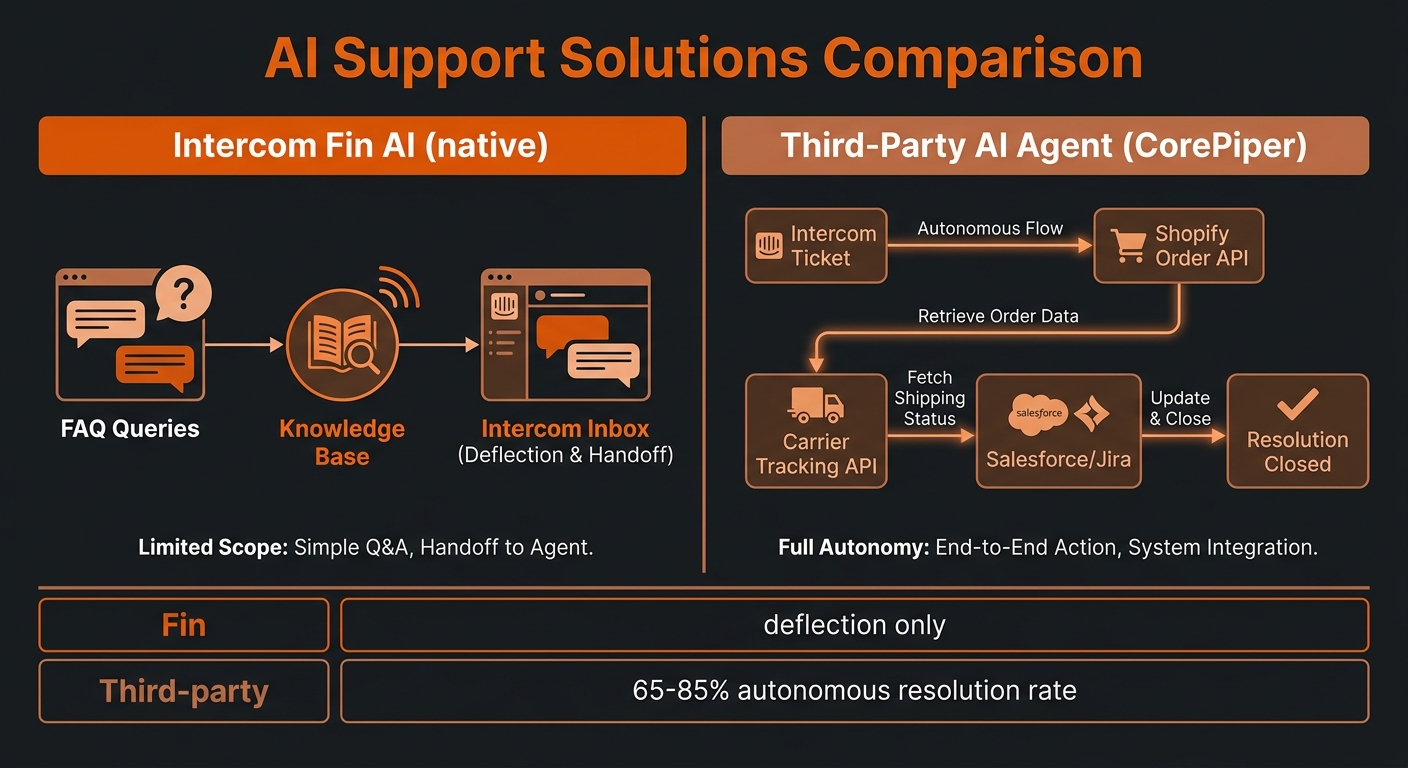
Intercom AI Agent: Autonomous Ticket Resolution Beyond Fin (2026 Guide)
An Intercom AI agent is a third-party autonomous resolution layer that connects to Intercom Inbox via API alongside Shopify, carrier tracking systems, and back-office platforms — resolving support tickets end-to-end without human input. Unlike Intercom Fin, which resolves queries within Intercom's knowledge base and conversation layer, a true cross-system AI agent reads live order data, executes refunds, and closes cases across every connected platform.
TL;DR: Intercom AI Options Compared
| Approach | What it does | System access | Autonomous resolution? | Best for |
|---|---|---|---|---|
| Intercom Fin (native) | Resolves queries using Intercom knowledge base and conversation history | Intercom articles + connected Intercom apps | Partial — FAQ and knowledge-base queries, limited cross-system action | Reducing inbound on policy and FAQ queries within Intercom's ecosystem |
| Intercom Copilot (native) | AI assistant helping reps draft replies, summarize conversations, and surface context | Intercom inbox data | No — human confirms every action | Teams that need faster rep throughput on existing ticket queue |
| Third-party AI agent (e.g. CorePiper) | Resolves tickets end-to-end across connected systems | Intercom + Shopify + carrier API + Salesforce/Jira | Yes — closes conversations without human intervention | Brands targeting 65–85% autonomous resolution on e-commerce and logistics tickets |
What Is Intercom Fin, and How Is It Different from an AI Agent?
Intercom Fin is the furthest along of the native helpdesk AI products in terms of autonomous intent — more so than HubSpot Breeze Copilot or Zendesk's AI reply assistant. Fin was designed from the outset as an AI agent, not just an assist tool. It reads your Intercom knowledge base, articles, and conversation history, and when a customer sends a query, Fin attempts to answer it or take action without routing to a human rep first.
That positioning makes Fin a stronger starting point than most native helpdesk AI. The gap that remains is not about intent — it is about scope.
What Fin handles well: FAQ and policy queries that can be resolved using your Intercom knowledge base. Shipping policy questions, return windows, account-level information that Intercom stores, subscription status within Intercom-connected billing tools. Fin 2 also introduced some action capability: it can trigger certain flows and look up information from connected Intercom apps, reducing pure deflection into partial resolution for some ticket categories.
Where Fin reaches its boundary: Cross-system resolution. The specific customer scenario — where is my order right now, why was my shipment delayed, execute this refund against the Shopify order, escalate this freight exception to a Jira ticket and update the Salesforce case — requires systems outside Intercom's native app layer. Fin does not have direct Shopify write access for refund execution. It does not query live carrier tracking APIs across FedEx, UPS, USPS, and DHL simultaneously. It does not update Salesforce opportunity or case records as part of a resolution workflow.
The result is the same pattern as with other native helpdesk AI: AI resolution rate — the percentage of tickets fully resolved without human involvement — plateaus at the boundary of what Intercom's ecosystem natively supports. For many e-commerce and logistics operations teams, that boundary comes at 30–40% of ticket volume, leaving the remaining 60–70% for humans despite having activated Fin.
How Does Intercom Fin Compare to Third-Party AI Agents?
The comparison matters most for teams setting automation targets above what Fin alone can achieve.
Fin's strengths are real. Its natural language understanding is strong, it integrates deeply with Intercom's conversation layer, and its knowledge-base resolution capability has improved significantly since Fin 2. For brands where the majority of support volume is genuinely knowledge-base-resolvable — subscription SaaS products with FAQ-heavy support queues, products with consistent policy and minimal order-state variance — Fin can reach meaningful deflection and containment numbers without third-party augmentation.
The Copilot vs. agent distinction: Intercom Copilot (formerly Fin's AI assist mode for reps) is a different product. Copilot surfaces relevant knowledge base content, suggests replies, and summarizes conversation history for the rep reviewing a ticket. It does not take autonomous action. For teams where the bottleneck is rep throughput rather than resolution autonomy, Copilot addresses a real need — but it does not move the AI containment rate needle, because a human is still in the loop for every resolution step.
Where third-party agents differ: A third-party AI agent connects to Intercom as an external system. It watches incoming conversations, evaluates each ticket against a decision tree built from your SOPs, reads the data it needs from connected external systems — Shopify order status, carrier API tracking, Salesforce case history — and takes the resolution action in the source system, then writes the outcome back to Intercom and closes the conversation. The key shift: the SOP logic and the cross-system execution layer live outside Intercom, which means resolution capability is no longer bounded by what Intercom's native app marketplace supports.
For the ticket categories that drive e-commerce support volume — WISMO, return requests, order modifications, shipping exceptions, and freight claims — the difference in resolution rate between Fin-only and Fin plus a third-party agent is typically the gap between 35–50% autonomous resolution and 65–85% autonomous resolution. The specific numbers depend on your ticket mix and how much of your volume is cross-system by nature.
What Tickets Can an Intercom AI Agent Actually Resolve?
As covered throughout this guide, resolution capability equals system access. The Intercom inbox is the communication layer; the resolution capability comes from what the AI agent can read and write across connected platforms.
WISMO (Where Is My Order?) tickets: If the AI agent has live carrier API connections — FedEx, UPS, USPS, DHL, Aftership, or a similar tracking aggregator — it reads the real-time tracking status for the specific order number, maps it to the appropriate customer message based on your communication SOP, sends the reply through Intercom, and closes the conversation autonomously. WISMO typically represents 30–50% of e-commerce support volume. A full breakdown of what this looks like in practice is in how to automate WISMO tickets for Shopify.
Return and refund requests: With Shopify write access, the AI agent evaluates each return against your refund SOP — order value thresholds, return window, item condition rules, exchange-first logic — executes the Shopify refund or generates a return label, updates the Intercom conversation, and confirms with the customer. The specific refund logic follows your documented policy, not AI discretion.
Order modifications: Address changes, cancellation requests, and quantity adjustments within defined windows can be handled autonomously when the agent has Shopify API write access and the modification falls inside the eligible pre-fulfillment window.
Shipping exception management: Late shipments, missed delivery attempts, damaged-in-transit reports, and carrier holds require pulling the live carrier status, applying your exception SOP — reship, refund, or hold — and executing the outcome. This is where the combination of carrier API access and Shopify execution capability matters most, and where Fin's native capability has the least coverage.
Freight claims and logistics disputes (B2B): For operations teams managing LTL freight, multi-carrier logistics, or 3PL claims workflows, the ticket complexity moves well beyond consumer support. A freight claim requires pulling the BOL, POD, carrier inspection records, and claims history, then filing against the correct carrier contract terms. This category connects to CorePiper's core logistics positioning — see the LTL claims automation playbook for detail on the workflow structure.
Cross-system escalations: When a ticket cannot be resolved autonomously — because it requires human judgment, policy exception approval, or legal review — the AI agent creates the appropriate record in Jira or Salesforce, attaches the conversation context and relevant data, routes to the right team queue, and updates the Intercom conversation with a status confirmation and expected SLA. As covered in how to orchestrate Salesforce, Zendesk, and Jira with AI, the handoff itself can be automated even when the resolution requires a human.
How Do You Set Up an AI Agent for Intercom?
Step 1 — Connect Intercom via API. Third-party AI agents connect to Intercom using the Intercom API — reading incoming conversations, accessing conversation metadata, and writing replies and status updates back to Intercom. No changes to Intercom's own configuration are required. Fin continues to operate in parallel: it can handle the first response layer on knowledge-base-resolvable queries, while the third-party agent takes over for cross-system resolution cases that Fin passes through.
Step 2 — Connect your source-of-truth systems. Link Shopify for order data and write access (refunds, return labels, cancellations). Connect carrier APIs for live tracking data. Add Salesforce and Jira if your operations team uses either for case management. The resolution capability of the AI agent is a direct function of how many authoritative data sources it can read and how many execution endpoints it can write to.
Step 3 — Upload your SOPs as decision rules. The AI agent does not improvise; it applies your documented policies. Return SOP, refund threshold SOP, shipping exception SOP, escalation SOP — each becomes a decision tree the agent applies when evaluating a ticket. SOP-driven AI automation covers why SOP structure matters more than model capability for resolution accuracy: a well-structured SOP with clear conditions and outcomes produces more reliable results than a more powerful model working from vague guidelines.
Step 4 — Run a supervised pilot. Before enabling autonomous execution, run the agent in review mode on a sample of real tickets. Every proposed action is reviewed by a human before it fires. This phase surfaces edge cases your SOPs didn't anticipate and gives your team confidence in the agent's decision logic before flipping to autonomous mode.
Step 5 — Enable autonomous execution and expand scope. Start autonomous execution on your highest-confidence ticket categories first — typically WISMO, where the data is objective and the action is low-risk. Expand to returns and order modifications as accuracy is confirmed. Freight claims and high-value exceptions can run in human-in-the-loop mode — where the agent prepares the complete resolution recommendation and a human approves in one click — before moving to full autonomy.
The typical time from API connection to first autonomous resolutions in production is one to two business days for standard e-commerce workflows.
When Is Fin Enough, and When Do You Need More?
Fin is the right starting point, not a ceiling. The question for each team is where their ticket mix places them relative to Fin's resolution boundary.
Fin is likely enough if: Your support volume is primarily FAQ and policy queries that can be answered from your Intercom knowledge base. You have a consistent, predictable product line without significant order-state complexity. Your average ticket requires one data point from within Intercom's ecosystem — not a multi-system lookup with an execution action in a connected platform.
You likely need a third-party agent if: A meaningful portion of your tickets require live data from systems outside Intercom — carrier APIs, Shopify order state, Salesforce cases. You are targeting autonomous resolution rates above 50% and finding that Fin alone plateaus short of that. Your tickets span freight, logistics, or multi-carrier operations where the resolution requires data pulls and system writes that Intercom's app marketplace does not cover natively. You are running multi-helpdesk environments — Intercom for consumer, Salesforce Service Cloud for enterprise, Jira for internal escalation — and need one AI agent layer that operates across all three.
The signal that Fin alone is not enough is usually visible in the ticket data: a meaningful share of conversations Fin marks as "handled" where the customer follows up with the same issue, because Fin answered the question but could not execute the resolution action. Deflection rate goes up; resolution rate and CSAT do not follow.
Intercom vs Zendesk vs Freshdesk for AI Automation
Intercom, Zendesk, and Freshdesk represent three different bets on where native AI capability should live in the helpdesk stack.
Intercom is the most AI-native of the three. It was rebuilt around Fin as a primary resolution layer, not retrofitted. The product experience is conversation-first, and Fin is integrated into that experience more deeply than Zendesk AI Reply or Freshdesk Freddy are integrated into their respective inboxes. For teams that prioritize the native AI experience and operate primarily within Intercom's ecosystem, this is a real advantage.
Zendesk has the largest app marketplace and the most mature enterprise feature set — SLA management, advanced routing, workforce management tools — but its AI is primarily an assist layer rather than an autonomous resolution layer at the same level as Fin. Zendesk's AI pricing has also drawn scrutiny for resolution-counting practices; see Zendesk AI agent pricing per resolution for the detailed breakdown. The Zendesk AI agent guide covers the full native vs. third-party agent comparison for Zendesk users.
Freshdesk offers the most price-competitive entry point of the three. Freddy AI is a capable assist and automation tool, but its autonomous resolution depth is closer to Zendesk's than to Fin's. For teams scaling from a low ticket volume, Freshdesk's price-to-feature ratio is difficult to beat; as ticket complexity grows, the same third-party AI agent gap appears. See the Freshdesk AI agent guide for the Freshdesk-specific breakdown.
For most e-commerce and operations teams, the choice of helpdesk (Intercom vs Zendesk vs Freshdesk) matters less than the decision about whether to augment it with a cross-system AI agent layer. The helpdesk conversation layer is a commodity; the resolution capability that connects it to Shopify, carrier APIs, and back-office systems is not.
What Metrics Should You Track After Deploying an Intercom AI Agent?
AI resolution rate — percentage of tickets fully resolved by the AI without human involvement. This is the primary metric that reflects whether the automation investment is working. As covered in what is AI resolution rate, the distinction between deflection (customer didn't escalate) and resolution (customer's problem was solved) is critical here. Fin's native reporting shows conversation outcomes; verify these against customer follow-up rates to distinguish genuine resolutions from deflections that return as repeat contacts.
AI containment rate — percentage of conversations handled by AI without human takeover. A high containment rate with a low resolution rate is a warning sign: the AI is keeping conversations, but not closing them successfully. AI containment rate benchmarks for agentic AI deployments in e-commerce run 65–85% at steady state; a well-tuned Fin implementation augmented with a third-party agent for cross-system cases should approach the upper range of that band.
First-contact resolution (FCR) — percentage of tickets resolved without the customer needing to re-contact. This is the clearest customer-experience signal for whether resolution quality is matching resolution rate. Automating resolutions that produce re-contact is worse than automating nothing: you have the cost of the automation plus the cost of the follow-up.
Human-in-the-loop intervention rate — on cases where the AI prepared a resolution recommendation for human approval, what percentage required modification before execution. This is the calibration metric for SOP accuracy: a high modification rate signals that your SOP decision rules need refinement, not that the AI is failing.
Escalation accuracy — when the AI escalates a ticket to a human or routes to Jira/Salesforce, is it routing to the right queue with the right context attached? Escalation accuracy is often ignored until it creates downstream backlogs; measuring it early prevents SLA misses from accumulating invisibly.
Frequently Asked Questions
Can Intercom Fin handle freight claims or logistics tickets?
Fin can answer policy questions about your freight claims process using your Intercom knowledge base — what documentation to submit, what the filing window is, what your SLA is for claim resolution. It cannot query carrier claims APIs, pull BOL or POD documents from logistics systems, or file a claim on your behalf in a TMS or carrier portal. Logistics and freight exception workflows that require live data pulls and system writes sit outside Fin's native resolution scope. A third-party AI agent with logistics system integrations handles this layer; see the LTL claims automation playbook for a full workflow breakdown.
Does using a third-party AI agent disable Intercom Fin?
No. Fin and a third-party AI agent operate in parallel. A common architecture: Fin handles the first response attempt on all incoming conversations using the knowledge base; for tickets Fin cannot resolve — those requiring live system lookups or execution actions in connected platforms — the conversation is passed to the third-party agent. Fin's deflection and knowledge-base capability is preserved; the third-party agent adds the cross-system resolution layer for the ticket categories Fin cannot close.
Will an Intercom AI agent work if we also use Salesforce Service Cloud for enterprise accounts?
Yes, and this is one of the stronger arguments for a third-party agent over relying on Fin alone. If your support operation splits across Intercom for consumer or SMB and Salesforce Service Cloud for enterprise accounts, a third-party AI agent that connects to both allows consistent SOP enforcement across both channels. CorePiper's positioning specifically addresses this multi-helpdesk scenario — see the Salesforce Service Cloud AI agent guide for the Salesforce-side integration detail.
Mustafa Bayramoglu is the founder of CorePiper (YC W19). He has spent the past seven years building AI automation for operations and case management workflows across logistics, e-commerce, and enterprise services.