
Gorgias AI Agent: Autonomous Resolution Beyond Automate for Shopify Brands (2026 Guide)
Gorgias AI Agent handles FAQ deflection inside the helpdesk. A third-party AI agent extends Gorgias with autonomous resolution across Shopify, carrier APIs, and back-office systems — here's how each works and when you need both.
 Mustafa BayramogluAugust 31, 202618 min read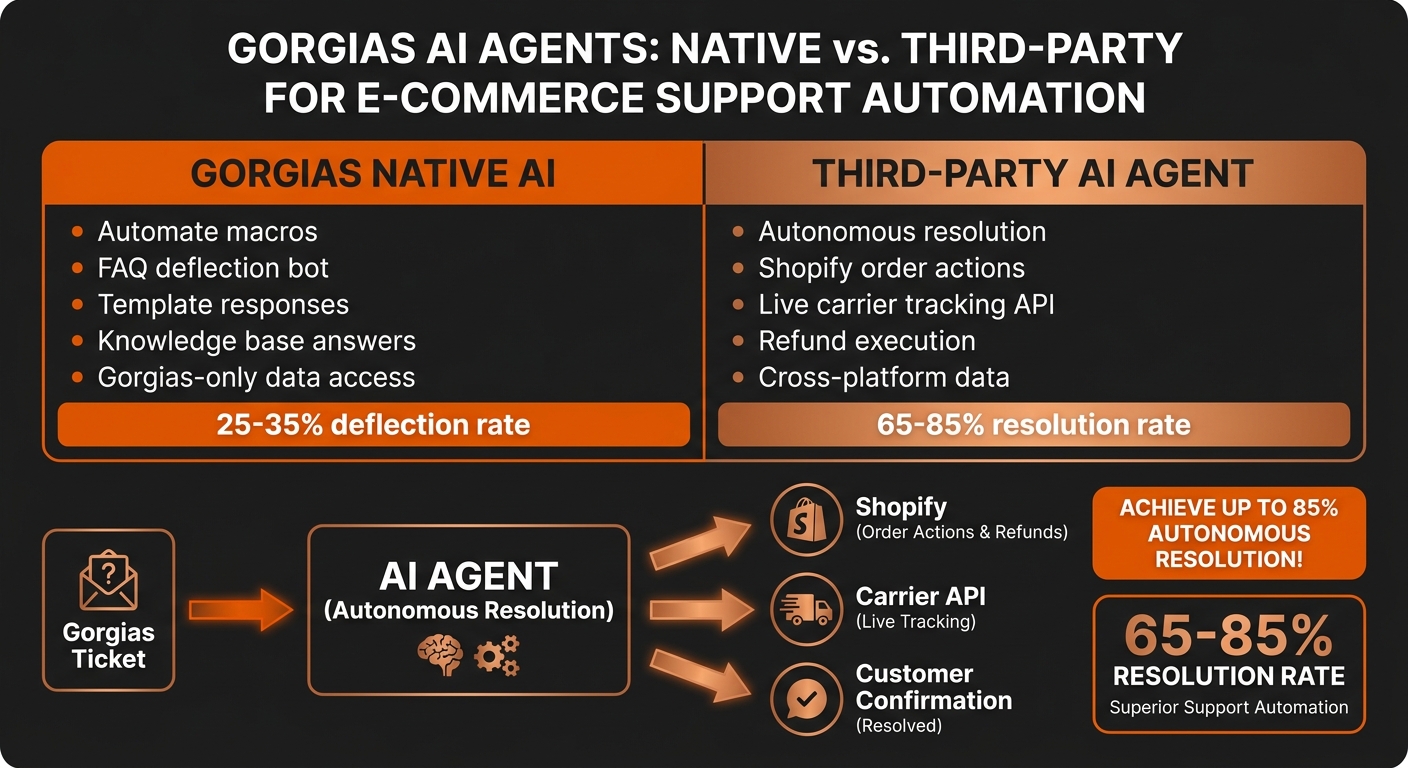
Gorgias AI Agent: Autonomous Resolution Beyond Automate for Shopify Brands (2026 Guide)
A Gorgias AI agent is either Gorgias's native AI Agent — a conversational bot that deflects FAQ queries using your helpdesk content and Shopify order data — or a third-party autonomous resolution layer that connects to Gorgias via API to execute actions end-to-end across Shopify, carrier APIs, and back-office systems without a human confirming each step. The two are architecturally different, and confusing them leads to automation goals that never close.
TL;DR: Gorgias AI Options Compared
| Approach | What it does | System access | Autonomous resolution? | Best for |
|---|---|---|---|---|
| Gorgias Automate (native) | Rule-based flows: auto-tag, auto-close, template macros, intent routing | Gorgias ticket data + basic Shopify order read | No — executes predefined rules, not judgment-based resolution | Routing efficiency and rep throughput on high-volume repetitive tickets |
| Gorgias AI Agent (native) | Conversational FAQ deflection via AI bot using knowledge base + order data | Gorgias knowledge base + Shopify order status read | Deflection only — no cross-system write actions without human confirmation | Reducing inbound volume on policy FAQ and basic order status queries |
| Third-party AI agent (e.g. CorePiper) | Resolves tickets end-to-end across connected systems using SOPs | Gorgias + Shopify write + carrier API + Salesforce/Jira | Yes — closes tickets without human intervention per action | Brands targeting 65–85% autonomous resolution rate |
What Is a Gorgias AI Agent?
The phrase "Gorgias AI agent" refers to two different things, and the distinction matters for planning automation goals.
Gorgias's native AI toolset has grown significantly since 2023. Gorgias Automate — the older and more widely used feature — handles rule-based ticket flows: automatically applying macros, tagging tickets by intent, routing conversations to the right queue, and sending templated responses for common request types. Automate is well-suited to volume management and rep efficiency; it reduces the time reps spend on routing and copy-pasting, and it can deflect a portion of FAQ queries without a human composing each reply.
Gorgias AI Agent, introduced more recently, adds a conversational layer. The AI bot handles incoming tickets through natural language understanding, pulling from your Gorgias knowledge base articles and Shopify order data to respond to questions about order status, shipping windows, return policies, and account details. Gorgias markets this as an AI agent, and for the FAQ deflection use case, it works — a customer asking "where is my order" gets a real tracking-based reply without a rep typing it.
The boundary: Gorgias AI Agent is a responder, not a resolver. It answers; it does not act. A customer requesting a refund gets a policy explanation, not an executed Shopify refund. A shipping exception requires a live carrier API query that Gorgias does not make natively. The ticket stays open until a human confirms and executes the action.
The third-party definition: An AI agent — in the agentic AI sense — perceives the support ticket, reasons against your SOP, queries connected systems in real time, executes the resolution action, and closes the case without waiting for human approval at each step. This is what end-to-end AI resolution means in practice: the AI is the decision-maker and action-taker, not a drafting assistant.
A third-party Gorgias AI agent connects to Gorgias as an external system — reading tickets from the Gorgias shared inbox via API, querying Shopify for live order data, calling carrier APIs for real tracking status, executing the resolution (refund, return label, tracking reply, escalation), and writing the outcome back to Gorgias — all without a rep confirming each step.
How Does Gorgias AI Compare to Third-Party AI Agents?
Gorgias occupies a distinct position among e-commerce helpdesks: it is the most tightly Shopify-integrated helpdesk on the market. Native Shopify order data — order number, fulfillment status, line items, customer history — surfaces directly in the Gorgias ticket view. Automate rules can trigger on Shopify order events (fulfillment, refund, cancellation) natively. This integration depth gives Gorgias AI Agent a genuine advantage on order-status queries compared to helpdesks that require custom Shopify API connections.
The comparison shifts when the question is autonomous resolution rate: the percentage of tickets fully resolved — the customer's issue closed and any required action executed — without human involvement.
Gorgias Automate handles rule-based deflection efficiently. Pre-defined macros close a ticket when the order is delivered; auto-replies set expectations on response time; intent-based routing gets tickets to the right queue faster. Automate does not apply judgment — it fires rules. When a ticket falls outside the defined rules, it lands with a rep unchanged.
Gorgias AI Agent adds natural language understanding, enabling it to handle conversational variations of FAQ queries that rigid rules would miss. The resolution ceiling is still FAQ-plus-order-status: anything requiring a Shopify write action (refund, cancellation, label generation), live carrier API data, or cross-platform data from Salesforce, Jira, or a 3PL portal hits the Gorgias boundary.
Third-party AI agents address the action gap. The AI reads the ticket, applies your refund SOP to the Shopify order record, executes the refund via Shopify API, sends the customer confirmation through Gorgias, and closes the ticket — autonomously. As covered in how to automate WISMO tickets, the same pattern applies to tracking queries: the AI pulls live carrier status, maps it to the correct customer message per your SOP, and sends the reply without a rep involved.
The Gorgias-specific advantage for third-party agents: because Gorgias already surfaces Shopify order context in the ticket, third-party agents connecting to Gorgias can read that context through the Gorgias API alongside their direct Shopify connection — reducing the number of API calls required to resolve each ticket.
What Tickets Can a Gorgias AI Agent Resolve?
Resolution capability depends on system access. Gorgias is the ticketing layer; the resolution capability comes from what the AI agent can read and write in connected platforms.
WISMO (Where Is My Order?) tickets: WISMO makes up 30–50% of e-commerce support volume for most Shopify brands. Gorgias AI Agent answers order status questions using the basic Shopify fulfillment status surfaced in the ticket. A third-party AI agent with a live carrier API connection — FedEx, UPS, USPS, DHL, Aftership — goes further: reading the real-time tracking event, mapping it to the correct customer communication per your SOP, and sending the reply through Gorgias. For packages with complex tracking histories (transit delays, carrier exceptions, delivery attempts), live carrier API data resolves questions that Shopify fulfillment status alone cannot answer.
Return and refund requests: Gorgias AI Agent can explain your return policy. A third-party AI agent with Shopify write access evaluates the return request against your refund SOP — order value thresholds, return window, item eligibility, exchange-first logic — and executes the Shopify refund or generates a return label without waiting for human review. The decision logic follows your documented policy, not AI discretion.
Order modifications: Address changes, cancellation requests, and quantity adjustments within defined policy windows require Shopify write access that Gorgias AI Agent does not execute natively. A third-party agent with Shopify API write permissions handles these autonomously when the modification is within your eligible window and policy parameters.
Shipping exceptions: Packages marked delivered but not received, transit delays beyond SLA, and damaged shipment reports require carrier API queries that Gorgias does not make natively. A third-party agent investigates through carrier portals, applies your resolution SOP, and responds accordingly. The full framework is covered in handling delivered-but-not-received claims.
Cross-platform escalations: For tickets requiring Salesforce case creation, Jira issue escalation, or handoff to a 3PL portal, a third-party AI agent that spans those platforms routes and populates the downstream record without manual data entry. Gorgias's native automation can route tickets internally; cross-system execution requires API access to those external platforms.
How Does Gorgias AI Work in a Multi-System E-Commerce Stack?
Most Shopify brands using Gorgias also run carrier integrations, a returns management platform, and often a separate back-office system for larger accounts. The gap Gorgias AI Agent leaves is not within Gorgias — it is at the boundary between Gorgias and those external systems.
A third-party AI agent sits between Gorgias and those external platforms, acting as the resolution orchestration layer:
- Ticket arrives in Gorgias — the customer sends a message through email, chat, or social. Gorgias logs the conversation and creates a ticket in the shared inbox.
- AI agent reads the ticket — the agent pulls the ticket via Gorgias API, reads any Shopify order context attached, and classifies the intent: WISMO, refund request, order modification, shipping exception, or escalation trigger.
- AI queries connected systems — for WISMO, it calls the carrier API with the shipment tracking number; for a refund request, it reads the Shopify order record and evaluates it against your refund SOP.
- AI executes the resolution — executes the Shopify action (refund, label, cancellation), sends the customer confirmation through the Gorgias conversation, and closes or tags the ticket per your workflow.
- Gorgias records the outcome — the Gorgias ticket and customer profile reflect the completed resolution, visible to any rep reviewing the history.
This architecture does not replace Gorgias. The ticketing layer, Shopify order context, macros, and human-agent workflows remain exactly in Gorgias — the AI agent extends what can be resolved autonomously without a rep confirming each action.
Teams using this architecture typically reach 65–85% autonomous resolution on standard Shopify e-commerce ticket types. The difference from Gorgias Automate's deflection rate (typically 20–35% of ticket volume) is whether the AI executes an action in a connected system or only applies a rule inside Gorgias.
When Does Gorgias AI Work Well Enough on Its Own?
Not every Shopify brand needs a third-party AI agent. Gorgias Automate and AI Agent are genuinely useful for:
High-volume FAQ deflection with a well-maintained knowledge base. If a significant portion of incoming tickets are questions your knowledge base already answers — return policy, shipping windows, sizing, product details — Gorgias AI Agent can deflect those before they reach a rep. The requirement is a current, well-structured knowledge base. Brands with outdated or sparse knowledge base content find AI Agent deflection rates disappointing.
Rule-based routing and rep efficiency. Gorgias Automate is the right tool for deterministic flows: auto-close on delivered orders with no reply for 3 days, auto-tag by Shopify tag or product category, auto-assign to the right team. These rules reduce rep overhead on volume management without requiring judgment-based AI.
Low cross-system resolution requirements. Brands whose tickets are primarily information requests — order status, policy questions, account details — see more value from Gorgias's native AI than brands where most tickets require executing a refund, filing a carrier claim, or modifying an order in Shopify. The native AI boundary aligns with information; the third-party agent boundary aligns with action.
The signal that Gorgias's native AI is no longer sufficient: your Automate deflection rate plateaus and the tickets still reaching human reps are routine WISMO queries, standard return requests, or order modifications that could be automated if the AI had Shopify write access and carrier API connections.
How Do You Set Up a Third-Party AI Agent Alongside Gorgias?
The setup sequence is consistent regardless of which helpdesk is in use:
Step 1 — Connect Gorgias. The third-party agent authenticates to Gorgias via OAuth or API key, enabling it to read incoming conversations, write replies, update ticket status, tag tickets, and assign conversations. No changes to Gorgias's internal configuration — macros, Automate rules, routing logic — are required.
Step 2 — Connect Shopify and carrier systems. The agent connects to Shopify for order read and write access, and to carrier integrations for live tracking — FedEx, UPS, USPS, DHL, or a tracking aggregator like Aftership. Any additional integrations relevant to your workflows (a 3PL API, a returns management platform, Salesforce, Jira) are added at this step.
Step 3 — Document your SOPs. The agent's resolution logic is your existing policies — refund thresholds, return windows, exchange-first eligibility, escalation criteria — structured as decision rules. This step requires documentation, not custom code. The quality of your SOPs determines the quality of automated resolution. The framework for SOP-driven AI agents covers how to structure these for consistent AI application.
Step 4 — Run a supervised pilot. Route a subset of tickets — WISMO first, since it is the highest-volume and most consistent ticket category — through the AI agent in a supervised mode where a rep reviews each resolution before it executes. This validates the resolution logic against real Gorgias tickets before going fully autonomous.
Step 5 — Scale by ticket category. After WISMO, extend to returns and refunds, order modifications, and shipping exceptions. Each category follows the same supervised-then-autonomous sequence. Full deployment for a standard Shopify e-commerce stack typically takes two to three weeks.
The advantage of adding a third-party agent alongside Gorgias rather than replacing Gorgias: your existing Automate rules, macros, knowledge base, and team workflows continue operating normally. The AI agent handles the resolution-requiring tickets; Gorgias Automate and AI Agent handle FAQ deflection and routing. The two layers are additive.
Gorgias vs. Zendesk vs. Freshdesk for AI-Driven E-Commerce Support
The choice of helpdesk shapes the AI agent implementation context but does not change the fundamental resolution architecture. A full comparison is covered in Gorgias vs. Zendesk vs. Freshdesk — the key difference for AI agent purposes:
Gorgias: Unmatched native Shopify integration. Order data, fulfillment events, and customer purchase history surface directly in the ticket without custom API work. The strongest helpdesk for DTC Shopify brands where the majority of tickets originate from order events. AI Agent is the fastest path to basic FAQ deflection for Shopify-specific queries. The limitation is the resolution ceiling: Gorgias does not extend to carrier APIs, Salesforce, Jira, or multi-platform case coordination natively.
Zendesk: Purpose-built enterprise helpdesk with more mature SLA management, deeper ticket routing logic, a broader app marketplace, and stronger enterprise deployment playbooks. Zendesk AI capabilities (via Advanced AI add-on) include more granular intent detection than Gorgias, but the same resolution ceiling applies — agent-assist without autonomous cross-system action. Zendesk AI agent limitations covers the gap in detail.
Freshdesk: More cost-efficient per seat at comparable feature levels. Freddy AI follows the same pattern as Gorgias AI Agent and Zendesk Advanced AI — copilot for agent assist, bot for deflection, no autonomous resolution across external systems. Stronger for teams that also use Freshsales or Freshmarketer and want everything in the Freshworks suite.
For Shopify brands already on Gorgias, the practical question is not "should I switch helpdesks" but "how do I add autonomous resolution to the Gorgias stack I already have." Adding a third-party AI agent answers that without a platform migration. The cross-platform support automation guide covers how the orchestration layer works across any helpdesk combination.
What to Measure After Adding a Gorgias AI Agent
Resolution metrics shift when a third-party AI agent is added to a Gorgias deployment. The most useful measurements:
Autonomous resolution rate by ticket category. What percentage of WISMO tickets are fully resolved without human action? Same for returns, order modifications, and shipping exceptions. Category-level resolution rates reveal which SOP coverage areas are solid and where the AI is escalating because the policy documentation is incomplete.
Gorgias Automate + AI Agent deflection rate vs. third-party resolution rate. Track these separately: Gorgias Automate and AI Agent deflect (reduce inbound volume before a rep or AI agent touches the ticket); the third-party agent resolves (acts on tickets that entered the queue). Both metrics matter, but they measure different things — conflating them inflates apparent automation performance.
Human escalation rate. Of all tickets the AI agent touches, what percentage does it escalate to a rep? A high escalation rate indicates either the ticket mix contains more complex cases than the SOP covers, or the SOP documentation needs refinement for the ticket categories being escalated.
First-contact resolution rate. Does the customer get a complete answer on the first AI response, or do they follow up? First-contact resolution is the lagging indicator of whether the AI resolution was actually correct — a ticket that resolves but generates a follow-up was not well-resolved.
Cost per resolved ticket. As autonomous resolution rate rises, cost per resolved ticket should fall. The cost-per-resolution framework shows the math at different ticket volumes; tracking this metric quarterly quantifies the AI agent's contribution to the support economics case.
Common Questions About Gorgias AI Agents
Does Gorgias AI Agent read live Shopify order data or only cached data?
Gorgias surfaces Shopify order data in tickets via a native integration that syncs order status, fulfillment, and customer details. For most order status queries, this sync is current enough to answer accurately. For tickets requiring the most current carrier tracking event — a package scanned an hour ago, a delivery attempt that just failed — a live carrier API connection provides more precise data than Shopify's fulfillment status field, which updates on carrier scan events pushed to Shopify, not on every carrier portal event.
Can a third-party AI agent work if I use Gorgias Automate rules for routing?
Yes. Gorgias Automate rules continue to operate independently. Automate handles routing, tagging, and macro application; the third-party AI agent handles resolution for the ticket categories assigned to it. The two layers do not conflict — you configure which ticket categories route to the AI agent (typically by intent tag or ticket attribute) and which remain with Automate flows or human queues.
Does a Gorgias AI agent require me to disable Gorgias AI Agent?
No. Gorgias AI Agent can continue handling FAQ deflection for queries it handles well — policy questions, basic order status, account FAQs. The third-party AI agent handles the resolution-requiring tickets: refund requests, shipping exceptions, order modifications. You can run both in parallel, with the third-party agent stepping in after Gorgias AI Agent escalates a ticket it cannot resolve.
What happens to tickets the AI agent cannot resolve?
The AI agent escalates to a human rep in Gorgias, tagging the ticket with the escalation reason and any data it gathered — order details, carrier query results, the step in the SOP where it escalated. Reps receive a pre-populated context view rather than starting from scratch. The human-in-the-loop AI framework covers how escalation handoffs are structured in SOP-driven agent architectures.
How does CorePiper price its Gorgias integration?
CorePiper uses a per-resolved-case model — you pay for tickets the AI agent closes autonomously, not for seats or monthly minimums. This aligns the cost structure to the outcome: as the autonomous resolution rate rises, the cost per ticket falls alongside it. For context on how per-resolution pricing compares to Gorgias's own AI Agent pricing and other helpdesk AI models, the AI support pricing models comparison covers the full landscape.
The Case for Adding Autonomous Resolution to Gorgias
Gorgias is the best Shopify helpdesk for DTC e-commerce brands — the native Shopify integration is genuinely ahead of Zendesk and Freshdesk for order-centric support workflows, and Automate's rule engine handles volume management efficiently. Gorgias AI Agent adds conversational FAQ deflection that reduces the portion of inbound that reaches a rep at all.
The ceiling: Gorgias AI Agent does not execute Shopify write actions, does not query carrier APIs, and does not manage cases across Salesforce, Jira, or third-party logistics platforms. The tickets it escalates are, for most Shopify brands, the majority of their ticket volume — WISMO queries requiring live carrier data, return requests requiring Shopify refund execution, shipping exceptions requiring multi-step investigation.
For brands that want to resolve 65–85% of ticket volume without human involvement per ticket, the path is a third-party AI agent that connects Gorgias to the resolution layer: Shopify for order actions, carrier APIs for live tracking, and documented SOPs for the decision logic. Gorgias stays in place — your macros, routing rules, knowledge base, and rep workflows unchanged — while the AI agent extends what can be resolved autonomously.
That is the difference between a helpdesk with AI features and an AI-first support operation built on top of a helpdesk.
If you're running Gorgias and want to move past the deflection ceiling into genuine autonomous resolution, the CorePiper demo walkthrough shows the specific ticket categories and resolution workflows relevant to a Shopify-native stack.
Mustafa Bayramoglu is the founder of CorePiper (YC W19) and has spent eight years building cross-platform operational automation for e-commerce and logistics companies.